



Introduction
CNNs do a great job at recognizing images (when appropriately trained).Problems arise when it comes to interpret the network: although one coded the network in question and knows all the tips and tricks necessary to train it efficiently, one might ignore how it generates the output from a given image.
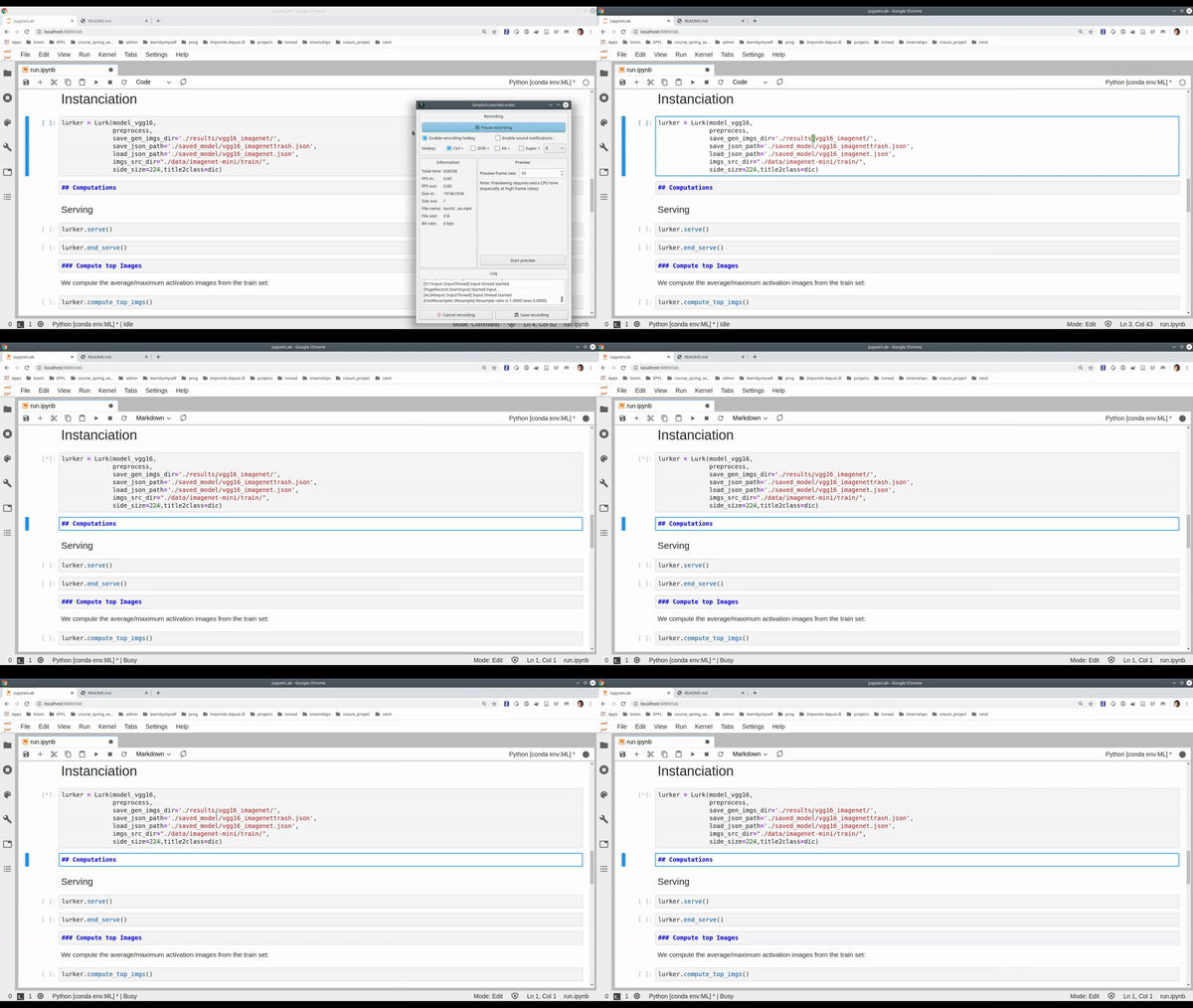
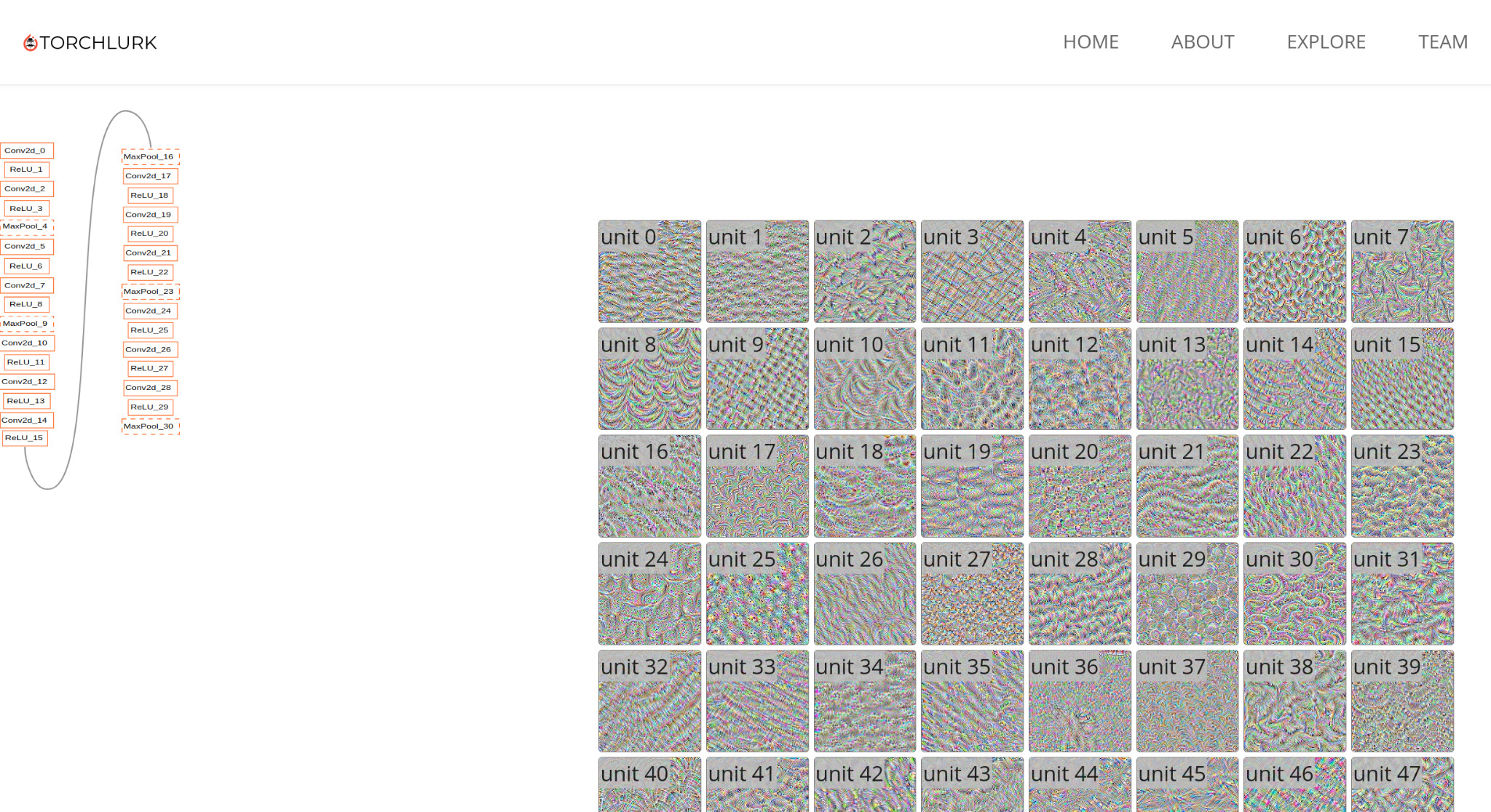
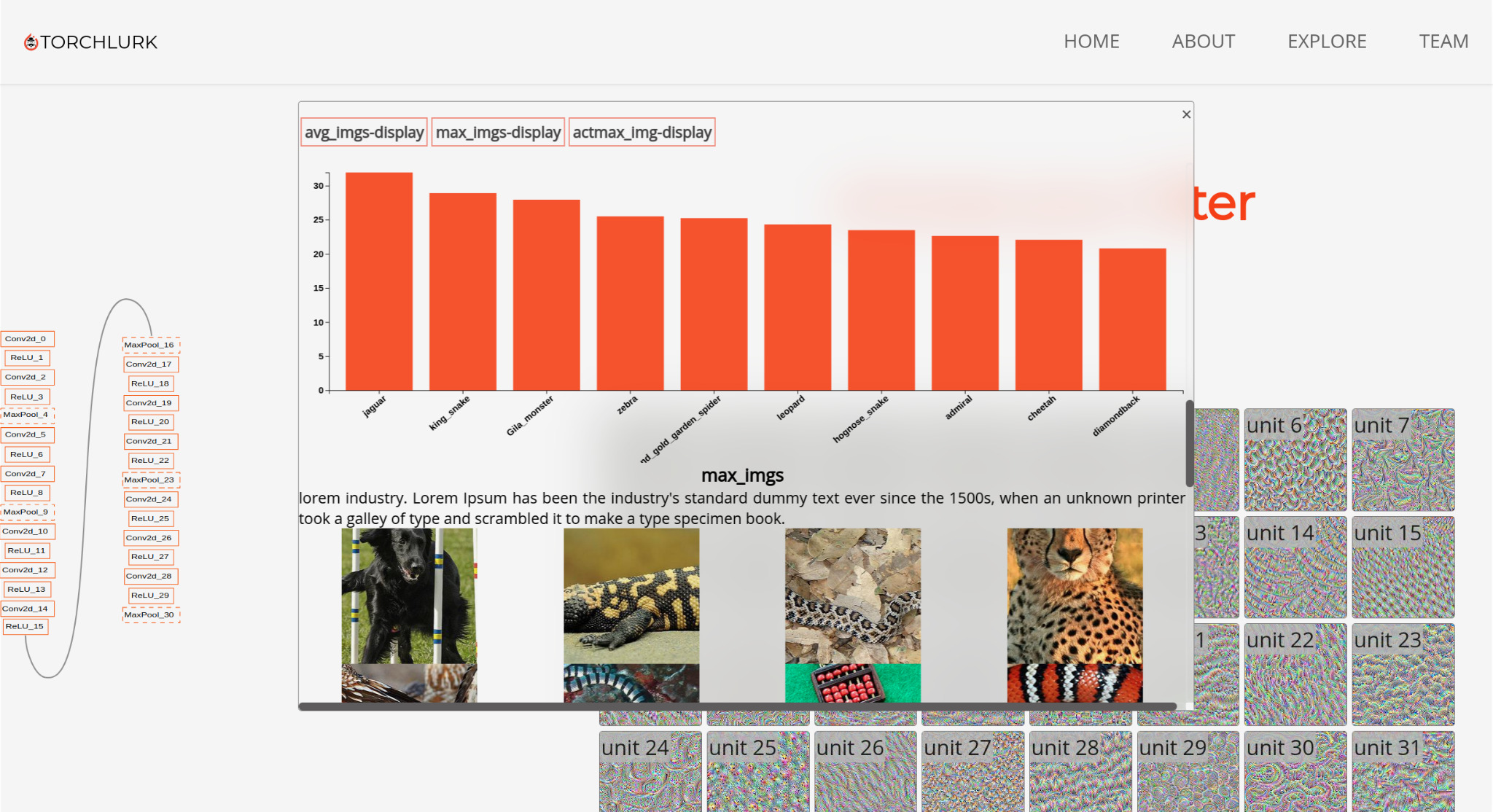
Torchlurk aims at helping the user in that sense: it provides an interface to visualize a Pytorch network in an efficient yet simple manner, similarly to Microscope.
All you need is the trained Pytorch network and its training set. That's it.
Installation ☕
Torchlurk is available on pip! Just run:pip install torchlurk
Overview ☝
Documentation 📚
Torchlurk has an online documentation which gets regularly updated.Quick Start ⌛
Your training set should follow the following structure in order for the lurker to load properly your datas:
.
├── src
│   ├── name_class1
│   │   ├── class1id_1.jpg
│   │   ├── class1id_2.jpg
│   │   ├── ...
│   ├── name_class2
│   │   ├── class2id_1.jpg
│   │   ├── class2id_2.jpg
│   │   ├── ...
│   ├── ...
1. Instanciation
import torchlurk
import torch

# load the trained model
your_model = ModelClass()
your_model.load_state_dict(torch.load(PATH))

# the preprocess used for the training
preprocess = transforms.Compose(...)

# and instanciate a lurker
lurker = Lurk(your_model,
          preprocess,
          save_gen_imgs_dir='save/dir',
          save_json_path='save/dir',
          imgs_src_dir=".source/dir",
          side_size=224)
2. Layer Visualization
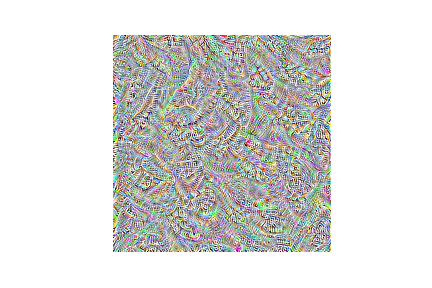
The layer visualization is an artificial image generated by gradient descent which aims at maximizing the acivation of a given filter: this gives useful insights on the type of texture/colors the filter in question is looking at in inputs images.
# compute the layer visualisation for a given set of layers/filters
lurker.compute_layer_viz(layer_indx = 12,filter_indexes=[7])
# OR compute it for the whole network
lurker.compute_viz()
# plot the filters
lurker.plot_filter_viz(layer_indx=12,filt_indx=7)
3. Max Activation
The max activation represents the top N images activating a given filter the most in terms of average or max score.
#compute the top activation images
lurker.compute_top_imgs(compute_max=True,compute_avg=True)
# plot them
lurker.plot_top("avg",layer_indx=12,filt_indx=7)

3.1 Deconvolution
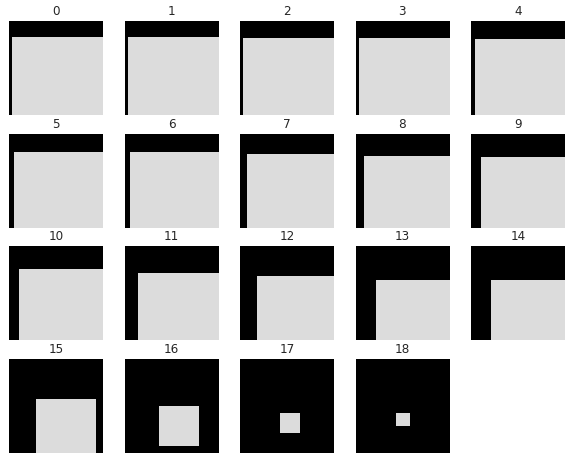
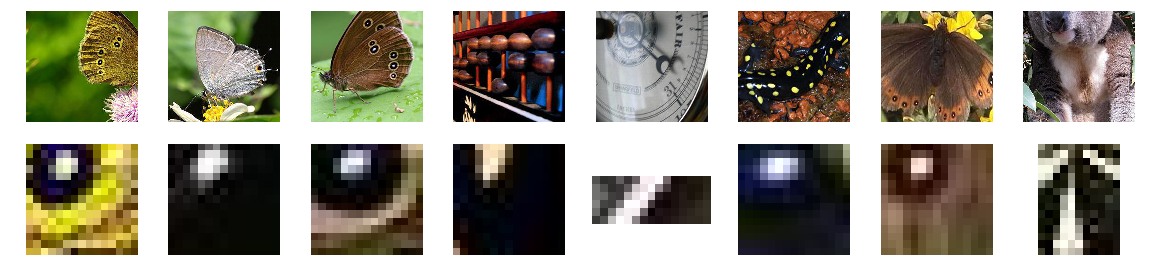
# plot the max activating images along with their cropped areas
lurker.plot_crop(layer_indx=2,filt_indx=15)
4. Gradients
Guided GRAD CAM is another way to check what a given filter is looking at: it relies in particular in isolating a specific location in the image that excites our neurons. For more information, check this article.
#compute the gradients
lurker.compute_grads()
# plot them
lurker.plot_top("avg",layer_indx=12,filt_indx=7,plot_imgs=False,plot_grads=True)

5. Histograms
Torchlurk allows you to visualize the most activating classes of the training using histograms: a very peaked distribution is often asssociated with a specialized filter.
# display the
lurker.plot_hist(layer_indx=12,filt_indx=7,hist_type="max",num_classes=12)

6. Serving
Torchlurk is equiped with a live update tool which allows you to visualize your computed results while coding.
#serve the application on port 5001
lurker.serve(port=5001)
lurker.end_serve()
Happy Lurking!
🕵
1 maintainer

Download files
Download the file for your platform. If you're not sure which to choose, learn more about installing packages.
Source Distribution
Built Distribution
Filter files by name, interpreter, ABI, and platform.
If you're not sure about the file name format, learn more about wheel file names.
Copy a direct link to the current filters
File details
Details for the file torchlurk-0.1.3.1.tar.gz.
File metadata
- Download URL: torchlurk-0.1.3.1.tar.gz
- Upload date:
- Size: 3.7 kB
- Tags: Source
- Uploaded using Trusted Publishing? No
- Uploaded via:
twine/3.3.0 pkginfo/1.7.0 requests/2.25.1 setuptools/53.0.0 requests-toolbelt/0.9.1 tqdm/4.54.1 CPython/3.6.9
File hashes
| Algorithm | Hash digest | |
|---|---|---|
| SHA256 |
90ee3bbf495743432bd09469155196a3b87e4041fb5caaff883e86adea36399b
|
|
| MD5 |
78e52a0d8ae54b0c82387aa8d5954136
|
|
| BLAKE2b-256 |
e1833d8664ccefd831bf5752ed4079495d7cd754ededd1623368a0da8e876b25
|
File details
Details for the file torchlurk-0.1.3.1-py3-none-any.whl.
File metadata
- Download URL: torchlurk-0.1.3.1-py3-none-any.whl
- Upload date:
- Size: 4.1 kB
- Tags: Python 3
- Uploaded using Trusted Publishing? No
- Uploaded via:
twine/3.3.0 pkginfo/1.7.0 requests/2.25.1 setuptools/53.0.0 requests-toolbelt/0.9.1 tqdm/4.54.1 CPython/3.6.9
File hashes
| Algorithm | Hash digest | |
|---|---|---|
| SHA256 |
810d01f92f83e1ca0a4c0566f060e651c293e3c543a59412968e96a266834b2b
|
|
| MD5 |
e5732cf680dcc0b328bb5da611daaf75
|
|
| BLAKE2b-256 |
b0c62fbd32d2fee054cb5d6cb44419fec2ebe1950bafc9b790d3f912db2d0af1
|














