

Machine learning metrics for distributed, scalable PyTorch applications.
What is Torchmetrics • Implementing a metric • Built-in metrics • Docs • Community • License













Looking for GPUs?
Over 340,000 developers use Lightning Cloud - purpose-built for PyTorch and PyTorch Lightning.
- GPUs from $0.19.
- Clusters: frontier-grade training/inference clusters.
- AI Studio (vibe train): workspaces where AI helps you debug, tune and vibe train.
- AI Studio (vibe deploy): workspaces where AI helps you optimize, and deploy models.
- Notebooks: Persistent GPU workspaces where AI helps you code and analyze.
- Inference: Deploy models as inference APIs.
Installation
Simple installation from PyPI
pip install torchmetrics
Other installations
Install using conda
conda install -c conda-forge torchmetrics
Install using uv
uv add torchmetrics
Pip from source
# with git
pip install git+https://github.com/Lightning-AI/torchmetrics.git@release/stable
Pip from archive
pip install https://github.com/Lightning-AI/torchmetrics/archive/refs/heads/release/stable.zip
Extra dependencies for specialized metrics:
pip install torchmetrics[audio]
pip install torchmetrics[image]
pip install torchmetrics[text]
pip install torchmetrics[all]  # install all of the above
Install latest developer version
pip install https://github.com/Lightning-AI/torchmetrics/archive/master.zip
What is TorchMetrics
TorchMetrics is a collection of 100+ PyTorch metrics implementations and an easy-to-use API to create custom metrics. It offers:
- A standardized interface to increase reproducibility
- Reduces boilerplate
- Automatic accumulation over batches
- Metrics optimized for distributed-training
- Automatic synchronization between multiple devices
You can use TorchMetrics with any PyTorch model or with PyTorch Lightning to enjoy additional features such as:
- Module metrics are automatically placed on the correct device.
- Native support for logging metrics in Lightning to reduce even more boilerplate.
Using TorchMetrics
Module metrics
The module-based metrics contain internal metric states (similar to the parameters of the PyTorch module) that automate accumulation and synchronization across devices!
- Automatic accumulation over multiple batches
- Automatic synchronization between multiple devices
- Metric arithmetic
This can be run on CPU, single GPU or multi-GPUs!
For the single GPU/CPU case:
import torch

# import our library
import torchmetrics

# initialize metric
metric = torchmetrics.classification.Accuracy(task="multiclass", num_classes=5)

# move the metric to device you want computations to take place
device = "cuda" if torch.cuda.is_available() else "cpu"
metric.to(device)

n_batches = 10
for i in range(n_batches):
    # simulate a classification problem
    preds = torch.randn(10, 5).softmax(dim=-1).to(device)
    target = torch.randint(5, (10,)).to(device)

    # metric on current batch
    acc = metric(preds, target)
    print(f"Accuracy on batch {i}: {acc}")

# metric on all batches using custom accumulation
acc = metric.compute()
print(f"Accuracy on all data: {acc}")
Module metric usage remains the same when using multiple GPUs or multiple nodes.
Example using DDP
import os
import torch
import torch.distributed as dist
import torch.multiprocessing as mp
from torch import nn
from torch.nn.parallel import DistributedDataParallel as DDP
import torchmetrics


def metric_ddp(rank, world_size):
    os.environ["MASTER_ADDR"] = "localhost"
    os.environ["MASTER_PORT"] = "12355"

    # create default process group
    dist.init_process_group("gloo", rank=rank, world_size=world_size)

    # initialize model
    metric = torchmetrics.classification.Accuracy(task="multiclass", num_classes=5)

    # define a model and append your metric to it
    # this allows metric states to be placed on correct accelerators when
    # .to(device) is called on the model
    model = nn.Linear(10, 10)
    model.metric = metric
    model = model.to(rank)

    # initialize DDP
    model = DDP(model, device_ids=[rank])

    n_epochs = 5
    # this shows iteration over multiple training epochs
    for n in range(n_epochs):
        # this will be replaced by a DataLoader with a DistributedSampler
        n_batches = 10
        for i in range(n_batches):
            # simulate a classification problem
            preds = torch.randn(10, 5).softmax(dim=-1)
            target = torch.randint(5, (10,))

            # metric on current batch
            acc = metric(preds, target)
            if rank == 0:  # print only for rank 0
                print(f"Accuracy on batch {i}: {acc}")

        # metric on all batches and all accelerators using custom accumulation
        # accuracy is same across both accelerators
        acc = metric.compute()
        print(f"Accuracy on all data: {acc}, accelerator rank: {rank}")

        # Resetting internal state such that metric ready for new data
        metric.reset()

    # cleanup
    dist.destroy_process_group()


if __name__ == "__main__":
    world_size = 2  # number of gpus to parallelize over
    mp.spawn(metric_ddp, args=(world_size,), nprocs=world_size, join=True)
Implementing your own Module metric
Implementing your own metric is as easy as subclassing an torch.nn.Module. Simply, subclass torchmetrics.Metric
and just implement the update and compute methods:
import torch
from torchmetrics import Metric


class MyAccuracy(Metric):
    def __init__(self):
        # remember to call super
        super().__init__()
        # call `self.add_state`for every internal state that is needed for the metrics computations
        # dist_reduce_fx indicates the function that should be used to reduce
        # state from multiple processes
        self.add_state("correct", default=torch.tensor(0), dist_reduce_fx="sum")
        self.add_state("total", default=torch.tensor(0), dist_reduce_fx="sum")

    def update(self, preds: torch.Tensor, target: torch.Tensor) -> None:
        # extract predicted class index for computing accuracy
        preds = preds.argmax(dim=-1)
        assert preds.shape == target.shape
        # update metric states
        self.correct += torch.sum(preds == target)
        self.total += target.numel()

    def compute(self) -> torch.Tensor:
        # compute final result
        return self.correct.float() / self.total


my_metric = MyAccuracy()
preds = torch.randn(10, 5).softmax(dim=-1)
target = torch.randint(5, (10,))

print(my_metric(preds, target))
Functional metrics
Similar to torch.nn, most metrics have both a module-based and functional version.
The functional versions are simple python functions that as input take torch.tensors and return the corresponding metric as a torch.tensor.
import torch

# import our library
import torchmetrics

# simulate a classification problem
preds = torch.randn(10, 5).softmax(dim=-1)
target = torch.randint(5, (10,))

acc = torchmetrics.functional.classification.multiclass_accuracy(
    preds, target, num_classes=5
)
Covered domains and example metrics
In total TorchMetrics contains 100+ metrics, which covers the following domains:
- Audio
- Classification
- Detection
- Information Retrieval
- Image
- Multimodal (Image-Text-3D Talking Heads)
- Nominal
- Regression
- Segmentation
- Text
Each domain may require some additional dependencies which can be installed with pip install torchmetrics[audio],
pip install torchmetrics['image'] etc.
Additional features
Plotting
Visualization of metrics can be important to help understand what is going on with your machine learning algorithms.
Torchmetrics have built-in plotting support (install dependencies with pip install torchmetrics[visual]) for nearly
all modular metrics through the .plot method. Simply call the method to get a simple visualization of any metric!
import torch
from torchmetrics.classification import MulticlassAccuracy, MulticlassConfusionMatrix

num_classes = 3

# this will generate two distributions that comes more similar as iterations increase
w = torch.randn(num_classes)
target = lambda it: torch.multinomial((it * w).softmax(dim=-1), 100, replacement=True)
preds = lambda it: torch.multinomial((it * w).softmax(dim=-1), 100, replacement=True)

acc = MulticlassAccuracy(num_classes=num_classes, average="micro")
acc_per_class = MulticlassAccuracy(num_classes=num_classes, average=None)
confmat = MulticlassConfusionMatrix(num_classes=num_classes)

# plot single value
for i in range(5):
    acc_per_class.update(preds(i), target(i))
    confmat.update(preds(i), target(i))
fig1, ax1 = acc_per_class.plot()
fig2, ax2 = confmat.plot()

# plot multiple values
values = []
for i in range(10):
    values.append(acc(preds(i), target(i)))
fig3, ax3 = acc.plot(values)
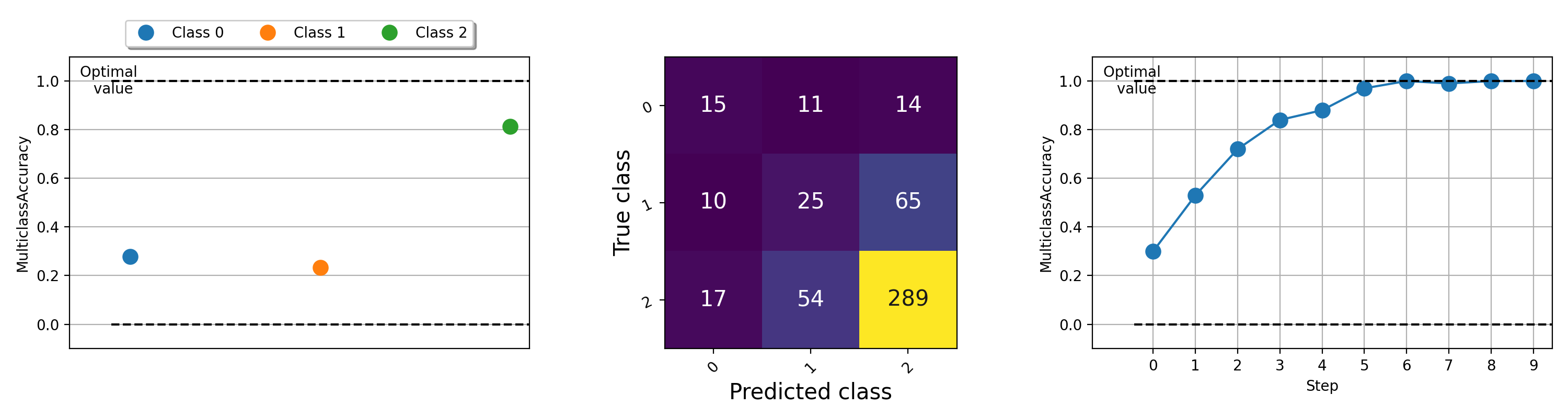
For examples of plotting different metrics try running this example file.
Contribute!
The lightning + TorchMetrics team is hard at work adding even more metrics. But we're looking for incredible contributors like you to submit new metrics and improve existing ones!
Join our Discord to get help with becoming a contributor!
Community
For help or questions, join our huge community on Discord!
Citation
We’re excited to continue the strong legacy of open source software and have been inspired over the years by Caffe, Theano, Keras, PyTorch, torchbearer, ignite, sklearn and fast.ai.
If you want to cite this framework feel free to use GitHub's built-in citation option to generate a bibtex or APA-Style citation based on this file (but only if you loved it 😊).
License
Please observe the Apache 2.0 license that is listed in this repository. In addition, the Lightning framework is Patent Pending.
Release files for torchmetrics 1.9.0
For a detailed explanation of source distributions (sdists) and built distributions (wheels), please see the package formats documentation.
Source distribution (sdist)
| File | Size | Uploaded | |
|---|---|---|---|
| torchmetrics-1.9.0.tar.gz | 581.8 kB | Details |
Built distribution (wheel)
| File | Interpreter | ABI | Platform | Reset |
|---|---|---|---|---|
| torchmetrics-1.9.0-py3-none-any.whl | Python 3 | none | any | Details |
Total release size: 1.6 MB
Release files / torchmetrics-1.9.0.tar.gz
| Download URL | torchmetrics-1.9.0.tar.gz |
|---|---|
| Size | 581.8 kB |
| Tags | Source |
|
SHA-256 checksum How to use checksums |
a488609948600df52d3db4fcdab02e62aab2a85ef34da67037dc3e65b8512faa
|
|
BLAKE2b-256 checksum How to use checksums |
813439b8b749333db56c0585d7a11fa62a283c087bb1dfc897d69fb8cedbefb1
|
| Upload date | |
|
Uploaded using Trusted Publishing? What is trusted publishing? |
Yes |
| Uploaded via |
twine/6.1.0 CPython/3.13.7
|
Provenance
Provenance describes where a file came from. On PyPI, provenance is shared via attestations, which provide a verifiable record of the build or publishing details. View details, limitations and caveats.


PyPI Publish Attestation
PyPI verified that this artifact, at this checksum, originated from the publisher listed below.
Signed by GitHub Actions, verified by PyPI on Mar 9, 2026.
Transparency logRelease files / torchmetrics-1.9.0-py3-none-any.whl
| Download URL | torchmetrics-1.9.0-py3-none-any.whl |
|---|---|
| Size | 983.4 kB |
| Tags | Python 3 |
|
SHA-256 checksum How to use checksums |
bfdcbff3dd1d96b3374bb2496eb39f23c4b28b8a845b6a18c313688e0d2d9ca1
|
|
BLAKE2b-256 checksum How to use checksums |
c3a2c7f6ebf546f8f644edf0f999aa98ece106986a77a7b922316bf6414ff825
|
| Upload date | |
|
Uploaded using Trusted Publishing? What is trusted publishing? |
Yes |
| Uploaded via |
twine/6.1.0 CPython/3.13.7
|
Provenance
Provenance describes where a file came from. On PyPI, provenance is shared via attestations, which provide a verifiable record of the build or publishing details. View details, limitations and caveats.
PyPI Publish Attestation
PyPI verified that this artifact, at this checksum, originated from the publisher listed below.
Signed by GitHub Actions, verified by PyPI on Mar 9, 2026.
Transparency log













