PyTorch implementation of NEP (Neuroevolution Potential)
Project description
TorchNEP
A pure PyTorch implementation of the NEP4 (Neuroevolution Potential) training framework.
Features
- GPUMD-compatible — output
nep.txtfiles load directly into GPUMD for MD simulation - Two-stage training — Stage 1: force-focused; Stage 2: energy-focused
- Multi-GPU training — distributed data parallel (DDP) across on one node or multiple nodes
- Fine-tuning — load any
nep.txtorcheckpoint.ptto do fine-tuning; optionally slim the model to only the element types present in the new dataset - ZBL — Universal ZBL repulsive potential with optional typewise cutoffs
Installation
TorchNEP needs only torch >= 2.0 and numpy, but neither is installed automatically — install the PyTorch build that matches your CUDA/CPU setup first (see the official guide; numpy comes with it).
Then install TorchNEP with:
pip install torchnep -U
or install from source code:
cd GPUMD/torchnep
pip install .
Training data (extended-XYZ)
TorchNEP reads extended-XYZ files. The parser is strict — the rules below are enforced, and violations raise on load.
Comment line tags
Lattice="ax ay az bx by bz cx cy cz"— mandatory. Nine floats in Å giving the three lattice vectors as rows. Every frame is treated as fully periodic, sopbc=...is ignored. For isolated clusters/molecules or a non-periodic direction, use a vacuum box wider than the NEP cutoff.energy=<value>— optional, eV. System energy.virial="vxx vxy vxz vyx vyy vyz vzx vzy vzz"— optional, eV. Must have exactly 9 components. Positive values denote compressed states, negative denote stretched states (GPUMD convention).stress="sxx sxy sxz syx syy syz szx szy szz"— optional, eV/ų. Must have exactly 9 components. Positive = stretched, negative = compressed — opposite sign to virial. If bothvirialandstressare present,virialwins.
Per-atom columns
The Properties=... schema declares column layout. TorchNEP reads only
three fields and silently ignores everything else (e.g. Z:I:1):
species:S:1— chemical symbol (case-sensitive; must match thetypelist innep.in).pos:R:3— Cartesian position in Å.force:R:3orforces:R:3— reference force in eV/Å (optional).
Training Parameters
Model architecture (GPUMD-compatible)
| Parameter | Default | Description |
|---|---|---|
type |
required | N name1 name2 ... — number and names of element types |
cutoff |
8 4 |
Radial and angular cutoff (Å) |
n_max |
6 6 |
Radial and angular expansion orders |
basis_size |
6 6 |
Chebyshev basis size per channel (radial / angular) |
l_max |
4 1 0 |
L_3b q_222 q_1111 q_112 q_123 q_233 q_134 — max L of 3-body terms (1–8) plus up to six boolean flags (matching GPUMD) enabling each higher-body invariant |
neuron |
30 |
Neurons in the (single) hidden layer |
zbl |
— | ZBL outer cutoff (Å); enables short-range repulsion |
use_typewise_cutoff_zbl |
— | Scale ZBL cutoffs by covalent radii |
Training hyperparameters
| Parameter | Default | Description |
|---|---|---|
epoch |
600 |
Total training epochs |
batch |
32 |
Structures per gradient step |
lr |
0.01 |
Initial learning rate |
stop_lr |
1e-6 |
Minimum learning rate (scheduler floor) |
lambda_e |
0.01 |
Energy loss weight |
lambda_f |
1.0 |
Force loss weight |
lambda_v |
0.01 |
Virial loss weight |
lambda_1 |
0.0 |
L1 regularisation |
lambda_2 |
0.0 |
L2 regularisation (weight decay) |
max_grad_norm |
10.0 |
Gradient clipping threshold |
lr_scheduler |
plateau |
LR schedule — plateau (ReduceLROnPlateau) or step (StepLR). Stage 1 and Stage 2 share this mode |
scheduler_patience |
15 |
For plateau: epochs without improvement before LR reduction. For step: epoch interval between LR reductions |
scheduler_factor |
0.7 |
LR reduction factor — multiplied on each decay in both modes |
stage2 |
0 |
Enable Stage 2 (1 = on) |
start_stage2 |
50 % of epochs | Epoch to switch to Stage 2 |
stage2_lr |
1e-3 |
Stage 2 learning rate |
stage2_scheduler_patience |
scheduler_patience |
Stage 2 scheduler patience (overrides Stage 1's; same semantics) |
stage2_scheduler_factor |
scheduler_factor |
Stage 2 LR decay factor (overrides Stage 1's) |
stage2_lambda_e |
1.0 |
Stage 2 energy weight |
stage2_lambda_f |
0.05 |
Stage 2 force weight |
stage2_lambda_v |
0.1 |
Stage 2 virial weight |
Runtime arguments
Everything that is not about hyperparameter values lives on the Python
function (train_nep / train_nep_sharded):
| Argument | Default | What it controls |
|---|---|---|
device |
auto | "cuda" / "xpu" / "mps" / "cpu"; any other stream-based PyTorch accelerator should also work if passed explicitly |
precision |
"float32" |
dtype for training + store, "float32" or "float64" |
backend |
"auto" |
"loop", "bmm", or "auto" |
use_autograd_forces |
False |
autograd-through-rij |
use_swa |
False |
maintain SWA-averaged model and save nep_average.txt |
use_compile |
False |
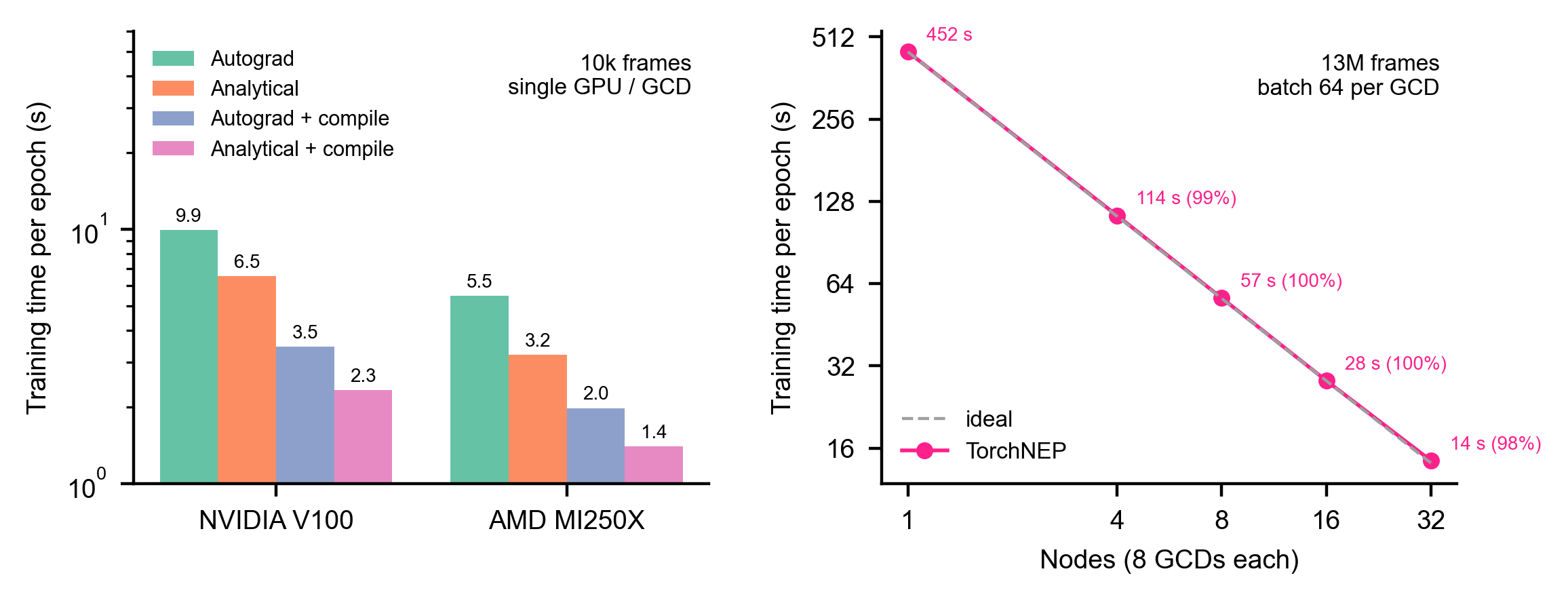
torch.compile the analytical compute (faster epochs after a one-time compile; needs Triton; ignored on the autograd path) |
print_interval |
10 |
log to screen every N epochs |
checkpoint_interval |
100 |
save checkpoint.pt every N epochs |
prediction_interval |
20 |
every N epochs run predict with the current-epoch weights and overwrite {energy,force,virial}_train.out |
restart |
True |
resume from checkpoint.pt if present |
finetune_from |
None |
load weights from a .pt or nep.txt and start a NEW training from them |
resume_from |
None |
path to a checkpoint to CONTINUE from (e.g. checkpoint_stage1.pt to redo Stage 2); takes precedence over the automatic checkpoint.pt pickup |
recompute_q_scaler |
False |
only with finetune_from: recompute the descriptor scaler on the new data instead of keeping the source model's |
slim_types |
False |
drop element types absent from the dataset |
energy_key |
"energy" |
comment-line tag read as reference energy (e.g. "atomization_energy") |
Output Files
| File | Contents |
|---|---|
nep_best.txt |
Best model |
nep_final.txt |
Model at the last epoch (used for the end-of-training predict) |
nep_average.txt |
SWA-averaged model (only with use_swa=True) |
checkpoint.pt |
Full training state |
checkpoint_stage1.pt |
Full end-of-Stage-1 checkpoint |
output.log |
Full console log |
loss.out |
Per-epoch: epoch, loss, RMSE_E (eV/atom), RMSE_F (eV/Å), RMSE_V, RMSE_stress (GPa), gnorm |
energy_train.out |
Per-frame predicted vs reference E/atom (eV/atom) |
force_train.out |
Per-atom predicted vs reference Fx Fy Fz (eV/Å) |
virial_train.out |
Per-frame predicted vs reference virial xx yy zz xy yz zx (eV/atom) |
stress_train.out |
Per-frame predicted vs reference stress (GPa) |
Launch training
Single GPU / CPU / MPS — train_nep
# run_train.py
from torchnep import train_nep
train_nep("nep.in", "train.xyz", output_dir="output")
python run_train.py
Multi-GPU, single node — train_nep_sharded
Each rank loads only 1/N of the structures, so total GPU memory for the data store scales as 1/N.
# run_train.py
from torchnep import train_nep_sharded
train_nep_sharded("nep.in", "train.xyz", output_dir="output")
torchrun --standalone --nproc_per_node=4 run_train.py # 4 GPUs on this node
Multi-GPU, multi-node (SLURM) — train_nep_sharded
For M nodes × N GPUs each, the key SLURM directives are:
#SBATCH --nodes=2 # M nodes
#SBATCH --ntasks-per-node=1 # 1 srun task per node; torchrun fans out to all GPUs
#SBATCH --gpus-per-node=4 # N GPUs per node
#SBATCH --cpus-per-task=16 # CPU cores per node
MASTER_ADDR=$(scontrol show hostnames "$SLURM_JOB_NODELIST" | head -n1)
MASTER_PORT=$((20000 + SLURM_JOB_ID % 40000))
srun --nodes=$SLURM_NNODES --ntasks-per-node=1 bash -c "
torchrun \
--nnodes=$SLURM_NNODES \
--nproc_per_node=\$SLURM_GPUS_ON_NODE \
--node_rank=\$SLURM_NODEID \
--rdzv_id=$SLURM_JOB_ID \
--rdzv_backend=c10d \
--rdzv_endpoint=$MASTER_ADDR:$MASTER_PORT \
run_train.py
"
Restart and Resume
Two ways to resume:
# 1) automatic: looks for checkpoint.pt in output_dir (restart=True default)
train_nep("nep.in", "train.xyz", output_dir="output")
# 2) explicit: continue from a specific checkpoint
train_nep("nep.in", "train.xyz", output_dir="output",
resume_from="output/checkpoint_stage1.pt")
What you can safely change on restart
| Parameter | Safe to change? | Notes |
|---|---|---|
epoch |
Yes | Extend training by increasing this |
lambda_e / lambda_f / lambda_v |
Yes | New weights take effect next epoch. |
stage2_lambda_e / stage2_lambda_f / stage2_lambda_v |
Yes | Same auto-reset rule. |
batch |
Yes | — |
stage2, start_stage2 |
Yes | Add Stage 2 to a run that did not have it, or push it later |
stage2_lr |
Only at the transition | Applied once, when training first crosses Stage 1 → Stage 2. If you resume from a checkpoint that was already in Stage 2, the checkpoint's current (possibly-decayed) LR is kept — editing stage2_lr then has no effect. To re-enter Stage 2 with a new LR, resume_from=".../checkpoint_stage1.pt". |
lr_scheduler (plateau ↔ step) |
Yes | Scheduler state from the old mode is incompatible and silently discarded; the new scheduler starts fresh from the current LR |
scheduler_patience / scheduler_factor |
Yes | Applied immediately |
stage2_scheduler_patience / stage2_scheduler_factor |
Yes | Applied immediately to the Stage 2 scheduler |
lr (Stage 1) |
No | Resume keeps the checkpoint's LR |
Architecture (neuron, cutoff, n_max, basis_size, l_max, type) |
No | Dimensions are fixed in the saved weights |
Fine-Tuning
Fine-tuning starts from a pre-trained model's weights instead of random initialisation. The architecture (nep.in parameters) must match the source model, but the new dataset's element types may be a subset of the original.
Basic fine-tuning
train_nep(
"nep.in",
"new_data.xyz",
output_dir="finetune_output",
finetune_from="pretrained/nep.txt", # or a "pretrained/checkpoint.pt"
slim_types=True,
)
finetune_from accepts:
nep.txt— GPUMD text format (works with models trained by GPUMD or TorchNEP)checkpoint.pt— full checkpoint (weights are extracted automatically)
If the new dataset contains fewer element types than the original model, slim_types=True removes the unused types before training begins, shrinking the model and speeding up training.
Standalone model slimming
from torchnep.model import NEPModel, slim_model
from torchnep.data import parse_nep_in
config = parse_nep_in("nep.in")
model = NEPModel(config)
model.load_weights_from_nep_txt("nep.txt")
slimmed = slim_model(model, ["Cr", "Ni"])
slimmed.save_nep_txt("nep_slim.txt", max_NN_radial, max_NN_angular)
Prediction
Single-structure prediction
from torchnep.nep import NEPCalculator
import numpy as np
calc = NEPCalculator("nep.txt")
result = calc.compute(
species=["Cr", "Cr", "Ni"],
positions=np.array([[0,0,0],[1.5,0,0],[3,0,0]]),
cell=np.eye(3) * 6.0,
)
print(result["energy"]) # (N,) per-atom energy (eV); sum for total
print(result["forces"]) # (N, 3) forces (eV/Å)
print(result["virial"]) # (N, 9) per-atom virial (eV)
# Split the NEP (neural-network) part from the ZBL repulsive part:
result = calc.compute(..., return_components=True)
print(result["energy_nep"], result["energy_zbl"]) # sum == result["energy"]
ASE calculator
If ASE is installed, any ASE workflow (relaxation, MD, EOS, …) can drive a trained model:
from ase.io import read
from torchnep.ase_calculator import NEP
atoms = read("POSCAR")
atoms.calc = NEP("nep.txt", dtype='float32', device='cuda')
print(atoms.get_potential_energy()) # eV
print(atoms.get_forces()) # (N, 3) eV/Å
print(atoms.get_stress()) # Voigt 6-vector eV/ų (periodic cells)
# NEP / ZBL / total breakdown of energy, forces, and stress:
parts = atoms.calc.get_components()
print(parts["nep"]["energy"], parts["zbl"]["energy"], parts["total"]["energy"])
Full-dataset prediction
Runs batched GPU inference on an entire .xyz file and writes GPUMD-compatible output files.
from torchnep import predict_dataset
predict_dataset(
"nep.txt",
"test.xyz",
output_dir="results",
dtype="float32", # float32 or float64
batch_size=500,
output_descriptor=0, # 0=off, 1=per-frame mean, 2=per-atom (matches GPUMD)
)
# writes energy_train.out, force_train.out, virial_train.out,
# stress_train.out, and (when output_descriptor != 0) descriptor.out
Source layout
The torchnep/ package is organised as follows:
| File | Role |
|---|---|
__init__.py |
Public API — re-exports the three entry points train_nep, train_nep_sharded, predict_dataset |
data.py |
I/O and parsing — reads extended-XYZ frames and nep.in, plus the NumPy brute-force neighbor builder used for training |
neighbor.py |
PyTorch linked-cell (cell-list) neighbor search, O(N) for the large structures of an ASE-driven MD run |
model.py |
Trainable NEP4 model (NEPModel) as an nn.Module, per-type fitting nets, ZBL, and slim_model |
ops.py |
Core differentiable kernels — Chebyshev/angular basis, descriptors, ANN evaluation, ZBL; pure-PyTorch loop/bmm backends |
nep.py |
NEPCalculator — loads a nep.txt and computes energy/forces/virial/descriptors for single structures |
predict.py |
Batched full-dataset inference (predict_dataset), writing GPUMD-compatible *_train.out files |
train.py |
Single-GPU/CPU training (train_nep): data store, two-stage loop, schedulers, checkpoint/restart, periodic predict |
train_sharded.py |
Data-sharded multi-GPU/multi-node training (train_nep_sharded) via DDP |
ase_calculator.py |
ASE Calculator wrapper (NEP) for relaxation, MD, EOS, phonons, … |
constants.py |
Shared constants — element table, covalent radii, NEP polynomial coefficients |
Citation
If you use TorchNEP in your research, please cite the following paper:
@misc{wu2026torchne,
title={TorchNEP: Ultra-Efficient and Accurate Training of Neuroevolution Potentials},
author={Yong-Chao Wu and Xiaoya Chang and Tero Mäkinen and Amin Esfandiarpour and Jian-Li Shao and Tapio Ala-Nissila and Zheyong Fan and Mikko Alava},
year={2026},
eprint={2606.19557},
archivePrefix={arXiv},
primaryClass={physics.comp-ph},
url={https://arxiv.org/abs/2606.19557},
}
Project details
Release history Release notifications | RSS feed
Download files
Download the file for your platform. If you're not sure which to choose, learn more about installing packages.
Source Distribution
Built Distribution
Filter files by name, interpreter, ABI, and platform.
If you're not sure about the file name format, learn more about wheel file names.
Copy a direct link to the current filters
File details
Details for the file torchnep-1.0.0.tar.gz.
File metadata
- Download URL: torchnep-1.0.0.tar.gz
- Upload date:
- Size: 105.5 kB
- Tags: Source
- Uploaded using Trusted Publishing? Yes
- Uploaded via: twine/6.1.0 CPython/3.13.12
File hashes
| Algorithm | Hash digest | |
|---|---|---|
| SHA256 |
f550cc95680bdc4adf4120229149c4b7b3861efe4b2a7358c680d190a666b5c5
|
|
| MD5 |
47937cb07018e13d68420c5cf9df24f6
|
|
| BLAKE2b-256 |
f54300f3f27502a715a9ca09f81c136283b8f3c62081b055cf897e1a6bf18759
|
Provenance
The following attestation bundles were made for torchnep-1.0.0.tar.gz:
Publisher:
torchnep-publish.yml on mushroomfire/GPUMD
-
Statement:
-
Statement type:
https://in-toto.io/Statement/v1 -
Predicate type:
https://docs.pypi.org/attestations/publish/v1 -
Subject name:
torchnep-1.0.0.tar.gz -
Subject digest:
f550cc95680bdc4adf4120229149c4b7b3861efe4b2a7358c680d190a666b5c5 - Sigstore transparency entry: 1967772163
- Sigstore integration time:
-
Permalink:
mushroomfire/GPUMD@6901094aa169e051ebf5f9f21ecefd1e018d88d5 -
Branch / Tag:
refs/tags/torchnep-v1.0.0 - Owner: https://github.com/mushroomfire
-
Access:
public
-
Token Issuer:
https://token.actions.githubusercontent.com -
Runner Environment:
github-hosted -
Publication workflow:
torchnep-publish.yml@6901094aa169e051ebf5f9f21ecefd1e018d88d5 -
Trigger Event:
push
-
Statement type:
File details
Details for the file torchnep-1.0.0-py3-none-any.whl.
File metadata
- Download URL: torchnep-1.0.0-py3-none-any.whl
- Upload date:
- Size: 114.6 kB
- Tags: Python 3
- Uploaded using Trusted Publishing? Yes
- Uploaded via: twine/6.1.0 CPython/3.13.12
File hashes
| Algorithm | Hash digest | |
|---|---|---|
| SHA256 |
72fdbfecdc185755fc674ea270f61d3b97d1b5dce5347da07a626b7aaff91846
|
|
| MD5 |
568c595512bea552e611ddd9fc557d21
|
|
| BLAKE2b-256 |
cd886156fcf09763a25e9c214153ae8a71ba3dc4ec2dc3de2b553121f396a483
|
Provenance
The following attestation bundles were made for torchnep-1.0.0-py3-none-any.whl:
Publisher:
torchnep-publish.yml on mushroomfire/GPUMD
-
Statement:
-
Statement type:
https://in-toto.io/Statement/v1 -
Predicate type:
https://docs.pypi.org/attestations/publish/v1 -
Subject name:
torchnep-1.0.0-py3-none-any.whl -
Subject digest:
72fdbfecdc185755fc674ea270f61d3b97d1b5dce5347da07a626b7aaff91846 - Sigstore transparency entry: 1967772353
- Sigstore integration time:
-
Permalink:
mushroomfire/GPUMD@6901094aa169e051ebf5f9f21ecefd1e018d88d5 -
Branch / Tag:
refs/tags/torchnep-v1.0.0 - Owner: https://github.com/mushroomfire
-
Access:
public
-
Token Issuer:
https://token.actions.githubusercontent.com -
Runner Environment:
github-hosted -
Publication workflow:
torchnep-publish.yml@6901094aa169e051ebf5f9f21ecefd1e018d88d5 -
Trigger Event:
push
-
Statement type: