





TorchOptics is an open-source Python library for simulating optical systems using Fourier optics, built on PyTorch. It provides GPU-accelerated, fully differentiable wave optics simulations, enabling end-to-end optimization of optical hardware jointly with machine learning models.
Learn more in our paper on arXiv.
Key Features
- 🌊 Differentiable Wave Optics: Model, analyze, and optimize optical systems using Fourier optics.
- 🔥 Built on PyTorch: GPU acceleration, batch processing, and automatic differentiation.
- 🛠️ End-to-End Optimization: Joint optimization of optical hardware and machine learning models.
- 🔬 Optical Elements: Lenses, phase/amplitude modulators, detectors, polarizers, and more.
- 🖼️ Spatial Profiles: Hermite-Gaussian, Laguerre-Gaussian, Zernike modes, gratings, and others.
- 🔆 Polarization and Coherence: Simulate polarized light and fields with arbitrary spatial coherence.
Installation
pip install torchoptics
Documentation
Full documentation is available at torchoptics.readthedocs.io.
Examples
Wave Propagation
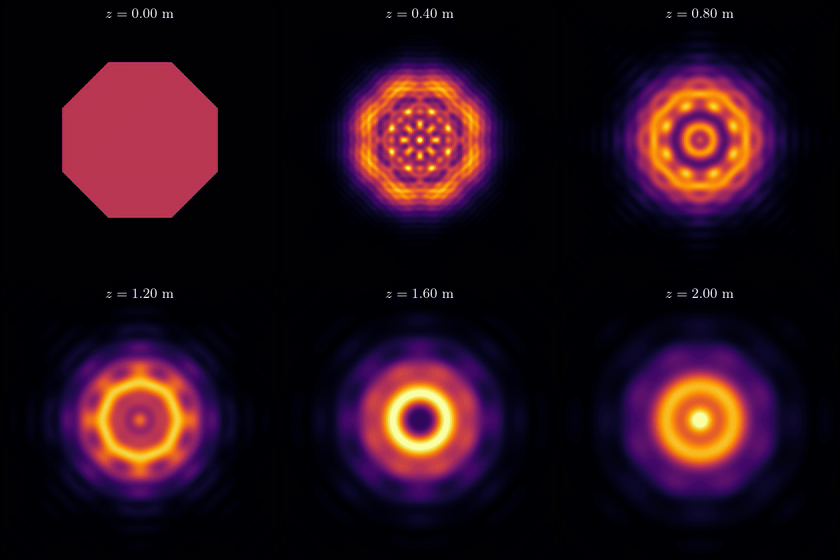
Simulate free-space propagation of an octagonal aperture (full example):
import torch
import torchoptics
from torchoptics import Field
from torchoptics.profiles import octagon

device = "cuda" if torch.cuda.is_available() else "cpu"
torchoptics.set_default_spacing(10e-6)
torchoptics.set_default_wavelength(700e-9)

field = Field(octagon(shape=500, radius=150e-5)).to(device)

for z in torch.linspace(0, 2, 11):
    field.propagate_to_z(z).visualize(title=f"z = {z:.2f} m")
4f Imaging System
Simulate a 4f system with a high-pass spatial filter (full example):
import torch
import torchoptics
from torchoptics import Field, System
from torchoptics.elements import AmplitudeModulator, Lens
from torchoptics.profiles import checkerboard, circle

device = "cuda" if torch.cuda.is_available() else "cpu"
torchoptics.set_default_spacing(10e-6)
torchoptics.set_default_wavelength(700e-9)

shape = 500
f = 50e-3

input_field = Field(checkerboard(shape, tile_length=200e-6, num_tiles=15)).to(device)

system = System(
    Lens(shape, f, z=1 * f),
    AmplitudeModulator(1 - circle(shape, radius=200e-6), z=2 * f),
    Lens(shape, f, z=3 * f),
).to(device)

for i in range(5):
    system.measure_at_z(input_field, z=i * f).visualize(title=f"z={i}f", vmax=1)

Inverse Design
Train a diffractive optical system to convert a Gaussian beam into a petal beam (full example):
import torch
import torchoptics
from torch.nn import Parameter
from torchoptics import Field, System
from torchoptics.elements import PhaseModulator
from torchoptics.profiles import gaussian, laguerre_gaussian

device = "cuda" if torch.cuda.is_available() else "cpu"
torchoptics.set_default_spacing(10e-6)
torchoptics.set_default_wavelength(700e-9)

shape = 250
waist_radius = 300e-6

input_field = Field(gaussian(shape, waist_radius=waist_radius), z=0).to(device)

petal_profile = laguerre_gaussian(shape, p=0, l=4, waist_radius=waist_radius)
petal_profile += laguerre_gaussian(shape, p=0, l=-4, waist_radius=waist_radius)
target_field = Field(petal_profile, z=0.8).normalize().to(device)

system = System(
    PhaseModulator(Parameter(torch.zeros(shape, shape)), z=0.2),
    PhaseModulator(Parameter(torch.zeros(shape, shape)), z=0.4),
    PhaseModulator(Parameter(torch.zeros(shape, shape)), z=0.6),
).to(device)

optimizer = torch.optim.Adam(system.parameters(), lr=0.05)
for iteration in range(100):
    optimizer.zero_grad()
    output_field = system.measure_at_z(input_field, 0.8)
    loss = 1 - output_field.inner(target_field).abs().square()
    loss.backward()
    optimizer.step()
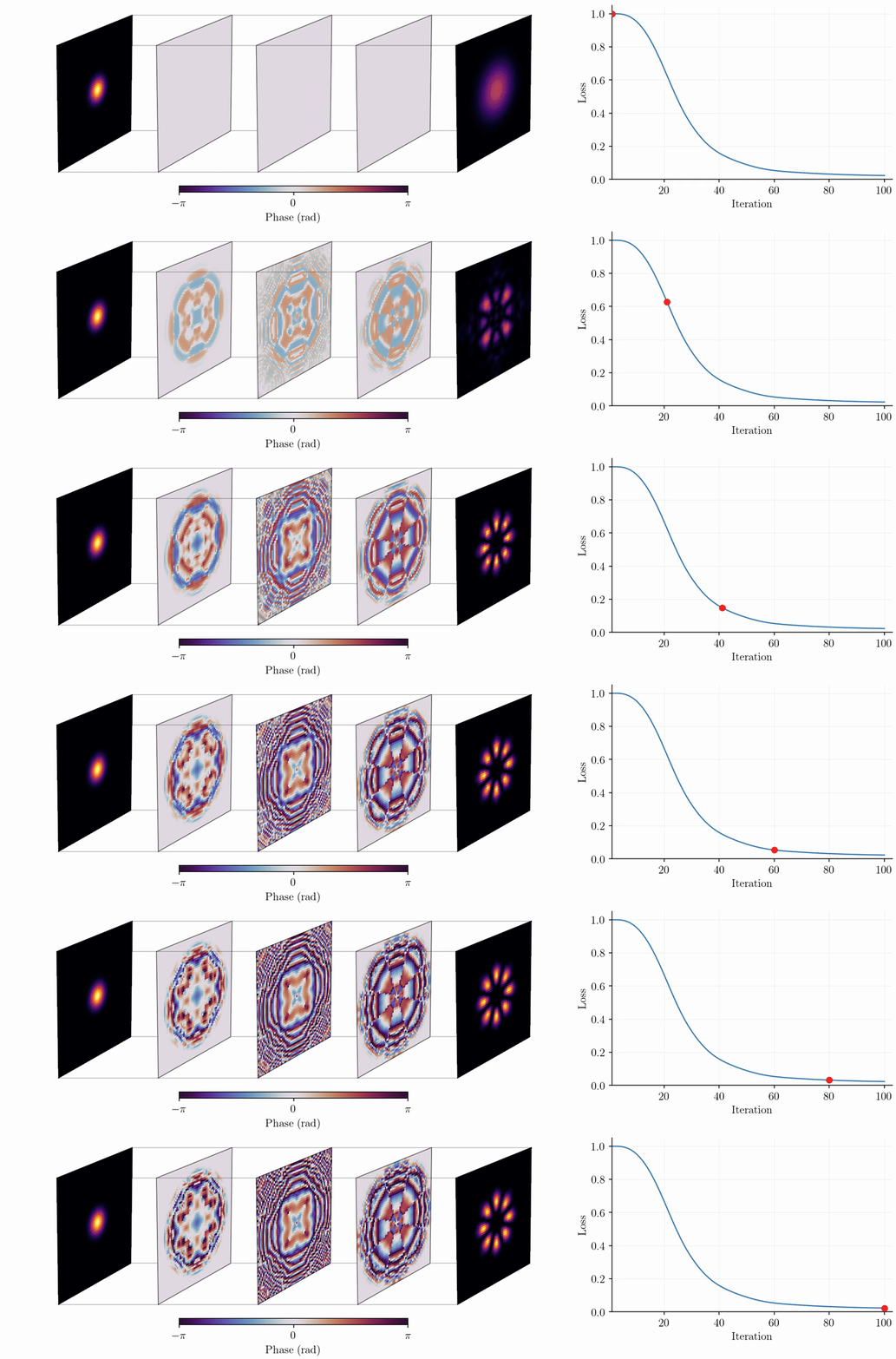
For more examples, see the examples gallery.
Contributing
Contributions are welcome! See the Contributing Guide for details.
Citing TorchOptics
If you use TorchOptics in your research, please cite our paper:
@misc{filipovich2024torchoptics,
      title={TorchOptics: An open-source Python library for differentiable Fourier optics simulations},
      author={Matthew J. Filipovich and A. I. Lvovsky},
      year={2024},
      eprint={2411.18591},
      archivePrefix={arXiv},
      primaryClass={physics.optics},
      url={https://arxiv.org/abs/2411.18591},
}
License
Distributed under the MIT License. See LICENSE for details.
1 maintainer

Metadata
1 maintainer
Release files for torchoptics 1.0.2
For a detailed explanation of source distributions (sdists) and built distributions (wheels), please see the package formats documentation.
Source distribution (sdist)
| File | Size | Uploaded | |
|---|---|---|---|
| torchoptics-1.0.2.tar.gz | 11.1 MB | Details |
Built distribution (wheel)
| File | Interpreter | ABI | Platform | Reset |
|---|---|---|---|---|
| torchoptics-1.0.2-py3-none-any.whl | Python 3 | none | any | Details |
Total release size: 11.2 MB
Release files / torchoptics-1.0.2.tar.gz
| Download URL | torchoptics-1.0.2.tar.gz |
|---|---|
| Size | 11.1 MB |
| Tags | Source |
|
SHA-256 checksum How to use checksums |
a85b685377844b8f7fa358335393abc3c7acd6fc9f27569f5f96ee33dc3d018d
|
|
BLAKE2b-256 checksum How to use checksums |
5293ccdbf7935eb9f29c21bc6ea10f995db3f52cca886898cc0136cbec8d846b
|
| Upload date | |
|
Uploaded using Trusted Publishing? What is trusted publishing? |
Yes |
| Uploaded via |
twine/6.1.0 CPython/3.13.7
|
Provenance
Provenance describes where a file came from. On PyPI, provenance is shared via attestations, which provide a verifiable record of the build or publishing details. View details, limitations and caveats.


PyPI Publish Attestation
PyPI verified that this artifact, at this checksum, originated from the publisher listed below.
Signed by GitHub Actions, verified by PyPI on Apr 2, 2026.
Transparency logRelease files / torchoptics-1.0.2-py3-none-any.whl
| Download URL | torchoptics-1.0.2-py3-none-any.whl |
|---|---|
| Size | 56.9 kB |
| Tags | Python 3 |
|
SHA-256 checksum How to use checksums |
535ce7b3b4abb11e4821ba51bce87ba4c06d95ba2ee950b2afd468d38d05482c
|
|
BLAKE2b-256 checksum How to use checksums |
ec5abd799d35b46069ef729f22379e4e30d319acec4fe570d08e7d6a3355f403
|
| Upload date | |
|
Uploaded using Trusted Publishing? What is trusted publishing? |
Yes |
| Uploaded via |
twine/6.1.0 CPython/3.13.7
|
Provenance
Provenance describes where a file came from. On PyPI, provenance is shared via attestations, which provide a verifiable record of the build or publishing details. View details, limitations and caveats.
PyPI Publish Attestation
PyPI verified that this artifact, at this checksum, originated from the publisher listed below.
Signed by GitHub Actions, verified by PyPI on Apr 2, 2026.
Transparency log













