

A PyTorch-based crystallographic Refinement library






TorchRef is a crystallographic refinement package built entirely on PyTorch. Autograd and GPU acceleration make it composable with machine-learning workflows and cheap to extend with new targets.
Scope. TorchRef is mainly a library/framework to build and experiment with. It is not intended to replace mainline refinement programs for standard problems.
Benchmark
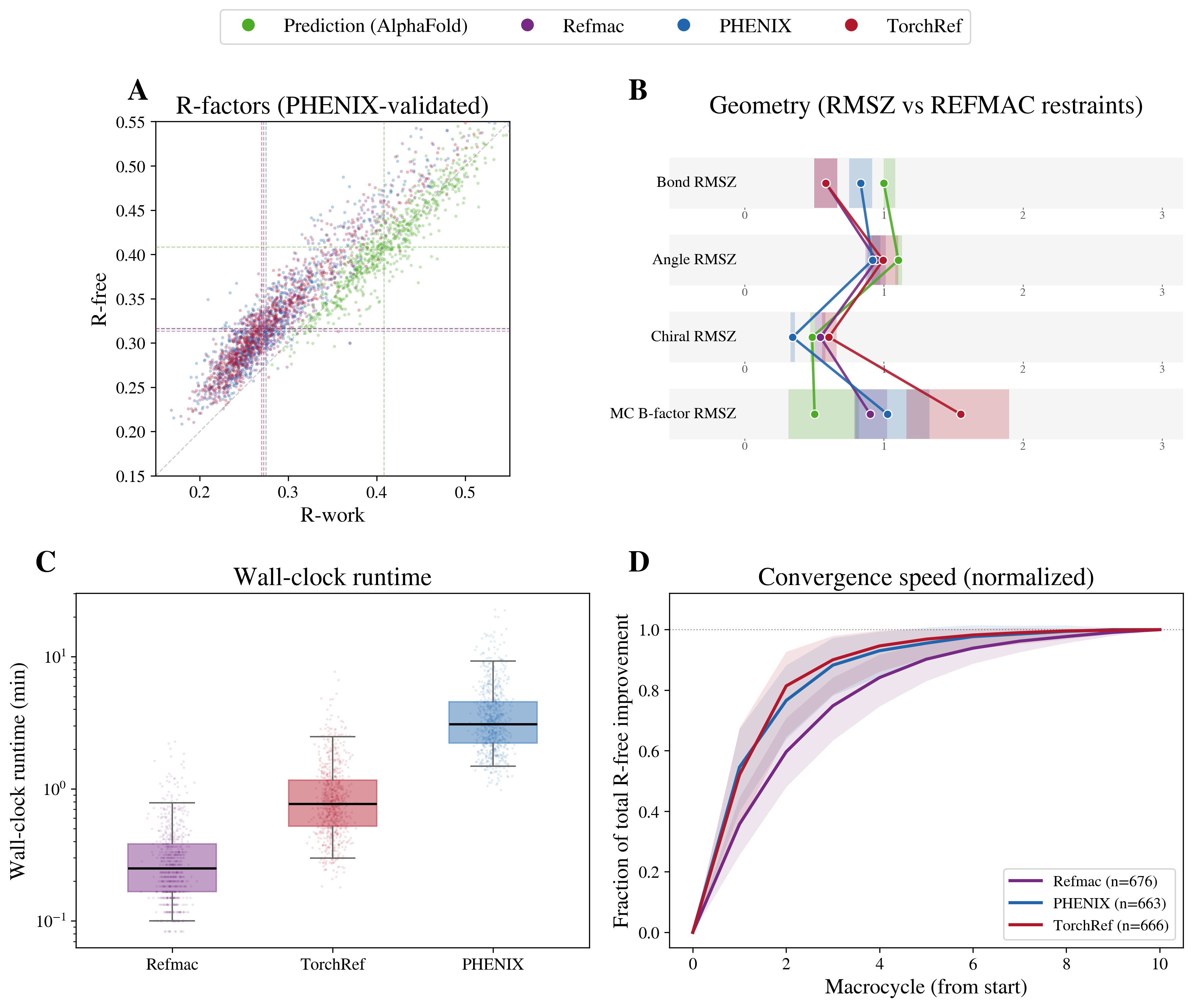
Refinement of Phaser-placed AlphaFold models against experimental data, on a conserved set of 723 PDB structures (1.40–3.00 Å). All engines start from the same placed models and are scored by one common validator (PHENIX).
(A) R-work and R-free per engine. Median R-free 0.3189 (TorchRef), 0.3164 (PHENIX), 0.3136 (REFMAC5); paired median difference, TorchRef minus reference, +0.0008 against PHENIX and +0.0047 against REFMAC. (B) Geometry RMS Z against REFMAC restraints, ideal 1.0: bond 0.58 (REFMAC 0.58, PHENIX 0.83), main-chain B 1.55 (REFMAC 0.90, PHENIX 1.03). (C) Wall-clock runtime per structure on 4 CPU cores: median 0.77 min (REFMAC 0.25, PHENIX 3.09). (D) Fraction of the total R-free improvement reached per macrocycle.
Key Features
-
Native PyTorch Integration: Built on PyTorch's
nn.Modulearchitecture, so TorchRef composes with PyTorch models, optimizers, and devices. -
Automatic Differentiation: No hand-written gradients. Define a new refinement target's forward pass and PyTorch supplies the derivatives.
-
Modular Architecture: Custom targets, restraints, and optimizers plug in without modifying core code.
-
GPU Acceleration: CUDA for structure factors, scaling, and optimization. Apple Silicon works through PyTorch's MPS backend — unsupported ops fall back to CPU automatically via
PYTORCH_ENABLE_MPS_FALLBACK=1, which TorchRef sets on import. -
FFT-based Structure Factors: F_calc via FFT, so large unit cells stay tractable.
Getting Started
| Notebook | Description |
|---|---|
 |
Quickstart — MTZ + PDB to refined structure, refined MTZ and CCP4 map; selection- and parameter-type-based refinement |
|
Structure factors — one-liner, SfFFT class, and manual voxel pipeline; autograd |
|
Targets and weighting — standard targets, static group weights, X-ray mode comparison, custom targets, driving an optimizer from a LossState |
Installation
pip install torchref
For development:
git clone --filter=blob:none --sparse https://github.com/HatPdotS/TorchRef.git
cd TorchRef
git sparse-checkout set torchref tests kernels
pip install ./kernels        # the prebuilt CPU kernels; needs a Rust toolchain (rustup.rs)
pip install -e ".[dev]"
Skipping pip install ./kernels is fine when the published torchref-kernels wheel
matches the checkout; pip then installs it from PyPI. Rebuild after editing anything in
kernels/.
This fetches ~40 MB instead of the full history (~800 MB, mostly test data and the paper
figures that lived in paper/ before v0.7.0). Files outside the checkout are fetched on demand,
so add paths later with git sparse-checkout add docs, or git sparse-checkout disable for all
of it. Requires Git ≥ 2.27.
Dependencies
Python ≥ 3.10, PyTorch ≥ 2.4, NumPy ≥ 2.0, Pandas ≥ 2.0, SciPy ≥ 1.10, Gemmi ≥ 0.5, reciprocalspaceship ≥ 0.9.18, Matplotlib ≥ 3.7. pyproject.toml carries the authoritative pinned ranges; upper bounds are set one minor version above the tested maximum, so a newer dependency will refuse to install rather than fail at runtime.
Testing
pytest tests/                      # all tests
pytest tests/ --cov=torchref       # with coverage
pytest tests/unit/                 # fast unit tests only
Slow tests need --run-slow. Accelerator tests are not opt-in: they run wherever CUDA or MPS is available and are skipped when it is not.
Contributing
Contributions are welcome. Please use NumPy docstring style, add tests for new functionality, and make sure the suite passes before submitting.
Questions, feature ideas and usage discussion are welcome on the TorchRef category of the rs-station forum.
Citing
If you use TorchRef in published work, please cite
Seidel, H.-P., Standfuss, J. & Weinert, T. (2026). TorchRef: An open-source PyTorch Framework for Crystallographic Refinement. Journal of Applied Crystallography, accepted.
The figure scripts, per-panel source data and the author accepted manuscript are in HatPdotS/TorchRef-paper.
License
MIT. See LICENSE.
1 maintainer

Metadata
1 maintainer
Release files for torchref 0.7.0
For a detailed explanation of source distributions (sdists) and built distributions (wheels), please see the package formats documentation.
Source distribution (sdist)
| File | Size | Uploaded | |
|---|---|---|---|
| torchref-0.7.0.tar.gz | 3.2 MB | Details |
Built distribution (wheel)
| File | Interpreter | ABI | Platform | Reset |
|---|---|---|---|---|
| torchref-0.7.0-py3-none-any.whl | Python 3 | none | any | Details |
Total release size: 6.6 MB
Release files / torchref-0.7.0.tar.gz
| Download URL | torchref-0.7.0.tar.gz |
|---|---|
| Size | 3.2 MB |
| Tags | Source |
|
SHA-256 checksum How to use checksums |
57933c82ec62a27257bf2cf0cdaf4e782a80474526f057e882d20c23e11eb0a6
|
|
BLAKE2b-256 checksum How to use checksums |
e65c964dfb2c593be2c17c770c4cdb7f8ba0c7637b983d15f8ad52e136b94019
|
| Upload date | |
|
Uploaded using Trusted Publishing? What is trusted publishing? |
Yes |
| Uploaded via |
twine/7.0.0 CPython/3.13.14
|
Provenance
Provenance describes where a file came from. On PyPI, provenance is shared via attestations, which provide a verifiable record of the build or publishing details. View details, limitations and caveats.


PyPI Publish Attestation
PyPI verified that this artifact, at this checksum, originated from the publisher listed below.
Signed by GitHub Actions, verified by PyPI on Oct 11, 2026.
Transparency logRelease files / torchref-0.7.0-py3-none-any.whl
| Download URL | torchref-0.7.0-py3-none-any.whl |
|---|---|
| Size | 3.4 MB |
| Tags | Python 3 |
|
SHA-256 checksum How to use checksums |
3f0b3f21b07a70b1c45743b0da1353ec99c00caba8fc023426b950592eba7f83
|
|
BLAKE2b-256 checksum How to use checksums |
f38b418f93606a55f6889f0398e445d8b55e82f63baefeb2cafd99b697bcae03
|
| Upload date | |
|
Uploaded using Trusted Publishing? What is trusted publishing? |
Yes |
| Uploaded via |
twine/7.0.0 CPython/3.13.14
|
Provenance
Provenance describes where a file came from. On PyPI, provenance is shared via attestations, which provide a verifiable record of the build or publishing details. View details, limitations and caveats.
PyPI Publish Attestation
PyPI verified that this artifact, at this checksum, originated from the publisher listed below.
Signed by GitHub Actions, verified by PyPI on Oct 11, 2026.
Transparency log













