
TornadoCash Demixer
Probabilistic demixing of Tornado Cash deposits using only public on-chain data. The toolkit links a depositor wallet to likely withdrawal addresses and reports each candidate with an evidence band and the evidence behind it. A band needs a linked address (a direct counterparty, a withdrawal sent by the depositor's side, or a shared exchange deposit address): on real depositors amount+timing and gas-price matches turn up as often by chance as for real exits, so they only corroborate. It also groups exits paid out together, links wallets of one operator and follows withdrawn funds forward.
Output is a set of leads for further investigation, not proof. Tornado Cash breaks the deposit-withdrawal link cryptographically; the tool looks for behavioural traces users leave around it.
What it does
- Finds a wallet's deposits into the 55 registered pools on 8 EVM networks (native transfers, internal transfers from contract wallets, ERC-20 transfers, direct or through a router).
- Groups deposits into vouchers (one pool, one session,
--gap-hours, default 24) and gives each voucher its own withdrawal search window. - Reads the pools'
Withdrawalevents in those windows and counts how many withdrawals each recipient received. A recipient that received exactly N withdrawals matches a voucher of N notes. - Scores every recipient: a count match weighted by how much of the recipient
field it eliminates (
disc; counted only atdisc >= 0.5in a field of at least 5 recipients), self-relayed withdrawals, reuse of a deposit gas price (only in blocks without an EIP-1559 base fee), and direct transactions with the depositor (not counted when the counterparty is a contract). - Reports a band per candidate:
strong(a linked address plus another evidence family),moderate(a linked address alone),weak(amount+timing and/or gas price without a linked address — chance-level on real depositors, see the placebo test in EVALUATION.md), with the evidence behind it: every family, whether it holds, and the numbers (share of the recipient field with the same count,disc, gas price). Candidates are ordered by band, then by an uncalibrated noisy-OR score taken across evidence families (within a family only the strongest signal counts). Reports state the analysis parameters and the block ranges read. - Marks the top candidates that had at most a day of history before their first withdrawal (fresh, disposable exits; shown as context, never scored).
- Groups exits withdrawn together in repeated bursts, the payout rhythm of an
operator that pooled several deposits; a group is listed when a corroborated
candidate or an exit you already know (
--known-exit) anchors it. - Finds the depositor's exchange deposit addresses and flags a recipient that
sent funds to the same one (
shared_deposit, linked-address family; on 999 random depositors 27 hits in real windows against 4 in decoy windows). - Marks a linked exit that withdrew within 72 hours of the deposit (early exit; context, never scored).
- Optionally runs a placebo check (
--placebo, or the web UI option): the same analysis on a decoy window that ends before the wallet's first deposit, so the report shows how many leads chance alone produces for this wallet. - Opens the HTML report with a case overview and a flow diagram: depositor, pools, candidate exits coloured by band.
- For several wallets: shared candidates, denomination-profile matches, cross-wallet consolidators graded against the window-overlap artefact, deposit synchronicity, shared private funders, and operator clusters (union-find on discriminating edges only).
- Traces split exits one hop forward to a common collection address (
cluster). - Follows withdrawn funds forward over several hops with FIFO attribution and
DEX-swap resolution, up to a labelled service (
trace). - Characterises an exit candidate: activity, pool inflows, next hops, a disposable
flag, optional address labels (
characterize).
The method, thresholds and the reasoning behind them are in docs/METHODOLOGY.md.
Components
| Module | Role |
|---|---|
tornado_demix/demix.py |
deposit detection, vouchers, search windows, withdrawal counting |
tornado_demix/heuristics.py |
signals, count_discrimination, noisy-OR score, bands |
tornado_demix/multi.py, graph.py |
multi-wallet correlation, consolidator grading, clustering |
tornado_demix/cluster.py |
one-hop tracing of split exits, on-disk cache |
tornado_demix/groups.py |
exit groups from joint withdrawal bursts |
tornado_demix/trace.py |
multi-hop FIFO tracing of withdrawn funds with swap resolution |
tornado_demix/characterize.py, attribution.py |
recipient-side analysis, address labels |
tornado_demix/etherscan.py, rpc.py, events.py |
explorer client, JSON-RPC probes, event decoding |
tornado_demix/networks.py, pools.py, data/networks.csv |
verified pool registry |
tornado_demix/report.py (report_csv, report_html, report_json) |
CSV, self-contained HTML and JSON reports |
tornado_demix/cli.py, webui/app.py |
command line and local Flask UI over the same functions |
tools/verify_pools.py |
on-chain verification of registry entries |
tools/calibrate.py |
precision/recall against confirmed cases (needs private data) |
tools/sensitivity.py |
ranking stability of saved results under perturbed weights |
tools/simulate.py |
synthetic benchmark: ablation, negative controls, counter-measures (results) |
tools/real_cases.py |
the method on two public laundering cases (KuCoin, Harmony) |
tools/ens_labels.py, tools/evaluate_labels.py |
an ENS-labelled set of depositor/exit pairs and the evaluation on it (results) |
tools/wang_baseline.py |
the ENS set scored under the Wang et al. (2023) protocol, with their H2/H3/H5 re-implemented |
tools/placebo_eval.py, tools/placebo_windows.py |
placebo (target-decoy) test on random real depositors, per evidence family and exit window (results) |
tools/placebo_dar.py, tools/placebo_dar_universe.py |
placebo test of the shared exchange-deposit-address signal on the cached runs and on 1,000 depositors read from the ENS universe |
tools/review_sample.py |
a blinded manual-review sheet of leads and hidden controls, and its scoring |
Requirements
- Python 3.9 or newer. Runtime dependency:
requests. The web UI addsflask. - An Etherscan V2 API key. One key covers Ethereum, BNB Smart Chain, Polygon,
Arbitrum, Base and Gnosis. Avalanche (Routescan) and Optimism (Blockscout) need
no key. On the free Etherscan plan the
getLogsendpoint was not available for BNB Smart Chain, Gnosis and Base at the time of writing.
Installation
From PyPI (the tornado-demix command and the pool registry):
python -m pip install tornado-demix
The web UI and the evaluation tools live in the repository. From a checkout:
python -m pip install .            # core: the tornado-demix command and the pool registry
python -m pip install ".[web]"     # plus Flask; run the UI from a checkout
python -m pip install -e ".[dev]"  # for development: tests and ruff
Dependencies and their version bounds are declared in pyproject.toml.
Configuration
Copy config/api.csv.example to config/api.csv and put your key in it, or set
ETHERSCAN_API_KEY:
service,api_key
etherscan,YOUR_KEY
Config files are looked up in $TORNADO_DEMIX_CONFIG (only there, when set),
then ./config/, then the repository's config/. One directory per case keeps
case inputs apart. config/wallets.csv (column address) can replace addresses
on the command line. config/networks.csv, if present, overrides the bundled
registry.
Address labels (optional)
Labels are not bundled. The tool reads one <network>.csv per chain
(ethereum.csv, bsc.csv, ...) with an address column and optionally entity,
label, category, source, confidence, from the directory given by
--attribution-dir or TORNADO_DEMIX_ATTRIBUTION.
A ready dataset in this format is prettydeath/wallet-attribution: about 115,000 addresses (exchanges, OFAC-sanctioned entities, scams, mixers, bridges, DeFi) on 47 networks, covering all eight networks of this tool.
git clone https://github.com/prettydeath/wallet-attribution
python -m tornado_demix characterize <address> --attribution-dir wallet-attribution/data
It is aggregated from public sources: the OFAC SDN address list (US government public record, via 0xB10C/ofac-sanctioned-digital-currency-addresses), dawsbot/eth-labels, tradezon/cex-list, MyEtherWallet/ethereum-lists and the proof-of-reserves wallets in DefiLlama-Adapters. The dataset's code is MIT; each label keeps the license of its upstream source, so check those before redistributing labels or using them commercially.
Labels are only displayed. They never change a score or a band, and a label is a claim by its source, not a finding of this tool.
Command line
# one wallet: CSV files, an HTML report and the full result as JSON
python -m tornado_demix demix 0x019b5bb2051797e33f726d0e7a8cb9b9c2003ac2 \
    --network ethereum --out-dir out/demix --report out/demix.html --json out/demix.json

# narrow the search to 6 hours after each voucher's last deposit
python -m tornado_demix demix <wallet> --exit-window 6

# list the exit group of an exit already known from the investigation
python -m tornado_demix demix <wallet> --known-exit <exit address>

# also run the same analysis on a decoy window before the first deposit
python -m tornado_demix demix <wallet> --placebo

# a 7-day exit window, as seen in public laundering cases
python -m tornado_demix demix <wallet> --rapid

# several wallets
python -m tornado_demix multi <wallet1> <wallet2> --report out/multi.html
python -m tornado_demix multi --wallets-csv config/wallets.csv

# split exits, one hop forward (resumable cache in --cache-dir)
python -m tornado_demix cluster <wallet> --cache-dir .cache/case-42

# describe an exit candidate
python -m tornado_demix characterize <address> --attribution-dir path/to/labels

# follow 10 ETH withdrawn to <address> in block 12000000 over up to 4 hops
python -m tornado_demix trace <address> --amount 10 --start-block 12000000 --report out/trace.html
python -m tornado_demix <command> --help lists every option. A configuration or
provider error exits with a non-zero status and a one-line message. Progress goes
to stderr; the summary to stdout.
Web UI
python webui/app.py # http://127.0.0.1:5000
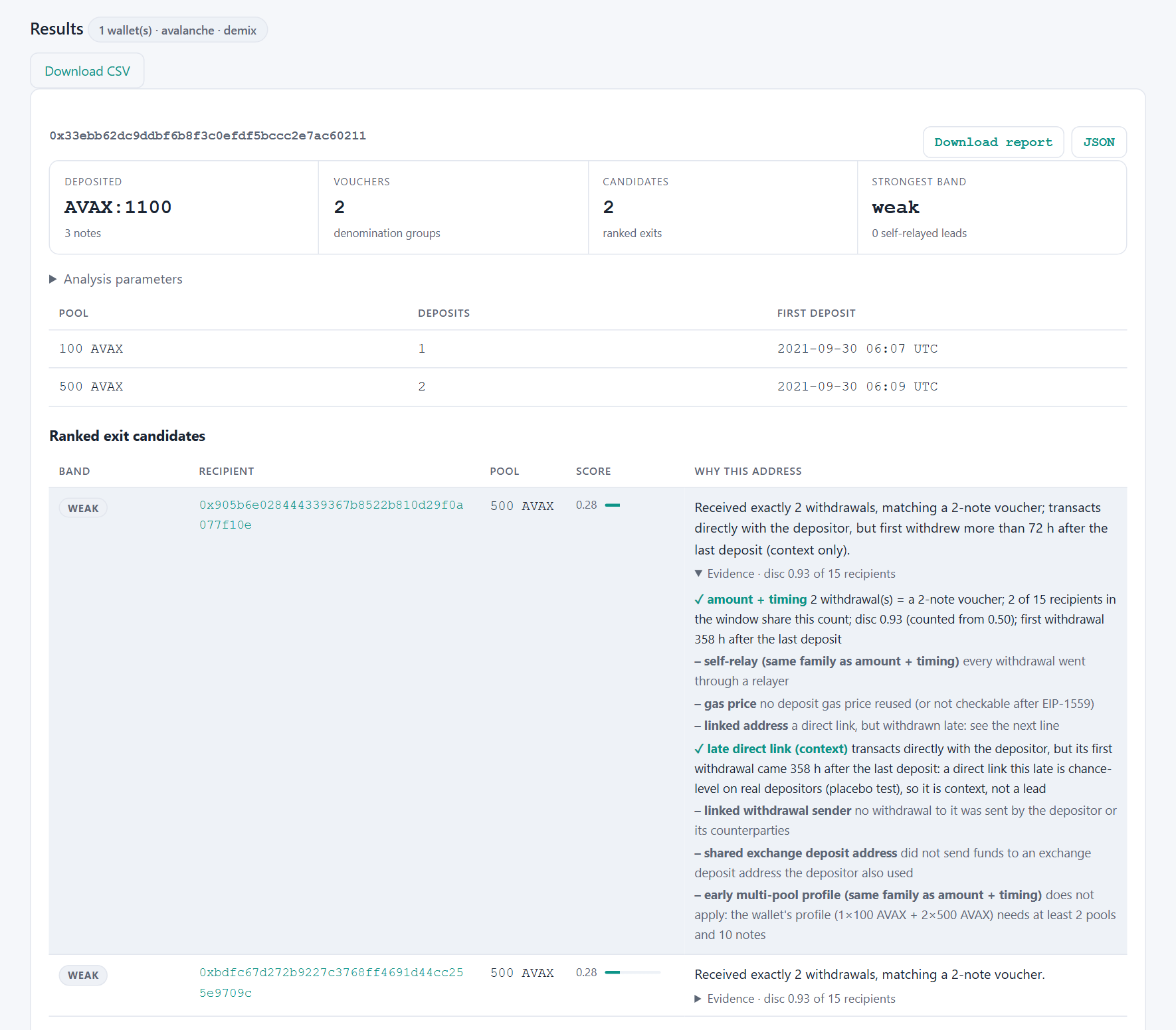
The form runs the same five analyses. For a demix run it shows the strongest band, the ranked candidates with their band and score, and for each candidate an Evidence panel listing every evidence family that was checked, whether it holds, and the numbers behind it. Analysis parameters lists the assumptions (voucher gap, window, thresholds) and the block ranges read. The CSV table, the HTML report and the full JSON result can be downloaded.
For trace, enter one exit address, the amount to follow and optionally the
block the funds arrived in, an ERC-20 token and the number of hops (up to 8). The
page lists where the traced funds stop and why (labelled address, hop limit, a
contract that paid nothing back, not moved on) and every edge with its attributed
amount, swaps included; the HTML report, CSV and JSON can be downloaded.
strong candidate (count match plus a direct transaction with the depositor) and the evidence panel listing every family that was checked.
The UI binds to localhost and has no authentication (forms carry a CSRF token); see SECURITY.md.
Documented cases
Five public cases with an external source of truth. Each can be re-run from the addresses shown (an Etherscan API key is enough; the Ronin labels need an attribution set). The screenshots are from the web UI; the CLI prints the same results. A new run can show slightly different counts as the chain grows and open search windows are clamped to the current block.
| # | Case | Analysis | What it shows | Source of truth |
|---|---|---|---|---|
| 1 | Ronin Bridge 2022 | characterize |
OFAC-labelled exploiter, bridge and USDC calls, 12,595 ETH to a second sanctioned address | OFAC, 14 Apr 2022 |
| 2 | Wintermute 2022 | characterize |
one 9.9435 ETH inflow from the 10 ETH pool; a disposable address | Merkle Science |
| 3 | Beanstalk 2022 | demix --exit-window 24 |
271 deposits in three hours; no candidate above weak |
Merkle Science |
| 4 | KuCoin 2020 | demix |
6 of 7 exits found through the linked withdrawal sender | tayvano/lazarus-bluenoroff-research |
| 5 | Harmony 2022 | demix --known-exit, multi, trace |
an exit group from one known exit; 14 depositors in 5 funder clusters; a three-hop trace | tayvano/lazarus-bluenoroff-research |
Attributing the Ronin, KuCoin and Harmony thefts to Lazarus is the conclusion of government and industry investigators, not of on-chain analysis; the identity of the Wintermute and Beanstalk attackers is not established.
1. Ronin Bridge exploiter
python -m tornado_demix characterize 0x098B716B8Aaf21512996dC57EB0615e2383E2f96
The exploiter received nothing from a Tornado pool; characterize shows where
its funds went next. With the attribution set loaded, the address itself and the
12,595.3 ETH destination are labelled OFAC-sanctioned, and the contract calls go
to Circle: USDC and the Ronin Bridge. Without labels the same hops are shown
unlabelled.
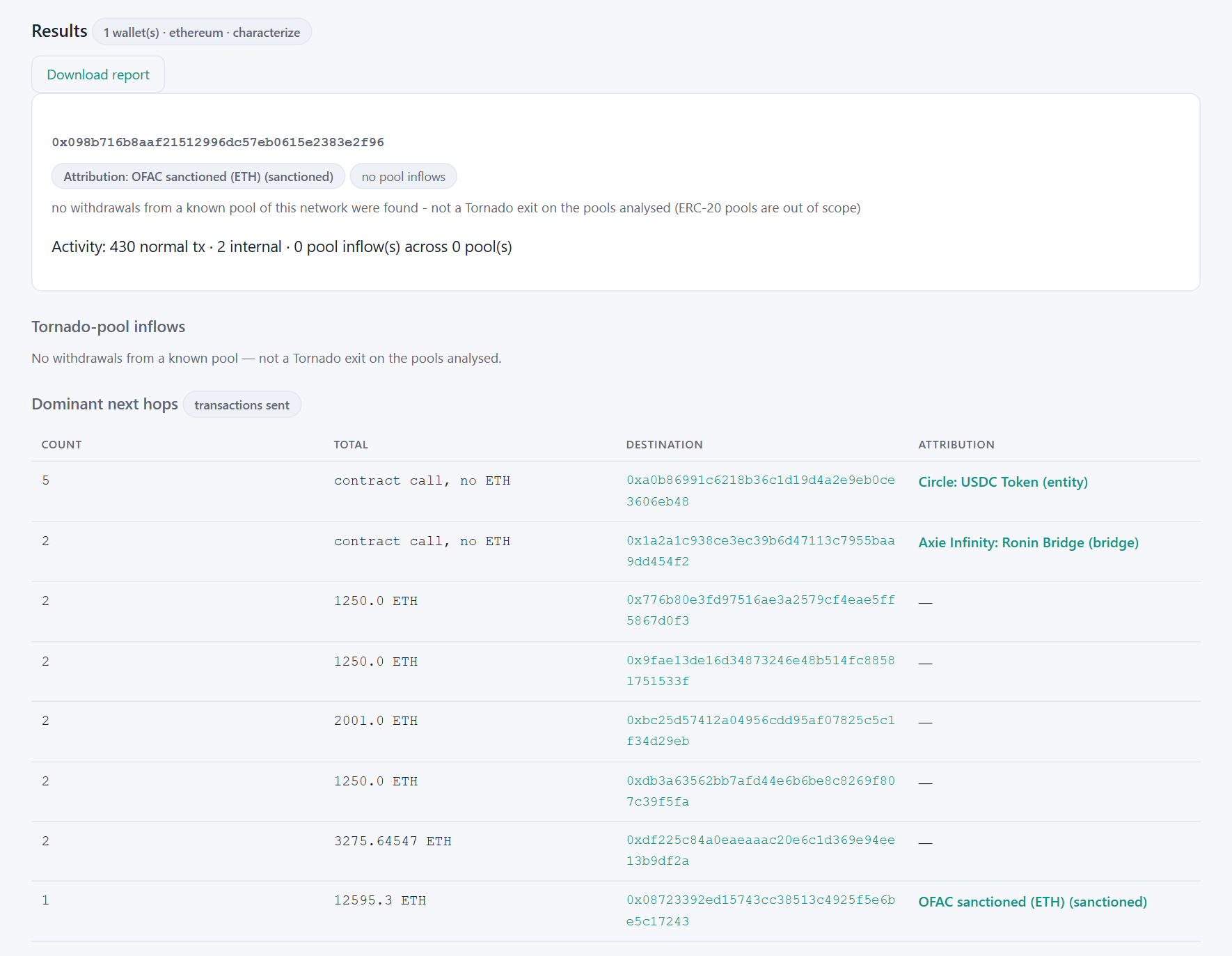
characterize on the Ronin exploiter: attribution labels, no pool inflows, and the dominant next hops with the 12,595.3 ETH transfer to a second sanctioned address.
2. Wintermute attacker
python -m tornado_demix characterize 0xe74b28c2eAe8679e3cCc3a94d5d0dE83CCB84705
One inflow of 9.9435 ETH from the 10 ETH pool on the day of the attack (2022-09-20), the first activity of the address: it is flagged as disposable, the pattern of 98.6 % of laundering exits in the MixLaunder cases.
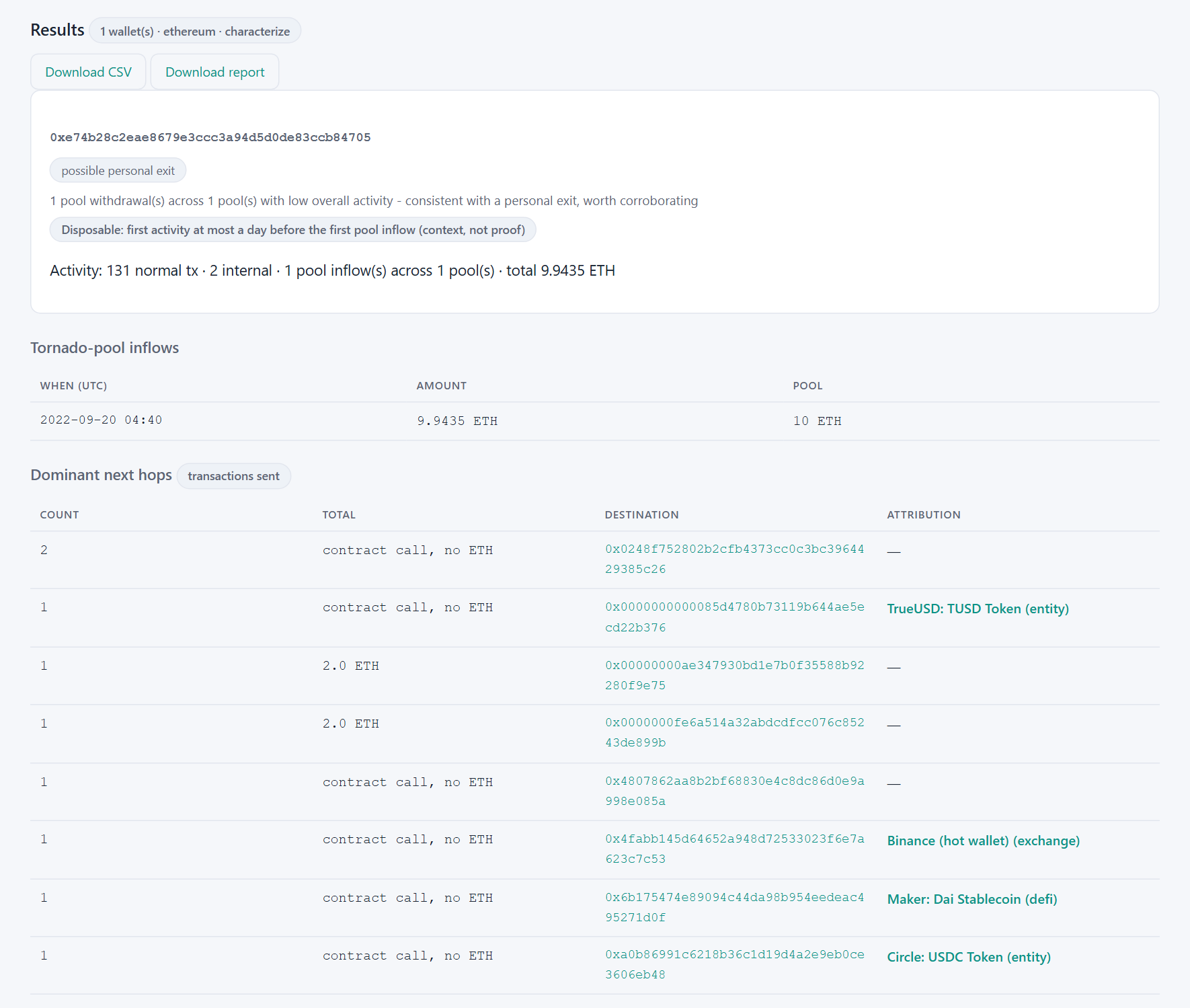
characterize on the Wintermute attacker: one pool inflow, classified as a possible personal exit and flagged disposable.
3. Beanstalk attacker
python -m tornado_demix demix 0x1c5dCdd006EA78a7E4783f9e6021C32935a10fb4 --exit-window 24
271 deposits (247 x 100, 14 x 10, 9 x 1 and 1 x 0.1 ETH) within about three
hours. With a 24-hour exit window the count match leaves one weak candidate and
nothing corroborated: a careful operator leaves no lead, and the tool says so
rather than naming an unrelated address.
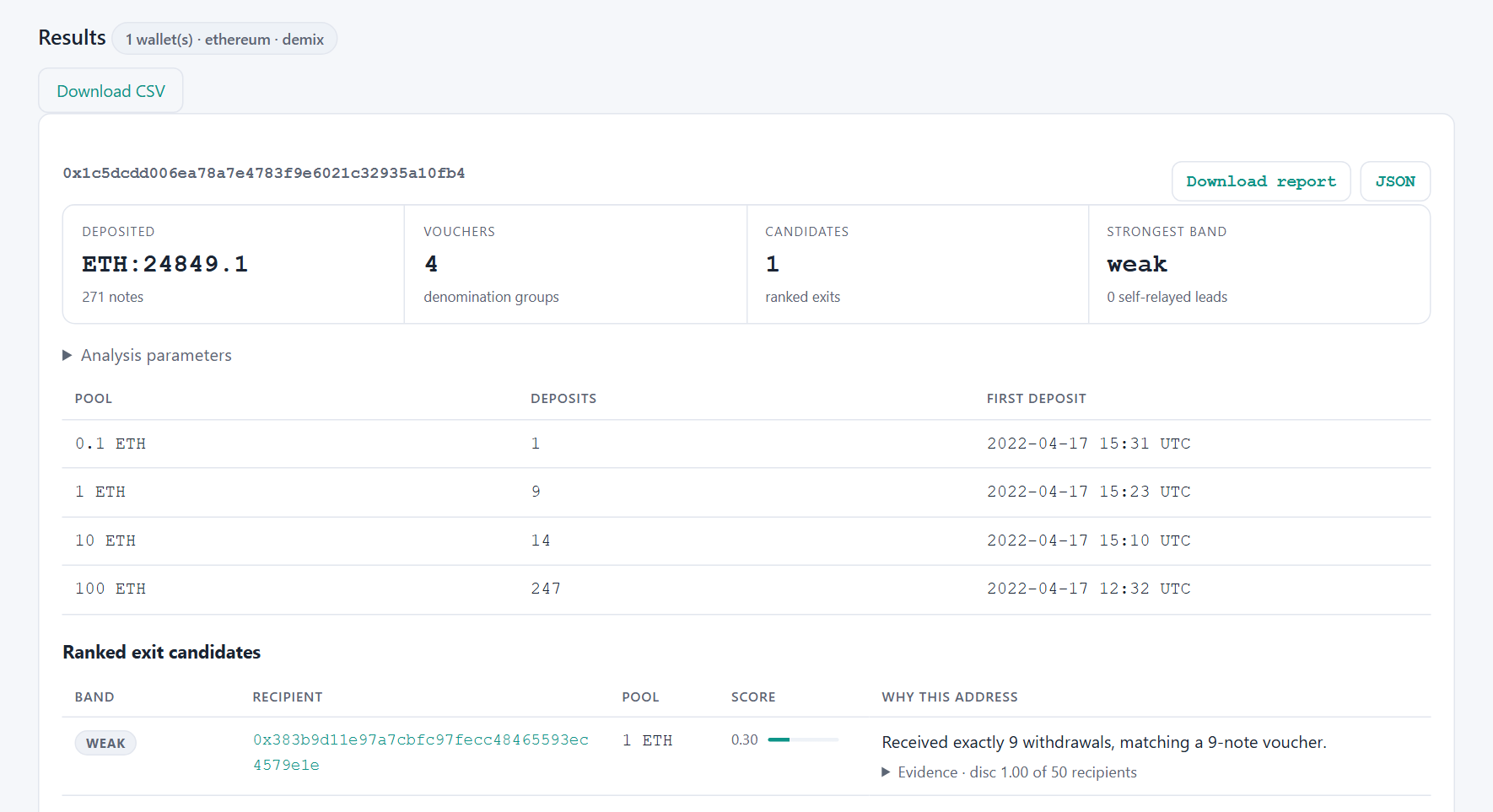
demix on the Beanstalk attacker: four vouchers, 271 notes, and a single weak count-match candidate.
4. KuCoin hack (2020)
python -m tornado_demix demix 0x820a7a97dd146fd97f79881afdf4767624973368
The attacker called withdraw() itself from an address investigators attribute
to it: 128 withdrawals to 7 exits. No exit received a voucher-sized count (each
got 11-29 notes against vouchers of 24 and 30 notes), so the count match finds nothing. The
depositor had transacted with that caller, so every withdrawal it sent marks its
recipient (linked_sender): 6 candidates, all 6 true exits; the seventh
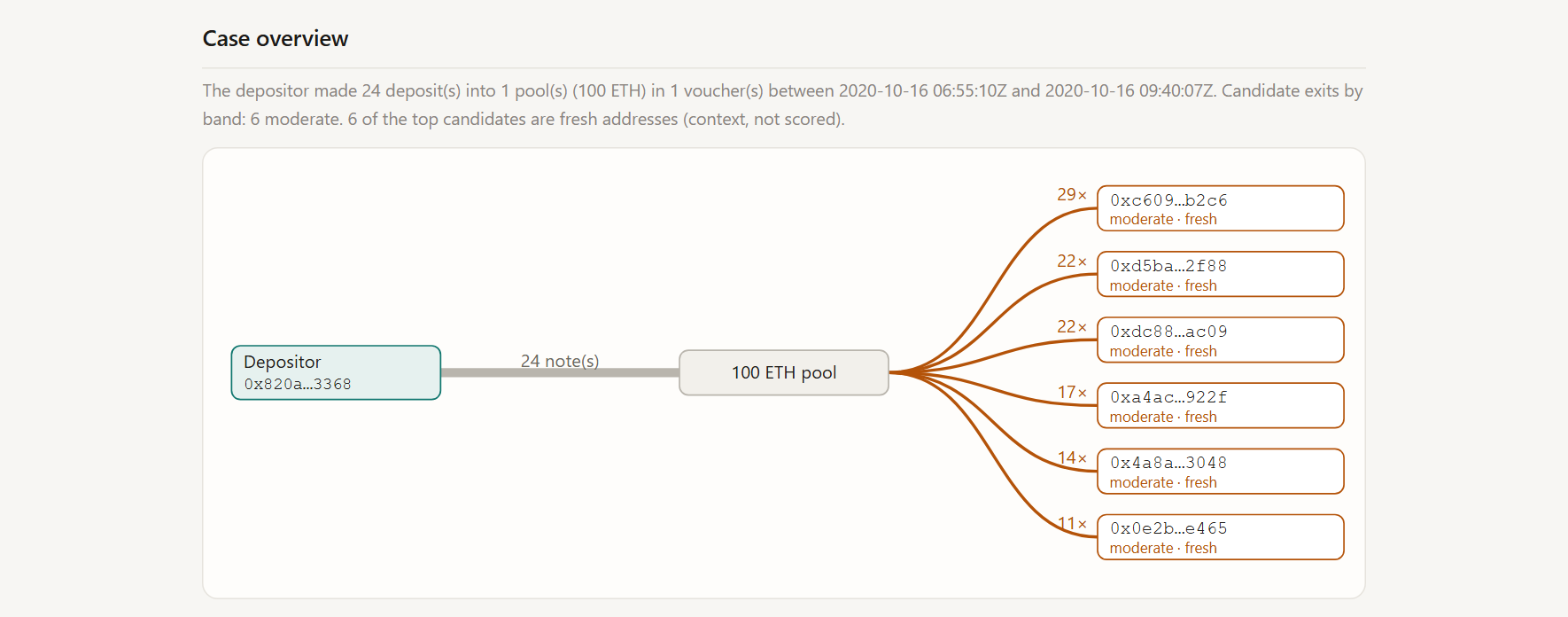
received its withdrawals months later, outside the window. The report opens with
a flow diagram from the depositor through the pool to the candidates.
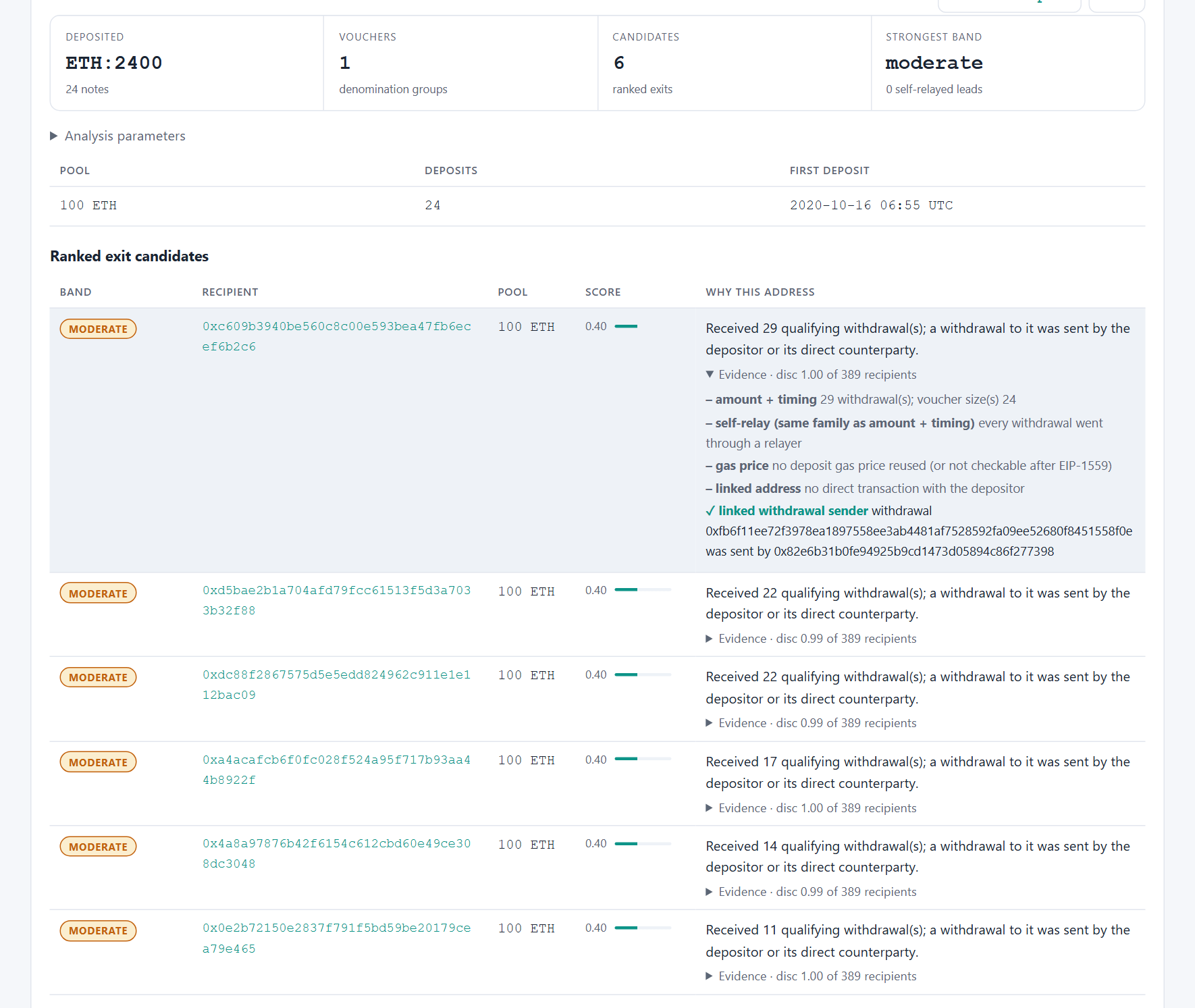
demix on a KuCoin depositor: six moderate candidates, each an exit that received withdrawals sent by the depositor's counterparty; the evidence panel shows which families hold.
With --placebo the same analysis also runs on a decoy window that ends a day
before the first deposit, where no withdrawal can spend this depositor's notes:
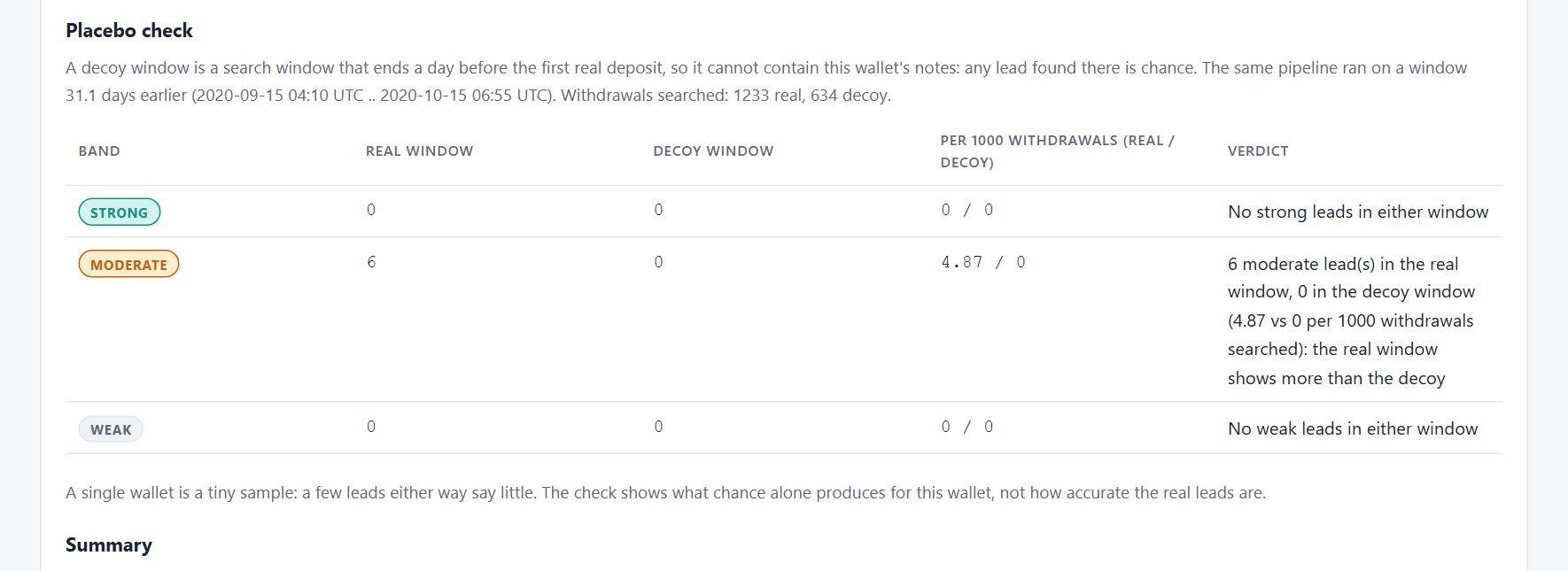
moderate leads in the real window, none in the decoy window; the one decoy candidate is weak.
5. Harmony Bridge hack (2022)
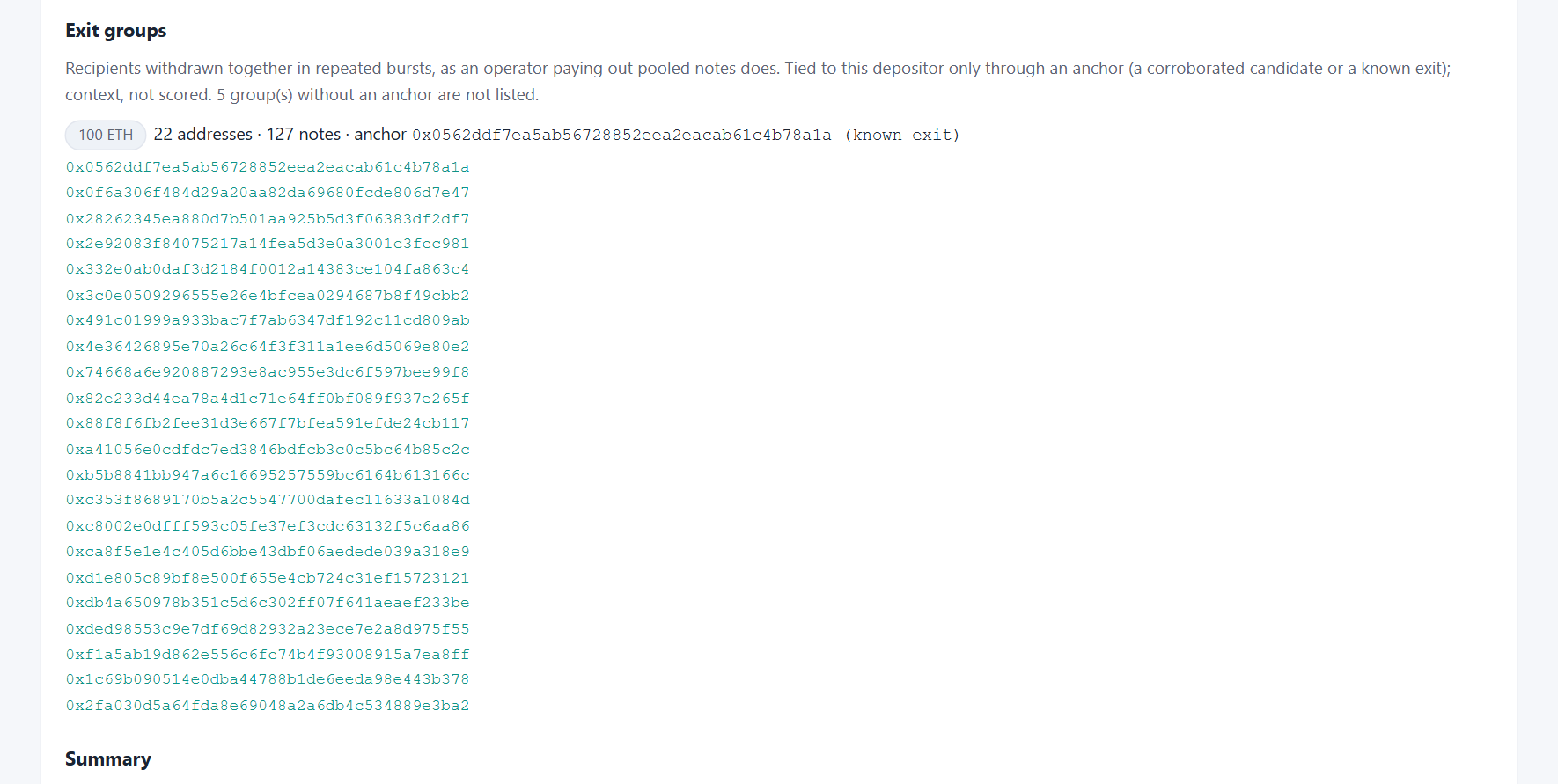
Investigators listed 14 depositors and 55 withdrawal addresses. The attacker pooled 857 notes of the 100 ETH pool and paid them out mostly six at a time, so the count match finds no exit and no false one. Three other analyses do.
Exit groups. Starting from one exit known from the investigation, demix
lists the recipients paid out in the same bursts:
python -m tornado_demix demix 0xe71d5fa89d1086d5c3b0ab03eeee2483d2d5ca97 \
    --known-exit 0x0562ddf7ea5ab56728852eea2eacab61c4b78a1a
Shared funders. Correlating the 14 depositors links all of them through five
immediate funders, each of which was paid directly by the bridge exploiter
0x0d04...ded00; a sixth, busy funder is left out:
python -m tornado_demix multi --wallets-csv docs/cases/harmony_depositors.csv
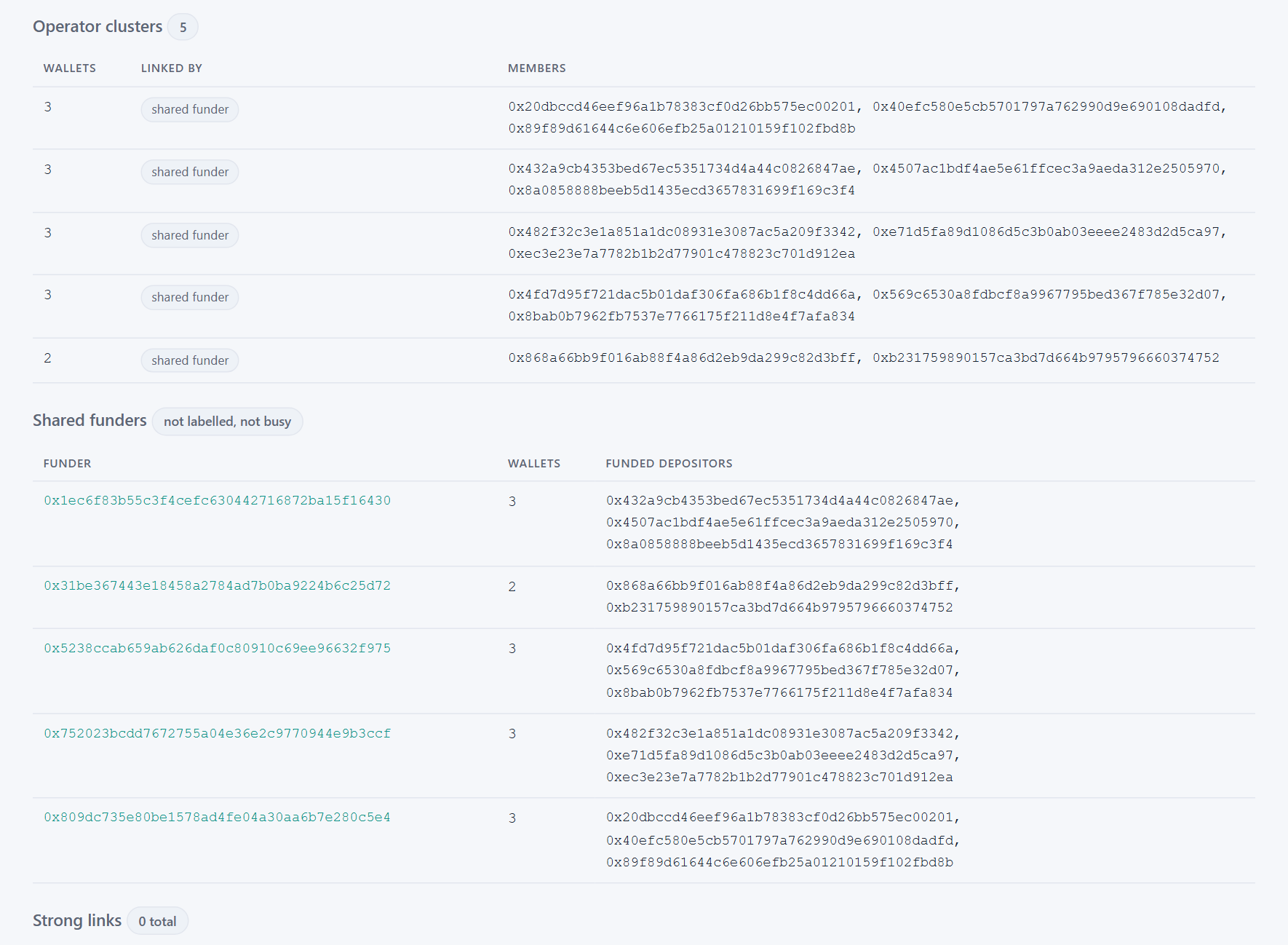
multi on the 14 Harmony depositors: operator clusters linked by a shared funder, and the funders themselves.
Trace. From an exit, trace follows the 100 ETH it received forward:
python -m tornado_demix trace 0x04bca8fa79f36749fa605597e9c9f6788c126944 --amount 100 --max-hops 3
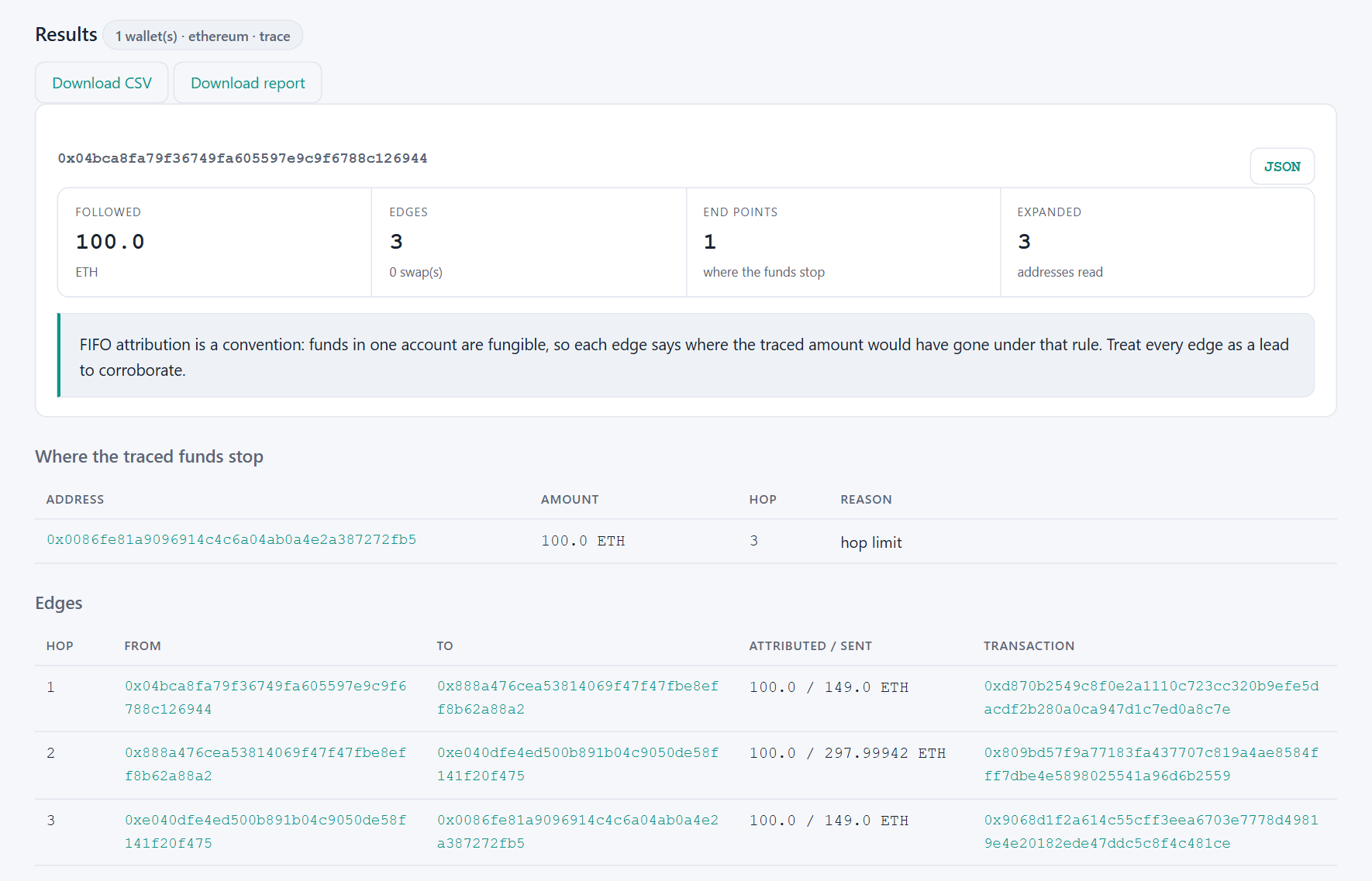
trace from a Harmony exit: the 100 ETH moves through two intermediate addresses; the trace stops at the hop limit.
The method on both public cases, with the numbers behind each claim, is in
docs/EVALUATION.md; python tools/real_cases.py repeats it.
Limitations
- Leads, not proof. The weights and
MIN_COUNT_DISCRIMINATION = 0.5are expert judgements; the score has not been calibrated on cases with known outcomes. The band does not depend on the weights at all; they only order candidates within a band (check a saved result withtools/sensitivity.py). How each component behaves on generated data with a known answer is in docs/EVALUATION.md. - On real depositors the count match, self-relay and gas-price reuse do not beat
chance: a placebo test on 152 random Ethereum depositors found as many such
leads in decoy windows before the first deposit as in the real windows, at every
window from 6 hours to 30 days. Only a linked address (a direct counterparty, a
withdrawal sent by the depositor's side, or a shared exchange deposit address)
stood above chance (30 against 7 over
30 days, 19 against 1 within 72 hours), so only it makes a
moderateorstrongband (details). - On 31 depositor/exit pairs labelled through ENS (2019-2026), demix found 16 of the 21 pairs inside its window, all through a direct transaction between the two addresses, which the label sees as well; without that signal it found one. Most labelled depositors made single-note deposits, which the count match cannot narrow (details).
- Single-note vouchers cannot be narrowed by count: every recipient in the window has count 1.
- Busy pools and long windows produce many equal counts.
--exit-windowtrades recall for discrimination. - A careful user defeats the method: relayers, long delays, split withdrawals
to fresh addresses. The result is then "no lead", or weak leads on unrelated
addresses that happen to share the voucher count, never a
moderateorstrongone. On the public KuCoin and Harmony laundering cases the count match found no exit (every exit collected notes of several deposits); in KuCoin the linked withdrawal sender found 6 of 7 exits for one depositor (docs/EVALUATION.md). - Only Tornado Cash pools in the registry are covered. Bridges, other mixers and
cross-chain hops are not followed;
clusterfollows one hop only, andtracefollows funds by FIFO attribution, a convention that does not hold when an address mixes the traced funds with others. - Native chains other than Ethereum, Polygon and Avalanche have no verified router in the registry, so routed deposits there are not detected.
characterizecounts inflows from native pools only.- Results depend on the explorer API. Provider failures raise errors instead of returning empty results, and pools whose search window cannot be resolved are reported as not searched.
Development
python -m pytest -q          # network access is blocked in tests
python -m pytest -m live     # on-chain registry check, needs network
python -m ruff check . && python -m ruff format --check .
Weight sensitivity of saved results (no API calls):
python tools/sensitivity.py out/demix.json:<expected exit> --samples 1000 --spread 0.5
Synthetic benchmark (no API calls, about half a minute):
python tools/simulate.py --experiment all --trials 200 --seed 1
Public laundering cases (KuCoin 2020, Harmony 2022; needs an API key):
python tools/real_cases.py
requirements-lock.txt pins every dependency with hashes (generated by
uv pip compile pyproject.toml --extra web --extra dev --python-version 3.9 --generate-hashes --universal); install it with
pip install --require-hashes -r requirements-lock.txt and then
pip install --no-deps -e . to reproduce a result with the same libraries.
CI runs the tests on Linux and Windows with Python 3.9 and 3.13 against the lock file, a test under a legacy Windows codepage, the linter, and a wheel install check.
Legal and ethical use
For research, compliance and authorised investigations. Every address processed is public on-chain data, but a label or a band attached to an address is an allegation about a person. Corroborate any lead independently before it appears in a report, a referral or a freeze request, and follow the terms of service of the data providers you use.
License
MIT, see LICENSE.
1 maintainer

Metadata
1 maintainer
Release files for tornado-demix 2.14.0
For a detailed explanation of source distributions (sdists) and built distributions (wheels), please see the package formats documentation.
Source distribution (sdist)
| File | Size | Uploaded | |
|---|---|---|---|
| tornado_demix-2.14.0.tar.gz | 207.6 kB | Details |
Built distribution (wheel)
| File | Interpreter | ABI | Platform | Reset |
|---|---|---|---|---|
| tornado_demix-2.14.0-py3-none-any.whl | Python 3 | none | any | Details |
Total release size: 320.1 kB
Release files / tornado_demix-2.14.0.tar.gz
| Download URL | tornado_demix-2.14.0.tar.gz |
|---|---|
| Size | 207.6 kB |
| Tags | Source |
|
SHA-256 checksum How to use checksums |
8b562891fa6c966392b5119538b5c17061f644186b326749e7c0432c747b5598
|
|
BLAKE2b-256 checksum How to use checksums |
297c7dfdd536de88b0cfc3cd2bfc535c3954f7dcd5a2ebffd375de788e008391
|
| Upload date | |
|
Uploaded using Trusted Publishing? What is trusted publishing? |
Yes |
| Uploaded via |
twine/7.0.0 CPython/3.13.14
|
Provenance
Provenance describes where a file came from. On PyPI, provenance is shared via attestations, which provide a verifiable record of the build or publishing details. View details, limitations and caveats.


PyPI Publish Attestation
PyPI verified that this artifact, at this checksum, originated from the publisher listed below.
Signed by GitHub Actions, verified by PyPI on Sep 29, 2026.
Transparency logRelease files / tornado_demix-2.14.0-py3-none-any.whl
| Download URL | tornado_demix-2.14.0-py3-none-any.whl |
|---|---|
| Size | 112.5 kB |
| Tags | Python 3 |
|
SHA-256 checksum How to use checksums |
d5044811bbd8472fac024a64b03602f925defdbb3dc6a37b658ae29f5dde3210
|
|
BLAKE2b-256 checksum How to use checksums |
6b8edd98335cb3356a8a9f23e98732289eeeff18172aebc434bd00fe8229e22f
|
| Upload date | |
|
Uploaded using Trusted Publishing? What is trusted publishing? |
Yes |
| Uploaded via |
twine/7.0.0 CPython/3.13.14
|
Provenance
Provenance describes where a file came from. On PyPI, provenance is shared via attestations, which provide a verifiable record of the build or publishing details. View details, limitations and caveats.
PyPI Publish Attestation
PyPI verified that this artifact, at this checksum, originated from the publisher listed below.
Signed by GitHub Actions, verified by PyPI on Sep 29, 2026.
Transparency log













