TPxLab
Reproducible global deconvolution and quantification of temperature-programmed catalyst data.


TPxLab turns CSV/XLSX TPR, TPD, and TPO curves into inspectable baseline corrections,
editable peak components, simultaneous mixed-model fits, coordinate-aware integrals,
unit-checked quantities, diagnostics, figures, and reproducible exports. One
AnalysisService powers the Python API, CLI, and Tkinter GUI.
Install
Install the current stable release from PyPI:
python -m pip install tpxlab
For development or to run the bundled examples from a source checkout:
git clone https://github.com/hdkim99/TPxLab.git
cd TPxLab
python -m pip install -e .
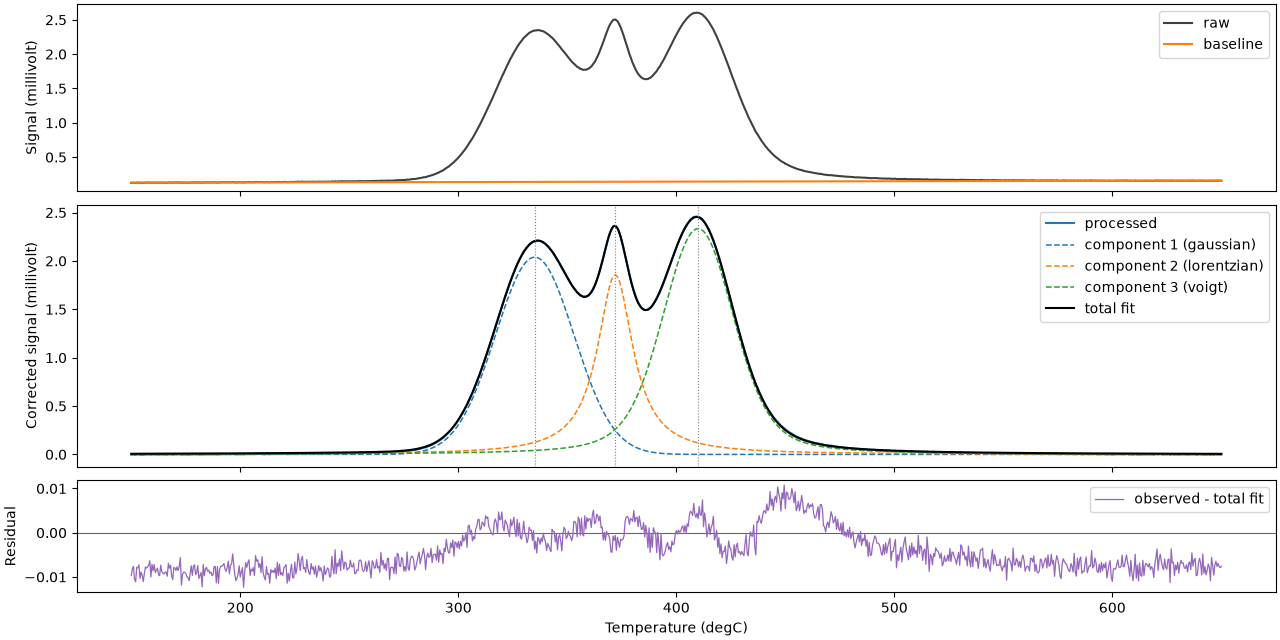
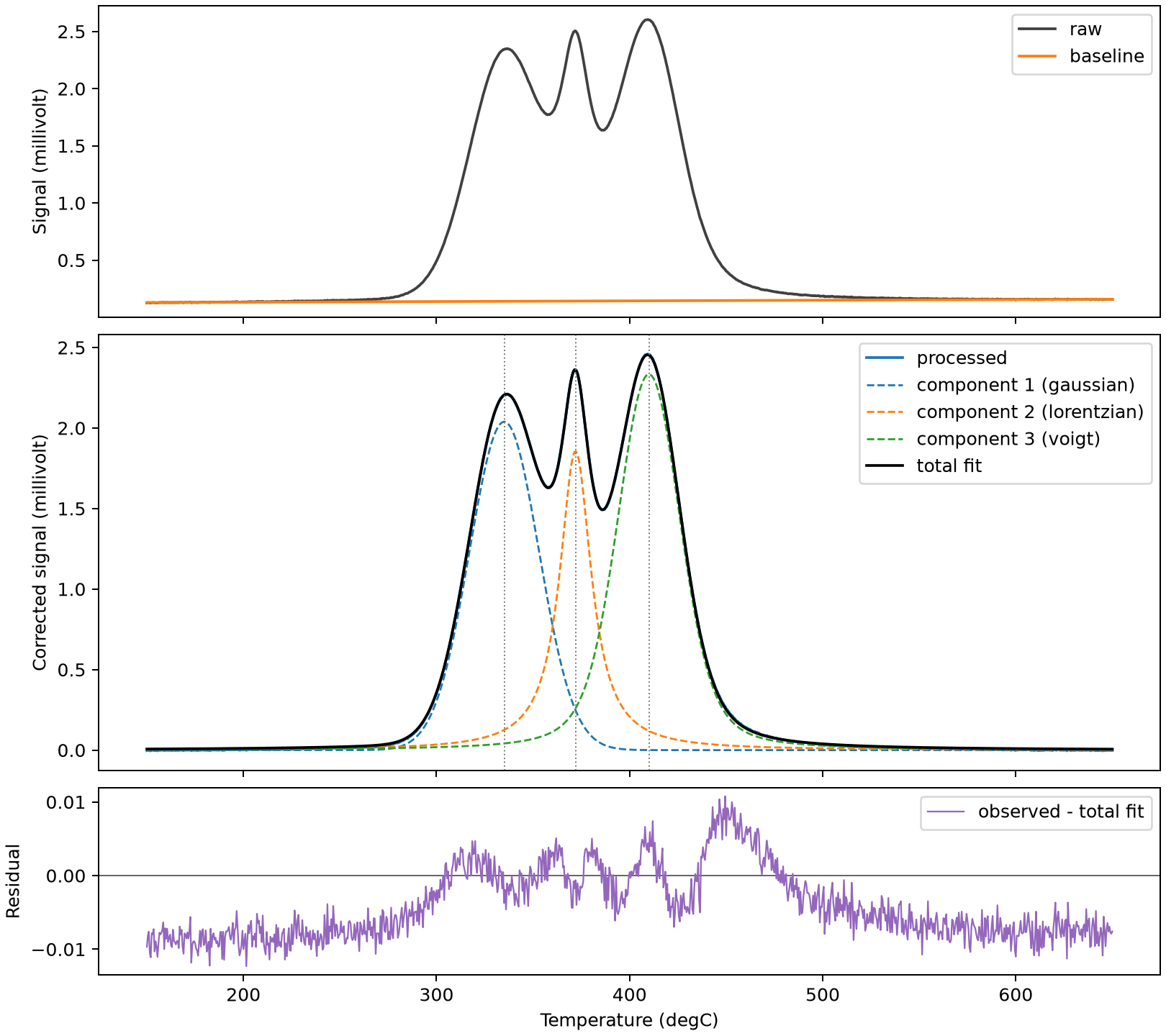
The repository social-preview candidate is the actual bundled-example result, not a mock interface.
30-second global quickstart
For the bundled overlapping example in a source checkout:
tpxlab analyze examples/overlapping_tpr.csv \
  --components-config examples/overlapping_components.json \
  --baseline linear \
  --output examples/output/global-analysis.xlsx \
  --figure examples/output/global-analysis.png

tpxlab-gui
The GUI follows: load and map columns/units -> baseline and detect -> add/update/remove components -> choose model, center/width bounds, fixed/shared width constraints -> fit and quantify -> inspect components/total/residual -> export. Every edit is passed through the service to the same scientific core used by the CLI.
Python API
from tpxlab import AnalysisService, AnalysisSettings, PeakSeed
from tpxlab.io import load_raw_data

raw = load_raw_data("examples/overlapping_tpr.csv")
components = [
    PeakSeed(
        332,
        220,
        540,
        model="gaussian",
        center_lower=310,
        center_upper=350,
        width_lower=5,
        width_upper=35,
    ),
    PeakSeed(
        373,
        220,
        540,
        model="lorentzian",
        center_lower=355,
        center_upper=390,
        width_lower=4,
        width_upper=25,
    ),
    PeakSeed(
        414,
        220,
        540,
        model="voigt",
        center_lower=395,
        center_upper=430,
        width_lower=4,
        width_upper=28,
    ),
]
result = AnalysisService().analyze(
    raw,
    AnalysisSettings(baseline_method="linear", fit_mode="global"),
    components,
)
print(result.global_fit.identifiable, result.global_fit.statistics.r_squared)
Support status in v0.2.x
| Capability | Status | Notes |
|---|---|---|
| CSV and XLSX import | Supported | explicit or conservative automatic 3-column mapping |
| Linear, polynomial, ALS baseline | Supported | raw data is copied and read-only |
| Positive/negative detector peaks | Supported | explicit polarity; raw/baseline stay in detector coordinates |
| Optional Savitzky-Golay smoothing | Supported | parameters exported |
| Peak detection and manual edits | Supported | positive-area peaks after explicit polarity; add/update/remove in GUI |
| Simultaneous global deconvolution | Supported | one summed residual; mixed Gaussian/Lorentzian/Voigt |
| Center/width constraints | Supported | positive areas; validated bounds and fixed parameters |
| Shared width constraint | Supported | named shared sigma or gamma groups only |
| Identifiability diagnostics | Supported | ordering, dof, rank, condition, active bounds, covariance status |
| Independent bounded fitting | Supported | v0.1-compatible mode; not overlapping deconvolution |
| Trapezoid/Simpson integration | Supported | actual time coordinates, including irregular sampling |
| Calibration + sample-mass quantification | Supported | Pint dimensional validation |
| Explicit reduction degree | Experimental | API only; user supplies stoichiometry |
| Draft interchange metadata | Experimental | org.tpxlab.analysis/0.2-draft; no integration adapter yet |
| Asymmetric peaks, automatic model selection | Planned | not implemented |
| TPSR and pulse chemisorption workflows | Planned | not implemented |
Outputs
XLSX contains Raw, Processed, Peaks, Components, Global_fit, Settings, Metadata, and QC sheets; a directory destination writes the same layers as CSV. Exports include original channels, component curves, total curve, residual, exact constraints, parameter ordering, component parameters/Tmax/area/height/FWHM, local standard errors, component and global covariance, RSS/RMSE/R²/dof, Jacobian rank, condition number, optimizer status, active bounds, numerical rank tolerance, integration source, units, source file, and QC issues. PNG/SVG/PDF figures include raw/baseline, components/total, and residual.
Scientific scope and limitations
- Global mode minimizes one residual vector between the complete processed signal and the sum of all components. It is not a sum of separately fitted curves.
- Nonlinear decomposition can be non-unique. A full-rank local Jacobian is necessary, not sufficient, for physical uniqueness. Rank-deficient fits report unavailable covariance; boundary solutions report boundary-limited uncertainty.
- Reported covariance is the local linearized least-squares approximation. It does not replace replicate experiments, profile likelihood, or domain-informed uncertainty.
- A shared
sigmaorgammashould be used only when components have a defensible common broadening mechanism. TPxLab never decides that assumption automatically. - Global component quantification integrates each fitted component against measured time. Independent mode integrates the observed bounded region. The export labels this source.
- Peak fit
areais with respect to temperature; calibrated detector integration is with respect to time. Both are labeled separately. - Baseline and model choices remain analytical assumptions requiring residual review. TPxLab orients explicitly declared positive/negative detector responses into positive-area models and does not infer polarity, gas identity, chemistry, oxidation state, stoichiometry, or expected consumption.
- Non-monotonic temperature programs are flagged; repeated temperature ranges require user review.
Definitions, equations, parameter ordering, and validation details are in Scientific methods. The reviewed, opt-in actual-research-data source is documented in Public data sources. The provisional, explicitly non-stable export contract is in Interchange metadata.
Related tools
- Ordifile — chromatographic data standardization.
- ReactorCheck — catalytic reactor calculation and QC.
- OperandoMerge — heterogeneous experiment timeline alignment.
These are independent repositories. Direct cross-project adapters are planned interoperability, not a current TPxLab feature.
Development
python -m pip install -e '.[dev]'
ruff check .
mypy src
pytest
python -m build
twine check dist/*
Runtime dependencies use permissive licenses compatible with MIT: NumPy/SciPy/pandas
(BSD), Pint (BSD), Matplotlib (PSF-based), and openpyxl (MIT). See pyproject.toml for
the declared dependency set and CONTRIBUTING.md
for the scientific contribution policy.
1 maintainer

Metadata
1 maintainer
Release files for tpxlab 0.2.2
For a detailed explanation of source distributions (sdists) and built distributions (wheels), please see the package formats documentation.
Source distribution (sdist)
| File | Size | Uploaded | |
|---|---|---|---|
| tpxlab-0.2.2.tar.gz | 507.0 kB | Details |
Built distribution (wheel)
| File | Interpreter | ABI | Platform | Reset |
|---|---|---|---|---|
| tpxlab-0.2.2-py3-none-any.whl | Python 3 | none | any | Details |
Total release size: 548.5 kB
Release files / tpxlab-0.2.2.tar.gz
| Download URL | tpxlab-0.2.2.tar.gz |
|---|---|
| Size | 507.0 kB |
| Tags | Source |
|
SHA-256 checksum How to use checksums |
946665802f8a8b8d55465a867ca32d98e0c06ec6dff27ebf137356d2d1151e5b
|
|
BLAKE2b-256 checksum How to use checksums |
8c59cd1bd7c12ada45c7c186f79c3dacd1c846e8ba80e0842bf760970f8ffa20
|
| Upload date | |
|
Uploaded using Trusted Publishing? What is trusted publishing? |
Yes |
| Uploaded via |
twine/7.0.0 CPython/3.13.14
|
Provenance
Provenance describes where a file came from. On PyPI, provenance is shared via attestations, which provide a verifiable record of the build or publishing details. View details, limitations and caveats.


PyPI Publish Attestation
PyPI verified that this artifact, at this checksum, originated from the publisher listed below.
Signed by GitHub Actions, verified by PyPI on Aug 23, 2026.
Transparency logRelease files / tpxlab-0.2.2-py3-none-any.whl
| Download URL | tpxlab-0.2.2-py3-none-any.whl |
|---|---|
| Size | 41.6 kB |
| Tags | Python 3 |
|
SHA-256 checksum How to use checksums |
0352da5b70559ded3d2ad9e9aeab8d820bf7ecd692334d22ab15be20c6dffb66
|
|
BLAKE2b-256 checksum How to use checksums |
d56713e05b7639a5ae11e32139a7084d228b93bbd9983631e70b627960fd6410
|
| Upload date | |
|
Uploaded using Trusted Publishing? What is trusted publishing? |
Yes |
| Uploaded via |
twine/7.0.0 CPython/3.13.14
|
Provenance
Provenance describes where a file came from. On PyPI, provenance is shared via attestations, which provide a verifiable record of the build or publishing details. View details, limitations and caveats.
PyPI Publish Attestation
PyPI verified that this artifact, at this checksum, originated from the publisher listed below.
Signed by GitHub Actions, verified by PyPI on Aug 23, 2026.
Transparency log