
Matching-engine conformance testing, reproducible failure reduction, and honest local benchmarks
Verified details
These details have been verified by PyPIProject links
GitHub Statistics
Maintainers

Project description

Tracebook
Conformance testing and reproducible failure analysis for matching engines.




Tracebook runs the same normalized order-lifecycle trace against an inspectable reference engine and your Rust, C++, Java, Python, or other candidate. It stops at the first semantic difference, explains what drifted, and reduces the failure to a deterministic JSONL reproducer.
Give it an engine. Get back the smallest trace that proves where it disagrees.
Quick start · Real failure · Profiles · Qualification · Adapters · CI · Architecture · Research
Quick Start
Tracebook requires Python 3.10-3.13. Install the dependency-light conformance distribution and materialize the current hash-verified adversarial suite:
If this environment already contains tracebook-sim 0.5.x, remove that
legacy package owner before installing either 0.6.0 distribution:
python -m pip uninstall -y tracebook-sim
python -m pip install "tracebook-conformance==0.6.0"
tracebook-conformance sample ./tracebook-suite-v2 --suite-version v2
tracebook-conformance --help
Suite v2 is the current default; the explicit option makes the copied contract
unambiguous if a later release adds another suite. These commands do not
require a source checkout, NumPy, or psutil. Install
tracebook-sim==0.6.0 instead when you need the simulator, benchmark,
profiling, visualization, replay, or corpus commands. Users migrating that
distribution from 0.5.x must use the uninstall-first handoff above:
python -m pip install "tracebook-sim==0.6.0"
The package-boundary decision documents the one-time ownership handoff and recovery command. A candidate engine remains a separate process by design. Once it speaks the versioned NDJSON protocol, run a deterministic campaign:
tracebook-conformance campaign \
  --profile fifo-limit-v1 \
  --seed 42 \
  --traces 25 \
  --events-per-trace 200 \
  --candidate-cmd './matching-engine --tracebook-stdio' \
  --corpus-dir .tracebook/corpus \
  --stop-after-first \
  --junit-output .tracebook/conformance.xml
Exit code 0 means every requested trace conformed. Exit code 1 means a
semantic difference was preserved with the original failure, reduced
reproducer, semantic diff, coverage evidence, campaign metadata, and JUnit
result. Exit code 2 is reserved for an invalid configuration, adapter
protocol, process, or filesystem failure.
For a working adapter before writing your own, use the native orderbook-rs walkthrough or the small Python process example. The Python example demonstrates protocol framing around Tracebook's own reference adapter; it is not an estimate of real engine-integration effort. Native integrations must faithfully translate lifecycle operations, numeric representations, ordered snapshots, and source IDs. The frozen design-partner study records adapter files ranging from 672 to 1,056 Rust lines and an 865-line Go adapter plus 130 lines of tests. Engine maintainers and independent evaluators can also open a structured engine qualification report. Successful and blocked attempts are both useful: the report records time to evidence, adapter size, protocol questions, profile boundaries, and whether the result belongs in the candidate project's CI.
A Real Four-Event Rust Failure
Flash's matching-engine benchmark
reported a historical FIFO defect in an orderbook-rs dependency: after a
partial fill, the oldest maker's remainder moved behind a later maker at the
same price. Upstream tracked the defect as
orderbook-rs #88
and fixed it in
PR #131.
Flash's merged schema-v1 export localizes its canonical stream at sequence
15738. Tracebook converts the exact 15,739-message prefix and reduces it to
four actual workload events. Independently, seed 42 generates a portable
Tracebook probe whose first incorrect trade is event 173; that trace also
reduces to four events while preserving the same maker-priority defect.
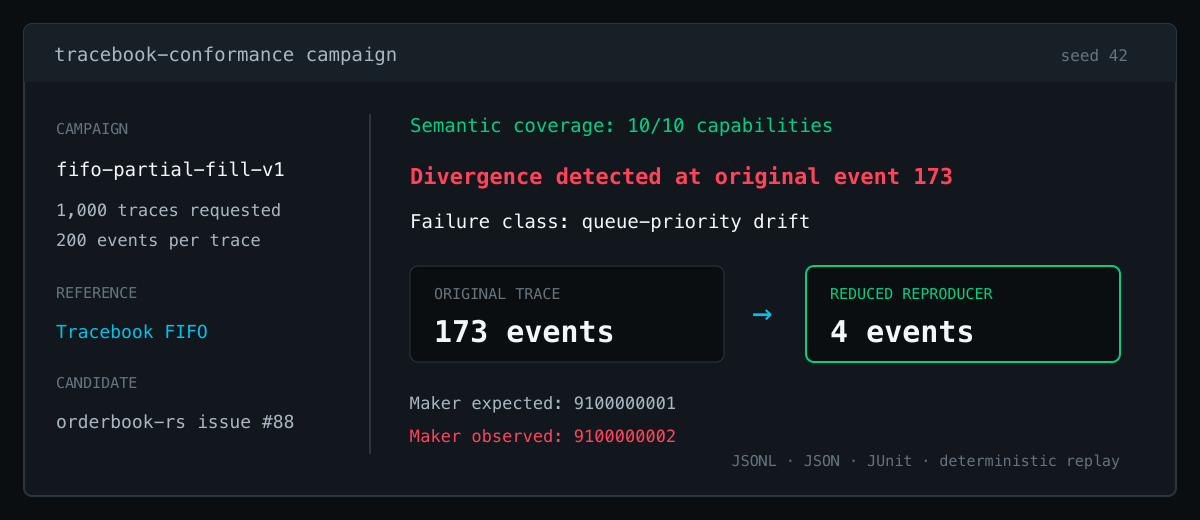
The reduced trace then becomes an ordinary CI regression: it must reproduce
against the affected revision and pass against orderbook-rs 0.12.0.
- Read the provenance and reduction case study
- Inspect the Flash schema-v1 divergence
- Inspect the Flash-derived four-event regression
- Inspect the four-event JSONL reproducer
- Review the native Rust adapter
This is a retrospective import of a defect Flash discovered, not a Tracebook discovery claim. The value Tracebook adds is deterministic generation, first-divergence localization, minimization, replay, and a reusable regression artifact.
What It Compares
| Surface | Comparison |
|---|---|
| Outcomes | Applied or rejected status plus stable rejection reason |
| Trades | Ordered maker/taker source IDs, side, price, and quantity |
| Resting state | Full price-time queue order, remaining quantity, owner, and symbol |
| Lifecycle | New, cancel, reduce, replace, clear, duplicate, and inactive requests |
| Instructions | Limit, market, IOC, FOK, and configured self-trade prevention |
| Isolation | Independent multi-symbol books and canonical state hashes |
| Evidence | Candidate-independent semantic coverage for compared events |
Tracebook transfers compact observations after each event and requests a full queue snapshot only at divergence and completion. Candidate execution time is not presented as engine latency because it includes process, serialization, and adapter overhead.
Portable Semantic Profiles
Profiles are versioned contracts. Existing names do not silently acquire new behavior, so seeds and campaign hashes remain reproducible.
| Profile | Contract |
|---|---|
fifo-limit-v1 |
FIFO limit orders, partial fills, cancel, reduce, replace, clear, duplicates, inactive requests, and multiple symbols |
fifo-full-v1 |
fifo-limit-v1 plus market, IOC, and FOK instructions |
fifo-partial-fill-v1 |
Portable FIFO lifecycle plus the real partial-fill continuation probe |
| Bundled suite v2 (current default) | Nine adversarial fixtures covering FIFO, instructions, encounter-based STP, tick grids, deep cancellation, multiple symbols, and pro-rata |
Campaigns use specified SplitMix64 trace seeds and candidate-independent generation. Immutable suite v1 remains available explicitly for reproducing its original eight-case contract. Reports distinguish semantic workload coverage from Python source coverage.
Read the profile, protocol, hashing, and minimizer contracts.
Profile Qualification
Use one command for the fixed and generated evidence inside the contract your engine actually claims:
tracebook-conformance qualify \
  --profile fifo-limit-v1 \
  --seed 42 \
  --traces 25 \
  --events-per-trace 200 \
  --candidate-cmd './matching-engine --tracebook-stdio' \
  --output-dir .tracebook/qualification
The atomic bundle includes qualification.json, qualification.xml, selected
fixed-suite results, campaign results, semantic coverage, and any minimized
failure. Qualification selection contract v1 uses bundled suite v2 by default;
these are separate version boundaries. fifo-limit-v1 qualification does not
run STP or pro-rata cases, so unsupported features stay explicit without
becoming false failures.
Read the research-grounded roadmap and adoption experiment.
Architecture
flowchart LR
    G["Versioned campaign"] --> R["Runner"]
    T["Normalized trace"] --> R
    R --> O["Reference engine"]
    R --> A["NDJSON adapter"]
    A <--> E["Candidate engine"]
    O --> D["Semantic diff"]
    A --> D
    D --> P["JSON / JUnit"]
    D --> M["Minimizer"] --> B["Failure bundle"]
The process boundary keeps the candidate independent of Tracebook's Python implementation. Adapters translate only between native engine operations and the canonical protocol.
Open the detailed component map.
Engine Adapters
| Candidate | Native surface | Evidence |
|---|---|---|
orderbook-rs 0.12.0 |
Rust FIFO lifecycle, market/IOC/FOK, STP, deterministic trade IDs, consumption-order queue snapshots | Conformant generated FIFO campaign; 7/9 standard cases with pro-rata and one STP policy difference explicit; semantics reviewed in upstream issue #203 and Tracebook issue #57 |
gocronx/matcher 0.2.0 |
Pinned Rust FIFO limit lifecycle over native events and snapshot format v1 | fifo-limit-v1 qualification passes 3/3 fixed cases, 25/25 generated traces, and 10/10 capabilities; upstream observation and replacement questions remain explicitly pending in issue #7 |
Historical orderbook-rs issue #88 |
Exact affected Rust dependency behind an opt-in Cargo feature | Flash sequence 15738 and generated event 173 independently reduce to four-event regressions |
faulty-orderbook-adapter |
Real Rust engine plus one documented injected queue-priority fault | Synthetic negative control reduced from event 173 to five causal events |
| PythonMatchingEngine | Pinned FIFO limit lifecycle, cancellation, reduction, replacement, clear, and queue snapshots | Compatible trace passes; unsupported instructions, STP, tick grid, and pro-rata remain visible differences |
| Your engine | Any language that can read and write newline-delimited JSON | Start from the adapter contract and gate only the profile your engine claims |
A divergence means two configured contracts disagree. It does not, by itself, declare either project incorrect.
Failure Artifacts
Every stopped campaign writes an atomic, content-addressed bundle:
| Artifact | Purpose |
|---|---|
campaign.json |
Seed, profile, generator version, trace count, campaign hash, and coverage |
failure.json |
Failure class, exact semantic path, engines, IDs, and reproduction expectation |
original.jsonl |
Complete generated history through the first divergence |
reduced.jsonl |
Deterministic minimized reproducer |
minimization.json |
Run budget, reduction evidence, and one-minimal status |
| JUnit XML | Portable test-report projection; the sample workflow uploads it, and a separate CI reporter is required for pull-request annotations |
Replay a stored expectation without regenerating anything:
tracebook-conformance reproduce \
  .tracebook/corpus/<failure-id>/reduced.jsonl \
  --candidate-cmd './matching-engine --tracebook-stdio'
Continuous Integration
This minimal job installs the public PyPI release. It assumes that a faithful stdio adapter already exists and can be built in the candidate repository; the adapter is the substantive engine-specific integration work. Replace the placeholder build and candidate commands:
name: Matching engine conformance

on: [pull_request]

jobs:
  conformance:
    runs-on: ubuntu-latest
    steps:
      - uses: actions/checkout@v7
      - uses: actions/setup-python@v6
        with:
          python-version: "3.12"
      - run: python -m pip install "tracebook-conformance==0.6.0"
      - run: make build
      - run: |
          tracebook-conformance qualify \
            --profile fifo-limit-v1 \
            --seed 42 \
            --traces 25 \
            --events-per-trace 200 \
            --candidate-cmd './build/matching-engine --tracebook-stdio' \
            --output-dir artifacts/qualification
The repository includes a
copy-paste workflow with artifact upload
and a short
CI integration guide.
qualify prints a concise human summary—profile, fixed and generated counts,
semantic coverage, PASS/FAIL, and reduced-trace details—to the job log. The
workflow uploads the lossless JSON and JUnit bundle for deeper review; it does
not install a JUnit annotation reporter.
Reference Semantics
The bundled Python engine is intentionally small and inspectable. It supports:
- FIFO and pro-rata allocation;
- limit, market, IOC, and FOK orders;
- cancellation, priority-preserving reduction, and priority-losing replacement;
- configurable self-trade prevention;
- detached queue snapshots and deterministic record/replay;
- stable structured outcomes for validation and lifecycle failures.
It is the executable oracle for declared Tracebook profiles, not a production exchange engine.
Additional Workbench Tools
The conformance wedge sits on top of useful lower-level tooling rather than removing it:
| Tool | Use |
|---|---|
| Normalized event replay | Replay CSV, JSON, or JSONL lifecycle streams with source-ID preservation |
| Coinbase Exchange L3 | Validate snapshot/feed sequence and normalize public Level 3 messages |
| Verified corpora | Bind local datasets to manifests, golden states, and reproducible import benchmarks |
| Performance reports | Separate generation, matching, lifecycle, memory, and monitoring measurements |
| Local dashboard | Inspect simulation and profiling artifacts without a hosted service |
These tools support correctness investigations. Tracebook does not claim that local Python timings predict production Rust or C++ latency.
Research And Citation
The first public conformance field note records the 15,739-to-four-event reduction, external semantic review, public- package qualification evidence, negative guided-generation result, and claim boundaries in one citable narrative.
Use CITATION.cff
for software citation metadata. Release-specific evidence remains bound to its
profile, candidate revision, workload identity, and artifact hashes.
Project Boundaries
Tracebook is not:
- a production exchange or broker gateway;
- a complete strategy backtester or portfolio platform;
- a realistic multi-agent market economy;
- a source of redistributable exchange data;
- a universal performance ranking for matching engines.
Read the product position and comparison with adjacent projects.
Platform Support
The release matrix runs Python 3.10-3.13 on Ubuntu. Atomic campaign and qualification bundles rely on descriptor-relative filesystem operations, so Ubuntu is currently the only release-tested platform for that evidence path. The implementation fails closed when those operations are unavailable; Windows qualification artifact publication is not currently supported. Manually measured macOS runs exist, but macOS is not a release-gated support target. Other library and CLI surfaces may work elsewhere without constituting a cross-platform support claim.
Contributing
Tracebook supports Python 3.10 through 3.13 on the platform boundary above and
is alpha software. The real four-event orderbook-rs case study currently
requires a source checkout.
git clone https://github.com/Taz33m/tracebook.git
cd tracebook
python -m venv venv
source venv/bin/activate
python -m pip install -e ".[dev]"
python -m pip install -e "./packaging/tracebook-sim[analysis,capture,dashboard]"
make quality
Start with the
contribution guide,
the command reference,
or an issue. Security reports follow
the private process in
SECURITY.md.
License
Project details
Verified details
These details have been verified by PyPIProject links
GitHub Statistics
Maintainers
Release history Release notifications | RSS feed

Download files
Download the file for your platform. If you're not sure which to choose, learn more about installing packages.
Source Distribution
Built Distribution
Filter files by name, interpreter, ABI, and platform.
If you're not sure about the file name format, learn more about wheel file names.
Copy a direct link to the current filters
File details
Details for the file tracebook_conformance-0.6.0.tar.gz.
File metadata
- Download URL: tracebook_conformance-0.6.0.tar.gz
- Upload date:
- Size: 1.6 MB
- Tags: Source
- Uploaded using Trusted Publishing? Yes
- Uploaded via: twine/6.1.0 CPython/3.13.14
File hashes
| Algorithm | Hash digest | |
|---|---|---|
| SHA256 |
245ef97a3c0c60b0c7f7e8abd54667e329046df9e27048c45aa78187e0b62130
|
|
| MD5 |
33d944841d1ecdf081f981ff7f32e0ad
|
|
| BLAKE2b-256 |
af03e1d5d098baee22287fc8b937edb9958b2f6ad5ac5fd245c66e2c334e9597
|
Provenance
The following attestation bundles were made for tracebook_conformance-0.6.0.tar.gz:
Publisher:
release.yml on Taz33m/tracebook
-
Statement:
-
Statement type:
https://in-toto.io/Statement/v1 -
Predicate type:
https://docs.pypi.org/attestations/publish/v1 -
Subject name:
tracebook_conformance-0.6.0.tar.gz -
Subject digest:
245ef97a3c0c60b0c7f7e8abd54667e329046df9e27048c45aa78187e0b62130 - Sigstore transparency entry: 2260502396
- Sigstore integration time:
-
Permalink:
Taz33m/tracebook@d7e20a345974f8fb57537512962e283f14ae51e3 -
Branch / Tag:
refs/tags/v0.6.0 - Owner: https://github.com/Taz33m
-
Access:
public
-
Token Issuer:
https://token.actions.githubusercontent.com -
Runner Environment:
github-hosted -
Publication workflow:
release.yml@d7e20a345974f8fb57537512962e283f14ae51e3 -
Trigger Event:
release
-
Statement type:
File details
Details for the file tracebook_conformance-0.6.0-py3-none-any.whl.
File metadata
- Download URL: tracebook_conformance-0.6.0-py3-none-any.whl
- Upload date:
- Size: 177.8 kB
- Tags: Python 3
- Uploaded using Trusted Publishing? Yes
- Uploaded via: twine/6.1.0 CPython/3.13.14
File hashes
| Algorithm | Hash digest | |
|---|---|---|
| SHA256 |
ecabe9396fe67e50cf772bc1794551001b81fd009c1c9144199a9a2585b2c26f
|
|
| MD5 |
f28a7e85741862495fc3f74a4aba23fd
|
|
| BLAKE2b-256 |
3e3e6c849bc86be719382f39d3884e4cc5cf908480b512fb961c6502561a73d7
|
Provenance
The following attestation bundles were made for tracebook_conformance-0.6.0-py3-none-any.whl:
Publisher:
release.yml on Taz33m/tracebook
-
Statement:
-
Statement type:
https://in-toto.io/Statement/v1 -
Predicate type:
https://docs.pypi.org/attestations/publish/v1 -
Subject name:
tracebook_conformance-0.6.0-py3-none-any.whl -
Subject digest:
ecabe9396fe67e50cf772bc1794551001b81fd009c1c9144199a9a2585b2c26f - Sigstore transparency entry: 2260502861
- Sigstore integration time:
-
Permalink:
Taz33m/tracebook@d7e20a345974f8fb57537512962e283f14ae51e3 -
Branch / Tag:
refs/tags/v0.6.0 - Owner: https://github.com/Taz33m
-
Access:
public
-
Token Issuer:
https://token.actions.githubusercontent.com -
Runner Environment:
github-hosted -
Publication workflow:
release.yml@d7e20a345974f8fb57537512962e283f14ae51e3 -
Trigger Event:
release
-
Statement type:






