
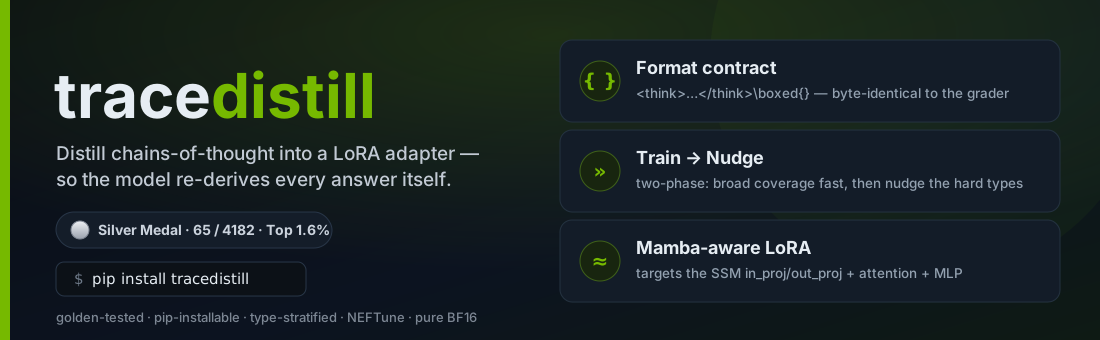





tracedistill
Distill teacher chains-of-thought into a LoRA adapter — so a model re-derives every answer itself, where no code may run.
tracedistill is the generalized core of team VCDAD's silver-medal solution to the
NVIDIA Nemotron Model Reasoning Challenge
(65 / 4182, Top 1.6%), extracted into a small, tested library you can run on your own
data. The medal-winning code is preserved verbatim in competition/ and
pinned to this library byte-for-byte by golden tests.
Give it (problem, teacher chain-of-thought, answer) triples and it trains a LoRA adapter
that reasons step-by-step and then emits a parseable \boxed{} — the recipe for tasks
where the grader can't run your code, so the solving procedure has to live inside the
model's own chain-of-thought.
Why not just SFTTrainer on your traces?
Four design choices, each implemented as a library piece:
- A strict format contract (
formatting.py). The SFT target is built byte-for-byte identical to the eval protocol —<think> … </think>\boxed{answer}— and the reasoning (from the teacher trace) is decoupled from the final answer (rewritten with the authoritative label). Train input ≈ eval input, so the model reliably boxes a correct answer instead of trailing off. - Two-phase
Train → Nudge(training.py). A hard, fast pass (high LR, clipping off) for broad coverage, then a tiny continuation (1/40 LR, cosine, clipping on) that squeezes the hard problem types while a balanced sprinkle of fresh easy data prevents catastrophic forgetting. - Type-stratified batching (
sampling.py). With a tiny effective batch, a naive shuffle can make a whole batch one problem type and swing the gradient. A round-robin "deal the cards" order keeps every effective batch type-balanced. - Architecture-aware LoRA (
lora.py). The competition base is a hybrid Mamba-2 + MoE model, so targets cover the SSMin_proj/out_projand attention and MLP — the detail a vanilla Llama recipe misses.
flowchart LR
D["CoT dataset<br/>prompt · cot · answer · type"] --> F["format contract<br/><think>…</think>\boxed{}"]
F --> S["two-phase split<br/>(hard in both)"]
S --> P1["Phase 1 · Train<br/>lr 2e-4 · clip off"]
P1 --> P2["Phase 2 · Nudge<br/>lr 5e-6 · cosine · clip on"]
P2 --> A["LoRA adapter"]
Install
pip install tracedistill            # light core: numpy / pandas / pyyaml
pip install "tracedistill[train]"   # + torch / transformers / trl / peft / datasets to train
The core (build_records, completion-only masking, stratified ordering, data splitting,
target selection, and config validation) is torch-free — it imports and unit-tests
without a GPU stack.
60 seconds
import tracedistill as td

# Your data: a DataFrame (or list of dicts) with prompt / generated_cot / answer / type.
records, types = td.build_records(df)      # the <think>…</think>\boxed{} format contract
order = td.build_stratified_index_order(types, batch_size=8, seed=42)  # type-balanced order
targets = td.target_modules_from_model(model)   # attention + Mamba SSM + MLP, auto-detected

# Hard rows intentionally appear in both phases; Phase 2's easy rows are a fresh reserve.
phase1_df, phase2_df = td.two_phase_split(df, hard_types=["cryptarithm_deduce"], seed=42)
Full two-phase training on an already-LoRA'd model:
from tracedistill import TwoPhaseConfig, PhaseConfig, train_two_phase

cfg = TwoPhaseConfig(hard_types=["cryptarithm_deduce", "cryptarithm_guess"],
                     phase1=PhaseConfig.train(), phase2=PhaseConfig.nudge())
train_two_phase(model, tokenizer, df, cfg)   # Phase 2 continues from Phase 1's weights
CLI
One YAML config drives an end-to-end run (load base model → architecture-aware LoRA →
Train → Nudge → save / package the adapter):
tracedistill --cfg examples/configs/quickstart.yaml             # small single-GPU
tracedistill --cfg examples/configs/reproduce_competition.yaml  # the medal setup (Kaggle)
tracedistill --cfg examples/configs/quickstart.yaml --dry-run   # validate data/split, no GPU
Measured: does distilling the trace actually help? (GSM8K, one RTX 4080)
examples/gsm8k_trace_distillation.py runs four
arms on a base (non-instruct) Qwen2.5-0.5B + LoRA through the public API and scores
boxed-answer accuracy on held-out GSM8K (greedy, parse \boxed{} exactly like a
grader). Every trained arm uses completion-only labels: the prompt is excluded from the
loss at the token boundary. The answer-only and one-phase trace arms use the same
initialization and optimizer settings; the reasoning trace between the <think> tags is
their only training-target difference.
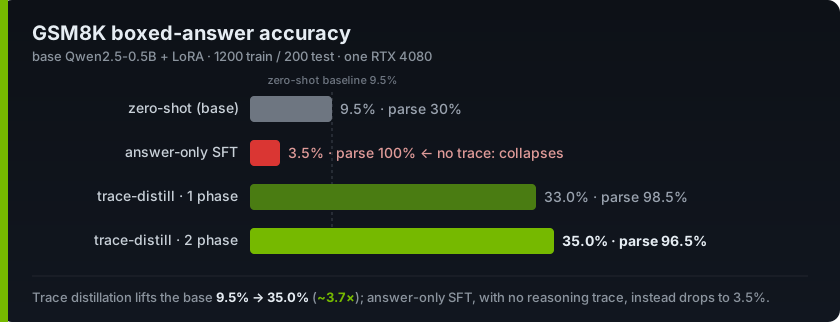
| arm | boxed accuracy | parse rate | hard-problem acc (≥5 steps) |
|---|---|---|---|
| zero-shot (base, no training) | 13.0% | 33.0% | 6.1% |
| answer-only SFT | 10.0% | 100.0% | 3.0% |
| trace-distill, 1 phase | 31.5% | 99.5% | 3.0% |
| trace-distill, 2 phase (Train→Nudge) | 33.0% | 99.0% | 12.1% |
The trace is the signal. With nearly identical parse rates, one-phase trace distillation beats answer-only SFT by 21.5 percentage points (31.5% vs 10.0%). The two-phase recipe reaches 33.0%, about 2.5× the 13.0% zero-shot accuracy.
Formatting and solving separate cleanly. Answer-only SFT reaches a 100% parse rate but
only 10.0% accuracy: learning to emit \boxed{} is not enough. Both trace arms retain
~99% parse rates while tripling the answer-only accuracy.
Nudge targets the tail. The hard-focused second phase moves overall accuracy from 31.5% to 33.0%, while ≥5-step accuracy rises from 3.0% to 12.1%. Because the two-phase arm also changes the data schedule, this is a recipe comparison rather than an isolated causal estimate of the Nudge step.
The complete run uses one seed and 200 held-out examples on a 0.5B model. Exact package versions, hardware, data fingerprints, commit, and per-bucket results are in the machine-readable result and reproducibility notes.
pip install "tracedistill[train]" datasets
python examples/gsm8k_trace_distillation.py        # ~45 min on one RTX 4080 (16 GB)
The competition result
On the hidden test set, the two-phase recipe on Nemotron-3-Nano-30B-A3B reached a
silver medal (65 / 4182, Top 1.6%). ~84% of the benchmark is "free" points that almost
everyone clears (gravity, unit conversion, Roman numerals, ciphers); the ranking is decided
by two hard families — cryptarithm and bit-manipulation — which is exactly what the
two-phase Nudge and the hard/easy split target. See docs/solution.md,
docs/dataset.md and docs/model-card.md for the
full methodology, and competition/ for the verbatim solution.
How it compares
naive formatting_func SFT |
tracedistill |
|
|---|---|---|
| Loss target | full rendered conversation | assistant completion only |
| Target format | freeform text | strict <think>…</think>\boxed{} contract |
| Answer source | as written in the trace | decoupled — official label re-boxed |
| Schedule | single pass | two-phase Train → Nudge |
| Batching | shuffle | type-stratified round-robin |
| LoRA targets | attention (+ MLP) | + Mamba-2 SSM in_proj/out_proj |
Provenance & validation
competition/— the original silver-medal solution, unmodified.tests/— golden tests:tests/reference_impl.pyholds verbatim copies of the competition'sbuild_records/build_stratified_index_order, and the suite assertstracedistillreproduces them byte-for-byte over hundreds of fuzzed cases. The 50+ light-core tests run in well under a second; the optional training layer has a separate compatibility job.
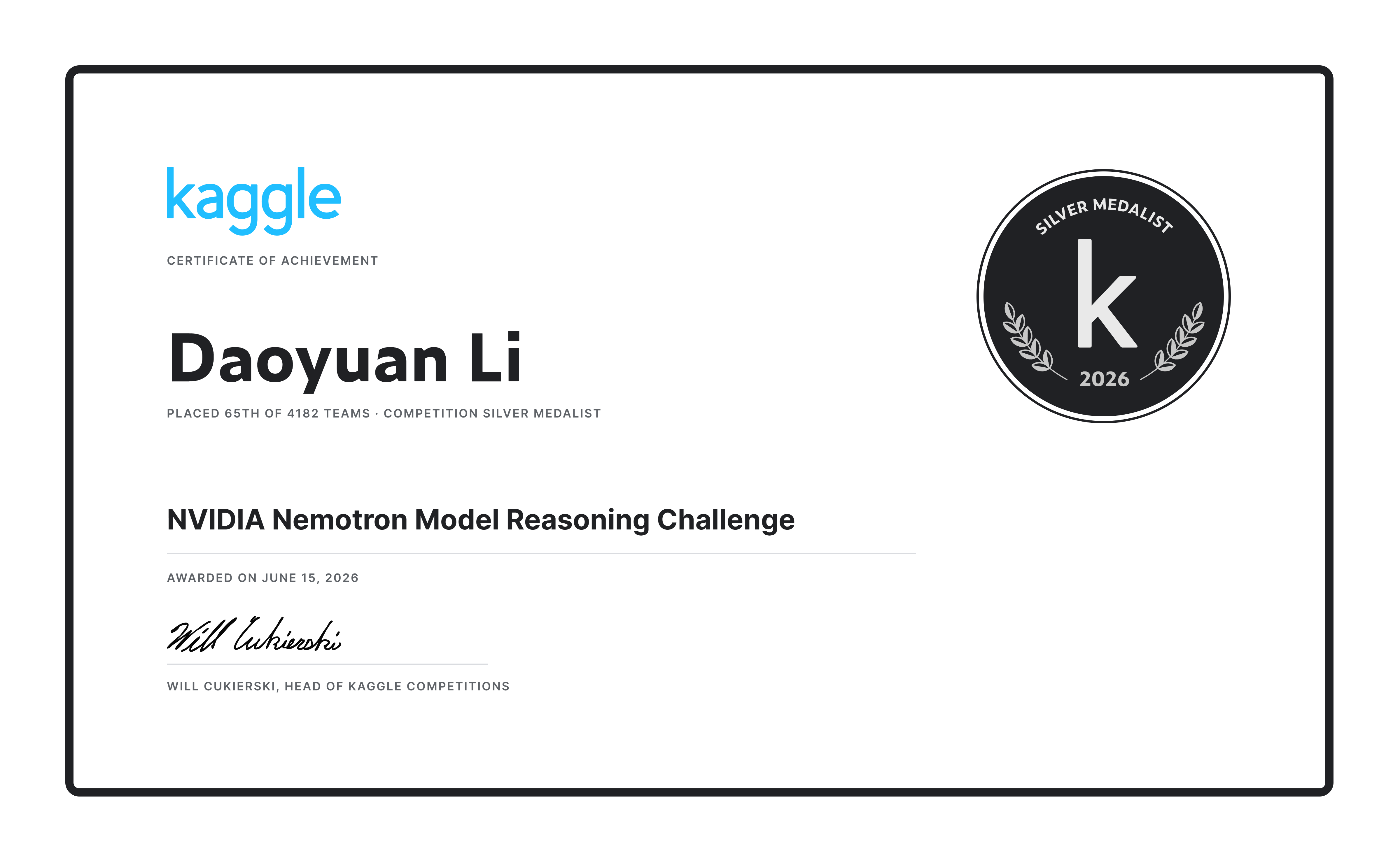
The official Kaggle Certificate of Achievement — Silver Medalist, 65th of 4182 teams:
Citation
@misc{li2026tracedistill,
  title  = {tracedistill: Two-Phase LoRA Trace-Distillation for Reasoning Models},
  author = {Li, Daoyuan},
  year   = {2026},
  note   = {Silver medal (65/4182), NVIDIA Nemotron Model Reasoning Challenge},
  url    = {https://github.com/DaoyuanLi2816/tracedistill}
}
License
MIT. The license covers the code and documentation in this repository; it does
not extend to the competition data or the base model, which remain under their
respective terms (see data/README.md).
1 maintainer

Download files
Download the file for your platform. If you're not sure which to choose, learn more about installing packages.
Source Distribution
Built Distribution
Filter files by name, interpreter, ABI, and platform.
If you're not sure about the file name format, learn more about wheel file names.
Copy a direct link to the current filters
File details
Details for the file tracedistill-0.2.0.tar.gz.
File metadata
- Download URL: tracedistill-0.2.0.tar.gz
- Upload date:
- Size: 33.2 kB
- Tags: Source
- Uploaded using Trusted Publishing? Yes
- Uploaded via:
twine/6.1.0 CPython/3.13.14
File hashes
| Algorithm | Hash digest | |
|---|---|---|
| SHA256 |
32e861f5326596303e23446ec341eb7de4174e0326428a58633e8ea9f60f1da5
|
|
| MD5 |
ef2808fb23c08f45982a152569695088
|
|
| BLAKE2b-256 |
24f0fc95996d5408d11acbbd12c9b509c5aadf8afda7124d1fb3afc2e0dd80a5
|
Provenance
The following attestation bundles were made for tracedistill-0.2.0.tar.gz:
Publisher:
release.yml on DaoyuanLi2816/tracedistill
-
Statement:
-
Statement type:
https://in-toto.io/Statement/v1 -
Predicate type:
https://docs.pypi.org/attestations/publish/v1 -
Subject name:
tracedistill-0.2.0.tar.gz -
Subject digest:
32e861f5326596303e23446ec341eb7de4174e0326428a58633e8ea9f60f1da5 - Sigstore transparency entry: 2256877540
- Sigstore integration time:
-
Permalink:
DaoyuanLi2816/tracedistill@03ca9f305f7aad78f5bde0aec53dd5373e101a76 -
Branch / Tag:
refs/tags/v0.2.0 - Owner: https://github.com/DaoyuanLi2816
-
Access:
public
-
Token Issuer:
https://token.actions.githubusercontent.com -
Runner Environment:
github-hosted -
Publication workflow:
release.yml@03ca9f305f7aad78f5bde0aec53dd5373e101a76 -
Trigger Event:
release
-
Statement type:
File details
Details for the file tracedistill-0.2.0-py3-none-any.whl.
File metadata
- Download URL: tracedistill-0.2.0-py3-none-any.whl
- Upload date:
- Size: 26.5 kB
- Tags: Python 3
- Uploaded using Trusted Publishing? Yes
- Uploaded via:
twine/6.1.0 CPython/3.13.14
File hashes
| Algorithm | Hash digest | |
|---|---|---|
| SHA256 |
4e4dd5904815a2caea089fd672edb04404ce5cefb70d9710e6591f8fb450d675
|
|
| MD5 |
49112714a98e3a1d1d3fa0bf95121b12
|
|
| BLAKE2b-256 |
61d63162b1f1eebd4244c41e1e44323c91a9f702ff8bf18cdd9e6daae1380345
|
Provenance
The following attestation bundles were made for tracedistill-0.2.0-py3-none-any.whl:
Publisher:
release.yml on DaoyuanLi2816/tracedistill
-
Statement:
-
Statement type:
https://in-toto.io/Statement/v1 -
Predicate type:
https://docs.pypi.org/attestations/publish/v1 -
Subject name:
tracedistill-0.2.0-py3-none-any.whl -
Subject digest:
4e4dd5904815a2caea089fd672edb04404ce5cefb70d9710e6591f8fb450d675 - Sigstore transparency entry: 2256877550
- Sigstore integration time:
-
Permalink:
DaoyuanLi2816/tracedistill@03ca9f305f7aad78f5bde0aec53dd5373e101a76 -
Branch / Tag:
refs/tags/v0.2.0 - Owner: https://github.com/DaoyuanLi2816
-
Access:
public
-
Token Issuer:
https://token.actions.githubusercontent.com -
Runner Environment:
github-hosted -
Publication workflow:
release.yml@03ca9f305f7aad78f5bde0aec53dd5373e101a76 -
Trigger Event:
release
-
Statement type:







