





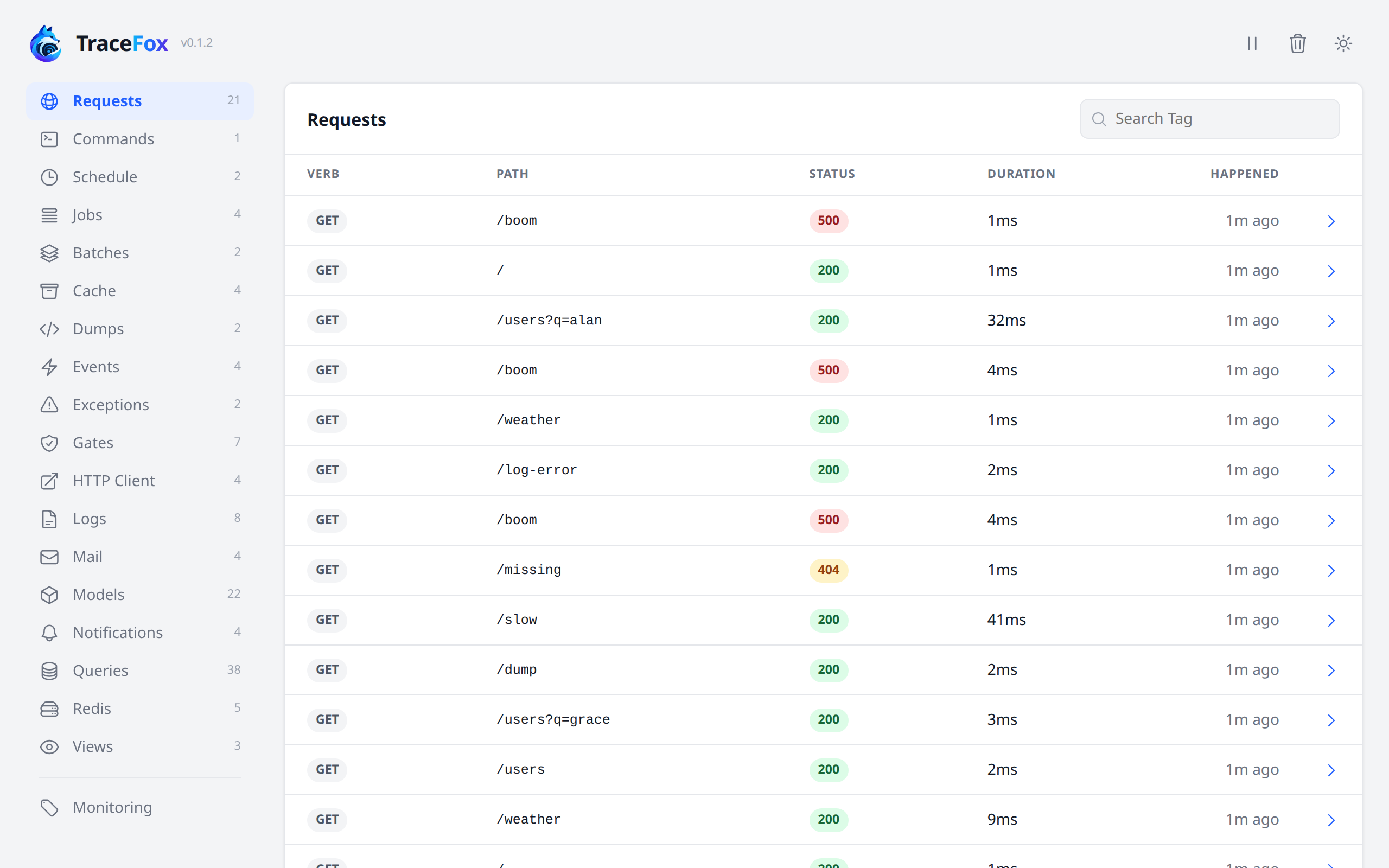
An elegant debug assistant for Python web apps, modelled on Laravel Telescope. It records the requests coming into your app, plus the exceptions, logs, database queries, ORM model changes, queued jobs, mail, notifications, cache operations, Redis commands, scheduled tasks, outgoing HTTP calls, template renders and variable dumps behind them. All of it appears in a Telescope-style dashboard.
pip install tracefox
It works with FastAPI / Starlette, Flask and Django, plus any other ASGI or WSGI framework.
┌─────────────┐  hooks   ┌──────────┐  batch   ┌────────┐  thread  ┌──────────────┐
│ your app    │ ───────► │ watchers │ ───────► │ core   │ ───────► │ SQL storage  │ ◄── dashboard (SPA)
│ (any fw)    │          │ (18)     │          │ filter │          │ (SQLAlchemy) │
└─────────────┘          └──────────┘          └────────┘          └──────────────┘
Screenshots
 |
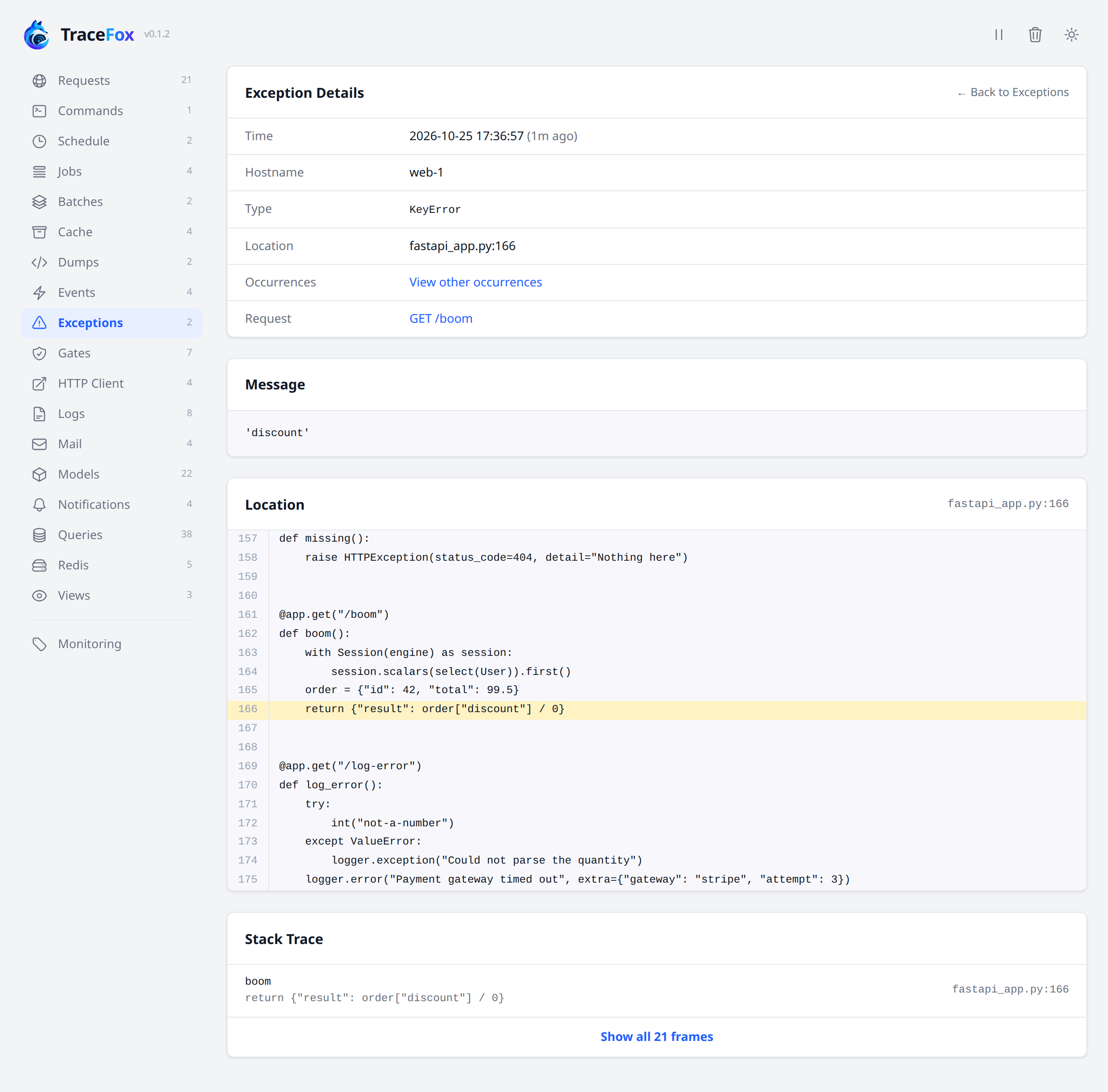 |
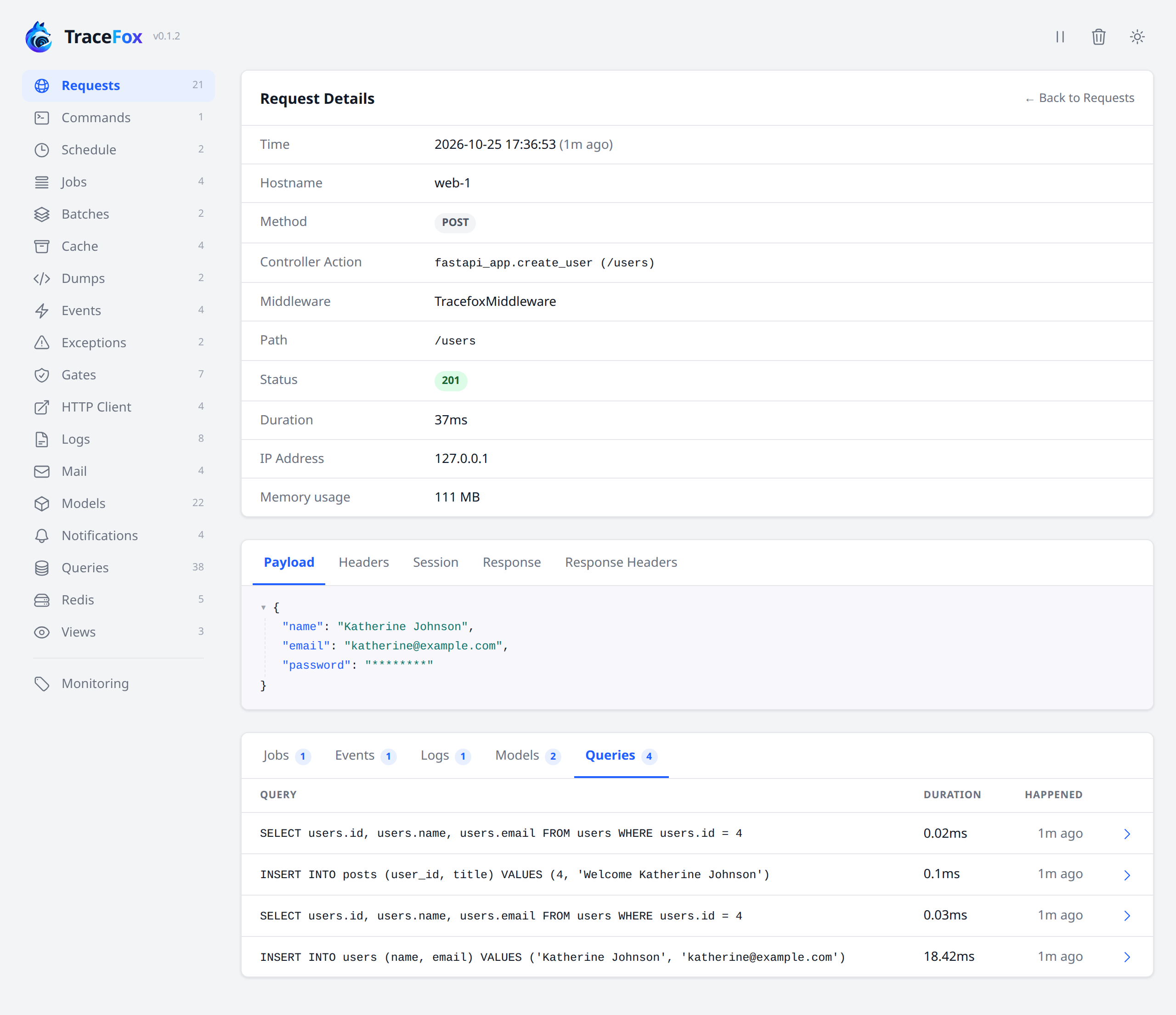
| Request detail: payload (password masked), headers, response, and every query, log, job and model change from that request | Exceptions: grouped occurrences, the failing line in context, and the stack trace |
 |
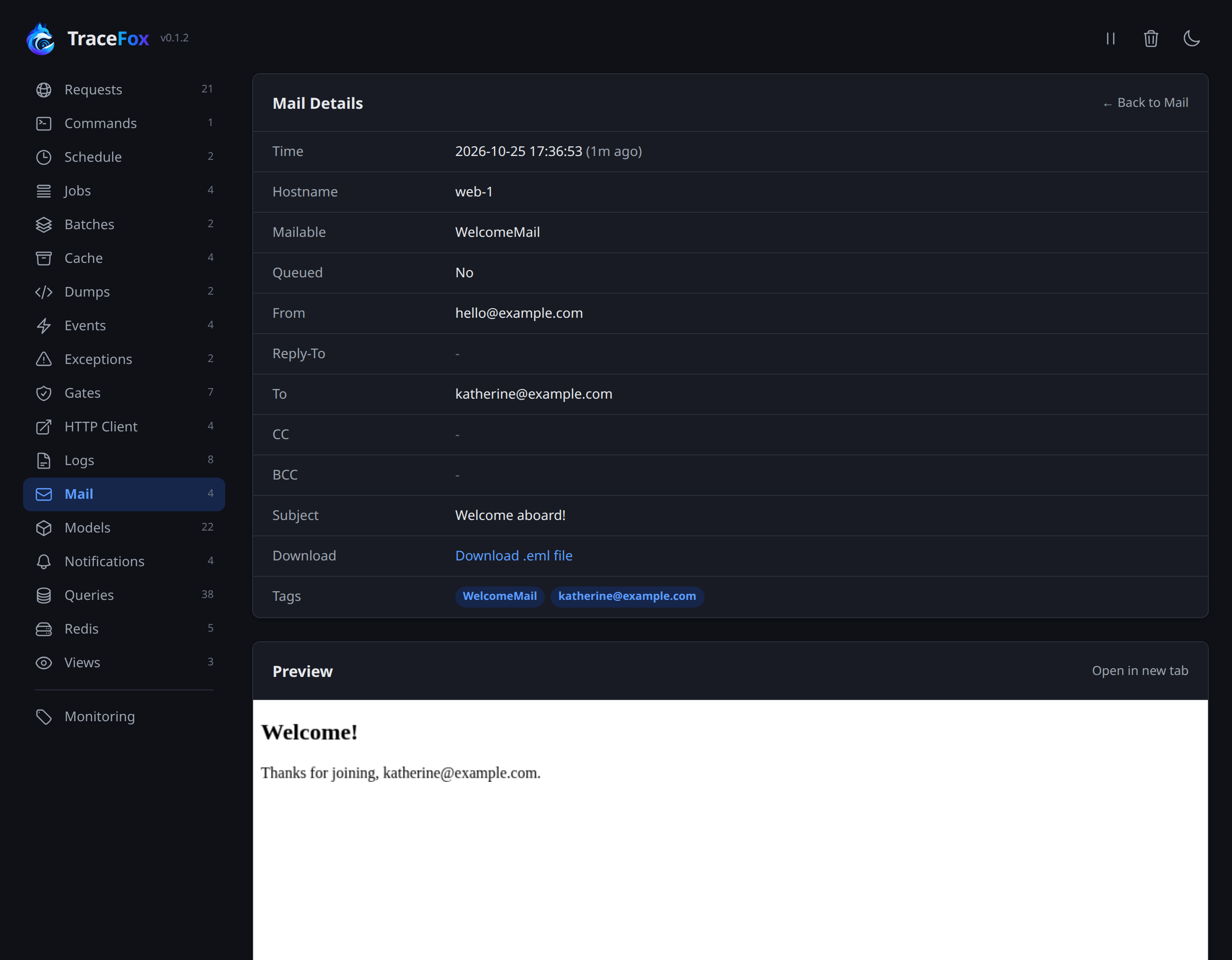 |
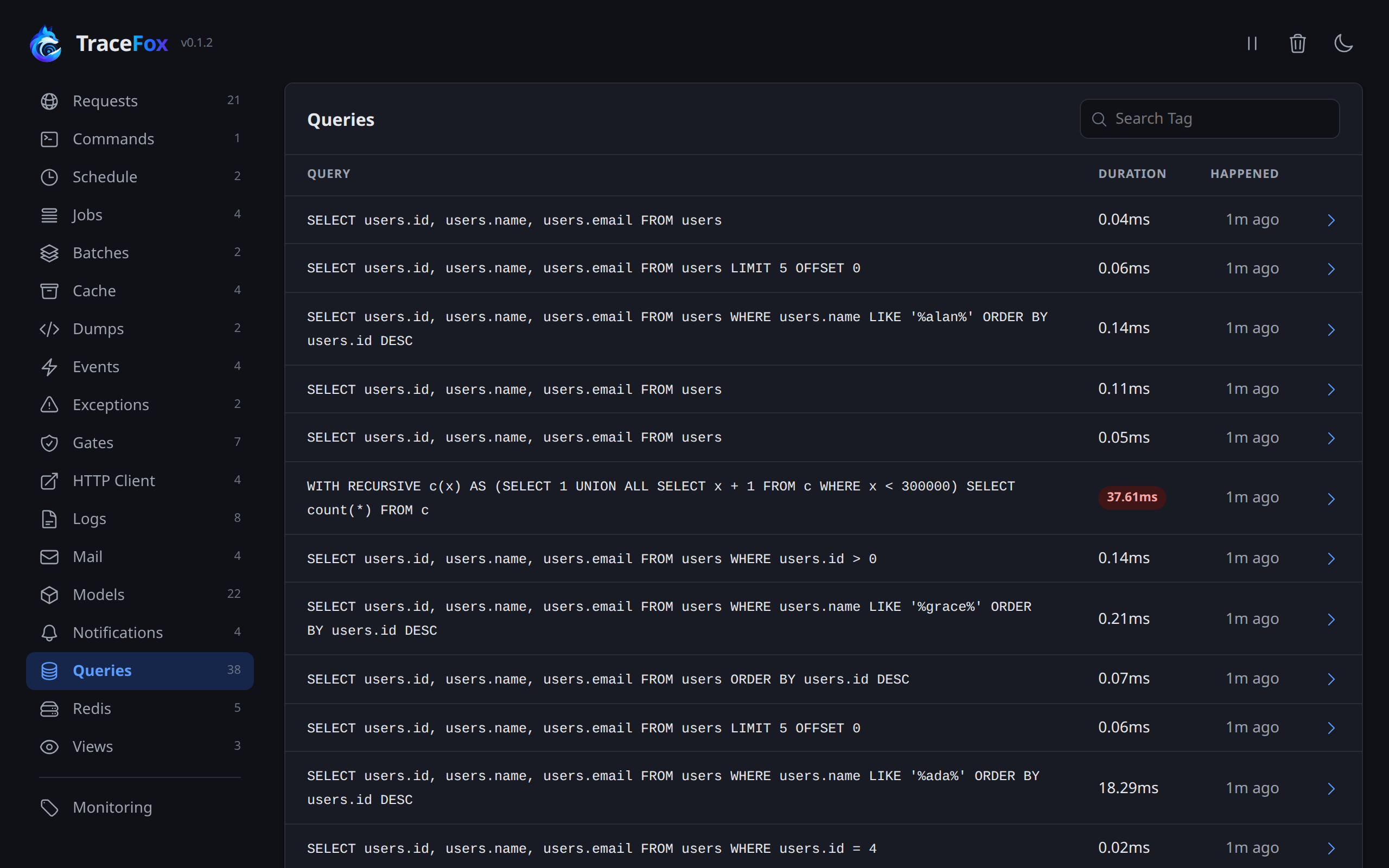
| Queries: SQL with bindings filled in, slow queries flagged (dark mode) | Mail: recipients, subject, HTML preview and .eml download (dark mode) |
Features
Everything that Laravel Telescope does, mapped to the Python ecosystem:
| Telescope screen | What tracefox records | Hooks |
|---|---|---|
| Requests | method, path, controller action, middleware, headers, payload, session, response, status, duration, memory, authenticated user | ASGI middleware, WSGI middleware, Django middleware |
| Commands | command, arguments, options, exit code (plus every entry recorded while it ran) | Click / Typer / Flask CLI, Django management commands, tracefox.command() |
| Schedule | command, expression, description, timezone, output | APScheduler 3.x, Celery beat |
| Jobs | name, queue, connection, tries, timeout, data, status pending → processed / failed, exception |
Celery (dispatch + worker), FastAPI/Starlette BackgroundTasks, @tracefox.job |
| Batches | total / pending / processed / failed jobs, progress | Celery group / chord |
| Cache | hit / missed / set / forget, key, value, expiration | Django cache framework, Flask-Caching, tracefox.record_cache() |
| Dumps | dumped values with file:line | tracefox.dump(value) |
| Events | name, payload, listeners | Django signals, blinker (Flask) signals, tracefox.record_event() |
| Exceptions | class, message, location with code preview, stack trace, context, occurrences grouped by family | unhandled request errors, logger.exception(), sys.excepthook, thread excepthook |
| Gates | ability, allowed / denied, arguments, location | Django has_perm, @tracefox.gate(), tracefox.record_gate() |
| HTTP Client | method, URI, headers, payload, status, response, duration | httpx (sync + async), requests, aiohttp |
| Logs | level, message, channel (logger), context (extra=), location |
stdlib logging |
mailable, from, to, cc, bcc, reply-to, subject, HTML preview, .eml download |
Django mail backends, smtplib (Flask-Mail), aiosmtplib (fastapi-mail), tracefox.record_mail() |
|
| Models | created / updated (with changed attributes) / deleted, plus hydration counts per request | SQLAlchemy ORM, Django ORM |
| Notifications | notification, notifiable, channel, response | tracefox.record_notification() |
| Queries | SQL with bindings interpolated, bindings, duration, slow tag, file:line of your code |
SQLAlchemy (every engine), Django ORM |
| Redis | command, connection, duration (pipelines too) | redis-py (sync + asyncio) |
| Views | template name, path, data keys | Jinja2 (Flask, Starlette templates), Django templates |
Plus the rest of Telescope's machinery:
- Batches of related entries. Everything recorded during one request, job or command shares a
batch_id. The detail page shows it all in tabs: a request's queries, logs, exceptions, jobs, mail and so on. - Tags. Tags are added automatically:
Auth:<id>, model keys likeapp.models.User:1,slow,failedand mail recipients. You can add your own withtracefox.tag(...)and search by tag on every screen. - Monitoring. Entries with a monitored tag are always recorded, even when filters would drop them.
- Exception families. Repeats of the same exception collapse into one row with an occurrence count and an "other occurrences" view.
- Filtering. Local, dev, test, UAT and staging environments record everything. In production (and any environment not on that list), a default filter keeps only failed requests, exceptions, failed jobs, scheduled tasks, slow queries and monitored tags. You can add
tracefox.filter(...)/tracefox.filter_batch(...). - Privacy. Sensitive request headers and parameters are masked as
********.password,authorizationandcookieare masked by default, and the lists are configurable. - Pause / resume recording, clear all entries, light / dark / system theme, live "Load New Entries", pruning.
- Safe by default. The dashboard is open only in
local; everywhere else it needs a login (see Dashboard access). Every write needs a custom header, which blocks CSRF. Watchers never raise into your app. - Low overhead. Entries are buffered per batch and written on a background thread. Libraries are hooked only if your app imports them, through import hooks.
Install
pip install tracefox            # core (SQLAlchemy is the only dependency)
pip install "tracefox[fastapi]" # or [flask] / [django]
Like Laravel Telescope, TraceFox keeps its entries in your application's own database. Its migrations add four tables: tracefox_entries, tracefox_entries_tags, tracefox_monitoring and tracefox_settings. See Database & migrations.
Quick start
FastAPI / Starlette
from fastapi import FastAPI
from sqlalchemy import create_engine
from tracefox.integrations.fastapi import init_tracefox

engine = create_engine(DATABASE_URL)   # your app's engine (an AsyncEngine works too)

app = FastAPI(debug=True)
init_tracefox(app, engine=engine)      # middleware + dashboard at /tracefox, entries in your database
Flask
from flask import Flask
from flask_sqlalchemy import SQLAlchemy
from tracefox.integrations.flask import FlaskTracefox

app = Flask(__name__)
app.config["SQLALCHEMY_DATABASE_URI"] = "postgresql://..."
db = SQLAlchemy(app)
FlaskTracefox(app)            # uses Flask-SQLAlchemy's database; dashboard + `flask tracefox prune|clear|pause|resume`
Django
# settings.py
INSTALLED_APPS += ["tracefox.integrations.django"]
MIDDLEWARE.insert(0, "tracefox.integrations.django.middleware.TracefoxMiddleware")
TRACEFOX = {
    "authorization": lambda request: request.user.is_staff,   # who may open the dashboard outside DEBUG
}

# urls.py
urlpatterns += [path("tracefox/", include("tracefox.integrations.django.urls"))]
python manage.py migrate # creates the tracefox tables in your default database
Management commands: tracefox_prune [--hours 48] [--keep-exceptions], tracefox_clear, tracefox_pause, tracefox_resume.
Any other ASGI / WSGI framework
from tracefox import tracefox
from tracefox.integrations import TracefoxMiddleware, TracefoxWSGIMiddleware
from tracefox.dashboard import TracefoxASGI, TracefoxWSGI

tracefox.start(environment="local")
asgi_app = TracefoxMiddleware(asgi_app)                 # record requests
# mount TracefoxASGI() (or TracefoxWSGI()) at /tracefox with your router
Open http://localhost:8000/tracefox.
Database & migrations
TraceFox works the way Laravel Telescope does: it stores entries next to your data, in your application's database, and creates its tables with migrations.
| Stack | Where entries go | How the tables are created |
|---|---|---|
| Django | the default database (or TRACEFOX = {"connection": "analytics"}) |
shipped migrations: python manage.py migrate |
| Flask + Flask-SQLAlchemy | Flask-SQLAlchemy's engine, detected automatically (SQLALCHEMY_DATABASE_URI also works) |
Flask-Migrate: tracefox install → flask db upgrade, or created on first use |
| FastAPI / Starlette / SQLAlchemy | the engine you pass: init_tracefox(app, engine=engine) |
Alembic: tracefox install → alembic upgrade head, or created on first use |
| No app database | database_url, defaulting to a local tracefox.sqlite3 |
created on first use |
Alembic / Flask-Migrate. This is the counterpart of php artisan telescope:install:
tracefox install            # writes migrations/versions/<rev>_create_tracefox_tables.py on top of your current head
alembic upgrade head        # or: flask db upgrade
Then keep --autogenerate from proposing to drop the tables. In env.py:
from tracefox.integrations.alembic import include_object

context.configure(connection=connection, target_metadata=target_metadata, include_object=include_object)
If migrations own your schema, pass auto_migrate=False so TraceFox never creates tables by itself. The migration is safe to run either way: it skips tables that already exist.
Async apps. If you pass an AsyncEngine (asyncpg, aiomysql, aiosqlite…), TraceFox writes to the same database through the matching blocking driver (psycopg / psycopg2, PyMySQL, sqlite3), because its writer runs on a background thread. Install that driver alongside your async one.
Own queries are invisible. TraceFox suspends recording while it reads or writes its tables, so they never show up on the Queries or Models screens.
Dashboard access
The environment name decides who can open the dashboard. TraceFox reads it from TRACEFOX_ENV, then APP_ENV, ENVIRONMENT and ENV; if none is set, it uses local when your framework runs in debug mode and production otherwise.
| Environment | Login needed? | What is recorded |
|---|---|---|
local |
no | everything |
dev, development, test, qa, uat, stage, staging |
yes | everything |
production and anything else |
yes | exceptions, failed requests and jobs, slow queries, scheduled tasks, monitored tags |
Outside local, the dashboard stays locked (403) until you choose how people log in.
1. Username and password (works with every framework). Set two environment variables on the server:
TRACEFOX_ENV=staging
TRACEFOX_USERNAME=admin
TRACEFOX_PASSWORD='a-long-random-password'
The browser shows a login prompt (HTTP Basic auth) when you open /tracefox. You can also set it in code, for one or several people:
init_tracefox(app, basic_auth=("admin", os.environ["TRACEFOX_PASSWORD"]))
init_tracefox(app, basic_auth={"ada": "…", "grace": "…"})
Serve the dashboard over HTTPS so the password isn't sent in clear text. Behind Apache mod_wsgi, enable WSGIPassAuthorization On so the login header reaches the app.
2. Your app's own login (like Laravel's viewTelescope gate). Pass a callback; it receives your framework's request and returns True for people allowed in:
# Django: staff users who are logged in to your site
TRACEFOX = {"authorization": lambda request: request.user.is_authenticated and request.user.is_staff}

# Flask (Flask-Login)
FlaskTracefox(app, authorization=lambda request: current_user.is_authenticated and current_user.is_admin)

# FastAPI / Starlette: anything you can check on the request, e.g. a session cookie or an internal network
init_tracefox(app, authorization=lambda request: request.session.get("role") == "admin")
If you set both, a viewer needs the username and password and must pass the callback.
To change which environments are open or record everything, use open_environments and record_all_environments. For example, open_environments=["local", "dev"] drops the login on a private dev box.
Configuration
Options are passed as keyword arguments to init_tracefox(app, ...) / FlaskTracefox(app, ...) / tracefox.start(...), through Flask's app.config["TRACEFOX"], or through Django's TRACEFOX = {...}.
| Option | Default | |
|---|---|---|
enabled |
$TRACEFOX_ENABLED or True |
master switch |
environment |
$TRACEFOX_ENV / $APP_ENV / $ENVIRONMENT / $ENV; otherwise local when the framework is in debug mode, else production |
decides dashboard access and what gets recorded |
open_environments |
["local"] |
environments where the dashboard needs no login |
record_all_environments |
local, dev, development, test, testing, qa, uat, stage, staging |
environments that record every entry; others use the default filter |
basic_auth |
$TRACEFOX_USERNAME + $TRACEFOX_PASSWORD |
built-in login: ("user", "password"), {"user": "password", ...} or "user:password" |
path |
/tracefox |
dashboard URL |
engine |
Flask-SQLAlchemy's engine when present | your app's SQLAlchemy Engine / AsyncEngine, or a callable returning one |
connection (Django) |
"default" |
which DATABASES alias holds the tracefox tables |
database_url |
$TRACEFOX_DATABASE_URL, else sqlite:///tracefox.sqlite3 when no app database is given |
a separate SQLAlchemy URL, if you'd rather not share the app database |
auto_migrate |
True |
create missing tracefox tables on first use (SQLAlchemy only; Django uses migrate) |
authorization |
None |
callable(request) -> bool; receives the framework's request object (combined with basic_auth when both are set) |
watchers |
all enabled | e.g. {"queries": {"slow": 50}, "redis": False, "logs": {"level": "WARNING"}} |
ignore_paths / only_paths |
static assets ignored | glob patterns for request recording |
hidden_request_headers / hidden_request_parameters / hidden_response_parameters |
auth headers, cookies, passwords, tokens | masked as ******** |
user_resolver |
framework default | callable(request) -> {"id", "name", "email"} |
default_filter |
True |
apply the production filter outside record_all_environments |
async_writes |
True |
write on a background thread (set False in tests) |
auto_prune_hours |
None |
prune automatically every hour, keeping N hours |
Watcher options:
| Watcher | Options |
|---|---|
requests |
size_limit (KB, default 64), ignore_http_methods, ignore_status_codes |
queries |
slow (ms, default 100), ignore_patterns (regex) |
logs |
level (default DEBUG), ignore_loggers |
exceptions |
ignore (class names) |
commands |
ignore (runserver, shell, migrate, … by default) |
events |
ignore, include_framework (framework signals are skipped by default) |
models |
events (created, updated, deleted), hydrations |
cache |
hidden (key globs whose values are masked) |
gates |
ignore_abilities |
http_client |
size_limit |
Customising
from tracefox import tracefox, dump

# Tag entries
@tracefox.tag
def tags(entry):
    return ["vip"] if entry.is_request() and entry.content.get("user", {}).get("id") == 1 else []

# Only keep what matters (monitored tags always pass)
tracefox.filter(lambda entry: entry.is_exception() or entry.is_failed_request() or entry.is_slow_query())

# Keep or drop a whole request/job/command batch
tracefox.filter_batch(lambda entries: any(e.is_exception() for e in entries))

tracefox.hide_request_parameters("ssn", "card_number")
tracefox.hide_request_headers("x-internal-token")
Manual instrumentation
Some Laravel concepts have no single standard in Python, so each one also has a small API:
dump(user, order)                                         # Dumps screen; returns its argument
tracefox.record_event("order.shipped", {"id": 7}, listeners=["NotifyCustomer"])
tracefox.record_notification("InvoicePaid", user, "slack", response={"ok": True})
tracefox.record_mail(mailable="WelcomeMail", to=["a@b.c"], subject="Hi", html="<h1>Hi</h1>")
tracefox.record_cache("hit", "user:1", value)
tracefox.record_gate("edit-post", allowed, [post])

@tracefox.gate("publish-post")           # records the boolean result
def can_publish(user, post): ...

@tracefox.job(queue="emails")            # records a processed / failed job and batches its entries
def send_digest(user_id): ...

with tracefox.command("import:users", {"file": path}):   # records a custom command
    ...

with tracefox.batch():                   # group entries recorded outside a request
    ...

with tracefox.without_recording():       # skip recording for a block
    ...
Maintenance
tracefox prune --hours 48 --keep-exceptions
tracefox clear
tracefox pause | resume
tracefox --database-url postgresql://... migrate
tracefox install                                   # add the Alembic / Flask-Migrate migration
Django has the same commands under manage.py: tracefox_prune, tracefox_clear, tracefox_pause, tracefox_resume. Run prune on a schedule, as Laravel's docs recommend, or set auto_prune_hours.
How it works
- Watchers hook libraries only when your app imports them. A
sys.meta_pathhook runs the callback after import, so tracefox never pulls in Celery or Django by itself. Every patch is reversible withtracefox.stop(). - Batches live in a
ContextVar, so they followasynccode, threadpools,asgirefand Celery tasks correctly. Entries are buffered and written when the request, job or command finishes. - Storage mirrors Laravel Telescope's schema:
tracefox_entries,tracefox_entries_tags,tracefox_monitoring, plustracefox_settings. Repeated exceptions are folded into families when they are written. - Out-of-order updates. A job can finish (in a worker, or a background task) before the request that dispatched it is written. That update is applied in memory if the entry is still buffered; otherwise the writer retries it for two minutes.
- The dashboard is a dependency-free single-page app served by a framework-agnostic handler, with thin ASGI, WSGI and Django adapters.
Development
uv venv && uv pip install -e ".[dev]"
pytest
TRACEFOX_ENV=local uvicorn examples.fastapi_app:app --reload   # demo that exercises every watcher
Releasing
Releases go to PyPI from GitHub Actions through Trusted Publishing, so no API token is stored.
main is protected: changes land through pull requests, and all six CI jobs (Python 3.9–3.14) must pass before merging. Direct pushes, force-pushes and deleting main are blocked for everyone. Release tags (v*) are locked once pushed, so they can't be moved or deleted.
- Open a pull request that bumps
versioninpyproject.tomland__version__insrc/tracefox/__init__.py, and merge it once CI passes. - Tag the merged commit and push the tag:
git checkout main && git pull && git tag v0.1.3 && git push origin v0.1.3. - The Publish to PyPI workflow checks the tag matches the version, then tests, builds and uploads the release.
A tag can't be moved after it's pushed. If a release goes wrong, fix it on main and release the next version.
License
MIT — see LICENSE.
1 maintainer

Metadata
1 maintainer
Release files for tracefox 0.1.3
For a detailed explanation of source distributions (sdists) and built distributions (wheels), please see the package formats documentation.
Source distribution (sdist)
| File | Size | Uploaded | Provenance | Actions |
|---|---|---|---|---|
| tracefox-0.1.3.tar.gz | 125.8 kB | With provenance | Details for tracefox-0.1.3.tar.gz |
Built distribution (wheel)
| File | Interpreter | ABI | Platform | Actions Reset |
|---|---|---|---|---|
| tracefox-0.1.3-py3-none-any.whl | Python 3 | none | any | Details for tracefox-0.1.3-py3-none-any.whl |
Total release size: 263.4 kB
Release files / tracefox-0.1.3.tar.gz
| Download URL | tracefox-0.1.3.tar.gz |
|---|---|
| Size | 125.8 kB |
| Tags | Source |
|
SHA-256 checksum How to use checksums |
12e2fd9937659962a044d897bcfa2835d262819dde96cf6a113c78a5dae348cc
|
|
BLAKE2b-256 checksum How to use checksums |
23bd8a582ea3fda74df9697bf7b5175a0d3b955a7c33a063e3af8d134eb76ce6
|
| Upload date | |
|
Uploaded using Trusted Publishing? What is trusted publishing? |
Yes |
| Uploaded via |
twine/7.0.0 CPython/3.13.16
|
Provenance
Provenance describes where a file came from. On PyPI, provenance is shared via attestations, which provide a verifiable record of the build or publishing details. View details, limitations and caveats.


PyPI Publish Attestation
PyPI verified that this artifact, at this checksum, originated from the publisher listed below.
Signed by GitHub Actions, verified by PyPI on Oct 26, 2026.
Transparency logRelease files / tracefox-0.1.3-py3-none-any.whl
| Download URL | tracefox-0.1.3-py3-none-any.whl |
|---|---|
| Size | 137.6 kB |
| Tags | Python 3 |
|
SHA-256 checksum How to use checksums |
31d9e8400a36229982ab016c934575a48cb2c12985ecab81765da34c5288d5b7
|
|
BLAKE2b-256 checksum How to use checksums |
e8ccd9cfddbc2d44ccc6f33b594cead9dc13ff436f504a3c1dc3e4570778d0c0
|
| Upload date | |
|
Uploaded using Trusted Publishing? What is trusted publishing? |
Yes |
| Uploaded via |
twine/7.0.0 CPython/3.13.16
|
Provenance
Provenance describes where a file came from. On PyPI, provenance is shared via attestations, which provide a verifiable record of the build or publishing details. View details, limitations and caveats.
PyPI Publish Attestation
PyPI verified that this artifact, at this checksum, originated from the publisher listed below.
Signed by GitHub Actions, verified by PyPI on Oct 26, 2026.
Transparency logSecurity for tracefox 0.1.3
Provenance
Provenance describes where a file came from. On PyPI, provenance is shared via attestations, which provide a verifiable record of the build or publishing details. View details, limitations and caveats.
Full provenance
All 2 files in this release have been uploaded with provenance metadata.
Attestation for tracefox-0.1.3.tar.gz
PyPI Publish Attestation
PyPI verified that this artifact, at this checksum, originated from the publisher listed below.
Signed by GitHub Actions, verified by PyPI on Oct 26, 2026.
Transparency logA note on package security
PyPI is a repository for distributing packages, not a service for auditing them. While third-party security researchers and our staff do their best to detect and remove malicious packages, PyPI cannot guarantee the quality, security or suitability of any given package.
To learn more about protecting yourself from malicious actors, visit our package security documentation.














