
TraceMap PR
Deterministic pull request impact reports for backend teams.





TraceMap PR reads the evidence a service already produces: git diff, OpenAPI, coverage,
per-test coverage, traces, and a small Python static scan. It turns that into a conservative
review comment showing which endpoints, background jobs, database tables, external services,
and tests may be touched by a change.
It does not call LLMs, embedding APIs, or external AI services. Every item in the report is tied to concrete evidence and a confidence score. When TraceMap does not know enough, it says so.
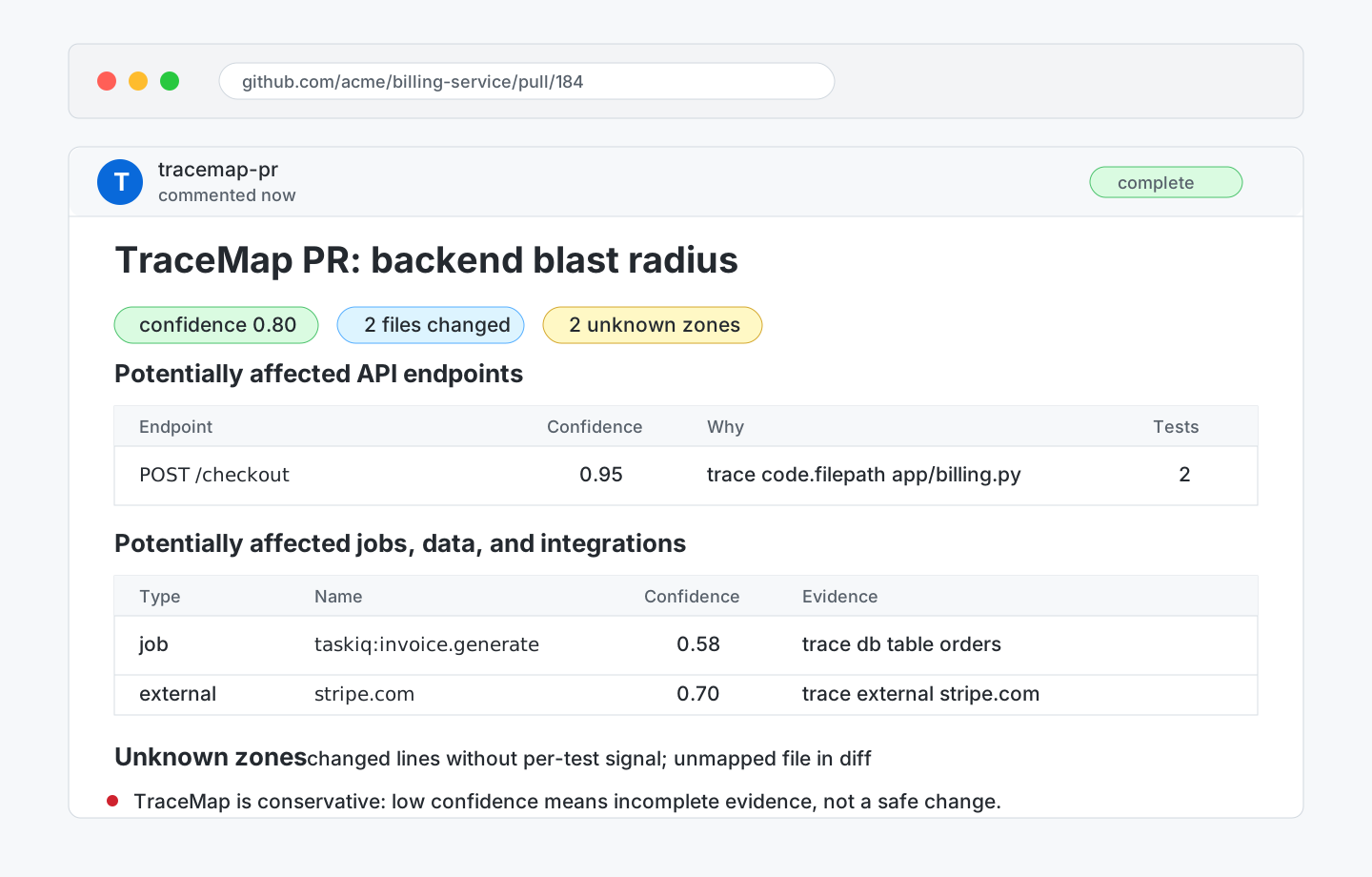
The screenshot above is based on the checked-in FastAPI demo fixture. It shows the main product surface: a pull request comment that reviewers can read without opening another tool.
Why It Exists
Backend pull requests often look smaller than they are. A two-file diff can move an API path, a queue task, a billing table, and a third-party call. Reviewers usually rebuild that map in their heads from code search, test names, traces, and memory.
TraceMap PR makes that map explicit. It is not proof that a change is safe. It is a fast, repeatable way to see the likely blast radius and the places where the available evidence is thin.
What You Get
- A Markdown report that can be posted as a GitHub PR comment.
- A JSON report for bots, dashboards, and follow-up automation.
- A local CLI that works without a server, database, account, or network call.
- A GitHub composite action for pull request workflows.
- A FastAPI server mode for artifact history, project-scoped tokens, and async report generation.
- A pytest plugin that writes per-test coverage in TraceMap's expected format.
Quickstart
Install the CLI and create a config in your backend repository:
uv tool install tracemap-pr
tracemap init --auto
tracemap doctor
tracemap impact --base origin/main --head HEAD --out tracemap-report.md || test "$?" = "1"
To try the checked-in demo from source:
uv sync --extra dev
uv run tracemap impact \
  --repo-root tests/fixtures/fastapi_demo \
  --config tests/fixtures/fastapi_demo/tracemap.yml \
  --diff-file tests/fixtures/repo_diff/diff_billing.patch \
  --out /tmp/tracemap-report.md || test "$?" = "1"
sed -n '1,120p' /tmp/tracemap-report.md
The impact command exits with code 1 after writing a report if it found visible unknown zones.
That is useful in CI, but surprising the first time you run it locally.
For better test signal, run pytest with coverage contexts and the TraceMap plugin:
uv add --dev tracemap-pr
uv run pytest --cov --cov-context=test \
  --tracemap-coverage-out .tracemap/per_test_coverage.json
Signals TraceMap Understands
TraceMap gets better as you give it more artifacts, but it is useful before everything is wired up.
| Signal | Supported inputs | What it helps answer |
|---|---|---|
| Diff | git diff or a unified patch file |
Which files and lines changed? |
| OpenAPI | JSON or YAML specs | Which HTTP operations may be involved? |
| Coverage | Cobertura XML, coverage.py JSON |
Are changed lines covered at all? |
| Per-test coverage | TraceMap pytest plugin JSON | Which tests touch the changed code? |
| Traces | normalized NDJSON, limited OTLP HTTP JSON | Which DB tables, queues, and external services appear near the code path? |
| Static scan | FastAPI routes, Taskiq tasks, SQLAlchemy declarative models | What can be mapped without runtime artifacts? |
Unsupported stacks still run in poor mode. The report will be less rich, and the missing pieces show up as warnings or unknown zones instead of being hidden.
GitHub Actions
Use pull_request, not pull_request_target. The action reads code and artifacts from the PR
checkout, so it should run with the normal pull request security model.
on:
  pull_request:

jobs:
  tracemap:
    runs-on: ubuntu-latest
    permissions:
      contents: read
      pull-requests: write
    steps:
      - uses: actions/checkout@v4
        with:
          fetch-depth: 0

      - uses: balyakin/tracemap-pr@v0.1.0
        with:
          github-token: ${{ secrets.GITHUB_TOKEN }}
Pin the action to a full commit SHA when your supply-chain policy requires immutable references.
Local CLI
Common commands:
tracemap init --auto
tracemap doctor
tracemap scan --base origin/main --head HEAD
tracemap impact --base origin/main --head HEAD --format markdown --out tracemap-report.md
tracemap impact --base origin/main --head HEAD --format json --out tracemap-report.json
Exit codes:
| Code | Meaning |
|---|---|
0 |
Report built and no visible unknown zones crossed the configured threshold. |
1 |
Report built, but visible unknown zones were found. |
2 |
Configuration, parsing, storage, graph, or report build error. |
3 |
Git diff command or diff parsing error. |
Server Mode
The CLI is the primary path. Server mode is for teams that want history, uploaded artifacts, project-scoped API tokens, and async report generation.
docker compose up --build
The API listens on http://localhost:8080. The included dashboard is server-rendered HTML on purpose; there is no SPA build step in the MVP.
Production server mode should use PostgreSQL, Redis for async work, a non-empty bootstrap token hash, and private artifact storage. See docs/SECURITY.md before exposing it outside localhost.
Configuration
tracemap init --auto writes tracemap.yml. A fuller example is available in
tracemap.example.yml.
The most important sections are:
scan: source globs for Python static analysis.openapi: OpenAPI JSON/YAML files.coverage: Cobertura, coverage.py JSON, and per-test coverage files.traces: normalized TraceMap traces and the supported OTLP JSON subset.privacy: header, query string, and attribute scrubbing.impactandscoring: traversal limits, unknown-zone threshold, and confidence weights.
Design Principles
- Deterministic first. The same inputs should produce the same report.
- Evidence is visible. A confidence score without a reason is not useful in review.
- Unknown zones stay visible. A short report is not better if it hides risk.
- The core pipeline is shared. CLI, API, and worker all call
tracemap_core. - Local use stays simple. PostgreSQL, Redis, and server mode are optional.
Project Layout
src/tracemap_core/      artifact parsing, graph building, scoring, reports
src/tracemap_cli/       Typer CLI and GitHub comment publishing
src/pytest_tracemap/    pytest plugin for per-test coverage output
src/tracemap_api/       FastAPI server, dashboard, API routes
src/tracemap_worker/    Taskiq worker entrypoint
tests/fixtures/         demo service, golden report, patch fixtures
docs/adr/               short architecture decisions
Current Scope
TraceMap PR is intentionally narrow today: Python 3.12, FastAPI, Taskiq, SQLAlchemy, GitHub PR comments, and self-hosted server mode. Other languages and CI providers can still use poor mode, but first-class static scanners are not there yet.
That tradeoff is deliberate. The project would rather be honest about a smaller set of signals than pretend to understand every stack.
License
MIT. See LICENSE.
Development
uv sync --extra dev
uv run ruff check .
uv run ruff format --check .
uv run mypy src
uv run pytest
uv run bandit -r src -ll
uv run pip-audit
uv build
The full CI checklist is documented in docs/CI.md.
This project was developed with AI assistance and is maintained by the author.
1 maintainer

Release files for tracemap-pr 0.1.0
For a detailed explanation of source distributions (sdists) and built distributions (wheels), please see the package formats documentation.
Source distribution (sdist)
| File | Size | Uploaded | |
|---|---|---|---|
| tracemap_pr-0.1.0.tar.gz | 208.0 kB | Details |
Built distribution (wheel)
| File | Interpreter | ABI | Platform | Reset |
|---|---|---|---|---|
| tracemap_pr-0.1.0-py3-none-any.whl | Python 3 | none | any | Details |
Total release size: 297.1 kB
Release files / tracemap_pr-0.1.0.tar.gz
| Download URL | tracemap_pr-0.1.0.tar.gz |
|---|---|
| Size | 208.0 kB |
| Tags | Source |
|
SHA-256 checksum How to use checksums |
b79385632536a3463a320ccecf00b82866e0de61b2c570384f856aa87c92dc8b
|
|
BLAKE2b-256 checksum How to use checksums |
1168478fc5ca661d5769d45f05e1a0bf61788c39795504830491556e52c5b035
|
| Upload date | |
|
Uploaded using Trusted Publishing? What is trusted publishing? |
Yes |
| Uploaded via |
twine/6.1.0 CPython/3.13.12
|
Provenance
Provenance describes where a file came from. On PyPI, provenance is shared via attestations, which provide a verifiable record of the build or publishing details. View details, limitations and caveats.


PyPI Publish Attestation
PyPI verified that this artifact, at this checksum, originated from the publisher listed below.
Signed by GitHub Actions, verified by PyPI on Jul 10, 2026.
Transparency logRelease files / tracemap_pr-0.1.0-py3-none-any.whl
| Download URL | tracemap_pr-0.1.0-py3-none-any.whl |
|---|---|
| Size | 89.1 kB |
| Tags | Python 3 |
|
SHA-256 checksum How to use checksums |
7ed4430a4a6391e31d608444e4cff4718fa771f3ca6784789e622c872cb93a0c
|
|
BLAKE2b-256 checksum How to use checksums |
9b019103aa6dc105901faf76d86780671a4a2e90f3dc9b1aea631f4b92c38650
|
| Upload date | |
|
Uploaded using Trusted Publishing? What is trusted publishing? |
Yes |
| Uploaded via |
twine/6.1.0 CPython/3.13.12
|
Provenance
Provenance describes where a file came from. On PyPI, provenance is shared via attestations, which provide a verifiable record of the build or publishing details. View details, limitations and caveats.
PyPI Publish Attestation
PyPI verified that this artifact, at this checksum, originated from the publisher listed below.
Signed by GitHub Actions, verified by PyPI on Jul 10, 2026.
Transparency log












