
traceval: Trace-to-Eval Compiler


Turn your Langfuse, LangSmith, or OTel trace exports into a pytest eval suite you own: one CLI, no platform, works offline.
Teams running LLM agents in production have observability traces, but only a fraction maintain evals. The raw material for good tests, thousands of real traces full of edge cases and errors, sits unused because turning it into a regression suite is manual and tedious.
traceval ingests agent traces from standard sources, normalizes them into a canonical Pydantic model, labels outcomes, clusters task shapes, and compiles the result into a human-editable eval suite: YAML cases, a pytest harness, and judge rubric scaffolds.

Quickstart
pip install traceval
traceval demo
open traceval-demo/analysis/report.html   # xdg-open on Linux
traceval demo runs the entire loop against a built-in demo agent: it generates 200 synthetic traces, ingests them, clusters the failures, compiles an eval suite, and then proves the headline claim by running that suite twice:
=== Demo complete: healthy agent PASSED, buggy agent FAILED ===
Failure-cluster report: traceval-demo/analysis/report.html
Run report: traceval-demo/evals/runs/run_20260702T072029851802Z.json
Run report: traceval-demo/evals/runs/run_20260702T072030171406Z.json

Re-run any stage manually:
  traceval ingest traceval-demo/synthetic_traces.jsonl -o traceval-demo/traces.db
  traceval analyze traceval-demo/traces.db -o traceval-demo/analysis
  traceval generate traceval-demo/traces.db -o traceval-demo/evals --include-failures
  traceval run traceval-demo/evals --target traceval.demo.agent:invoke_agent --judge fake
  traceval calibrate traceval-demo/evals/runs/run_20260702T072030171406Z.json
How it works
graph LR
    A[OTel / Langfuse / LangSmith traces] --> B[Canonical trace DB]
    B --> C[Label and cluster]
    C --> D[YAML cases + pytest + rubrics]
    D --> E[Run, diff, calibrate]
Features
- Ingests OpenTelemetry GenAI, Langfuse, and LangSmith exports, plus generic JSONL. Malformed lines are logged as warnings instead of crashing the run (tested against corrupt fixtures in
tests/fixtures/). - Labels every trace with a rule-based outcome taxonomy (
success,tool_error,validation_error,loop,timeout,bad_output) that you can extend with your own Python rules via--rules. - Clusters task shapes with Jaccard shingle similarity, fully offline: no embeddings, no API calls. Numeric tokens are normalized, so "order 57978" and "order 12345" land in the same cluster.
- Deterministic generation: regenerating a suite from the same database is byte-identical, so evals diff cleanly in git.
- Regression cases are inverted: a failure trace asserts the failure does not recur (forbidden error signatures, tool-loop bounds, non-empty output), never that the agent reproduces it.
- Redacts emails, credit cards, phone numbers, and API tokens before case inputs are written (add your own scrubber with
--redact-hook). traceval runexits nonzero on any failing case and diffs against a previous report with--compare, so CI can gate deploys on it.traceval calibratemeasures judge-vs-human agreement per cluster and flags rubrics the automated judge scores unreliably.
How traceval differs from Langfuse, LangSmith, and eval frameworks
Langfuse and LangSmith both support building eval datasets from traces, inside their platforms: you select the production traces where the agent failed and add them to a dataset, then run evaluations there. LangSmith's Insights Agent goes further and clusters failure modes from your traces automatically. These are good tools and traceval reads their exports rather than competing with them.
traceval is the standalone version of that workflow: it reads the trace files you already exported and compiles them into a pytest suite you commit to your own repo. No account, no SDK instrumentation, no platform to adopt, works offline.
| Langfuse / LangSmith | traceval | |
|---|---|---|
| Where evals live | their platform | your repo (committed pytest) |
| Requires an account or SDK | yes | no |
| Runs offline | no | yes (FakeJudge default) |
| Failure to committed test | manual, multi-step | one command |
DeepEval is a framework you write evals in; traceval is a compiler that generates them from your trace exports. They can coexist, since traceval's output is plain pytest.
Walkthrough on your own traces
The command outputs below are real, captured from a run over the demo trace set (regenerate them with scripts/readme-outputs.sh). CLI output is colorized in terminals; rich auto-disables styling when the stream is not a TTY and honors the NO_COLOR environment variable, so piped and CI output is always plain text.
1. Ingest
traceval ingest traces.jsonl -o traces.db # --format auto|otel|langfuse|langsmith|generic
Ingested 200 traces (209 spans).
Malformed spans do not abort the ingest; warnings are written to <traces.db>.log.
2. Analyze
traceval analyze traces.db -o analysis
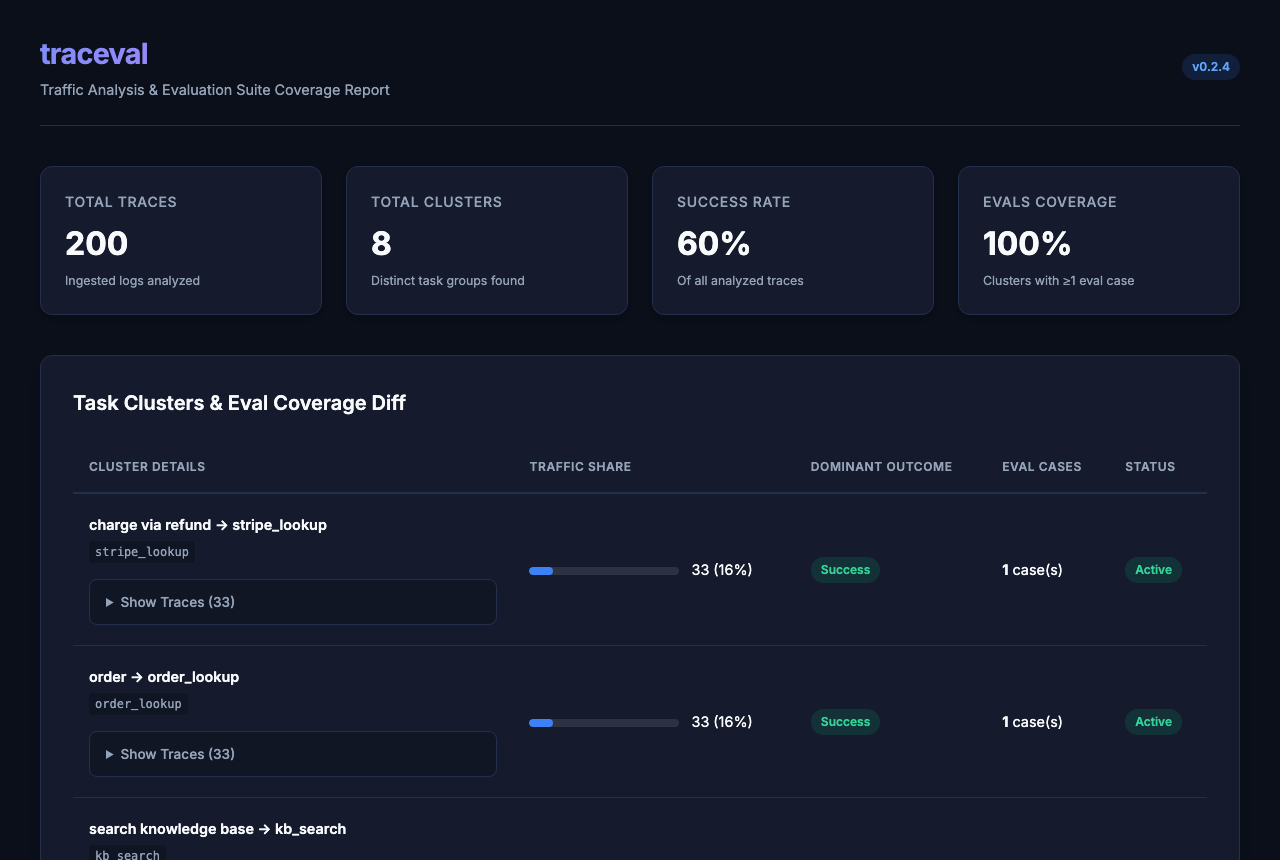
Outcomes: success 60% · tool_error 15% · loop 10% · timeout 8% · validation_error 8%
Clusters: 8 task clusters found.
Top failure cluster: "refund stripe -> stripe_lookup -> (tool_error)" (30 traces)
Report written to analysis/report.html
analysis/report.html is the single-file page shown in the screenshot above. Pass --evals evals/ to overlay eval coverage per cluster, and --rules my_rules.py to add your own labeling rules. To view it over HTTP instead of file://, traceval serve analysis starts a stdlib localhost server and prints the report URL.
Custom labeling rules, the redaction hook, and judge configuration are documented in docs/extending.md.
3. Generate
traceval generate traces.db -o evals --include-failures
Wrote 8 eval cases across 8 clusters → evals/cases/*.yaml
Wrote judge rubrics → evals/rubrics/*.md
Wrote pytest harness → evals/test_generated.py, evals/conftest.py
Every case is a reviewable YAML file. Golden cases assert the recorded successful behavior. Regression cases, generated from failure traces, assert the failure does not recur: forbidden error tokens (word-boundary matched, filtered against tokens that success traces also use), tool-loop bounds, and non-empty output. A regression case passes for any agent that avoids that failure mode; golden cases carry general bug detection.
4. Run
traceval run evals --target myapp.agent:invoke_agent --judge fake
traceval Run Summary
┏━━━━━━━━━━━━━━━━━━━━━━┳━━━━━━━━━━━━┳━━━━━━━━━┳━━━━━━━━━━━━━━┓
┃ Case ID              ┃ Cluster    ┃ Outcome ┃ Latency (ms) ┃
┡━━━━━━━━━━━━━━━━━━━━━━╇━━━━━━━━━━━━╇━━━━━━━━━╇━━━━━━━━━━━━━━┩
│ c_0c422a7a__case_001 │ c_0c422a7a │  PASS   │         <0.1 │
│ c_1e5d0942__case_002 │ c_1e5d0942 │  PASS   │         <0.1 │
│ c_2c881177__case_003 │ c_2c881177 │  PASS   │         <0.1 │
│ c_361535b0__case_004 │ c_361535b0 │  PASS   │         <0.1 │
│ c_9a8a4644__case_005 │ c_9a8a4644 │  PASS   │         <0.1 │
│ c_d30af83a__case_006 │ c_d30af83a │  PASS   │         <0.1 │
│ c_d3f3b631__case_007 │ c_d3f3b631 │  PASS   │         <0.1 │
│ c_e834c13c__case_008 │ c_e834c13c │  PASS   │         <0.1 │
└──────────────────────┴────────────┴─────────┴──────────────┘
Total: 8 | Passed: 8 | Failed: 0 | Errored: 0
The target is an HTTP URL or a module:function callable; the exact request/response contract, with a copy-pasteable FastAPI example, is in docs/targets.md. Checks cover exact, contains_any, not_contains, regex, json_schema, tool_sequence, no_tool_loop, and judge. Run reports land in <evals_dir>/runs/ (override with --runs-dir); pass --compare <previous report> to print regressions and improvements between runs. The exit code is nonzero when any case fails.
5. Calibrate the judge
An LLM judge is only as trustworthy as its agreement with human judgment. calibrate samples judge-scored results from a run report and presents each agent output for blind pass/fail labeling in the terminal; judge verdicts stay hidden until the end so they cannot anchor you.
traceval calibrate evals/runs/run_<timestamp>.json --sample 8
Judge Calibration Summary
┏━━━━━━━━━━━━┳━━━━━━━━━┳━━━━━━━━━━━┓
┃ Cluster    ┃ Labeled ┃ Agreement ┃
┡━━━━━━━━━━━━╇━━━━━━━━━╇━━━━━━━━━━━┩
│ c_0c422a7a │       1 │      100% │
│ c_1e5d0942 │       1 │      100% │
│ c_2c881177 │       1 │      100% │
│ c_361535b0 │       1 │      100% │
│ c_9a8a4644 │       1 │        0% │
│ c_d30af83a │       1 │      100% │
│ c_d3f3b631 │       1 │      100% │
│ c_e834c13c │       1 │      100% │
└────────────┴─────────┴───────────┘
Overall agreement: 88% on 8 case(s) | false-pass (judge OK, human not): 1 | false-fail: 0
WARNING: Judge unreliable (< 80% agreement) for clusters: c_9a8a4644. Review their rubrics before trusting automated scores.
False-pass counts (judge approved, human rejected) are called out because that is the dangerous direction: a lenient judge waves bad outputs into production. Clusters below --min-agreement (default 80%) are flagged for rubric review, and the full labels plus stats are written to calibration.json.
Scripting with --json
ingest, analyze, generate, and run accept --json: human-readable output is suppressed and a single JSON object is printed to stdout. run still exits nonzero on failures.
traceval analyze traces.db --json | python -m json.tool
GitHub Action
Gate deploys on your generated eval suite. The action installs traceval, runs the suite, and fails the job on any regression:
jobs:
  agent-evals:
    runs-on: ubuntu-latest
    steps:
      - uses: actions/checkout@v4
      - uses: theramkm/traceval@v0.2.7
        with:
          evals-dir: evals/
          target: myapp.agent:invoke_agent   # or an HTTP URL
          judge: fake                        # offline; 'openai' needs an API key
Inputs: evals-dir and target (required); judge, compare, only, runs-dir, traceval-version, python-version (optional). For a real LLM judge, set judge: openai and pass OPENAI_API_KEY (or GEMINI_API_KEY) via env: from your repository secrets.
Development
See CONTRIBUTING.md for setup.
Run the test suite with make test and the full gate set with make lint.
Honest Limitations
- Side-Effect Free: traceval assertions evaluate input/output matches. It does not attempt to replay side effects (e.g., updating database records) on mock tools.
- Text Telemetry: The canonical model is optimized for text logs. Image or multimodal payloads in traces are logged as references.
- Static Visualization: The coverage report is a portable, single-file HTML page. There is no hosted web service.
FAQ
Doesn't LangSmith or Langfuse already do this? Yes, inside their platforms (LangSmith Insights, Langfuse offline evals). traceval is for when you want the tests in your own repo, runnable by plain pytest in any CI, with no vendor in the loop. It reads their exports rather than replacing them.
Why not DeepEval? Different layer: DeepEval is the assertion framework you write evals in, traceval is the suite generator that produces them from traces. Use both if you like, since traceval emits plain pytest.
What happens when the export formats change? Adapters track the documented export shapes, the test fixtures are the contract that catches drift, and the generic JSONL format is the guaranteed on-ramp if a backend shape moves out from under an adapter. Format drift is a known maintenance cost, documented in docs/formats.md.
1 maintainer

Release files for traceval 0.2.7
For a detailed explanation of source distributions (sdists) and built distributions (wheels), please see the package formats documentation.
Source distribution (sdist)
| File | Size | Uploaded | |
|---|---|---|---|
| traceval-0.2.7.tar.gz | 1.0 MB | Details |
Built distribution (wheel)
| File | Interpreter | ABI | Platform | Reset |
|---|---|---|---|---|
| traceval-0.2.7-py3-none-any.whl | Python 3 | none | any | Details |
Total release size: 1.1 MB
Release files / traceval-0.2.7.tar.gz
| Download URL | traceval-0.2.7.tar.gz |
|---|---|
| Size | 1.0 MB |
| Tags | Source |
|
SHA-256 checksum How to use checksums |
239d88b7ea8c779ec2c2d2c2c5d87425216c07debd7b36b1c6d95b90ba9613e9
|
|
BLAKE2b-256 checksum How to use checksums |
de2aeaa6912995b4c6017d2291097007723cae55b842be97d9fa1874504f59d4
|
| Upload date | |
|
Uploaded using Trusted Publishing? What is trusted publishing? |
Yes |
| Uploaded via |
twine/6.1.0 CPython/3.13.12
|
Provenance
Provenance describes where a file came from. On PyPI, provenance is shared via attestations, which provide a verifiable record of the build or publishing details. View details, limitations and caveats.


PyPI Publish Attestation
PyPI verified that this artifact, at this checksum, originated from the publisher listed below.
Signed by GitHub Actions, verified by PyPI on Jul 6, 2026.
Transparency logRelease files / traceval-0.2.7-py3-none-any.whl
| Download URL | traceval-0.2.7-py3-none-any.whl |
|---|---|
| Size | 60.4 kB |
| Tags | Python 3 |
|
SHA-256 checksum How to use checksums |
022050df0d61786cb8db979fdb9f254a22cd434531a03096dd451501f082daa3
|
|
BLAKE2b-256 checksum How to use checksums |
1eb0a3ed503b1fa465c8557aae6ef4e0317f24d11a6de8db908e00513776b579
|
| Upload date | |
|
Uploaded using Trusted Publishing? What is trusted publishing? |
Yes |
| Uploaded via |
twine/6.1.0 CPython/3.13.12
|
Provenance
Provenance describes where a file came from. On PyPI, provenance is shared via attestations, which provide a verifiable record of the build or publishing details. View details, limitations and caveats.
PyPI Publish Attestation
PyPI verified that this artifact, at this checksum, originated from the publisher listed below.
Signed by GitHub Actions, verified by PyPI on Jul 6, 2026.
Transparency log













