
trackinizer🐾





Epistemological database for agent and human efforts, beliefs, and findings.

Watch the 27-second tour: the graph, a root's island and a Belief in it, Issues and Artifacts, and a message to an agent in the console, answered live.
Quick Start
# Mac:
#   # Required for quick install.
#   brew install uv
#   # Optional for a real Postgres backend; default uses pglite engine.
#   brew install postgresql@18 pgvector

# Ubuntu/Debian:
#   # Required for quick install.
#   sudo apt-get install -y curl
#   curl -LsSf https://astral.sh/uv/install.sh | sh
#   # Optional for a real Postgres backend; default uses pglite engine.
#   PG_MAJOR="$(apt-cache depends postgresql | grep -m1 -oP 'postgresql-\K\d+')"
#   sudo apt-get install -y postgresql "postgresql-$PG_MAJOR-pgvector"

uv tool install trackinizer

# Local server at http://127.0.0.1:8765.
trackinizer

# CLI to trackinizer server.
trax
Centralized agent database for inquiries (Issues + Artifacts), work, and
knowledge. Three core tables (inquiries, edges, change_log) backed
by Postgres (real or PGlite). FastAPI on top.
types/ is the design contract. Every other module is a realization of
that contract over Postgres + HTTP.
The UI
The web app browses the same records the API serves. Its source is web/
(web/README.md), and the package ships it
built: trackinizer serves it at /app/, and / leads there. To use it on
your own machine, run the server in single-user local mode, then open
http://127.0.0.1:8765/app/:
trackinizer --no-auth
--no-auth makes every request an admin, so keep the server on localhost, its
default --host. Without it, the API accepts only API tokens, which is how
trax and agents connect, and /app/ follows the same rule: a browser gets
the sign-in page, and the package ships no browser sign-in.
--app-dir DIR serves the app built in DIR in place of the packaged one. In
a source checkout the server serves web/dist without it, once ./npm run build has run in web/; the flag is for a build kept elsewhere, such as a
deploy's symlink to its current build. The server reads DIR on every
request, so switching the link puts a new build live without a restart.
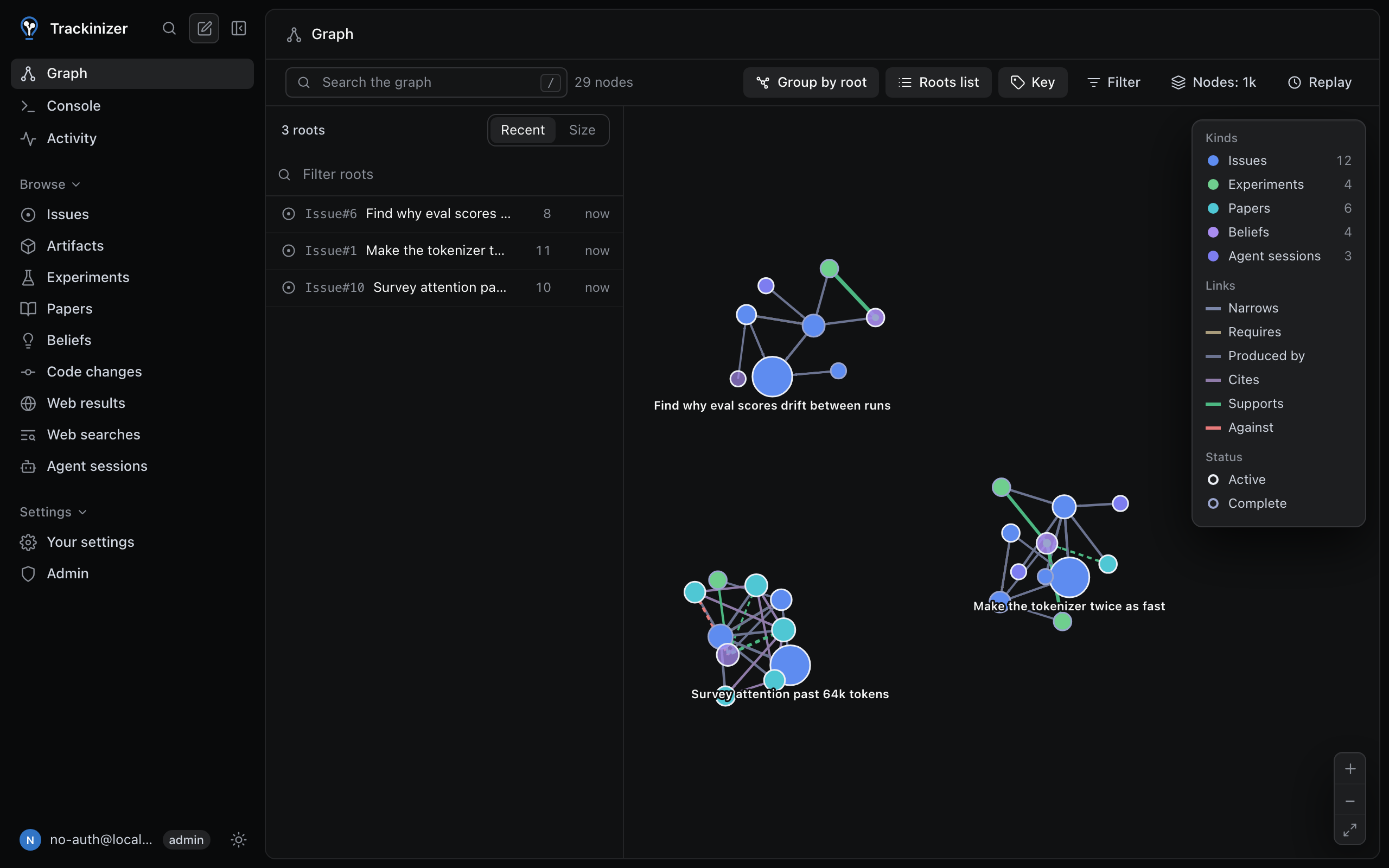
Graph -- the inquiry web (Issues, Beliefs, Papers, Experiments, …) as typed nodes and edges, each root's subgraph gathered into an island and the roots listed.
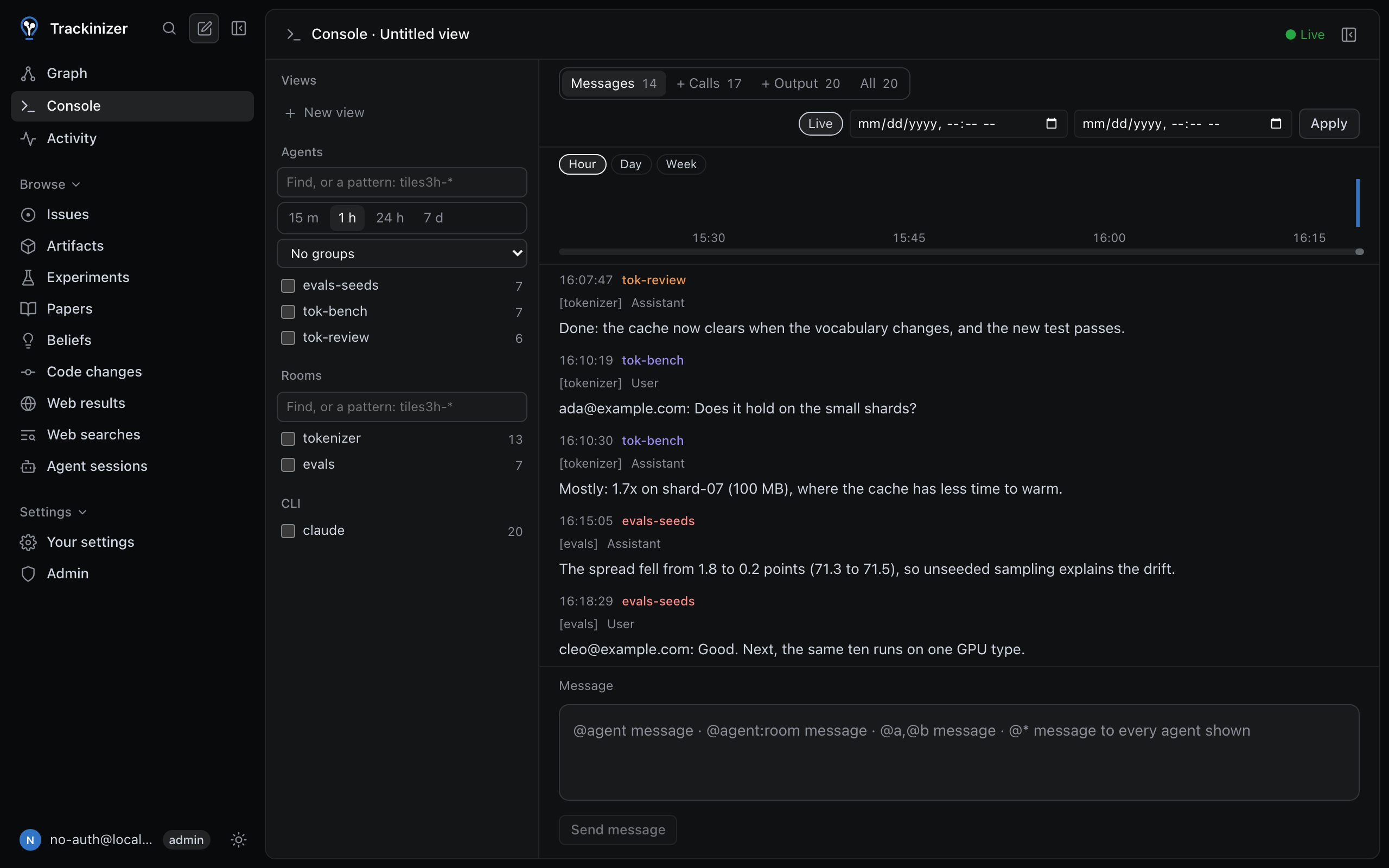
Console -- the agents' live sessions: saved views, filters by agent and room,
messages alone or every tool call, and a line to message agents, with @
suggestions.
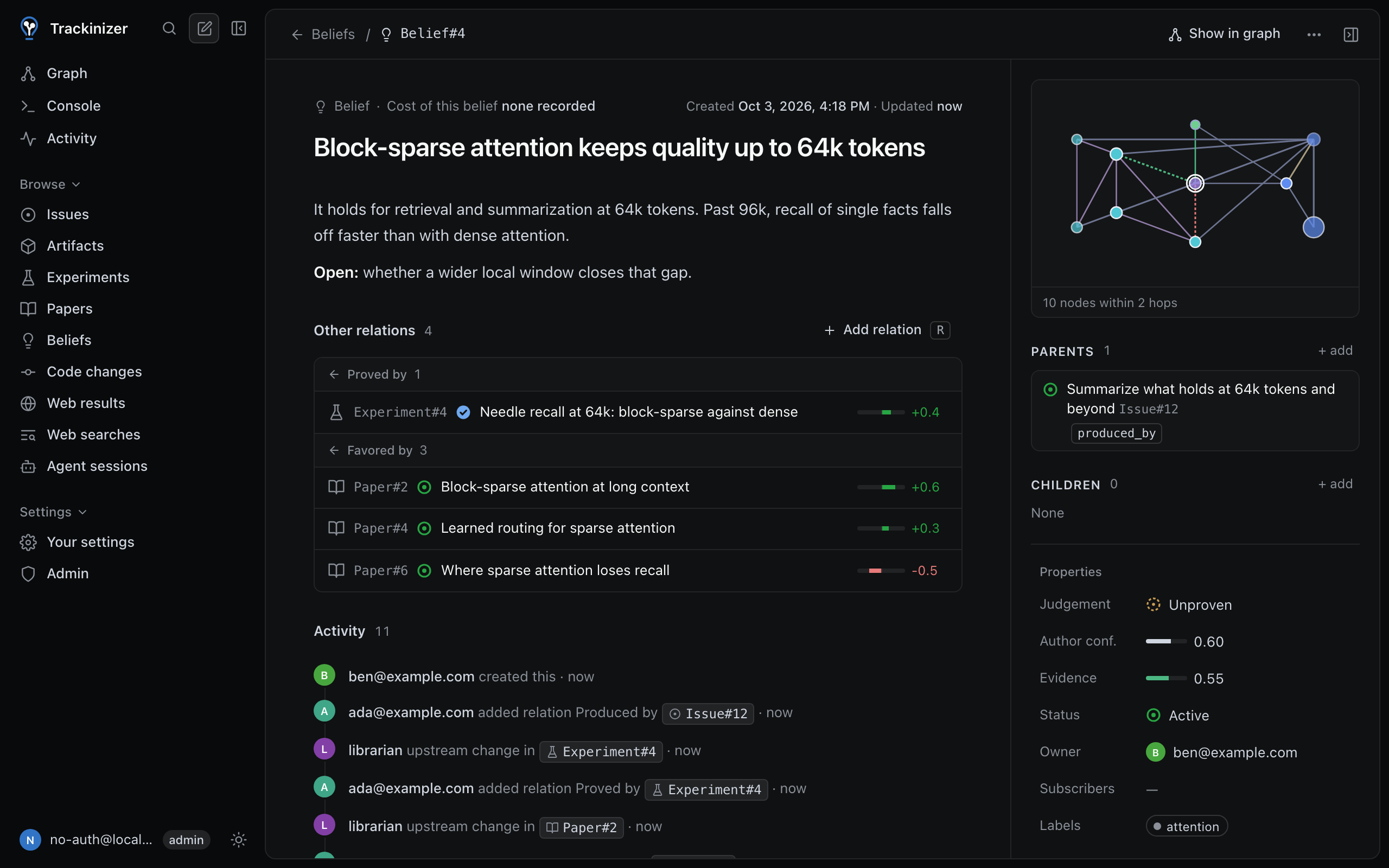
Belief -- a claim with its evidence for and against, its parents and children, a graph of what lies within two hops, and its activity.
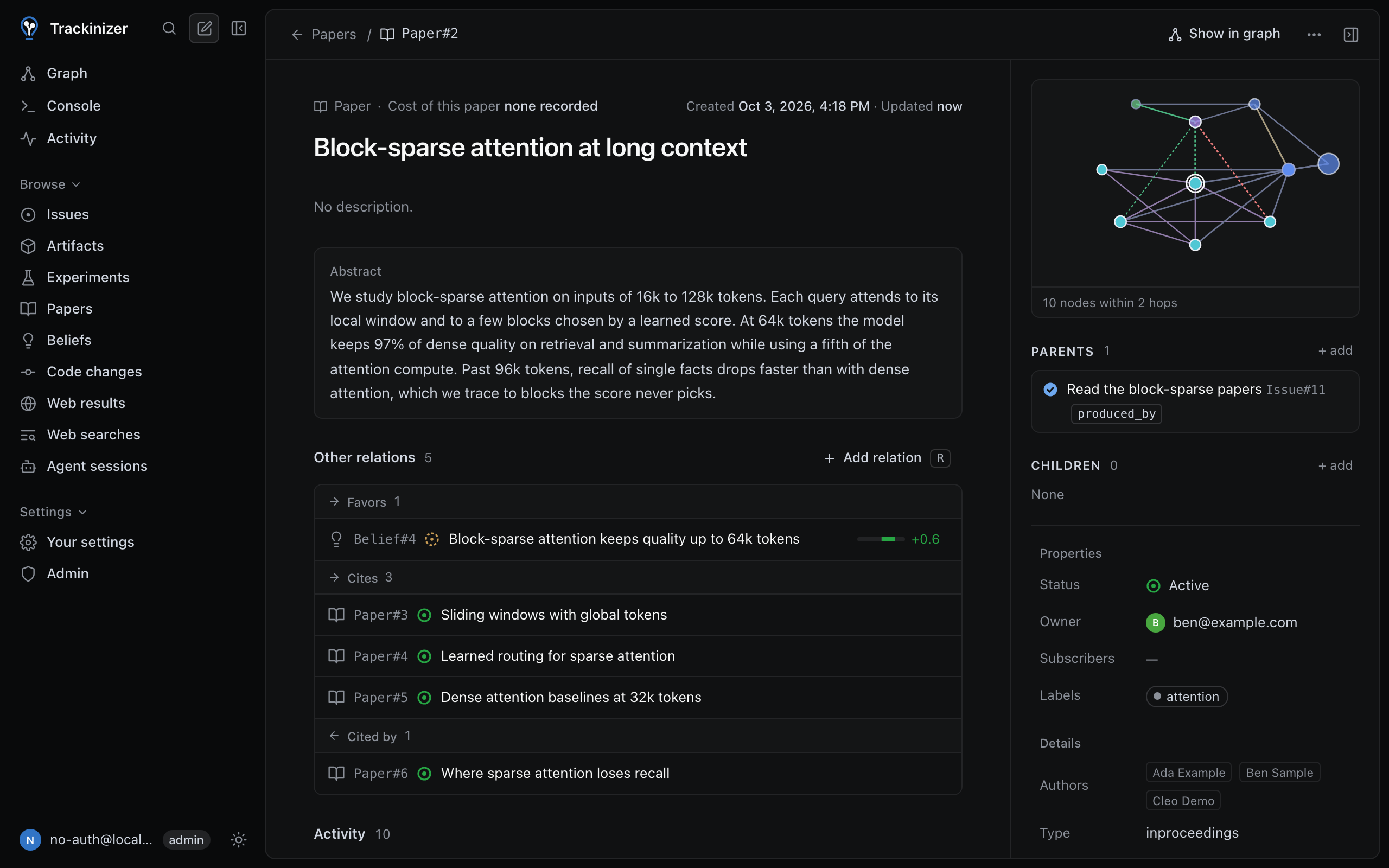
Paper -- abstract, authors, and the papers it cites and is cited by.
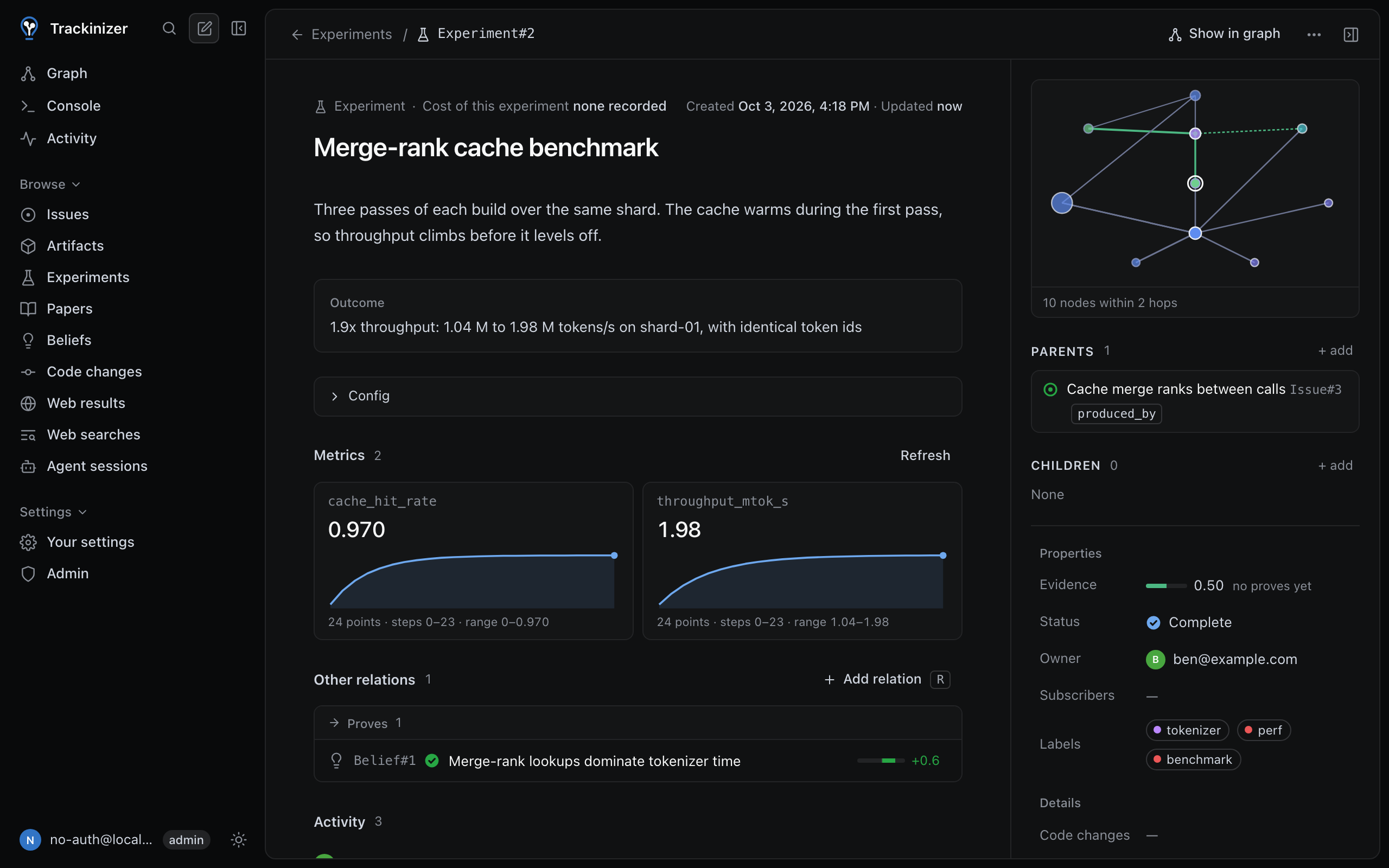
Experiment -- its outcome, config and metric charts, and the Belief it proves.
The model
Everything in the system is an Inquiry, which has two variants: an
Issue is a unit of "work" and an Artifact is the output of that work.
Giving both a single type is what lets the same edges relate them -- work
can produce knowledge, and knowledge can elicit more work, without crossing a
type boundary.
Each row below lists the fields that class adds; every kind also has everything above it.
Inquiry                  # An effort, ongoing or completed.
│   id
│   seq
│   owner
│   account
│   status
│   title
│   description
│   labels
│   marginal_cost
│   subscribers
│   superseded_by
│   supersedes
│   produces
│   produced_by
│   created
│   modified
│
├── Issue                # Work to pursue.
│       issue_kind
│       validation
│       priority
│       narrows
│       narrowed_by
│       requires
│       required_by
│
└── Artifact             # Knowledge produced and cited.
    │   proves
    │   favors
    │
    ├── Experiment       # Empirical measurement.
    │       codechanges
    │       outcome
    │       config
    │       proved_by
    │       favored_by
    │
    ├── Belief           # Proposition.
    │       judgement
    │       confidence
    │       proved_by
    │       favored_by
    │
    ├── Paper            # Bibliographic source.
    │       abstract
    │       authors
    │       publication_type
    │       venue
    │       subvenue
    │       publish_date
    │       source
    │       google_scholar_cluster_id
    │       google_scholar_cites_id
    │       cites
    │       cited_by
    │
    ├── CodeChange       # One git commit.
    │       sha
    │
    ├── WebSearch        # One query.
    │       query
    │       provider
    │
    ├── WebResult        # One URL.
    │       url
    │
    └── AgentSession     # A captured CLI run.
            cli
            cli_session_id
            started
            ended
            rooms
            opened_by_api_key_id
Relationships are directed and every one has an inverse view, so a parent and a child describe the same edge from either end:
                              OLDER  (parent)

    {narrows,requires}     {produced_by,supersedes}     {proves,favors}
            ▲                         ▲                        ▲
            │                         │                        │
          Issue ┄┄┄┄┄┄┄┄┄┄┄┄┄┄┄┄┄▷ Inquiry ◁┄┄┄┄┄┄┄┄┄ {Belief,Experiment}
            │                         │                        │
            ▼                         ▼                        ▼
{narrowed_by,required_by}  {produces,superseded_by}  {proved_by,favored_by}

                               NEWER  (child)
- Parents are always older than children, on each edge's own clock:
creation-time for every edge except
requires, which is completion-time. - Any Inquiry can be
produced_byolder ones (its origins) andsuperseded_byothers (M:N knowledge surgery). - An Issue can be
narrowed_by(broader to narrower) orrequired_by(it is the prerequisite another waits on). Both are Issue to Issue. proves/favorsgo from any Artifact to aBelieforExperiment-- anything may cite, only a claim may be cited. They carry a valence in [-1, 1]: sign is polarity, magnitude is weight.provesvotes in the proof predicate;favorsis context that informs but does not vote.cites/cited_byis Paper to Paper and stands apart from the six above: a bibliographic fact we record rather than a claim we reason over. No valence, no scheduling effect, and exempt from the acyclicity rule, since mutual citation is real data and not a cycle we own.
See docs/epistemy.md for why each verb
is named what it is.
Storage
Three tables carry the model and other tables support them.
| table | holds |
|---|---|
inquiries |
one row per Inquiry, all kinds. kind discriminates; (kind, seq) gives the short ref (Issue#7) from a per-kind sequence. Optional columns are nullable, so NULL is the single encoding of "unset". |
edges |
every relationship, as (from_id, to_id, edge_kind). Citation edges carry valence. A CHECK constrains which kind pairs each edge kind admits, and cycles are rejected on insert. |
change_log |
append-only audit. Each row is one change with (old_*, new_*) snapshot pairs; milestone rows carry no delta, their signal is that they exist. Drives the trax recent feed and idempotency replay. |
Per-kind detail that does not fit one row lives in its own table, keyed
back to inquiries(id) and deleted with it:
| table | holds |
|---|---|
experiment_metrics |
(key, step, value) time series for an Experiment. CHECKs mirror the wire's validators -- non-blank bounded key, non-negative step, finite value -- so a stored row can always be read back. |
session_records |
the ordered record log of an AgentSession, (session_id, part, idx), each holding one trackinizer.lib.agent IR record as JSON. part is one source FILE (a session spans several); idx is DERIVED from position in it, which is what makes re-ingest idempotent. Backs the live console feed. |
session_manifests |
one row per part: what the file was called, what it declared, and how much of it is live. |
session_ciphertext |
Thinking.encrypted, split off so retention can drop it without touching what search indexes. |
session_slash_commands |
commands the human typed into the TUI. Not records: never written to any session log, so they hold no idx. |
inquiry_embeddings |
one vector per (inquiry_id, model) for semantic search. |
Auth is three more: users, api_keys (scrypt-hashed, prefix-indexed),
and allowlist.
The typed fields on Inquiry (produces, supersedes, citation lists)
are projections the Store fills by reading edges -- the edge table is the
real storage.
trax export > graph.jsonl writes the graph as JSON lines: the rows of the
tables above, minus embeddings, ciphertext, and auth. Unlike a copy of the
PGlite datadir it is not tied to the storage internals that wrote it, and an
unchanged graph exports the same bytes twice. Line format:
docs/api.md section 3.24.
Package dependency graph
Four layers, two legs sharing one contract spine. An arrow means "imports / depends on" and points toward the dependency.
┌──────────────┐                      ┌──────────────┐
│    trax      │                      │    server    │   leaves: nothing
│    (CLI)     │                      │  (__main__)  │   imports these
└──────┬───────┘                      └──────┬───────┘
       │                                     │
       ▼                                     ▼
┌──────────────┐                      ┌──────────────┐
│   client     │                      │     api      │   server leg adds
│ (httpx SDK)  │                      │  (FastAPI    │   Store; client leg
│              │                      │   handlers)  │   adds httpx
└──────┬───────┘                      └──────┬───────┘
       │                                     │
       └──────────────┬──────────────────────┘
                      │  both import
                      ▼
              ┌───────────────┐
              │     wire      │   transport contract = THE API
              │  bodies       │   definition (request/response
              │  routes       │   models, route table, filters, refs)
              │  filters      │
              │  refs         │
              └───────┬───────┘
                      │
                      ▼
              ┌───────────────┐
              │     types     │   domain dataclasses;
              │  inquiries    │   imports nothing internal
              │  edges        │
              │  change_log   │
              │  cost         │
              └───────────────┘
Two legs, one shared spine:
- client leg:
trax→client→wire→types - server leg:
server/__main__→server/api→wire→types
The whole point of this split: types/ + wire/ + client/ form a
self-contained client distribution. wire/ and client/ never import
api, server, store, web, fastapi, asyncpg, or trax, so a
published Python client carries no server dependencies.
Layering rules
-
types/is a closed island. Nothing intypes/imports anything outside it. Everything else eventually imports from it. The dataclasses, Protocols, andColumnSpecmetadata intypes/are the data design contract; the rest of the package realizes it. -
wire/is the API contract; it is the single definition of the HTTP surface. It holds the Pydantic request/response bodies (FieldSet[T],FieldOp[T],FieldMutation,Submit*, edge bodies), theFilter/Refshapes, and the route table the server registers from and the client builds requests from. It importstypes/and nothing else internal. Server and client both derive from it, so neither hand-writes a path or a body shape -- that is what prevents server/client/doc drift. -
client/is the standalone SDK;traxis a thin CLI over it.client/iswire/+httpx.traxowns only CLI concerns (grammar, parsing, rendering) and callsclient.Client. Neitherclient/norwire/may import the server side or the CLI. -
No cycles. Each arrow above goes one direction.
server/primitives.pyimportsserver/setter_dispatch.RUNTIME_HOOKSand mutates it at import time (late-binding theresults/codechangesvalidators).server/store.pyimportsprimitives, so the side effect lands before anyStoreinstance is constructed. -
server/sql.pyis orthogonal. It loadsassets/schema.sqlfrom disk.server/schema_gen.pysubstitutes generated bodies into the loaded text at bootstrap; the two never import each other. -
server/api/is the HTTP boundary. Routes are thin: pydantic-validate the wire body, call oneStoremethod, serialize the result. Anything non-trivial belongs inserver/store.py, not in a route.
Reading order
Pick one of these orders depending on what you came in for.
-
"What does Trackinizer model?" Start in
types/. Readinquiries.py, thenedges.py, thenchange_log.py. Readdocs/design.mdfor the model and philosophy. -
"What is the HTTP API / how do I avoid drift?" Start in
wire/routes.py: the route table is derived from theColumnSpecmetadata intypes/inquiries.py. The server registers handlers by iterating it (server/api/edit.py,edge.py), the client builds requests from it (client/client.py), so neither hand-writes a path.server/api/routes_drift_test.pyfails if a handler diverges from the table. -
"How does a submit reach the database?"
server/api/submit.py→wire/bodies.py(body validation) →server/store.py(submit_X) →server/primitives.py(insert_inquiry,insert_edge). -
"How does an edit fan out notifications?"
server/api/edit.py→server/store.py(set_X→_set_field) →server/setter_dispatch.py(RUNTIME_HOOKS[col]) →server/notify.py(post-commit buffer +LISTEN/NOTIFY). -
"How does the schema get built?"
server/__main__.py→store.bootstrap()→server/sql.py(schema_migrations()) →server/schema_gen.py(substitute_schema_placeholders()) → the four_generate_*functions. Generated text is derived fromColumnSpecmetadata on the dataclasses intypes/. Seedocs/db_schema_migration.mdfor running migrations, squashing, and deploying schema changes. -
"How does a
dependency_changedcascade work?"store.emit_change→store._cascade_dependency_changed→store._parent_edges→types/edges.EdgeKindPolicy. The policy table is the single declaration site for which endpoint of each edge kind is the dependent.
Running
trackinizer                        # pglite (default)
trackinizer --engine pg --dsn ...  # against real Postgres
trackinizer --no-auth              # single-user local mode: everyone is admin
trackinizer --app-dir DIR          # the web app built in DIR at /app/
trackinizer --no-web               # without /api/web, /app/ or the login page
trax is the client half and talks to any reachable server, so it is
useful on its own:
trax help                          # grammar and subjects
trax issue                         # list issues
From a source checkout, both are uv run python -m trackinizer.server
and uv run python -m trackinizer.trax.
See example.sh for a worked end-to-end submit/edit/query session.
System dependencies
Integration tests (@pytest.mark.integration) use a Postgres server backend
via pytest-postgresql and also requires pgvector.
PGlite bundles its own vector extension, so the default pglite engine has
no system deps.
Ubuntu/Debian
# Extension packages are always named `postgresql-NN-<ext>` -- there is no
# unversioned alias -- so derive NN from the metapackage instead of hardcoding
# it (18 above 24.04, 16 on 24.04).
PG_MAJOR="$(apt-cache depends postgresql | grep -m1 -oP 'postgresql-\K\d+')"
sudo apt-get install -y postgresql "postgresql-$PG_MAJOR-pgvector"
macOS
# Homebrew's pgvector supports postgresql@17 and @18.
brew install postgresql@18 pgvector
See also
Sibling projects in the rekursiv-ai family:
- sagent — The self-mutating multi-provider coding-agent CLI and typed Python library.
- wesearch — Web search, resilient page fetch, and scholarly-paper lookup without a browser stack.
- madcatter — Rich-based Markdown renderer for the terminal; ships the
mdcatCLI. - priml — Composable PyTorch building blocks: models, optimizers, losses, and a step-based training loop.
- configgle — Hierarchical experiment configuration in typed pure-Python dataclasses instead of YAML.
- copybarista — Bidirectional source sync for publishing OSS-ready trees from a monorepo.
Citing
If you find our work useful, please consider citing:
@misc{rekursivai2026trackinizer,
      title={Trackinizer - Epistemological database for agent and human efforts, beliefs, and findings.},
      author={Joshua V. Dillon and Dan Kondratyuk},
      year={2026},
      howpublished={Github},
      url={https://github.com/rekursiv-ai/trackinizer},
}
2 maintainers


Metadata
2 maintainers
Release files for trackinizer 0.1.5
For a detailed explanation of source distributions (sdists) and built distributions (wheels), please see the package formats documentation.
Source distribution (sdist)
| File | Size | Uploaded | |
|---|---|---|---|
| trackinizer-0.1.5.tar.gz | 4.8 MB | Details |
Built distribution (wheel)
| File | Interpreter | ABI | Platform | Reset |
|---|---|---|---|---|
| trackinizer-0.1.5-py3-none-any.whl | Python 3 | none | any | Details |
Total release size: 7.8 MB
Release files / trackinizer-0.1.5.tar.gz
| Download URL | trackinizer-0.1.5.tar.gz |
|---|---|
| Size | 4.8 MB |
| Tags | Source |
|
SHA-256 checksum How to use checksums |
e34812b15b3dbb8c97ce1cd4060c4f7d15bb582446e0de63465b99066f696cf7
|
|
BLAKE2b-256 checksum How to use checksums |
58075ad4cb06e9407c59377bfb27e287cd1bbc09ce5c49dbab33efd1aefd84ec
|
| Upload date | |
|
Uploaded using Trusted Publishing? What is trusted publishing? |
Yes |
| Uploaded via |
twine/7.0.0 CPython/3.13.14
|
Provenance
Provenance describes where a file came from. On PyPI, provenance is shared via attestations, which provide a verifiable record of the build or publishing details. View details, limitations and caveats.


PyPI Publish Attestation
PyPI verified that this artifact, at this checksum, originated from the publisher listed below.
Signed by GitHub Actions, verified by PyPI on Oct 4, 2026.
Transparency logRelease files / trackinizer-0.1.5-py3-none-any.whl
| Download URL | trackinizer-0.1.5-py3-none-any.whl |
|---|---|
| Size | 3.0 MB |
| Tags | Python 3 |
|
SHA-256 checksum How to use checksums |
ee8bae9a6d683fc9296801b78c4a25eea3e3a6e43d5f972a31326c1747339d3d
|
|
BLAKE2b-256 checksum How to use checksums |
62808a455279e44a2d646ffad8b1c3979b40074afa593a784cd6aa23c00f8649
|
| Upload date | |
|
Uploaded using Trusted Publishing? What is trusted publishing? |
Yes |
| Uploaded via |
twine/7.0.0 CPython/3.13.14
|
Provenance
Provenance describes where a file came from. On PyPI, provenance is shared via attestations, which provide a verifiable record of the build or publishing details. View details, limitations and caveats.
PyPI Publish Attestation
PyPI verified that this artifact, at this checksum, originated from the publisher listed below.
Signed by GitHub Actions, verified by PyPI on Oct 4, 2026.
Transparency log













