
Dukascopy tick downloader and candle/tick exporter for backtesting workflows.
Project description

tradedesk-dukascopy


Dukascopy tick downloader and candle exporter for use in backtesting your trading strategies.
This tool downloads raw tick data from Dukascopy, converts it into clean, deterministic CSV candle files, and writes a metadata sidecar describing exactly how the data was produced.
It is designed to be run once per dataset, not repeatedly during backtests.
Quick start
Install:
pip install tradedesk-dukascopy
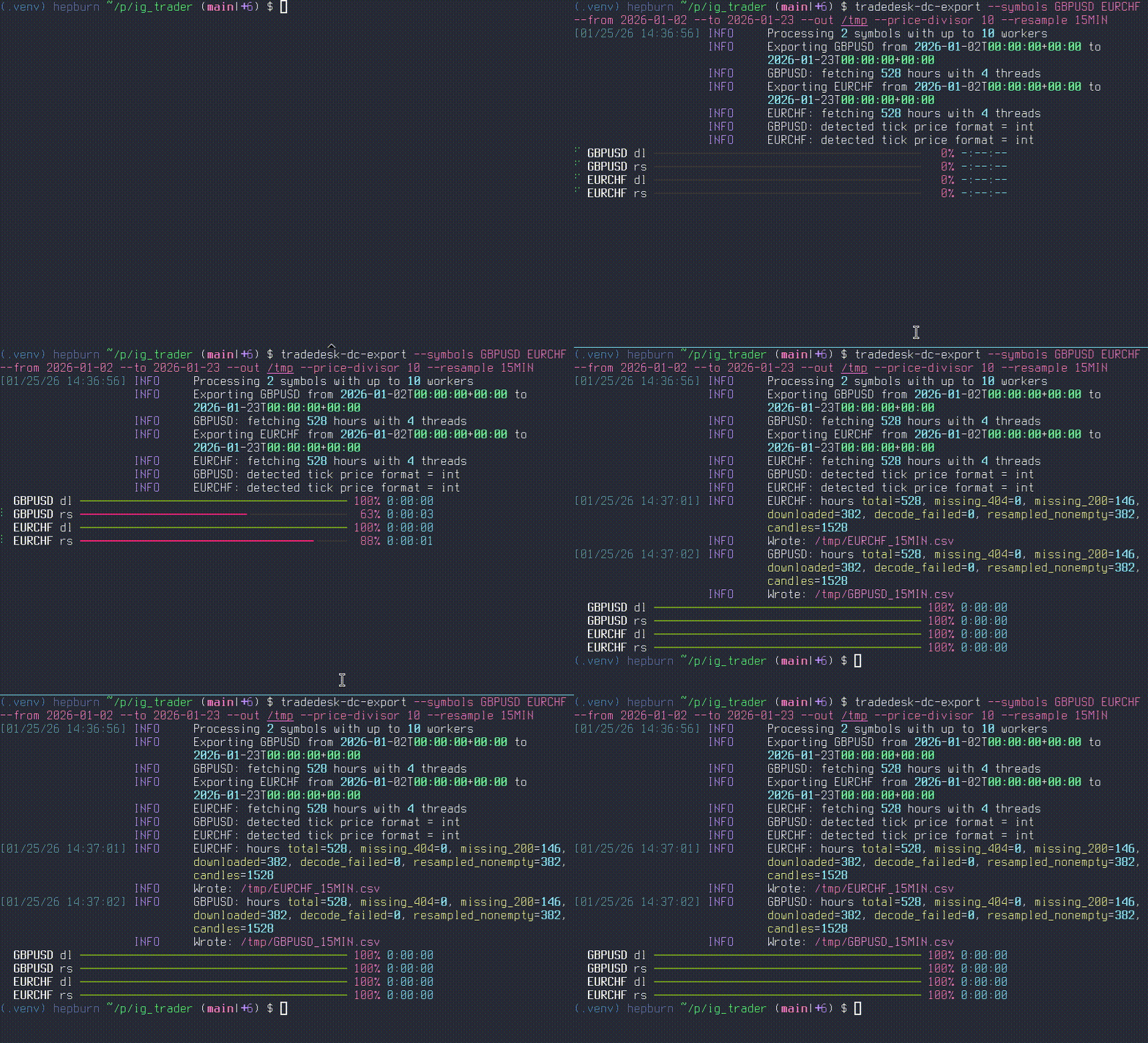
Export 5-minute candles for EURUSD:
tradedesk-dc-export --symbols EURUSD \
  --from 2025-01-01 --to 2025-01-31 \
  --resample 5min \
  --out data \
  --cache-dir ./cache \
  --price-divisor 1000 \
  --workers 1
This produces:
data/
  EURUSD_5MIN_bid.csv
  EURUSD_5MIN_bid.csv.meta.json
  EURUSD_5MIN_ask.csv
  EURUSD_5MIN_ask.csv.meta.json
You can now point your backtest engine at the bid or ask CSV directly, depending on which price side you want to replay.
Price scaling (--price-divisor)
Dukascopy tick prices are stored as integers or scaled values depending on the instrument.
This tool applies price scaling once, at export time, using --price-divisor.
Examples:
| Instrument | Typical divisor |
|---|---|
| EURUSD | 1000 |
| USDJPY | 100000 |
| Indices | 1 or 10 |
If unsure, use probe mode:
tradedesk-dc-export --symbols GBPSEK \
  --from 2025-07-01 --to 2025-07-01 \
  --probe
Probe mode prints sample ticks at different divisors without writing files.
GBPSEK: detected tick price format = int
GBPSEK @ 2025-07-01T00:00:00+00:00 (int): first 10 ticks
first tick raw: 2025-07-01T00:00:00.326000+00:00 bid_i 1297675 ask_i 1298619 vol 1.149999976158142
  divisor      1: bid 1297675.000000 ask 1298619.000000
  divisor     10: bid 129767.500000 ask 129861.900000
  divisor    100: bid 12976.750000 ask 12986.190000
  divisor   1000: bid 1297.675000 ask 1298.619000
  divisor  10000: bid 129.767500 ask 129.861900
  divisor 100000: bid 12.976750 ask 12.986190
using --price-divisor 1.0:
2025-07-01T00:00:00.326000+00:00 bid 1297675.0 ask 1298619.0 bid_vol 1.149999976158142
2025-07-01T00:00:01.128000+00:00 bid 1297800.0 ask 1298661.0 bid_vol 0.9200000166893005
2025-07-01T00:00:01.329000+00:00 bid 1297796.0 ask 1298621.0 bid_vol 0.9200000166893005
2025-07-01T00:00:03.335000+00:00 bid 1297796.0 ask 1298591.0 bid_vol 0.9200000166893005
2025-07-01T00:00:03.737000+00:00 bid 1297842.0 ask 1298695.0 bid_vol 1.149999976158142
2025-07-01T00:00:05.340000+00:00 bid 1297850.0 ask 1298655.0 bid_vol 0.9200000166893005
2025-07-01T00:00:06.542000+00:00 bid 1297862.0 ask 1298709.0 bid_vol 0.9200000166893005
2025-07-01T00:00:08.546000+00:00 bid 1297874.0 ask 1298709.0 bid_vol 0.9200000166893005
2025-07-01T00:00:10.556000+00:00 bid 1297877.0 ask 1298724.0 bid_vol 0.9200000166893005
2025-07-01T00:00:12.562000+00:00 bid 1297839.0 ask 1298684.0 bid_vol 1.149999976158142
Repairing an existing cache
If you already populated --cache-dir with the wrong price scale, the package
ships a repair command:
tradedesk-dc-normalize --cache-dir ./cache --dry-run
tradedesk-dc-normalize --cache-dir ./cache --symbols EURUSD USDJPY
tradedesk-dc-normalize rewrites cached daily candle files in place when it
detects prices that are clearly outside the expected real-price range for a
symbol. It picks the power-of-ten factor in [1e-5, 1e5] whose result sits
closest to the geometric midpoint of the band, so it corrects both
over-scaled days (e.g. a --price-divisor 1.0 cache that stored raw
int32 ticks) and under-scaled days (e.g. a cache that was already
divided too aggressively at export time). Days whose median price already
falls inside the expected range are left untouched.
The normalizer only updates the cached daily candle files under --cache-dir.
If you already wrote range-level CSVs with --out, rerun your export command
after normalizing so those output files are regenerated from the corrected
cache.
Rescaling a cache that drifted off its own dominant scale
tradedesk-dc-normalize brings each day's prices into a hardcoded
natural-units band (e.g. USDJPY 50–500). That is the wrong target when the
downstream consumer expects prices at the symbol's existing scaled-cache
convention (for instance the bulk of an FX/JPY cache exported with
--price-divisor 10, leaving USDJPY at ~15 700 rather than ~157.0).
Use tradedesk-dc-rescale for that case. It finds the symbol's dominant
cache scale (median of per-day medians) and snaps every off-scale day back
onto it by a power-of-ten factor:
tradedesk-dc-rescale --cache-dir ./cache --dry-run
tradedesk-dc-rescale --cache-dir ./cache --symbols USDJPY
Days whose median cannot be reconciled to a power of ten of the dominant
scale are reported as unfixable; delete and re-export those with the
matching --price-divisor.
Write-time scale-discontinuity sentry
tradedesk-dc-export automatically refuses to commit a freshly-resampled
daily CSV whose median close diverges by more than 3× from the medians of
its neighbours already on disk. The bi5 hour files for that day are kept so
the day can be retried with the matching --price-divisor. See
tradedesk_dukascopy.scale_sentry for the failure mode this catches —
typically a cache stitched together from multiple tradedesk-dc-export
runs that used different --price-divisor values.
Data-quality audit scripts
The repository also ships three maintainer-oriented audit scripts under
scripts/ for checking whether an existing local candle cache still looks
healthy after exporter changes or upstream Dukascopy drift.
scripts/dukascopy_audit.py is a read-only local audit. It inspects the
cached 1-minute bid/ask candles for each instrument and emits JSON covering:
- session-gap counts and longest intraday gap
- DST-transition day bar-count anomalies
- spread sanity percentiles
- stale-price runs
Example:
python scripts/dukascopy_audit.py \
  --cache ./cache \
  --instruments EURUSD GBPUSD USDJPY XAUUSD \
  --year-start 2024 \
  --year-end 2025 \
  --out /tmp/dukascopy_audit.json
scripts/dukascopy_cross_provider.py is a cross-provider check. It compares
the local Dukascopy daily close series against ECB/Frankfurter reference rates
for FX and Yahoo Finance reference closes for indices, metals, and commodity
proxies.
Example:
python scripts/dukascopy_cross_provider.py \
  --cache ./cache \
  --instruments EURUSD GBPUSD USDJPY XAUUSD USA500IDXUSD \
  --start 2024-01-01 \
  --end 2025-12-31 \
  --out /tmp/dukascopy_cross_provider.json
scripts/audit_fx_scale.py is a focused FX scale-corruption audit. For each
DD_{bid,ask}.csv.zst under <cache_dir>/<SYMBOL>, it flags day files
whose median close falls outside an explicit FX-rate envelope (e.g.
[0.30, 2.00] for NZDUSD-style 4-decimal FX), so caches that were exported
with the wrong --price-divisor show up immediately. It reports per-year
and day-of-week histograms, or with --print-dates emits one ISO date per
line for shell pipelines.
Example:
python scripts/audit_fx_scale.py NZDUSD --cache-dir ./cache --min 0.30 --max 2.00
python scripts/audit_fx_scale.py NZDUSD --cache-dir ./cache --print-dates
These scripts are intended for maintainers validating cached data quality, not
for the normal export path. dukascopy_cross_provider.py performs live HTTP
requests to external reference feeds, so it requires internet access in
addition to a populated local cache.
Intended workflow
This tool is intended to be used as a data preparation step, not as part of your backtest runtime loop:
- Download and export historical data once
- Commit or archive the output CSV + metadata if applicable
- Run fast, deterministic backtests against local files
Output files and --cache-dir
When run, the tool will fetch new or missing raw data files from Dukascopy for the instrument(s) and periods that you specify. These are always compressed, hourly files. Once fetched, the files are converted to CSV format tick files and aggregated into daily files. When all 24 hour periods are available and the daily CSV file is written to the cache, the raw native files are discarded.
Dukascopy downloads are notoriously slow and unreliable due to rate limiting and limited resources available for their service. This tool has multiple strategies to address and work around those limitations, including retaining the raw files until a full daily file of CSV data can be written. Re-running the same tradedesk-dc-export is both safe and efficient - it will only attempt to fill in gaps and will finish very quickly where downloads or conversions are already cached.
Re-export also self-heals stranded raw-tick day-dirs before its all-cached early-exit check, in three cases:
- Empty day-dirs — a directory left behind with no staged files.
- Already-committed day-dirs — a run was interrupted after writing a day's
bid+ask candle CSVs but before deleting the underlying
.bi5directory; the redundant day-dir is removed and the candle CSVs are left byte-for-byte intact. - All-empty 0-byte
.bi5day-dirs — a market-closed day (weekend, holiday, or Friday late-close hours) where every fetched hour returned no ticks, so no candle CSV is ever written but the staging dir lingers and would trip a downstream consumer's old-format guard. These empty.bi5carry no recoverable data and are losslessly reproducible, so the dir is removed. This branch is age-gated by--commit-partial-after-days(see below) so a same-day in-flight export — whose early empty hours are staged before ticks arrive — is left alone.
In every case there is no leftover state to confuse downstream consumers.
For this to work well though, you should treat the cache directory as a permanent, not a transient store of local market data that can be added to over time. Best practice is to always specify a --cache-dir that points to your common market data trove wherever you use the tool from.
Concurrency and Dukascopy reliability
Each symbol export uses up to two downloader threads internally. --workers
controls how many symbols are exported concurrently, so the total request
concurrency can grow quickly.
Dukascopy becomes unreliable when too many requests are in flight. If you want
to stay near the safest limit of two concurrent download threads, keep
--workers 1. Re-running the same command is idempotent and is the intended way
to fill cache gaps caused by failed hours.
Committing days with permanent gaps (--commit-partial-after-days)
Some historical Dukascopy hours never return tick data — they 404 or hand back
a payload the decoder cannot parse, no matter how many times the export is
re-run. Without intervention those days stay forever uncommitted: their
candles are never written, the raw .bi5 files stay stranded on disk, and any
downstream backtest that touches the symbol can refuse to load.
--commit-partial-after-days N lets the exporter commit such a day from the
hours that did decode once the day is older than N days (default 7).
Younger gap days still get the original "leave the bi5 in place and retry
next run" treatment.
tradedesk-dc-export --symbols LIGHTCMDUSD \
  --from 2022-01-01 --to 2022-12-31 \
  --out data --cache-dir ./cache \
  --price-divisor 1000 --workers 1 \
  --commit-partial-after-days 7
Each partial-commit decision is recorded in a per-symbol append-only
_partial_days.jsonl manifest under the cache directory
({day, missing_hours, gap_reason, committed_at}). The candle CSV schema is
unchanged. Use --commit-partial-after-days 0 to commit immediately — useful
for one-off backfill sweeps that target known-old orphaned day-dirs.
Days flagged by the write-time scale-discontinuity sentry (see below) are
never partial-committed regardless of age. Re-run them with the matching
--price-divisor instead.
Logging verbosity (--log-level)
--log-level controls how much the exporter prints (default info). Accepted
values, from quietest to noisiest, are fatal, error, warn, info,
debug, and trace. fatal and trace are convenience aliases mapped onto
the standard library's CRITICAL and DEBUG levels, so trace behaves
identically to debug rather than erroring out.
tradedesk-dc-export --symbols EURUSD \
  --from 2025-01-01 --to 2025-01-31 \
  --out data --cache-dir ./cache --workers 1 \
  --log-level debug
Use --log-level debug (or trace) when diagnosing slow or failing Dukascopy
hours — the extra detail surfaces per-hour fetch and decode decisions.
Resampled CSV using --out
If you resample to an --out location, the tool writes separate bid and ask
OHLCV CSV files with UTC timestamps that include an explicit +00:00 offset:
timestamp,open,high,low,close,volume
2025-01-01 00:00:00+00:00,1.10342,1.10361,1.10311,1.10355,1234.0
- Timestamps are always UTC
- Prices are floats after applying the price divisor
- Volume is derived from tick volume
Metadata sidecar (.meta.json)
Every output CSV is accompanied by a metadata file describing how it was generated:
{
  "data_type": "candles",
  "generated_at": "2026-03-06T16:58:50.397630Z",
  "params": {
    "date_from": "2026-01-05",
    "date_to": "2026-01-06",
    "price_side": "bid",
    "resample": "15MIN"
  },
  "price_divisor": 10.0,
  "schema_version": "1",
  "source": "dukascopy",
  "symbol": "GBPUSD",
  "timestamp_format": "iso8601_utc"
}
This ensures datasets are self-describing and reproducible, even months later.
--resample requires --out. If you run the tool without --resample, it will
populate the --cache-dir with the cached source data and daily candles but it
will not emit the final range-level output CSVs in --out.
Requirements
- Python 3.11+
- Internet access to Dukascopy datafeed
Credentials and Release Automation
Normal exporter usage, local development, and CI do not require repository secrets or broker credentials.
Maintainers running .github/workflows/prepare-release.yml need these
repository secrets configured:
RELEASE_APP_IDRELEASE_APP_PRIVATE_KEY
The release workflow uses those secrets to mint a GitHub App token for
checkout, version bumping, pushing the release commit, and creating the GitHub
release. .github/workflows/publish.yml uses PyPI trusted publishing via
GitHub OIDC (id-token: write), so no PyPI API token secret is expected in
this repository.
License
Licensed under the Apache License, Version 2.0. See: https://www.apache.org/licenses/LICENSE-2.0
Copyright 2026 Radius Red Ltd.
Contributing
See CONTRIBUTING.md for guidelines on contributing to tradedesk-dukascopy.
Project details
Release history Release notifications | RSS feed


Download files
Download the file for your platform. If you're not sure which to choose, learn more about installing packages.
Source Distribution
Built Distribution
Filter files by name, interpreter, ABI, and platform.
If you're not sure about the file name format, learn more about wheel file names.
Copy a direct link to the current filters
File details
Details for the file tradedesk_dukascopy-0.6.0.tar.gz.
File metadata
- Download URL: tradedesk_dukascopy-0.6.0.tar.gz
- Upload date:
- Size: 261.4 kB
- Tags: Source
- Uploaded using Trusted Publishing? Yes
- Uploaded via: twine/6.1.0 CPython/3.13.12
File hashes
| Algorithm | Hash digest | |
|---|---|---|
| SHA256 |
6274f4dfe8685c70721ab0448d88ece13d9fc815f93d0488943bd7d037d89071
|
|
| MD5 |
34d2dcb2ba7f5a6a1d5633833ecb672e
|
|
| BLAKE2b-256 |
0669a43928efa64a7caffa95abab76f81ea75dace911c5ec7209b84d326de08a
|
Provenance
The following attestation bundles were made for tradedesk_dukascopy-0.6.0.tar.gz:
Publisher:
publish.yml on radiusred/tradedesk-dukascopy
-
Statement:
-
Statement type:
https://in-toto.io/Statement/v1 -
Predicate type:
https://docs.pypi.org/attestations/publish/v1 -
Subject name:
tradedesk_dukascopy-0.6.0.tar.gz -
Subject digest:
6274f4dfe8685c70721ab0448d88ece13d9fc815f93d0488943bd7d037d89071 - Sigstore transparency entry: 1770241559
- Sigstore integration time:
-
Permalink:
radiusred/tradedesk-dukascopy@d2258c5e58898fc4d9c9ca404d39019946cbc8fa -
Branch / Tag:
refs/tags/v0.6.0 - Owner: https://github.com/radiusred
-
Access:
public
-
Token Issuer:
https://token.actions.githubusercontent.com -
Runner Environment:
github-hosted -
Publication workflow:
publish.yml@d2258c5e58898fc4d9c9ca404d39019946cbc8fa -
Trigger Event:
release
-
Statement type:
File details
Details for the file tradedesk_dukascopy-0.6.0-py3-none-any.whl.
File metadata
- Download URL: tradedesk_dukascopy-0.6.0-py3-none-any.whl
- Upload date:
- Size: 44.4 kB
- Tags: Python 3
- Uploaded using Trusted Publishing? Yes
- Uploaded via: twine/6.1.0 CPython/3.13.12
File hashes
| Algorithm | Hash digest | |
|---|---|---|
| SHA256 |
a63dff07c8586df35fe4896871c501aae86226cf5779cff9fe0229c932e7d077
|
|
| MD5 |
76cae4ed7dae3858a72d70692a36ad85
|
|
| BLAKE2b-256 |
103d0f69acf5f554d95688b375f0491ba5f556e0f6d438142212e3d5b86d32d7
|
Provenance
The following attestation bundles were made for tradedesk_dukascopy-0.6.0-py3-none-any.whl:
Publisher:
publish.yml on radiusred/tradedesk-dukascopy
-
Statement:
-
Statement type:
https://in-toto.io/Statement/v1 -
Predicate type:
https://docs.pypi.org/attestations/publish/v1 -
Subject name:
tradedesk_dukascopy-0.6.0-py3-none-any.whl -
Subject digest:
a63dff07c8586df35fe4896871c501aae86226cf5779cff9fe0229c932e7d077 - Sigstore transparency entry: 1770242419
- Sigstore integration time:
-
Permalink:
radiusred/tradedesk-dukascopy@d2258c5e58898fc4d9c9ca404d39019946cbc8fa -
Branch / Tag:
refs/tags/v0.6.0 - Owner: https://github.com/radiusred
-
Access:
public
-
Token Issuer:
https://token.actions.githubusercontent.com -
Runner Environment:
github-hosted -
Publication workflow:
publish.yml@d2258c5e58898fc4d9c9ca404d39019946cbc8fa -
Trigger Event:
release
-
Statement type:






