
Learning Methodologies for Autoregressive Neural Emulators.





Installation • Quickstart • Background • Features • Taxonomy • License
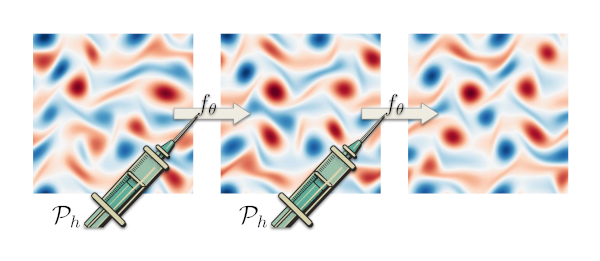
Convenience abstractions using optax to train neural networks to
autoregressively emulate time-dependent problems taking care of trajectory
subsampling and offering a wide range of training methodologies (regarding
unrolling length and including differentiable physics).
Installation
Clone the repository, navigate to the folder and install the package with pip:
pip install trainax
Requires Python 3.10+ and JAX 0.4.13+. 👉 JAX install guide.
Documentation
The documentation is available at fkoehler.site/trainax.
Quickstart
Train a kernel size 2 linear convolution (no bias) to become an emulator for the 1D advection problem.
import jax
import jax.numpy as jnp
import equinox as eqx
import optax  # pip install optax
import trainax as tx

CFL = -0.75

ref_data = tx.sample_data.advection_1d_periodic(
    cfl = CFL,
    key = jax.random.PRNGKey(0),
)

linear_conv_kernel_2 = eqx.nn.Conv1d(
    1, 1, 2,
    padding="SAME", padding_mode="CIRCULAR", use_bias=False,
    key=jax.random.PRNGKey(73)
)

sup_1_trainer, sup_5_trainer, sup_20_trainer = (
    tx.trainer.SupervisedTrainer(
        ref_data,
        num_rollout_steps=r,
        optimizer=optax.adam(1e-2),
        num_training_steps=1000,
        batch_size=32,
    )
    for r in (1, 5, 20)
)

sup_1_conv, sup_1_loss_history = sup_1_trainer(
    linear_conv_kernel_2, key=jax.random.PRNGKey(42)
)
sup_5_conv, sup_5_loss_history = sup_5_trainer(
    linear_conv_kernel_2, key=jax.random.PRNGKey(42)
)
sup_20_conv, sup_20_loss_history = sup_20_trainer(
    linear_conv_kernel_2, key=jax.random.PRNGKey(42)
)

FOU_STENCIL = jnp.array([1+CFL, -CFL])

print(jnp.linalg.norm(sup_1_conv.weight - FOU_STENCIL))   # 0.033
print(jnp.linalg.norm(sup_5_conv.weight - FOU_STENCIL))   # 0.025
print(jnp.linalg.norm(sup_20_conv.weight - FOU_STENCIL))  # 0.017
Increasing the supervised unrolling steps during training makes the learned stencil come closer to the numerical FOU stencil.
Background
After the discretization of space and time, the simulation of a time-dependent partial differential equation amounts to the repeated application of a simulation operator $\mathcal{P}h$. Here, we are interested in imitating/emulating this physical/numerical operator with a neural network $f\theta$. This repository is concerned with an abstract implementation of all ways we can frame a learning problem to inject "knowledge" from $\mathcal{P}h$ into $f\theta$.
Assume we have a distribution of initial conditions $\mathcal{Q}$ from which we sample $S$ initial conditions, $u^{[0]} \propto \mathcal{Q}$. Then, we can save them in an array of shape $(S, C, *N)$ (with C channels and an arbitrary number of spatial axes of dimension N) and repeatedly apply $\mathcal{P}$ to obtain the training trajectory of shape $(S, T+1, C, *N)$.
For a one-step supervised learning task, we substack the training trajectory into windows of size $2$ and merge the two leftover batch axes to get a data array of shape $(S \cdot T, 2, N)$ that can be used in supervised learning scenario
$$ L(\theta) = \mathbb{E}{(u^{[0]}, u^{[1]}) \sim \mathcal{Q}} \left[ l\left( f\theta(u^{[0]}), u^{[1]} \right) \right] $$
where $l$ is a time-level loss. In the easiest case $l = \text{MSE}$.
Trainax supports way more than just one-step supervised learning, e.g., to
train with unrolled steps, to include the reference simulator $\mathcal{P}_h$ in
training, train on residuum conditions instead of resolved reference states, cut
and modify the gradient flow, etc.
Features
- Wide collection of unrolled training methodologies:
- Supervised
- Diverted Chain
- Mix Chain
- Residuum
- Based on JAX:
- One of the best Automatic Differentiation engines (forward & reverse)
- Automatic vectorization
- Backend-agnostic code (run on CPU, GPU, and TPU)
- Build on top and compatible with Equinox
- Batch-Parallel Training
- Collection of Callbacks
- Composability
Acknowledgements
Citation
This package was developed as part of the APEBench paper (accepted at Neurips 2024), we will soon add the citation here.
Funding
The main author (Felix Koehler) is a PhD student in the group of Prof. Thuerey at TUM and his research is funded by the Munich Center for Machine Learning.
License
MIT, see here
fkoehler.site · GitHub @ceyron · X @felix_m_koehler · LinkedIn Felix Köhler
1 maintainer

Metadata
1 maintainer
Release files for trainax 0.0.2
For a detailed explanation of source distributions (sdists) and built distributions (wheels), please see the package formats documentation.
Source distribution (sdist)
| File | Size | Uploaded | |
|---|---|---|---|
| trainax-0.0.2.tar.gz | 29.1 kB | Details |
Built distribution (wheel)
| File | Interpreter | ABI | Platform | Reset |
|---|---|---|---|---|
| trainax-0.0.2-py3-none-any.whl | Python 3 | none | any | Details |
Total release size: 70.9 kB
Release files / trainax-0.0.2.tar.gz
| Download URL | trainax-0.0.2.tar.gz |
|---|---|
| Size | 29.1 kB |
| Tags | Source |
|
SHA-256 checksum How to use checksums |
3c7eeeb94e351db7ff0b036b1c1fb6f78ddc25ab72d6c1afe69547cbefa70ca8
|
|
BLAKE2b-256 checksum How to use checksums |
95e4ba802dff60d93f8701f9910546c848356b34816d67993d990efb0e5a7faf
|
| Upload date | |
|
Uploaded using Trusted Publishing? What is trusted publishing? |
Yes |
| Uploaded via |
twine/5.1.1 CPython/3.12.7
|
Release files / trainax-0.0.2-py3-none-any.whl
| Download URL | trainax-0.0.2-py3-none-any.whl |
|---|---|
| Size | 41.8 kB |
| Tags | Python 3 |
|
SHA-256 checksum How to use checksums |
402a798beb17534c61ca383ce354a2325c395e8fe6125603a73cdc85f30b8f0c
|
|
BLAKE2b-256 checksum How to use checksums |
d3f9747a4d67dcbb0e6925a0902abf9239ba9f80aeb672501db416459e9c77ec
|
| Upload date | |
|
Uploaded using Trusted Publishing? What is trusted publishing? |
Yes |
| Uploaded via |
twine/5.1.1 CPython/3.12.7
|














