
trainlint
Agent skills and an offline checker for ML bugs that do not crash.


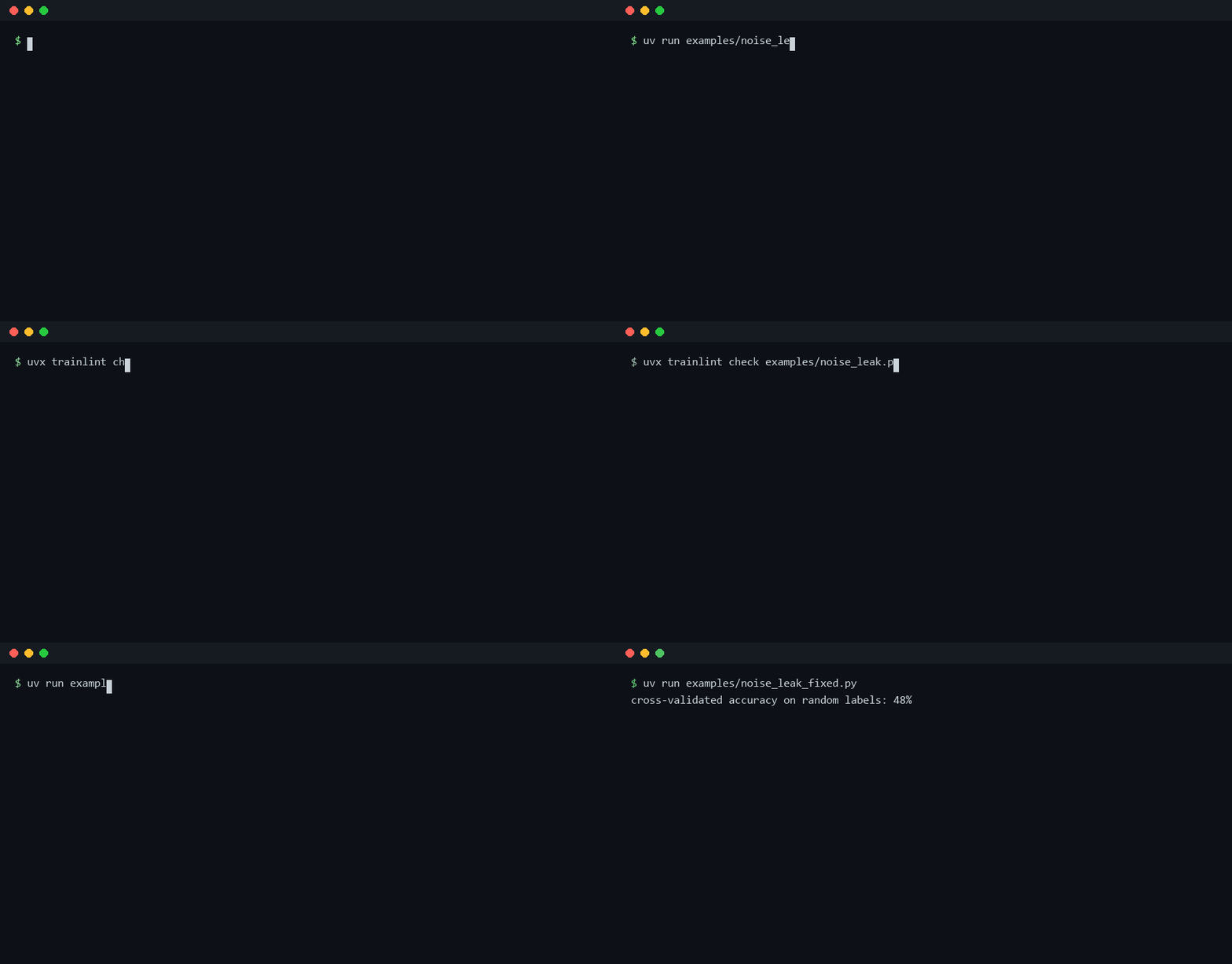
The 5,000 features and the labels are random, so no model can beat 50%. Picking features before
cross-validating reports 85%. The GIF is rendered from the real output of the commands shown;
assets/make_assets.py rebuilds it.
Install
uvx trainlint check .
or pipx install trainlint / pip install trainlint. It needs Python 3.10 or newer, has no
dependencies, and never touches the network or a GPU.
Quickstart
uvx trainlint check train.py     # find the bugs in a script, a folder, or a repo
uvx trainlint skills install     # teach your coding agent to avoid them
skills install copies four skills into ./.claude/skills. Use --agent agents for
./.agents/skills, --global for your user folder, or --dest DIR for any other place.
More ways to run the checker:
trainlint check src/ --ignore TL005   # skip a rule
trainlint check . --format json       # for scripts and CI
trainlint rules                       # list every rule
Exit code 0 means no findings, 1 means findings, 2 means a usage error. To silence a finding on one line:
scaler.fit(X_all) # trainlint: ignore[TL002] fitting on the pooled set is intended here
In GitHub Actions:
- run: uvx trainlint check .
Why it exists
ML code fails quietly. A scaler fitted before the split, a model left in eval mode, or a softmax
in front of CrossEntropyLoss still trains and still prints a number. Coding agents and people
both write these mistakes, and general linters do not know what the code is for. trainlint is a
small offline checker for the common cases, plus skills that tell an agent how to avoid them in
the first place.
What it does
- Twelve rules, TL001 to TL012, listed below and explained with examples in docs/rules.md.
- Each finding shows the line, a pointer into the code, and a one-line fix.
- Pure standard library. It parses the code and never runs it.
- Text or JSON output, rule selection, and per-line ignore comments.
- Four Agent Skills that cover the same ground and run the checker when it is installed.
| Rule | Flags |
|---|---|
| TL001 | Scaler, encoder, selector or resampler fitted on all rows before a split or cross-validation |
| TL002 | Transform or model fitted on a validation or test split |
| TL003 | model.eval() inside a training loop with no model.train() to switch back |
| TL004 | Evaluation under no_grad in a script that never calls model.eval() |
| TL005 | Training script that never sets a random seed |
| TL006 | float16 autocast without a GradScaler, or a scaled loss stepped without scaler.step |
| TL007 | Script that resumes from checkpoints but saves no optimizer state |
| TL008 | softmax or sigmoid at the end of a model trained with a logits loss |
| TL009 | Gradients never cleared, or cleared between backward() and step() |
| TL010 | Loss added to a running total or list as a tensor, keeping every graph alive |
| TL011 | y_true and y_pred swapped, or class labels passed to roc_auc_score |
| TL012 | Validation or test DataLoader with drop_last=True |
| Skill | Covers |
|---|---|
ml-data-leakage |
Splits, pipelines, grouped and time-ordered data, resampling, the test set |
ml-training-loop |
Modes, gradient order, loss inputs, shapes, seeds, mixed precision |
ml-metrics-eval |
Argument order, scores versus labels, averaging, imbalance, variance |
ml-checkpoint-resume |
What a checkpoint must hold, best versus last, verifying a resume |
How far to trust it
The checks parse each file with Python's ast module and match calls by name. There is no type
inference and no cross-file analysis, so:
- Splits are recognized by variable names such as
X_train,val_loaderandy_test. - A bug whose cause sits in another file is not seen.
- A heuristic can be wrong. When it is, add an ignore comment and open an issue.
python -m bench runs the checker over a corpus of 18 buggy scripts, one or two per rule, each
with a fixed twin:
rule    buggy files  caught   false alarms on fixed twins
TL001             3       3                             0
TL002             1       1                             0
TL003             1       1                             0
TL004             1       1                             0
TL005             1       1                             0
TL006             2       2                             0
TL007             1       1                             0
TL008             2       2                             0
TL009             2       2                             0
TL010             1       1                             0
TL011             2       2                             0
TL012             1       1                             0
total            18      18                             0
I wrote that corpus together with the rules, so it guards against regressions and says nothing about accuracy on code I have not seen.
For a check on someone else's code, I ran it over all 93 Python files of
pytorch/examples at commit acc295d and read every
finding:
git clone https://github.com/pytorch/examples && cd examples
git checkout acc295dc7b90714f1bf47f06004fc19a7fe235c4
trainlint check .
It reports 21 findings. By my reading, 19 are real: 15 scripts never set a seed (one declares a
--seed option and never uses it), 3 tensor-parallel scripts never clear gradients, and one script
resumes from a snapshot without saving optimizer state. Two more are correct as written but
harmless, because those models have no dropout or batch norm to leave in training mode. The first
run also flagged three distributed-autograd scripts for missing zero_grad(), which was a false
positive that is now fixed. This is one repository of tutorial code and I did the reviewing, so
treat it as a spot check. It tells you nothing about what the rules miss.
Compared with other tools
| Tool | What it covers | Where trainlint differs |
|---|---|---|
| ruff, pylint, flake8 | General Python style and bugs | None of their rules know about splits, eval mode or metrics. Use them alongside trainlint. |
| TorchFix | Removed and deprecated PyTorch functions, requires_grad typos, unsafe torch.load |
Its README lists no rules for training logic. trainlint does not check API deprecations. |
| mllint | Repository-level quality of ML projects: version control, dependencies, code quality | It looks at project hygiene. trainlint reads training and evaluation code. |
| Deepchecks | Checks that run on real datasets and models, including drift | Deepchecks needs your data and model loaded. trainlint reads source only and runs nothing. |
| General skill collections | Engineering process for coding agents | They are not specific to ML. trainlint's skills target training and evaluation code and come with a checker. |
Roadmap
- Jupyter notebook support
- SARIF output for GitHub code scanning
- Settings in
pyproject.toml - More rules: training loaders without shuffling,
retain_graphin a loop, normalization on a whole DataFrame before the split - A benchmark that measures how often an agent writes these bugs with and without the skills (needs an API key, so it will be optional)
Issues labeled good first issue are small and have a clear definition of done.
Contributing
False positives and missed bugs are the most useful reports. See CONTRIBUTING.md for setup and for how to add a rule.
uv sync
uv run pytest
uv run ruff check . && uv run ruff format --check .
uv run python -m bench
License
MIT
If trainlint saved you an afternoon, a star on the repository helps other people find it.
1 maintainer

Metadata
1 maintainer
Release files for trainlint 0.1.1
For a detailed explanation of source distributions (sdists) and built distributions (wheels), please see the package formats documentation.
Source distribution (sdist)
| File | Size | Uploaded | Provenance | Actions |
|---|---|---|---|---|
| trainlint-0.1.1.tar.gz | 222.5 kB | Without provenance | Details for trainlint-0.1.1.tar.gz |
Built distribution (wheel)
| File | Interpreter | ABI | Platform | Actions Reset |
|---|---|---|---|---|
| trainlint-0.1.1-py3-none-any.whl | Python 3 | none | any | Details for trainlint-0.1.1-py3-none-any.whl |
Total release size: 253.8 kB
Release files / trainlint-0.1.1.tar.gz
| Download URL | trainlint-0.1.1.tar.gz |
|---|---|
| Size | 222.5 kB |
| Tags | Source |
|
SHA-256 checksum How to use checksums |
ce483d123c03c12e862c338e3aea0e612e4a2f90c4604f81db1ea8b827c58cf6
|
|
BLAKE2b-256 checksum How to use checksums |
ea729f293ec9462af88e96654c4da118dde1c6106c2eab37f4bbafabcf26f8c8
|
| Upload date | |
|
Uploaded using Trusted Publishing? What is trusted publishing? |
No |
| Uploaded via |
uv/0.13.1 {"installer":{"name":"uv","version":"0.13.1","subcommand":["publish"]},"python":null,"implementation":{"name":null,"version":null},"distro":null,"system":{"name":null,"release":null},"cpu":null,"openssl_version":null,"setuptools_version":null,"rustc_version":null,"ci":null}
|
Release files / trainlint-0.1.1-py3-none-any.whl
| Download URL | trainlint-0.1.1-py3-none-any.whl |
|---|---|
| Size | 31.3 kB |
| Tags | Python 3 |
|
SHA-256 checksum How to use checksums |
3b71675059ee1a7783dce7178cc78acd3d5dcdd24b56c112054b2c2ae16e20ef
|
|
BLAKE2b-256 checksum How to use checksums |
d54f917ac5de5678416ec28f7518dbb0d91aa89e69a1a418c2a2bfe40482b8a1
|
| Upload date | |
|
Uploaded using Trusted Publishing? What is trusted publishing? |
No |
| Uploaded via |
uv/0.13.1 {"installer":{"name":"uv","version":"0.13.1","subcommand":["publish"]},"python":null,"implementation":{"name":null,"version":null},"distro":null,"system":{"name":null,"release":null},"cpu":null,"openssl_version":null,"setuptools_version":null,"rustc_version":null,"ci":null}
|
Security for trainlint 0.1.1
Provenance
Provenance describes where a file came from. On PyPI, provenance is shared via attestations, which provide a verifiable record of the build or publishing details. View details, limitations and caveats.
No provenance found
None of the files in this release were uploaded with provenance metadata.
A note on package security
PyPI is a repository for distributing packages, not a service for auditing them. While third-party security researchers and our staff do their best to detect and remove malicious packages, PyPI cannot guarantee the quality, security or suitability of any given package.
To learn more about protecting yourself from malicious actors, visit our package security documentation.














