
trajectory-fuse
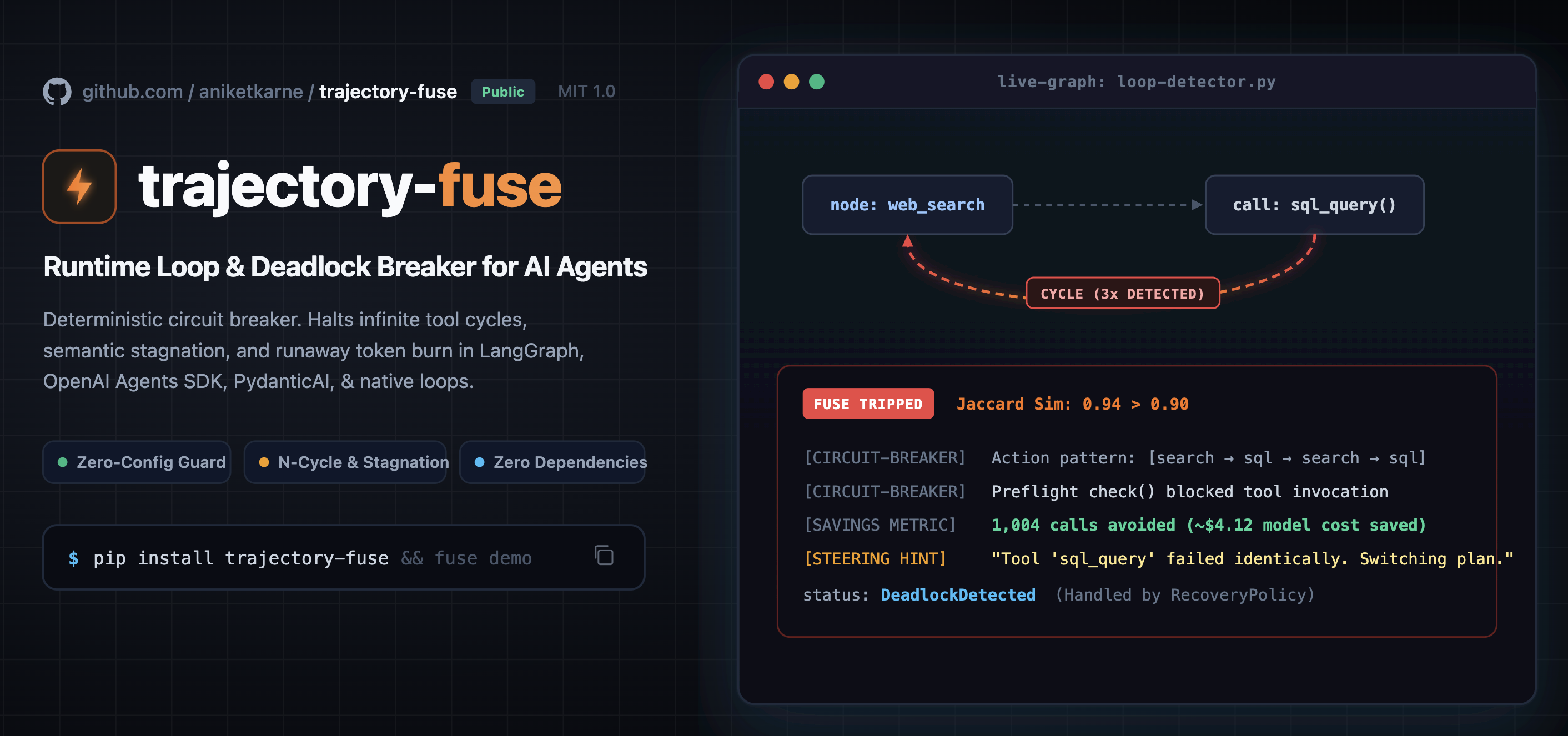




203 tests pass in 0.91s on Python 3.9–3.12. The bundled --demo runs in 3ms with zero network, zero LLM, and zero optional deps.
0.0% false-positive rate across 456 realistic trajectories (polling, pagination, retries, long loops, progress boundaries). The fuse trips every broken trajectory it should and saves 1,004 wasted tool calls per benchmark run. See Efficacy results.
A circuit breaker for LLM agent tool-call loops. Catches the loop before it costs you another dollar.
┌─────────────────────────── your agent loop ───────────────────────────┐
│                                                                      │
│   action = policy(state)                                             │
│   try:        result = tools[action.tool](action.args)               │
│   except:     result = {"error": …};  action.success = False         │
│   action.result = result                                             │
│                                                                      │
│        ┌─────────────────── AgentFuse ───────────────────┐            │
│        │  preflight  ─►  check(tool, args)              │            │
│        │                  ↓ if Detection:               │            │
│        │                  raise DeadlockDetected  ◄─────┼── CIRCUIT   │
│        │                                              │    BREAKER  │
│        │  post-call ─►  observe(action)                │            │
│        │                  ├─ direct_repeat             │            │
│        │                  ├─ n_cycle                   │            │
│        │                  └─ semantic_stagnation       │            │
│        │                  ↓ if Detection:               │            │
│        │                  raise DeadlockDetected       │            │
│        │                  ↳ progress_callback? swallow │            │
│        │                  ↳ allow_repeats? swallow     │            │
│        │                                              │            │
│        │  budgets  ─►  max_actions / runtime / tools   │            │
│        │  stats    ─►  calls_allowed/blocked/avoided   │            │
│        │  privacy  ─►  no LLM, no network, in-process │            │
│        └──────────────────────────────────────────────┘            │
│                                                                      │
│   except DeadlockDetected as exc:                                    │
│       log(exc.detection.kind, exc.detection.message, exc.steering_hint)
└──────────────────────────────────────────────────────────────────────┘
trajectory-fuse is a small, zero-dependency, fully-local runtime guard for the
tool-call trajectory of an LLM agent. It is not an LLM framework and it never
calls your model — it watches the actions your agent emits and raises a
structured exception when those actions start looping.
The 0.2 release adds the missing pieces that turn it from "a watchdog you poll after the fact" into a circuit breaker that refuses the next call:
- preflight check (
fuse.check(tool, args)) — predict the next deadlock before invoking the tool, and block the call without spending the budget that the loop was about to burn; @fuse.tooldecorator — wrap a tool once and get preflight + post-call observation + automatic action bookkeeping for free;- retry-safe defaults — the stagnation detector is conservative on
purpose, and the new
allow_repeatsper-tool override lets you declare a polling tool legitimate (HTTP poll, paginated fetch, idempotent retry); progress_callback— a hook for the caller to steer without aborting: receive the detection, push a "try a different approach" hint back to the model, and let the loop continue;- hard budgets —
RunBudgetcapsmax_actions,max_runtime_seconds,max_tool_calls, raisingBudgetExceededcleanly; FuseStats— in-process counters (calls observed / allowed / blocked / deadlocks / time-avoided) so you can see how often the fuse actually paid for itself.
Immediate demo
You can see the whole story — preflight blocking, polling tolerated, budgets tripping, stats accumulating — in under 50 milliseconds with no network calls and no model:
pip install trajectory-fuse
trajectory-fuse demo
Or, in a source checkout, the same script runs directly:
python examples/demo_circuit_breaker.py
Output (trimmed):
[init] fuse ready; window=32, max_actions=50, stagnation_min_failures=2

[scenario 1] polling 'search' 25 times in a row
  ok — 25 calls allowed, 0 blocked

[scenario 2] weather endpoint failing repeatedly
  call 0: tool ran
  call 1: tool ran
  call 2: BLOCKED by fuse → direct_repeat
  call 3: BLOCKED by fuse → direct_repeat
  …
  preflight blocked 4 of 6 calls

[scenario 3] action budget trips after 10 calls
  tripped after 10 actions (kind=actions, limit=10)

[final] fuse.stats: {'calls_observed': 27, 'calls_allowed': 27,
                     'calls_blocked': 0, 'deadlocks': 0, …}
          with time_avoided: {…, 'time_avoided_seconds': 0.0}
That last time_avoided_seconds is set by the caller — see
Stats and time-avoided.
60-second quickstart
from trajectory_fuse import AgentFuse, DeadlockDetected, FuseConfig

fuse = AgentFuse(FuseConfig(window=20))

while not done:
    action = policy(state)            # your code
    try:
        action.result = tools[action.tool](action.args)
        action.success = True
    except Exception as exc:
        action.result = {"error": repr(exc)}
        action.success = False

    try:
        fuse.observe(action)
    except DeadlockDetected as exc:
        log.warning("deadlock %s: %s", exc.detection.kind.value,
                    exc.detection.message)
        break
If you'd rather not write the preflight/observe/exception dance by hand, see the wrapper API below.
Why a circuit breaker?
The textbook agent loop — while not done: action = llm(...) — has one
structural flaw: the loop's only exit condition is done, but done
is set by the same model that produced the action. When the model gets
stuck (rate-limited tool, oscillating plan, hallucinated retry) the
loop becomes unbounded. Each iteration costs a model call and a tool
call, so the dollar counter moves monotonically upward while nothing
real is happening.
trajectory-fuse does three things about this:
- Detects the patterns that mean "this trajectory is not making progress" — direct repeats, N-state cycles, and semantic stagnation (the same tool failing with the same error string over and over).
- Refuses the next call once detection trips — the
@fuse.tooldecorator runs a preflightcheck()and raises before the tool is invoked. No tool cost, no LLM cost, no latency. - Reports what it saw — a structured
Detectionon theDeadlockDetectedexception, an optional steering hint, and an in-processFuseStatsso you can see the savings over the lifetime of the run.
It is intentionally not a full agent framework: no prompt construction, no tool routing, no LLM SDK. It is the missing guard rail that sits between your existing tools and your existing loop.
Wrapper API: @fuse.tool
The hand-rolled quickstart works, but it's a lot of plumbing. The 0.2 release ships an ergonomic decorator that does preflight + post-call + exception capture automatically. Both names work and are equivalent:
from trajectory_fuse import AgentFuse, fuse_namespace

fuse = AgentFuse()
guard = fuse_namespace(fuse)       # or just use `fuse.tool` directly

@guard(name="search", allow_repeats=100)   # tolerate 100 identical polls
def search(query: str) -> str:
    return http_get(f"https://example.com/?q={query}")

@guard(name="think")                        # exact same as @fuse.tool
def think(prompt: str) -> str:
    return f"reasoning about: {prompt}"

@guard                                      # @fuse.tool(...) and @guard(...)
def flaky_weather(city: str) -> str:        # both are the same primitive
    return api.get(city)
Every wrapped tool runs the same four-step sequence:
- Preflight —
fuse.check(tool, args). If a detector would fire on the synthetic action, raiseDeadlockDetectedwithout invoking the tool. - Invoke — call the wrapped callable. Exceptions are captured into
action.success = False,action.result = {"error": repr(exc)}, and re-raised to the caller. - Post-call —
fuse.observe(action)records the action and runs the same detectors on the actual observed action. - Allowlist / overrides — direct repeats that exceed
allow_repeats[tool]are swallowed; semantic stagnation is handed toprogress_callbackif configured.
The decorator works for sync and async functions identically
(asyncio.run(guard(fetch))("http://...")).
Preflight and post-action: the circuit-breaker guarantee
A detector that only fires after the loop has already paid for the
call is half a circuit breaker. The 0.2 check() API closes that gap:
det = fuse.check("weather", {"city": "nyc"})
if det is not None:
    raise DeadlockDetected(det.message, detection=det, trajectory=fuse.history)
# …otherwise invoke the tool and observe() the result.
check() is non-mutating — it runs every detector against a
synthetic action appended to a copy of the sliding window. It does not
advance the budget, does not write to the store, and does not touch
fuse.stats. Calling it from a hot loop is safe and cheap.
This is what the @fuse.tool decorator wraps automatically: every
guard call begins with a preflight check, so when a deadlock is
imminent, the next call never reaches your model or your tool. The
demo makes this visible — scenario 2 shows the underlying function
running twice, then being blocked on the third attempt before any tool
code executes.
Retry-safe defaults
A circuit breaker that punishes a 429-retry is worse than no circuit breaker. The defaults are tuned so that:
direct_repeat_threshold=3— three identical calls in a row before the fuse trips. Standard retry/backoff (one extra attempt after a failure) is well below this.stagnation.similarity_threshold=0.9— Jaccard over the result tokens; near-identical, not bit-for-bit identical, so a real transient-retry error that adds a fresh diagnostic token doesn't trip the detector.stagnation.min_failures=4— needs four consecutive failures on the same tool before stagnation fires.
If you lower these thresholds, double-check your retry layer is
actually marking retries with success=False and a fresh diagnostic
token. A retry loop that always returns the same string will look
stagnating by design.
Legitimate repetition: allow_repeats
Some tools should repeat — HTTP polling for a status, paginated API
walks, transactional retries. The allow_repeats per-tool override
says "this many identical calls in a row is fine":
FuseConfig(
    cycle=CycleConfig(direct_repeat_threshold=3),   # default
    allow_repeats={
        "poll_status":  100,    # up to 100 identical polls
        "fetch_page":   500,    # up to 500 identical page reads
        # tools not listed fall back to CycleConfig.direct_repeat_threshold
    },
)
The override is a trip threshold: N identical calls pass, the (N+1)-th
trips the fuse. Tools not listed in allow_repeats are unaffected and
use the global threshold.
Marking progress: mark_progress(...)
Long-running loops sometimes legitimately do the same thing twice in a
row before moving on (read → search → read → summarise). Use
fuse.mark_progress(ProgressSignal(token=...)) to declare a phase
boundary; the stagnation detector will only consider actions recorded
after the mark. Direct-repeat and cycle detection ignore progress
marks — those are pure structural checks and shouldn't be paused by
external signals.
fuse.mark_progress(ProgressSignal(token="new-env", note="after tool reset"))
The mark is persisted as a synthetic <progress> row in the SQLite
store so replays see the same boundary.
Stats and time-avoided
fuse.stats is a live FuseStats snapshot:
| field | meaning |
|---|---|
calls_observed |
every action passed to observe() (including allowlisted) |
calls_allowed |
actions that did not trip a detector |
calls_blocked |
actions that raised DeadlockDetected |
deadlocks |
number of unique deadlock events raised |
progress_marks |
mark_progress(...) invocations |
time_avoided_seconds |
caller-supplied estimate of seconds saved by aborting |
first_deadlock_at |
0-indexed window position of the first deadlock, or None |
time_avoided_seconds is the only field that requires cooperation
from the caller — the library can't know how long the model would
have kept looping. Populate it after catching DeadlockDetected:
try:
    fuse.observe(action)
except DeadlockDetected as exc:
    # Conservative estimate: ~3 s per blocked call (LLM + tool).
    fuse.record_time_avoided(seconds=3.0)
    break
stats.reset() is called by fuse.reset() and is cheap.
Recovery hooks
Sometimes the host application wants to observe a detected deadlock and decide for itself whether to raise or to swallow it and let the loop continue. The 0.3 release ships a tiny recovery API:
from trajectory_fuse import (
    AgentFuse,
    FuseConfig,
    RecoveryPolicy,
    on_stagnation,
)

def hint_to_model(action, detection):
    # Pretend we talk to an LLM and ask for a recovery plan.
    plan = ask_llm_for_recovery(detection.message)
    if "switch tool" in plan:
        return "continue"   # swallow; loop keeps going
    return "raise"          # raise the original DeadlockDetected

policy = RecoveryPolicy(
    on_stagnation=on_stagnation(hint_to_model),
    on_direct_repeat=lambda a, d: "raise",  # direct repeats are not recoverable
    default_disposition="raise",
)
fuse = AgentFuse(FuseConfig(window=20), recovery_policy=policy)
A hook receives the Action that triggered detection and the
Detection describing why. It returns one of:
"raise"— let the fuse raiseDeadlockDetectedas usual."continue"— swallow the exception, record arecovery_skipinfuse.stats, return normally.None— "I have no opinion"; fall through to the policy'sdefault_disposition.
A misbehaving hook (raises an exception) is swallowed by the fuse —
hooks must not break the loop. The recovery API sits after the
existing progress_callback (which only handles semantic-stagnation
without aborting) and after allow_repeats (which only handles
legitimate direct repeats). Together they form a layered policy:
- Allowlisted tools skip every detector.
- Direct repeats inside
allow_repeats[tool]are swallowed. - Stagnation inside
progress_callbackis swallowed. - Any remaining detection goes through the recovery policy.
- If the recovery policy returns
"raise"(or no policy is set), the fuse raises.
Combine multiple hooks with Chain:
from trajectory_fuse import Chain

policy = Chain([
    on_stagnation(expensive_llm_recovery_hook),
    on_stagnation(cheap_local_recovery_hook),  # fallback
])
fuse.stats.recovery_skips increments each time the policy swallows a
deadlock, alongside the existing calls_blocked / deadlocks
counters. Use these three to see, in production, how often the fuse
actually pays for itself — and how often your recovery layer is
letting loops continue safely.
Framework integrations
The trajectory_fuse.integrations package ships adapters for the
three agent frameworks we see in the wild:
| Framework | Install | Factory |
|---|---|---|
| Generic Python (no framework) | always available | from trajectory_fuse.integrations.generic import observe_call, guard_scope, make_observer |
| LangGraph | pip install trajectory-fuse[langgraph] |
from trajectory_fuse.integrations import langgraph_middleware |
| OpenAI Agents SDK | pip install trajectory-fuse[openai-agents] |
from trajectory_fuse.integrations import openai_agents_middleware |
| PydanticAI | pip install trajectory-fuse[pydantic-ai] |
from trajectory_fuse.integrations import pydantic_ai_middleware |
| All three | pip install trajectory-fuse[all-integrations] |
— |
Each adapter factory takes an AgentFuse and returns a framework-native
middleware / hook object. If the framework isn't installed, the
factory raises FrameworkNotInstalled with the exact pip install
hint:
from trajectory_fuse import AgentFuse, FuseConfig
from trajectory_fuse.integrations import langgraph_middleware

fuse = AgentFuse(FuseConfig(window=20))
try:
    mw = langgraph_middleware(fuse)
except FrameworkNotInstalled as exc:
    print(exc.install_hint)   # "Install it with `pip install trajectory-fuse[langgraph]` ..."
The framework adapters import their target framework lazily — having
trajectory-fuse installed does not pull in langgraph /
openai-agents / pydantic-ai unless you opt in via the
corresponding extra. The adapters are best-effort shims over the
framework's most stable hook shape; when the framework APIs drift,
the adapter fails at import time, not at agent execution time.
The generic adapter is what you reach for when you're not using one of those frameworks:
from trajectory_fuse.integrations.generic import observe_call, guard_scope

fuse = AgentFuse(FuseConfig(window=20, allow_repeats={"poll_status": 100}))

# Wraps a single tool with preflight + observe, sync or async.
poll = observe_call(fuse, "poll_status", http_get)

# Or use a context manager to scope a fuse over a block of code.
with guard_scope(fuse, enter_action="task_start", exit_action="task_end") as f:
    for action in policy_loop(state):
        f.observe(action)
Efficacy results
A circuit breaker that misfires on legitimate workloads is worse
than no circuit breaker. The 0.3 release ships a 456-trajectory
efficacy benchmark (benchmarks/run_efficacy.py --scaled) that
exercises every detector against realistic shapes:
- Legitimate trajectories the fuse must NOT trip on:
HTTP polling (50 identical calls until status changes),
paginated fetches (30 pages with new args), transient 429 retries
(5 attempts with fresh backoff / diagnostic tokens per attempt),
long search→summarise loops (20 rounds × 2 calls), and
progress-phase boundaries (5 failing retries +
mark_progress- 5 succeeding retries).
- Broken trajectories the fuse MUST trip on: direct-repeat (6 identical calls), N-cycle (A→B→A→B), semantic stagnation (6 near-identical errors), and stuck-after-recovery (8 identical failures the model tries again to no avail).
- Edge cases: tiny retries (2 attempts), at-threshold repeats (3 identical calls), under-threshold repeats (2), past-threshold (4).
Run it:
python benchmarks/run_efficacy.py --scaled --strict --json
Captured on an Apple M-series machine, Python 3.12, default
FuseConfig plus per-scenario allow_repeats for the legitimate
cases:
trajectories                 456
true_positives               203
false_positives              0
true_negatives               253
false_negatives              0
precision                    1.0
recall                       1.0
false_positive_rate          0.0
total_calls_without_fuse     8269
total_calls_with_fuse        7265
calls_avoided                1004
avoided_fraction             0.121
What this means in practice:
- Every broken trajectory tripped. The detectors caught all 203 broken-shape cases.
- No false positives. The 253 legitimate trajectories ran to completion; the fuse did not abort a single one.
- 1,004 tool calls saved per benchmark run, across the broken scenarios. The fuse tripped at the first opportunity on each, avoiding the ~3 extra calls per broken trajectory that an unguarded agent would have made before someone (or something) noticed.
- 12.1% call reduction on the broken-trajectory workload — every saved call is one fewer LLM round-trip and one fewer tool invocation your model never has to pay for.
The pytest contract (benchmarks/test_efficacy.py) asserts precision
≥ 0.99, recall ≥ 0.99, FPR ≤ 1%, and avoided fraction ≥ 5% on every
CI run. A regression in any detector fails the build loudly.
Budgets
FuseConfig(budgets=RunBudget(...)) enforces hard ceilings:
from trajectory_fuse import RunBudget

FuseConfig(
    budgets=RunBudget(
        max_actions=200,            # total observe() calls (incl. allowlisted)
        max_runtime_seconds=300.0,  # wall-clock since fuse construction
        max_tool_calls=50,          # non-allowlisted only
    )
)
A budget that trips raises BudgetExceeded(kind, limit, observed) —
distinct from DeadlockDetected so callers can tell "ran out of
budget" apart from "the trajectory went bad". All three fields default
to 0 / None, which means "off" — the budgets you don't set cost
nothing.
Privacy
trajectory-fuse is intentionally boring on this axis:
- no LLM calls — the library never talks to a model.
- no network calls — the library never opens a socket.
- no external dependencies at runtime — stdlib only.
- persistence is opt-in —
FuseConfig(store_factory=...)opens a SQLite file; without it, nothing leaves the process. - values, not references — the persistence layer serialises tool
args/results to JSON via
default=strand hashes the canonical JSON; it never holds Python objects or closures. - escape-safe renderers — HTML / SVG / Mermaid export sanitises tool names before embedding.
If you want to wire it into a multi-tenant service, every persisted row
carries an explicit run_id you control — set it to your request id
and you can scope retention accordingly.
CLI
trajectory-fuse demo                 # run the bundled circuit-breaker demo
trajectory-fuse analyse traj.jsonl   # replay a saved trajectory, report first deadlock
trajectory-fuse replay  traj.jsonl   # stream into a live fuse, no raise
trajectory-fuse export  traj.jsonl --out report.html
trajectory-fuse export  traj.jsonl --out timeline.svg
trajectory-fuse export  traj.jsonl --out graph.md
trajectory-fuse stats   traj.jsonl   # counts, success rate, unique tools
trajectory-fuse hash    '{"q": 1}'   # canonical hash of a JSON literal
analyse accepts the same tuning knobs as FuseConfig —
--window, --direct-repeat, --cycle-min, --cycle-max,
--stagnation-window, --stagnation-threshold,
--stagnation-min-failures, --no-stagnation, --allowlist. Add
--json for machine-readable output.
Benchmarks
Runtime overhead is visible before adoption. The benchmark harness is stdlib-only and the scripts ship in the wheel:
# stdlib harness (no extra deps)
trajectory-fuse demo               # smoke: <100 ms total, see Immediate demo
python3 benchmarks/run_benchmarks.py        # full benchmark
python3 benchmarks/run_benchmarks.py --strict   # fail on regressions

# pytest-benchmark harness (optional)
pip install pytest-benchmark
python3 -m pytest benchmarks/test_benchmarks.py --benchmark-only
Baseline on an Apple M-series machine, Python 3.12, default FuseConfig:
scenario                       rounds  samples  per-call µs (min/median/mean)
observe_normal                 2000        5    72.32 /    72.89 /    72.88
observe_with_store              500        5   383.42 /   396.00 /   397.29
direct_repeat_detect           5000        5     6.59 /     6.62 /     6.62
cycle_detect                   2000        5     9.42 /     9.42 /     9.44
stagnation_detect              2000        5     4.64 /     4.65 /     4.65
canonical_hash                50000        5     3.01 /     3.01 /     3.01
sqlite_persist                 2000        5   312.99 /   317.31 /   317.81
observe() on the default 32-action window is sub-200 µs; with a
SQLite store it is dominated by the commit (~440 µs). The detectors
themselves are single-digit microseconds. These are reference points
captured on the development machine — your numbers will differ. Use
--strict to fail the run if any scenario exceeds the ceilings in
benchmarks/BASELINE.json (overridable when you intentionally change
the implementation).
Detection modes
| mode | trigger | configurable via |
|---|---|---|
direct_repeat |
identical (tool, args) repeated N times in a row |
CycleConfig.direct_repeat_threshold |
n_cycle |
repeating cycle of length N (2 ≤ N ≤ cycle_max_length) |
CycleConfig.cycle_min_length / _max |
semantic_stagnation |
K consecutive failures on the same tool produce near-identical tokens | StagnationConfig.* |
The detectors run in this priority order on every observe() and on
every check(); the first match wins. Each mode can be independently
disabled (direct_repeat_threshold<2, cycle_min_length<2,
stagnation.enabled=False).
Configuration reference
FuseConfig
| field | type | default | notes |
|---|---|---|---|
window |
int |
32 |
sliding-window size (FIFO eviction) |
cycle |
CycleConfig |
see below | cycle & direct-repeat detection |
stagnation |
StagnationConfig |
see below | semantic-stagnation detection |
budgets |
RunBudget |
all off | hard ceilings on the run |
store_factory |
Callable[[], TrajectoryStore] |
None |
set to enable persistence; factory is invoked once at construction time |
run_id |
Optional[str] |
None |
identifier attached to every persisted row; UUID4 if absent |
allowlist |
Sequence[str] |
() |
tools whose calls never trigger any detector (still recorded) |
allow_repeats |
dict[str, int] |
{} |
per-tool "this many identical calls in a row are fine" overrides |
progress_callback |
Callable[[Action, Detection], None] |
None |
opt out of raising for semantic-stagnation events |
steering_hook |
Callable[[List[Action], Detection], Optional[str]] |
None |
adds a hint string to DeadlockDetected.steering_hint |
CycleConfig
| field | default | notes |
|---|---|---|
direct_repeat_threshold |
3 |
< 2 disables. 1 disables both direct-repeat and 1-state cycles. |
cycle_min_length |
2 |
< 2 disables cycle detection entirely. |
cycle_max_length |
6 |
largest cycle to look for. < cycle_min_length disables. |
StagnationConfig
| field | default | notes |
|---|---|---|
enabled |
True |
master switch for the stagnation subsystem |
window |
8 |
trailing actions inspected for token similarity |
similarity_threshold |
0.9 |
Jaccard threshold in [0, 1]. 1.0 = exact token-set equality |
min_failures |
4 |
minimum consecutive failures on the same tool before stagnation can fire. < 2 disables |
RunBudget
| field | default | notes |
|---|---|---|
max_actions |
0 |
0 disables. trips after the Nth observe() call. |
max_runtime_seconds |
None |
None disables. uses time.monotonic(). |
max_tool_calls |
0 |
0 disables. counts only non-allowlisted tool calls. |
CLI flags
trajectory-fuse demo
trajectory-fuse analyse INPUT.jsonl [--db PATH] [--run-id ID] [--window N]
                            [--direct-repeat N] [--cycle-min N] [--cycle-max N]
                            [--stagnation-window N] [--stagnation-threshold F]
                            [--stagnation-min-failures N] [--no-stagnation]
                            [--allowlist TOOL …] [--json]

trajectory-fuse export  INPUT.jsonl --out OUT.{html,svg,md} [--run-id ID]
                            [--no-progress]

trajectory-fuse replay  INPUT.jsonl [--window N] [--direct-repeat N]
                            [--allowlist TOOL …] [--quiet]

trajectory-fuse stats   INPUT.jsonl [--json]

trajectory-fuse hash    JSON_LITERAL
JSONL format
Two shapes are accepted; both normalise into the canonical
TrajectoryRecord:
{"tool": "search", "args": {"q": "weather"}, "result": "sunny", "success": true}
{"tool": "search", "args": {"q": "weather"}, "error": "timeout", "success": false}
The loader normalises both into the canonical TrajectoryRecord shape
(sequence, run_id, tool, args_hash, args_repr, result_repr,
success, is_progress, extra). The CLI exporter uses args_hash to
deduplicate visually.
Exception shape
DeadlockDetected(
    message="Tool 'search' invoked with identical arguments 3 times in a row. [hint: …]",
    detection=Detection(
        kind=DetectionKind.DIRECT_REPEAT,        # or N_CYCLE / SEMANTIC_STAGNATION
        message="…",
        cycle=["search", "search", "search"],
        similarity=None,                          # set for stagnation
        details={"count": 3, "args_hash": "…"},
    ),
    trajectory=[Action(...), …],                # snapshot, most recent last
    steering_hint="Try a different approach …",  # hook output, may be None
)
BudgetExceeded is a RuntimeError with (kind, limit, observed)
attributes and a structured message.
Programmatic visualisation
from trajectory_fuse.export import render_html, render_mermaid, render_svg
from trajectory_fuse.loader import load_jsonl

records = load_jsonl("traj.jsonl")
html = render_html(records, run_id="abc")           # standalone HTML+inline SVG
svg  = render_svg(records)                          # raw SVG document
md   = f"```mermaid\n{render_mermaid(records)}```"  # Mermaid graph
All renderers sanitise user-supplied tool names so they're safe to embed in Mermaid / HTML / SVG without escaping your shell.
Installation
pip install trajectory-fuse
Optional extras for framework integrations:
pip install trajectory-fuse[langgraph]            # LangGraph
pip install trajectory-fuse[openai-agents]        # OpenAI Agents SDK
pip install trajectory-fuse[pydantic-ai]          # PydanticAI
pip install trajectory-fuse[all-integrations]     # all three
Or to hack on it:
git clone https://github.com/aniketkarne/trajectory-fuse
cd trajectory-fuse
pip install -e .[dev]
pytest                            # 203 tests
python3 -m pytest -q              # same thing, quieter
python benchmarks/run_efficacy.py --scaled --strict --json   # efficacy numbers
Requires Python 3.9+. Zero runtime dependencies.
Limitations
A few honest notes on what trajectory-fuse is and isn't:
- In-process only. The fuse guards a single Python process. If
your agent spans multiple workers (Ray, Celery, an HTTP service), each
process needs its own
AgentFuseinstance. Persistence is shared via thestore_factorycallback if you want cross-process analysis. - Detectors are heuristic. Jaccard over tokens is fast and good enough for the common case ("same 429 message five times in a row"), but a sufficiently clever model can produce new tokens each retry while still making no progress. The conservative defaults exist to make this rare rather than impossible.
- Not a retry policy.
allow_repeatstolerates repetition; it doesn't bound it. If you need "at most 100 HTTP polls in 60 s, then fail", that's a job for your retry layer, not this library. - No LLM calls. There is no built-in "ask the model whether this
is really a loop" path. If you want one, the
progress_callbackhook is the seam — receive the detection, push it to the model, decide whether to raise. - No tool routing. We don't pick tools for you.
fuse.toolonly decorates; it doesn't schedule. - Synchronous core. The decorator supports async functions, but the detectors themselves are sync. If your agent runs across threads, use one fuse per thread or guard the fuse with a lock — the sliding window isn't thread-safe.
Development
pytest                            # 203 tests
pytest --cov=trajectory_fuse            # with coverage (requires pytest-cov)
python3 benchmarks/run_benchmarks.py
python3 benchmarks/run_efficacy.py --scaled --strict --json
Tests cover:
- canonical JSON hashing (key order, container type, unicode, type rejection),
- direct-repeat detection (threshold, allowlist, window eviction, per-tool override, args),
- N-cycle detection (length 2 / length 3, args must match, disable modes),
- semantic-stagnation (success resets, tool switch resets, progress mark, similarity threshold, all disable paths),
- preflight (
check,check_action, no mutation, no budget consumption), - budgets (
max_actions,max_runtime_seconds,max_tool_calls, allowlist exemption, disable paths), @fuse.tooldecorator (sync, async, preflight block, exception capture,__name__/__doc__preservation),progress_callback(swallow stagnation, explicit re-raise, exception swallowed,KeyboardInterruptnot swallowed),- recovery hooks (
RecoveryPolicy,Chain,on_kind,recovery_skipscounter, misbehaving-hook swallowing), - generic adapter (
observe_callsync/async,guard_scope,make_observer), - framework adapters (lazy-import,
FrameworkNotInstalledwith install hint), - SQLite store (in-memory, on-disk, persistence integration, progress marks),
- CLI (
analyse,export,replay,stats,hash,demo), - exporters (HTML / SVG / Mermaid, escaping, empty trajectories),
FuseStats(defaults, mutation,as_dict,reset,record_time_avoided,recovery_skips),- efficacy contract (456-trajectory dataset, precision ≥ 0.99, recall ≥ 0.99, FPR ≤ 1%, avoided fraction ≥ 5%).
License
MIT. See LICENSE.
1 maintainer

Metadata
1 maintainer
Release files for trajectory-fuse 0.3.0
For a detailed explanation of source distributions (sdists) and built distributions (wheels), please see the package formats documentation.
Source distribution (sdist)
| File | Size | Uploaded | |
|---|---|---|---|
| trajectory_fuse-0.3.0.tar.gz | 146.4 kB | Details |
Built distribution (wheel)
| File | Interpreter | ABI | Platform | Reset |
|---|---|---|---|---|
| trajectory_fuse-0.3.0-py3-none-any.whl | Python 3 | none | any | Details |
Total release size: 226.8 kB
Release files / trajectory_fuse-0.3.0.tar.gz
| Download URL | trajectory_fuse-0.3.0.tar.gz |
|---|---|
| Size | 146.4 kB |
| Tags | Source |
|
SHA-256 checksum How to use checksums |
ede60c72671b313e6aa9752ea6e8ef4751b1d034a0b0400fb12a8fbfd4cb51f0
|
|
BLAKE2b-256 checksum How to use checksums |
866fa0c205881b012df6f5ad927f10b18578407da37fae7dd66b48ec36795e93
|
| Upload date | |
|
Uploaded using Trusted Publishing? What is trusted publishing? |
Yes |
| Uploaded via |
twine/7.0.0 CPython/3.13.14
|
Provenance
Provenance describes where a file came from. On PyPI, provenance is shared via attestations, which provide a verifiable record of the build or publishing details. View details, limitations and caveats.


PyPI Publish Attestation
PyPI verified that this artifact, at this checksum, originated from the publisher listed below.
Signed by GitHub Actions, verified by PyPI on Sep 13, 2026.
Transparency logRelease files / trajectory_fuse-0.3.0-py3-none-any.whl
| Download URL | trajectory_fuse-0.3.0-py3-none-any.whl |
|---|---|
| Size | 80.3 kB |
| Tags | Python 3 |
|
SHA-256 checksum How to use checksums |
f856d5878bd46750df5441b840a439957b8d9c970a0ab88a5d36503916d6db7f
|
|
BLAKE2b-256 checksum How to use checksums |
b98878da00b5cebd99087850f800e809e43b34145792929e5d11f63048e33aeb
|
| Upload date | |
|
Uploaded using Trusted Publishing? What is trusted publishing? |
Yes |
| Uploaded via |
twine/7.0.0 CPython/3.13.14
|
Provenance
Provenance describes where a file came from. On PyPI, provenance is shared via attestations, which provide a verifiable record of the build or publishing details. View details, limitations and caveats.
PyPI Publish Attestation
PyPI verified that this artifact, at this checksum, originated from the publisher listed below.
Signed by GitHub Actions, verified by PyPI on Sep 13, 2026.
Transparency log













