

The simple non-linear GNSS time series trajectory model




A Python library for modeling GNSS position time series with support for:
- Secular trends, acceleration and seasonal components
- Slow Slip Events (SSE) with raised-cosine templates, with optional nonlinear optimisation of their timing
- Earthquake co-seismic offsets with log, exponential, or combined log+exp post-seismic terms
- Station-specific non-earthquake steps (antenna, receiver, monument changes) from a separate step catalogue
Postseismic selection
An earthquake gets a postseismic term only if it passes these (customizable) checks:
- Magnitude at least
postseismic_mag_threshold(default 6.5; 0 disables the gate). - Co-seismic step at least
postseismic_min_step_amplitude(default 5 mm). - The postseismic amplitude has the same sign as the step.
- The information criterion (
postseismic_selection_criterion) prefers the model with the term.
The shape is chosen per earthquake among the allowed candidates:
log: afterslip-like, with tau fromtau_grid.exp: viscoelastic-like, with tau fromtau_grid_exp. Allowed from magnitudepostseismic_exp_min_mag(default 7.5).log+exppair: both taus searched jointly, withtau_exp >= postseismic_exp_min_ratio * tau_log. Needspostseismic_allow_combined=True, both kinds inpostseismic_models, and magnitude at leastpostseismic_pair_min_mag.
By default, only log is used (postseismic_models=['log']). The accepted terms are stored in model.post_specs and shared by predict().
Nonlinear SSE timing
With sse_optimize_timing=True (or model.fit(optimize_sse_timing=True)), the start and end of each SSE are adjusted by whole days within a tolerance around the catalogue times:
- For each candidate (start, end), the linear coefficients are profiled out exactly: the chi-square is computed on data and template projected onto the complement of all other columns, so no refit is needed per candidate.
- Tolerance per event is
min(sse_timing_tol_max_days, max(sse_timing_tol_days, sse_timing_tol_frac * duration)). sse_timing_prior=Trueadds a Gaussian prior pulling start and end toward the catalogue.- A changed timing is accepted only if it improves the information criterion (
sse_timing_criterion, 'bic' or 'aic'). - The search is coordinate descent over all SSEs (
sse_timing_max_roundspasses). Each round rebuilds the design matrix, so postseismic selection is rerun with the current SSE times. It stops when neither SSE times nor postseismic decisions change. - Each search starts from the catalogue times, so the tolerance is centred on the catalogue (or on the master's times when a
nonlinear_prioris used, see below).
The outcome is in results.metadata['sse_timing']. Call model.reset_sse_timing() to go back to the catalogue times.
Sharing nonlinear parameters across components
Postseismic decay times and SSE start and end times are physical properties of the source, so they are the same on every GNSS component, while amplitudes differ. The user can fit one component (the master, chosen from your prior knowledge of the signal), export its nonlinear parameters, and use them on the other components:
- Master. A full fit (postseismic selection, SSE timing) on the component where the signal is clearest.
export_nonlinear(). Returns the postseismic kinds and taus (per earthquake) and the fitted SSE times as a plain, JSON-serialisable dict.- Followers. Pass the dict as
nonlinear_prior=to the model of another component.
Two modes, set with nonlinear_prior_mode:
| Mode | Postseismic | SSE times |
|---|---|---|
fixed (default) |
The master's kind and tau for each matched earthquake | The master's start and end |
window |
Same kinds; tau within nonlinear_prior_tau_window grid steps |
Within nonlinear_prior_sse_window_days of the master's times |
Events are matched by date, so the follower can have a different event set. Events the master doesn't contain are searched normally, and each follower still decides per component whether a postseismic term is significant.
Examples
East-West component of two stations, fitted with the nonlinear SSE timing and non-linear visco-elastic post-seismic relaxation formulation.
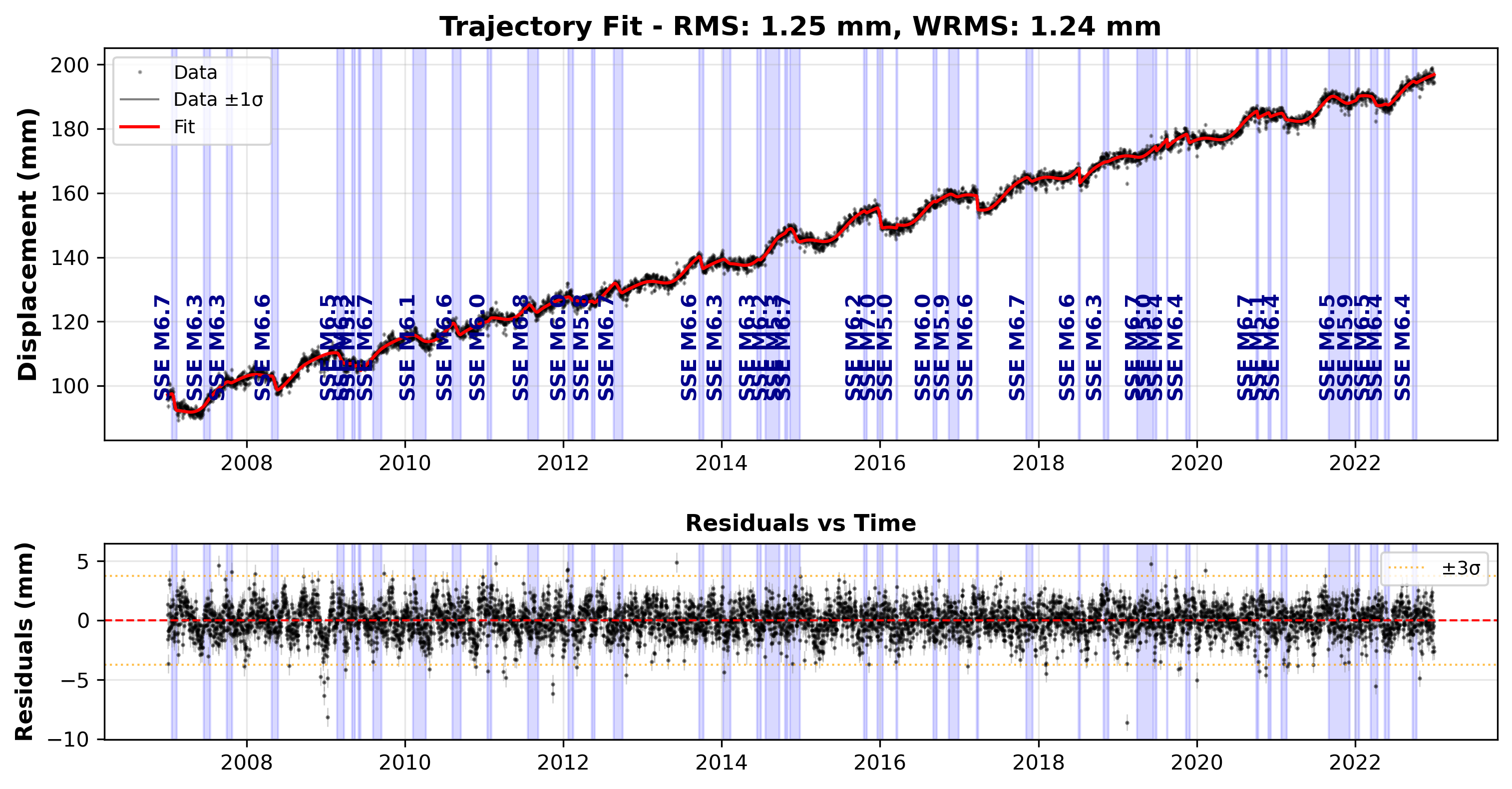
Example of modeled GNSS position time series for the station ALBH (Cascadia), E-W component. Source code: example_cascadia.py.
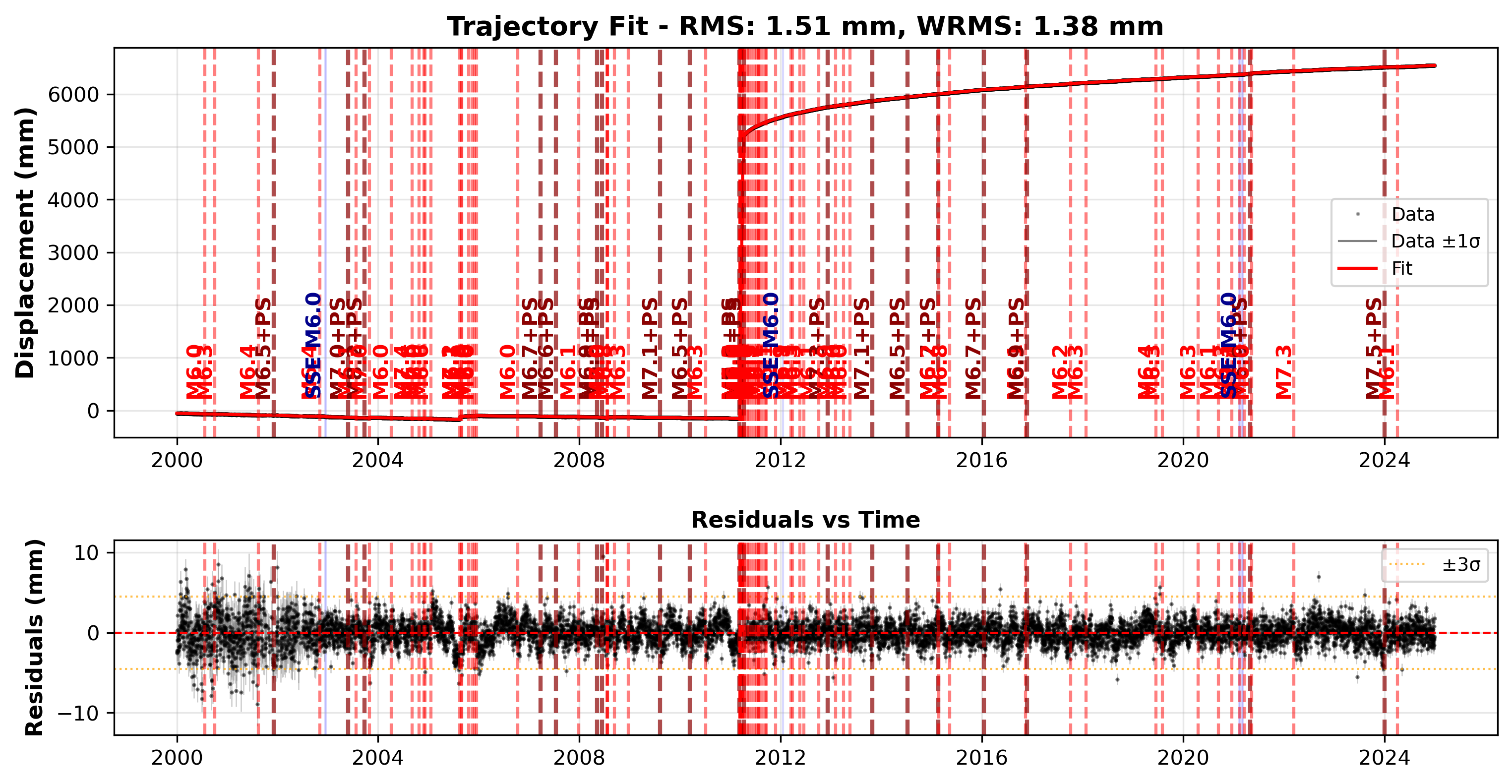
Example of modeled GNSS position time series for the station J550 (Japan), E-W component. Source code: example_japan.py.
Features
Core Capabilities
- Flexible design matrix construction with polynomial trends, seasonal terms, and transient events
- Automated postseismic selection using magnitude thresholds, step amplitude filters, sign consistency checks, and AIC/BIC/F-test criteria
- Event-type discrimination: Distinguish between earthquakes (with postseismic) and equipment changes (step only)
- Uncertainty quantification with covariance matrices, confidence intervals, and VIF-based multicollinearity detection
- Multiple fitting strategies: OLS, LASSO, ElasticNet, iterative outlier removal
Advanced Postseismic Filtering
trajmod implements a 4-tier filtering system to prevent overfitting:
- Magnitude threshold: Only earthquakes ≥ M6.5 (configurable) are considered
- Step amplitude threshold: Only events with |step| ≥ 2mm (configurable) get postseismic
- Sign consistency: Postseismic decay must have the same sign as co-seismic step
- Statistical significance: ΔAIC < -2 (or BIC/F-test) required to include postseismic
This ensures physically meaningful postseismic signals are retained while suppressing noise fitting.
Installation
From PyPI:
pip install trajmod
From source:
git clone [https://github.com/gcostantino/trajmod](https://github.com/gcostantino/trajmod)
cd trajmod
pip install -e .
Requirements: Python 3.9 or later, numpy, scipy, matplotlib, scikit-learn, pyproj, requests.
Quick Start
import numpy as np
from datetime import datetime, timedelta
from trajmod.model import TrajectoryModel
from trajmod.config import ModelConfig
from trajmod.events import CatalogFetcher

# Synthetic data
t0 = datetime(2020, 1, 1)
times = np.array([t0 + timedelta(days=i) for i in range(365)])
data = np.random.randn(365) * 2.0
errors = np.ones(365) * 2.0

# Earthquakes ...
eq_catalog = [{'date': datetime(2020, 3, 15), 'lat': 40.0, 'lon': -120.0, 'magnitude': 7.2}]

# ... or fetch them from USGS
fetcher = CatalogFetcher()
eq_catalog = fetcher.fetch_usgs(
    lat=40.0, lon=-120.0, radius_km=500,
    start_date="2020-01-01", end_date="2020-12-31",
    min_magnitude=5.0,
)

# Station steps (antenna, receiver changes): separate from earthquakes
step_catalog = [{'date': datetime(2020, 8, 1), 'event_type': 'antenna_change'}]

config = ModelConfig(
    d_param=1.0,
    include_seasonal=True,
    postseismic_models=['log', 'exp'],
    postseismic_allow_combined=True,
    postseismic_mag_threshold=6.5,
    postseismic_min_step_amplitude=2.0,
    postseismic_selection_criterion='bic',
    postseismic_selection_threshold=-2.0,
)

model = TrajectoryModel(
    t=times, y=data, sigma_y=errors,
    station_lat=40.0, station_lon=-120.0,
    eq_catalog=eq_catalog,
    step_catalog=step_catalog,
    config=config,
)

results = model.fit(compute_uncertainty=True)

print(results.summary())
print(results.template_names)
print(results.metadata['uncertainty'].standard_errors)

future_times = np.array([t0 + timedelta(days=i) for i in range(365, 730)])
predictions = model.predict(future_times)
Catalogs
Earthquakes
from trajmod.events import CatalogFetcher

fetcher = CatalogFetcher()
eq_catalog = fetcher.fetch_usgs(
    lat=40.0, lon=-120.0, radius_km=500,
    start_date="2020-01-01", end_date="2023-12-31",
    min_magnitude=5.0,
)
Your own catalogue is a list of dicts with a datetime (not a string) in 'date' or 'time', plus lat, lon and magnitude. The other fetchers are fetch_isc, fetch_nied and fetch_jma, and each has a _box variant for a rectangular region.
Station steps
Antenna, receiver and monument changes go in step_catalog, usually one list per station:
step_catalog = [
    {'date': datetime(2013, 5, 2), 'event_type': 'antenna_change'},
    {'date': datetime(2016, 8, 14), 'event_type': 'receiver_change'},
]
model = TrajectoryModel(..., eq_catalog=eq_catalog, step_catalog=step_catalog)
Each step gets one column named STEP_{i}_{date}_{label}. Steps are not filtered by distance, never get postseismic terms, and are not pruned unless requested with select_events(selector, event_type='step'). Two steps on the same day (or a step on the day of an earthquake) produce identical columns. Antenna-type rows found in eq_catalog are moved to the step catalogue with a warning.
Catalogs are validated on model creation. See the Catalog Format Guidelines for the full specification.
Configuration
ModelConfig(
    # Spatial filtering: R = 10^((0.43*M - 0.7)/d); None = no filter
    d_param=1.0,
    d_param_sse=None,        # SSE override (omit to inherit d_param)
    d_param_eq=0.8,          # earthquake override (omit to inherit d_param)

    # Baseline
    include_seasonal=True,
    acceleration_term=True,

    # Postseismic
    fit_postseismic_decay=True,
    postseismic_models=['log', 'exp'],
    postseismic_allow_combined=True,
    postseismic_mag_threshold=6.5,
    postseismic_exp_min_mag=7.5,
    postseismic_pair_min_mag=7.5,
    postseismic_exp_min_ratio=2.0,
    tau_grid=[7, 14, 30, 60, 90, 180, 1800],
    tau_grid_exp=[180, 365, 730, 1460, 2920],
    postseismic_min_step_amplitude=2.0,
    enforce_postseismic_sign_consistency=True,
    postseismic_selection_criterion='bic',
    postseismic_selection_threshold=-2.0,
    postseismic_backfit_passes=2,

    # SSE timing optimisation
    sse_optimize_timing=True,
    sse_timing_tol_days=5.0,
    sse_timing_tol_frac=0.25,
    sse_timing_tol_max_days=30.0,
    sse_min_duration_days=1,
    sse_timing_step_days=1,
    sse_timing_prior=True,
    sse_timing_criterion='bic',
    sse_timing_max_rounds=2,
    sse_timing_allow_overlap=False,

    # Event merging
    merge_earthquakes_same_day=False,
    merge_close_sse=False,
    max_overlap_merge_sse=5,
)
Non-earthquake steps
Antenna, receiver and monument changes go in a separate step_catalog, usually one file per station. They get one step column each, are never filtered by distance, never get postseismic terms, and are not pruned unless you ask (select_events(selector, event_type='step')).
step_catalog = [
    {'date': datetime(2013, 5, 2), 'event_type': 'antenna_change'},
    {'date': datetime(2016, 8, 14), 'event_type': 'receiver_change'},
]

model = TrajectoryModel(..., eq_catalog=eq_catalog, step_catalog=step_catalog)
Columns are named STEP_{i}_{date}_{label}. Two steps on the same day, or a step on the day of an earthquake, give identical columns, and a warning is logged.
Antenna-type rows still found in eq_catalog are moved to the step catalogue automatically, with a warning. The step catalogue is validated by validate_step_catalog.
Supported event types:
'earthquake'(default): Co-seismic step + postseismic (if passes filters)'antenna_change': Step only, no postseismic'equipment_change': Step only, no postseismic'monument_change': Step only, no postseismic
Example Log Output
INFO: Initialized model: 1095 time points, 0 SSEs, 3 EQs, 1 steps
INFO:   EQ 0 (M7.8, step=8.5mm): log tau=90d + exp tau=730d, ΔBIC=-15.3, Δχ²=-42.1 -> KEPT
INFO:   EQ 2 (M6.8, step=4.1mm): log tau=60d, ΔBIC=-8.2, Δχ²=-19.0 -> KEPT
...
Advanced Usage
Multi-component workflow
from trajmod.model import TrajectoryModel
from trajmod.config import ModelConfig
from trajmod.model.nonlinear_prior import save_prior, load_prior

cfg = ModelConfig(sse_optimize_timing=True, postseismic_models=['log', 'exp'])

# 1. Fit the master component (here the vertical, chosen from prior knowledge)
master = TrajectoryModel(t=t, y=y_up, sigma_y=sigma_up,
                         station_lat=lat, station_lon=lon,
                         sse_catalog=sse_catalog, eq_catalog=eq_catalog, config=cfg)
master.fit()

# 2. Export its nonlinear parameters (optionally save them)
prior = master.export_nonlinear()
save_prior(prior, 'station_prior.json')        # load_prior('station_prior.json') to reuse

# 3. Fit the other components with the master's parameters
cfg_follow = ModelConfig(sse_optimize_timing=True, postseismic_models=['log', 'exp'],
                         nonlinear_prior_mode='fixed')
for name, (y, sigma) in {'E': (y_e, sigma_e), 'N': (y_n, sigma_n)}.items():
    follower = TrajectoryModel(t=t, y=y, sigma_y=sigma,
                               station_lat=lat, station_lon=lon,
                               sse_catalog=sse_catalog, eq_catalog=eq_catalog,
                               config=cfg_follow, nonlinear_prior=prior)
    follower.fit()
Notes:
- Use the same catalogues and config for the master and the followers, apart from the prior options.
fixedmode estimates amplitudes only, so uncertainties on the followers do not include the uncertainty of the shared taus and times. They are conditional on the master's values.- Compare the followers with independent fits if you suspect the components differ (for example a vertical component with a different time constant). Large differences mean the shared assumption is doubtful there.
- The prior is a plain dict.
export_nonlinear()works on any fitted model, so a follower can serve as the master for another component.
Fitting strategies
from trajmod.strategies.fitting import LassoFitter, IterativeRefinementFitter

results = model.fit(method=LassoFitter(cv=5, positive=False))
results = model.fit(method=IterativeRefinementFitter(max_iterations=10, threshold=3.0))
Event selection
from trajmod.events.event_selection import KneeEventSelector

selector = KneeEventSelector(criterion='bic', method='knee')
selected = model.select_events(selector, event_type='sse', plot=True, save_plot='sse_selection.png')
event_type can be 'sse', 'eq' or 'step'. Other selectors: LassoEventSelector, MarginalScreeningSelector, ThresholdEventSelector, AmplitudeThresholdSelector, CompositeEventSelector.
Visualization
from trajmod.visualization import TrajectoryVisualizer

TrajectoryVisualizer.plot_fit(model)
TrajectoryVisualizer.plot_components(model)
Also available: plot_fit_windowed, plot_coefficients, plot_event_selection, plot_correlation_matrix, plot_acf, plot_periodogram, plot_residuals_vs_fitted.
API Reference
Core Classes
-
TrajectoryModel: Main model classbuild_design_matrix(): Construct design matrix with multi-level filtering (e.g., post-seismic)fit(): Fit model with OLS or custom strategypredict(): Predict at new time pointsselect_events(): Automatic event selectionfit_pruning(): Fit model with automatic event pruning according to information reductionreset_sse_timing(): Optimize SSE templates with non-linear shrinking/expansion of templatesexport_nonlinear(): Nonlinear parameters of a fitted model (postseismic kinds and taus, SSE times) as a JSON-serialisable dictTrajectoryModel(..., nonlinear_prior=dict): Use parameters exported from another component
-
ModelConfig: Configuration dataclass- All model parameters with validation
-
ModelResults: Results container- Coefficients, fitted values, residuals, uncertainties, template_names, rms, weighted rms, n_observations, n_parameters, metadata, get_coefficient(name), summary()
Template Functions
TemplateFunctions: Basis functionsoffset(),trend(),acceleration()seasonal_sin(),seasonal_cos()step(): Heaviside step for earthquakeslog_decay(): Logarithmic postseismic decayexp_decay(): Exponential (Maxwell-like) postseismic decayraised_cosine(): SSE template
Fitting Strategies
OLSFitter: Ordinary least squaresLassoFitter: LASSO with CVElasticNetFitter: ElasticNet with CVIterativeRefinementFitter: Robust fitting with outlier removal
Citation
If you use this code in your research, please cite:
@software{trajmod2026,
  author = {Costantino, Giuseppe},
  title = {trajmod: the simple non-linear GNSS trajectory model},
  year = {2026},
  url = {https://github.com/gcostantino/trajmod}
}
License
MIT License - see LICENSE file for details.
Contributing
Contributions are welcome! Please:
- Fork the repository
- Create a feature branch
- Run
blackformatter andflake8linter - Submit a pull request
Acknowledgments
Parts of this codebase were developed with assistance from Claude (Anthropic AI).
This package implements a separable non-linear trajectory modeling technique, with particular focus on automated model selection with information criteria and event filtering to prevent overfitting.
This software is inspired by Bevis & Brown, (2014), Blewitt et al. (2016) and Marill et al. (2021).
Contact
Giuseppe Costantino - [giuseppe.costantino@ens.fr]
Project Link: https://github.com/gcostantino/trajmod
1 maintainer

Metadata
1 maintainer
Release files for trajmod 2.1.0
For a detailed explanation of source distributions (sdists) and built distributions (wheels), please see the package formats documentation.
Source distribution (sdist)
| File | Size | Uploaded | Provenance | Actions |
|---|---|---|---|---|
| trajmod-2.1.0.tar.gz | 1.9 MB | Without provenance | Details for trajmod-2.1.0.tar.gz |
Built distribution (wheel)
| File | Interpreter | ABI | Platform | Actions Reset |
|---|---|---|---|---|
| trajmod-2.1.0-py3-none-any.whl | Python 3 | none | any | Details for trajmod-2.1.0-py3-none-any.whl |
Total release size: 2.0 MB
Release files / trajmod-2.1.0.tar.gz
| Download URL | trajmod-2.1.0.tar.gz |
|---|---|
| Size | 1.9 MB |
| Tags | Source |
|
SHA-256 checksum How to use checksums |
dc449328d54233e2384e9beffd4a515df630bec491d153237f2e4957caadb261
|
|
BLAKE2b-256 checksum How to use checksums |
f5371dd90925124c14f4cf536f18cbd55240cad003bdd9a94ceeb6371ff89b9d
|
| Upload date | |
|
Uploaded using Trusted Publishing? What is trusted publishing? |
No |
| Uploaded via |
twine/6.2.0 CPython/3.12.8
|
Release files / trajmod-2.1.0-py3-none-any.whl
| Download URL | trajmod-2.1.0-py3-none-any.whl |
|---|---|
| Size | 99.5 kB |
| Tags | Python 3 |
|
SHA-256 checksum How to use checksums |
f9e2f8167c5357c220ed31f78f11bc1a53674c29bdce63d58d6cf5d2655d2da1
|
|
BLAKE2b-256 checksum How to use checksums |
031a917fe59a92b1f8cae71ef984298ae04e69a23c74ce53b863c5a984a2a118
|
| Upload date | |
|
Uploaded using Trusted Publishing? What is trusted publishing? |
No |
| Uploaded via |
twine/6.2.0 CPython/3.12.8
|
Security for trajmod 2.1.0
Provenance
Provenance describes where a file came from. On PyPI, provenance is shared via attestations, which provide a verifiable record of the build or publishing details. View details, limitations and caveats.
No provenance found
None of the files in this release were uploaded with provenance metadata.
A note on package security
PyPI is a repository for distributing packages, not a service for auditing them. While third-party security researchers and our staff do their best to detect and remove malicious packages, PyPI cannot guarantee the quality, security or suitability of any given package.
To learn more about protecting yourself from malicious actors, visit our package security documentation.














