
Growth, yield, and management simulator for Chilean plantation forests

Project description
Treemun: a growth and yield simulator for Chilean plantation forest



A Python package that implements a discrete-time simulation framework for evaluating management policies in Pinus radiata and Eucalyptus globulus forest stands, with integrated optimization capabilities for forest management planning.
Key Features:
- Forest growth simulation for Pinus and Eucalyptus species
- Multiple configurable management policies
- Total aereal biomass calculation using allometric equations (based on Miranda et al. (2023) report)
- Random forest landscape generation (instance building)
- Includes a forest management optimization model example
- Support for multiple optimization solvers
- Data preparation for optimization algorithms
- Guaranteed reproducibility through seeds
Tool Objectives
- Simulate forest stand-level biomass growth dynamics across multi-decadal planning horizons for Pinus radiata and Eucalyptus globulus species.
- Enable comparison of silvicultural strategies through automated generation of multiple stand-policy combinations to evaluate the biological/economic yield of each forest stand.
- Provide a decision support framework for tactical/strategic forest management planning, creating a seamless workflow from biological growth modeling to prescriptive management optimization.
- Deliver an accessible computational tool that reduces technical barriers to applying operations research methodologies in forest management context, supporting both research and educational applications.
Simulator's Empirical Foundation
The growth models implemented in this system are founded upon comprehensive field data from Chilean forest plantations, documented by Hernández et al. (2011) and Corvalán et al. (2012). The subsequent analytical work of Miranda et al. (2023) establishes the technical and theoretical guidelines for the present tool, which focuses specifically on two species: Pinus radiata and Eucalyptus globulus.
Forest Stand Classification
The table below summarizes the set of species-specific ecological and management dimensions for the considered forest stands, whose values (state-parameters) served as a basis for adjusting parameters for the mathematical foundation of the growth model.
| Dimension | Pinus radiata | Eucalyptus globulus |
|---|---|---|
| Geographic Zone | Z6-Z7 | Z01-Z02 |
| Site Index | 23, 26, 29, 32 | 24, 26, 28, 30, 32 |
| Management Regime | Pulpable, Multipurpose, Intensive 1 or 2 | Unmanaged |
| Stand Condition | Managed | Unmanaged |
| Initial Density | 1250 trees/ha | 800, 1250 trees/ha |
Understanding the Classification Dimensions
-
Site Index (SI): The average height of the dominant trees at a base age of 10 years. It is calculated from the total height of the 100 trees per hectare with the largest DBH (Diameter at Breast Height, measured at 1.3 m above ground level).
-
Management Regime: The management scheme applied to the stand, which can be one of the following:
- Pulpable: A regime involving thinning to waste (pre-commercial thinning).
- Multipurpose: A regime where the stand has been pruned and thinned twice.
- Intensive 1: A regime where the stand has been pruned three times and thinned twice.
- Intensive 2: A regime where the stand has been pruned two or three times and thinned twice, depending on site quality.
- Unmanaged: When none of the above regimes are applied.
-
Stand Condition: The state of the forest stand relative to its management history.
-
Initial Density: The initial number of trees per hectare in the forest stand at age 0 (at the time of planting).
Simulator's Mathematical Foundation
The simulator is functionally grounded in the forest stand-level biomass prediction model developed by Miranda et al. (2023), whose structure was selected through rigorous nonlinear least squares fitting using the Levenberg-Marquardt algorithm.
Core Growth Equation
The general growth equation models stand total biomass as a function of stand age:
B_t^s = [α · (E_t^s)^β + γ] · A^s
Where:
- B_t^s: Total aerial biomass (m³) of forest stand s in time period t.
- E_t^s: Biological age of forest stand s in time period t.
- α, β, γ: Model coefficients that vary based on forest stand characteristics.
- A^s: Area of forest stand s (ha).
The specific coefficient values for each specie, zone, initial density, site index (SI), management type and condition are provided in the appendix tables.
Simulation Logic
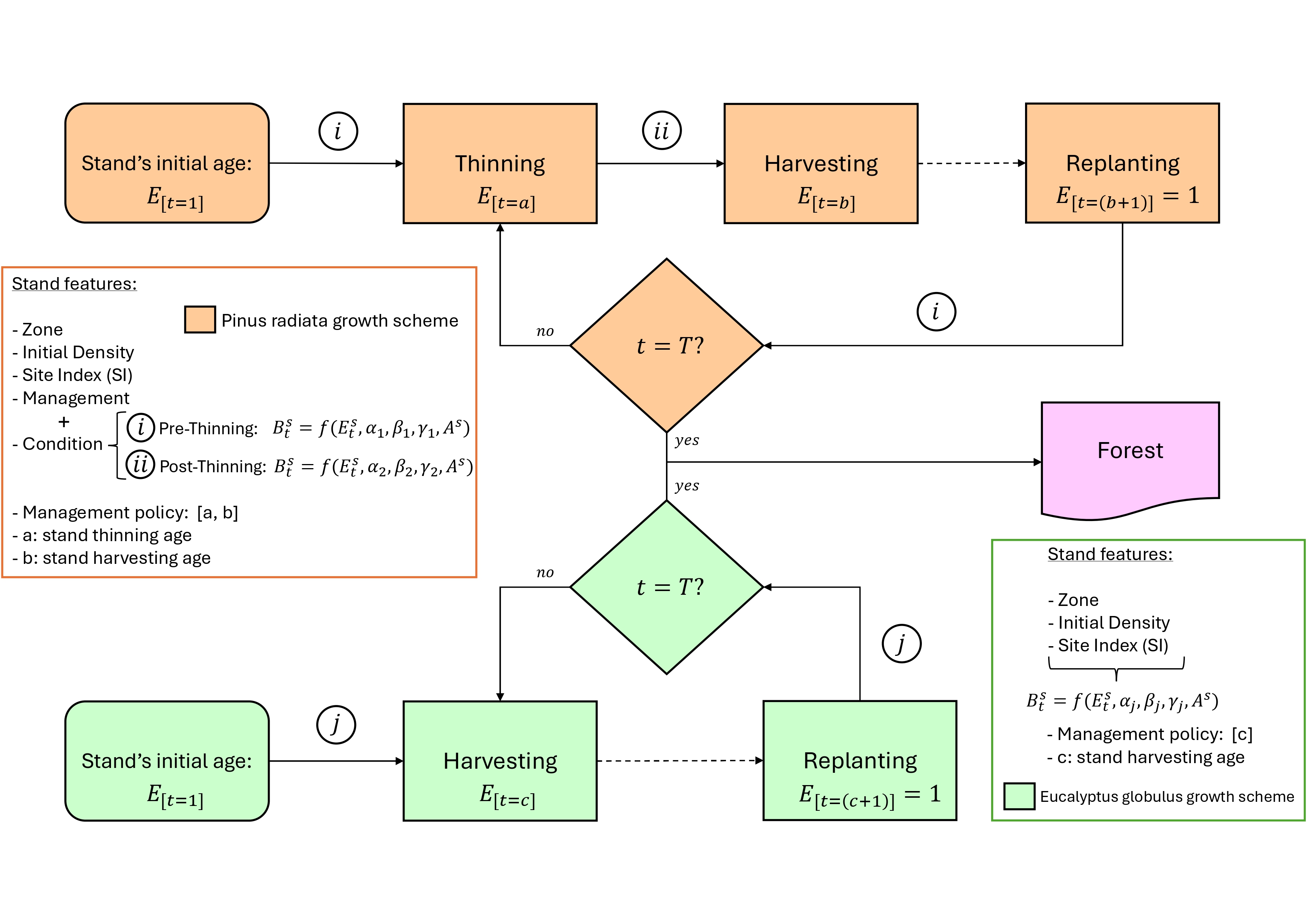
Species-Specific Management Policies
Pinus radiata stands follow a dual-curve growth model:
- State 0 (pre-thinning):
B_t^s = f(E_t^s, α₁, β₁, γ₁, A^s)for t ≤ thinning-age - State 1 (post-thinning):
B_t^s = f(E_t^s, α₂, β₂, γ₂, A^s)for thinning-age < t ≤ harvest-age
Eucalyptus globulus stands use a single continuous growth curve: B_t^s = f(E_t^s, αⱼ, βⱼ, γⱼ, A^s) with management determined solely by harvest age.
Regeneration Cycle
Following any harvest, the model assumes immediate replanting, resetting the stand's biological age to 1 in the subsequent period.
Simulation Period vs Biological Age
- Simulation Period (t): Discrete time steps of the planning horizon, where t ∈ {1, 2, ..., H}
- Stand Biological Age (E): Physiological age of trees, evolves as:
E^s(t) = initial_age_s + t - 1  (if no harvest)
E^s(t) = t - t_last_harvest      (if harvested)
Growth Simulation Examples
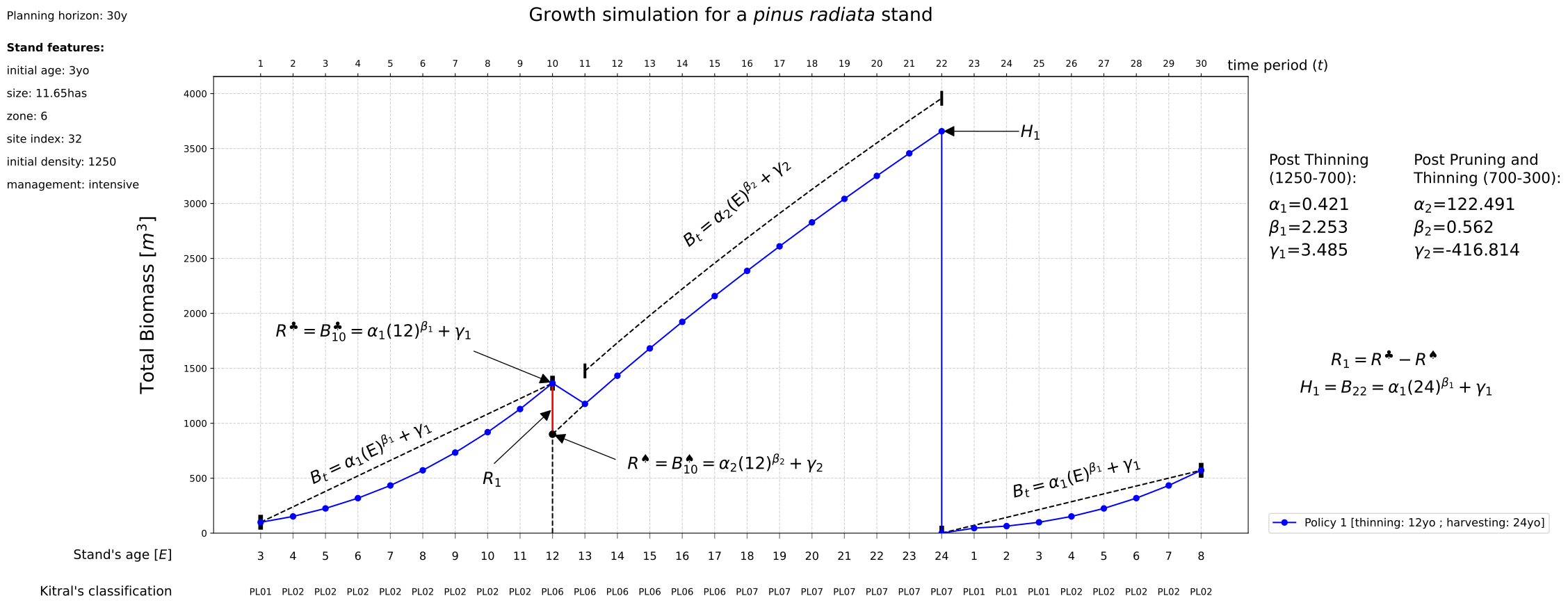
Pinus radiata Example
11.65 ha stand over 30-year horizon with thinning at age 12 (t=10) and harvest at age 24 (t=22).
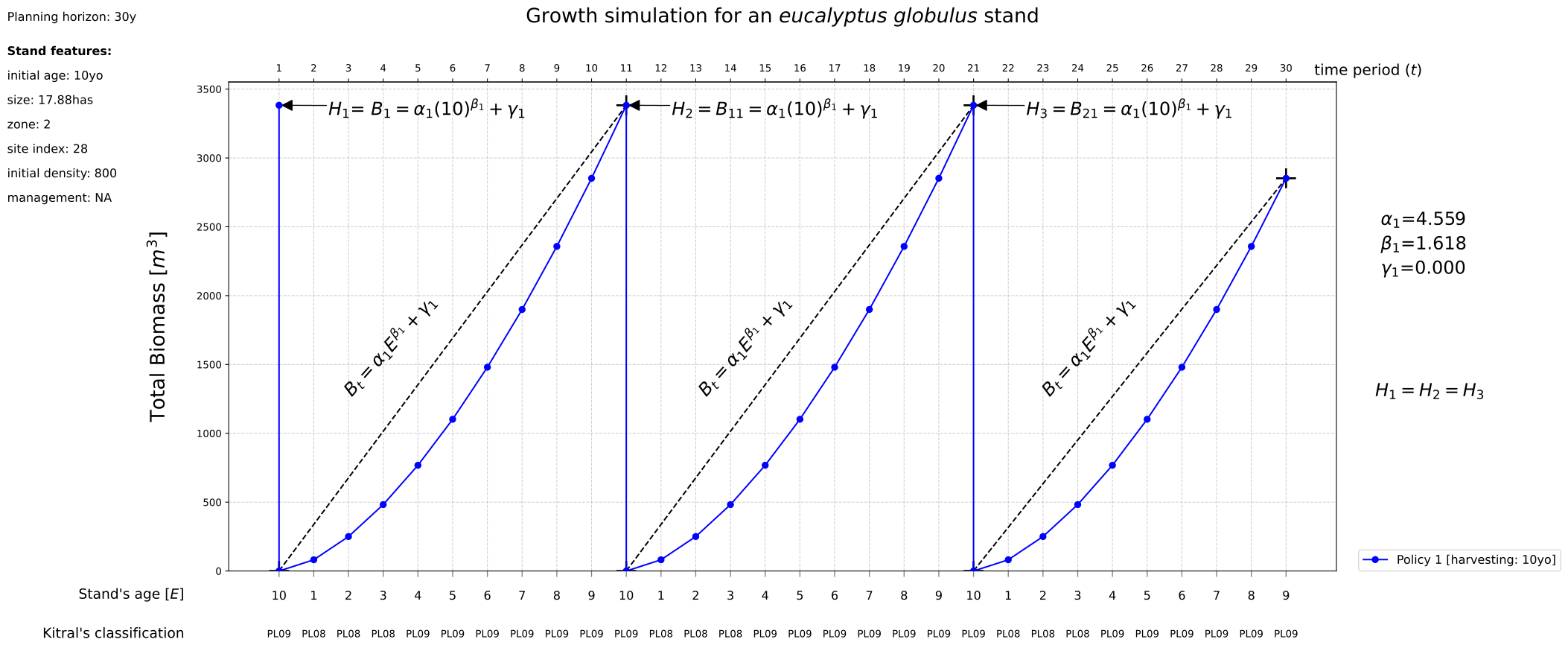
Eucalyptus globulus Example
17.88 ha stand over 30-year horizon with harvests at 10-year intervals (t=1, 11, 21).
Mathematical Model
The optimization module implements a Mixed-Integer Linear Programming (MILP) model for strategic forest management planning, extending Johnson and Scheurman's (1977) Model I formulation to address multi-species plantation management.
Problem Formulation
The model addresses the landscape-level forest management problem where a heterogeneous forest landscape is partitioned into a set I of management units (stands) that can be managed using different policies j ∈ J over a planning horizon T. The objective is to determine the optimal policy assignment for each stand to maximize the Net Present Value (NPV) of biomass collection while ensuring sustainability and even-flow constraints.
Decision Variables and Parameters
Decision Variables:
- xij: Binary variable indicating whether policy j is assigned to stand i (xij = 1 if assigned, 0 otherwise)
- vt: Auxiliary continuous variable tracking total biomass collected in period t
Parameters:
- aijt: Biomass collected from stand i under policy j in period t (m³)
- aijT: Standing biomass in stand i under policy j at the end of planning horizon (m³)
- rt: Biomass revenue in period t ($/m³)
- τ: Annual discount rate
- B: Minimum required standing biomass at planning horizon end (m³)
Model Formulation
- Objective Function (NPV Maximization): $$\text{maximize } \sum_{i \in I} \sum_{j \in J} \sum_{t \in T} \frac{r^t \cdot a_{ijt} \cdot x_{ij}}{(1+\tau)^t}$$
Subject to:
-
Single Policy Assignment Constraint: $$\sum_{j \in J} x_{ij} = 1 \quad \forall i \in I$$
-
Biomass Collection Tracking: $$\sum_{i \in I} \sum_{j \in J} a_{ijt} \cdot x_{ij} = v_t \quad \forall t \in T$$
-
Even-Flow Constraint (Non-decreasing harvest): $$v_{t+1} \geq v_t \quad \forall t \in T \setminus {|T|}$$
-
Sustainability Constraint: $$\sum_{i \in I} \sum_{j \in J} a_{ij}^T \cdot x_{ij} \geq B$$
-
Variable Domains: $$x_{ij} \in {0,1} \quad \forall i \in I, j \in J$$ $$v_t \geq 0 \quad \forall t \in T$$
This formulation seek to identify landscape’s policy plan that maximizes the NPV across the planning horizon (Eq. 0) considering that: (i) at most one policy j is selected for each stand i (Eq. 1), (ii) the biomass collected is non-decreasing over time, therefore the biomass collected in period t + 1 must be at least as much as in period t (Eqs. 2 & 3), and (iii) at the end of the planning horizon, a minimum total amount of standing biomass (defined as B) is guaranteed (Eq. 4). The last restriction (Eq. 5) refers to the nature of the variables.
Installation
Basic Installation
pip install treemun-sim
Installation with Optimization Solvers
# With free CBC solver (recommended)
pip install treemun-sim[solvers]

# With commercial solvers (requires licenses)
pip install treemun-sim[solvers-extended]

# Complete installation with development tools
pip install treemun-sim[complete]
Solver Requirements
- CBC: ✅ Included with
[solvers]installation - CPLEX: Requires IBM ILOG CPLEX license
Basic Usage
Forest Simulation
import treemun_sim as tm

# Simulation with default parameters
forest, summary, final_biomass, collected_biomass = tm.simular_bosque()

print(f"Generated {len(forest)} stand-policy combinations")
print(f"Total optimization data points: {len(collected_biomass)}")
Forest Management Optimization
import treemun_sim as tm

# Generate forest data

horizon = 15
num_stands = 100

forest, summary, final_biomass, collected_biomass = tm.simular_bosque(
    horizonte=horizon,
    num_rodales=num_stands
)

# Create optimization model
model = tm.forest_management_optimization_model(
    bosque=forest,
    a_i_j_T=final_biomass,
    a_i_j_t=collected_biomass,
    horizon=horizon,
    pine_revenue=12,           # $/m³
    eucalyptus_revenue=10,     # $/m³
    min_ending_biomass=25000,  # m³
    discount_rate=0.08         # 8% annual
)

# Solve model
results = tm.solve_model(model, solver_name='cbc', gap=0.01)

# Extract solution
solution = tm.extract_results(model, results)

if solution:
    print(f"Optimal NPV: ${solution['objective_value']:,.2f}")
    print(f"Pine stands managed: {solution['total_pinus_stand_treated']}")
    print(f"Pine stands planning: {solution['pinus_stand_plan']}")
    print(f"Eucalyptus stands managed: {solution['total_eucalyptus_stand_treated']}")
    print(f"Eucalyptus stands planning: {solution['eucalyptus_stand_plan']}")
    print("Total biomass collected per period:", solution['total_harvest_per_period'])
Visual Examples
The following figures illustrate how different management policies affect biomass dynamics over time (30 years horizon) for representative stands:
Pinus radiata Stand Simulation
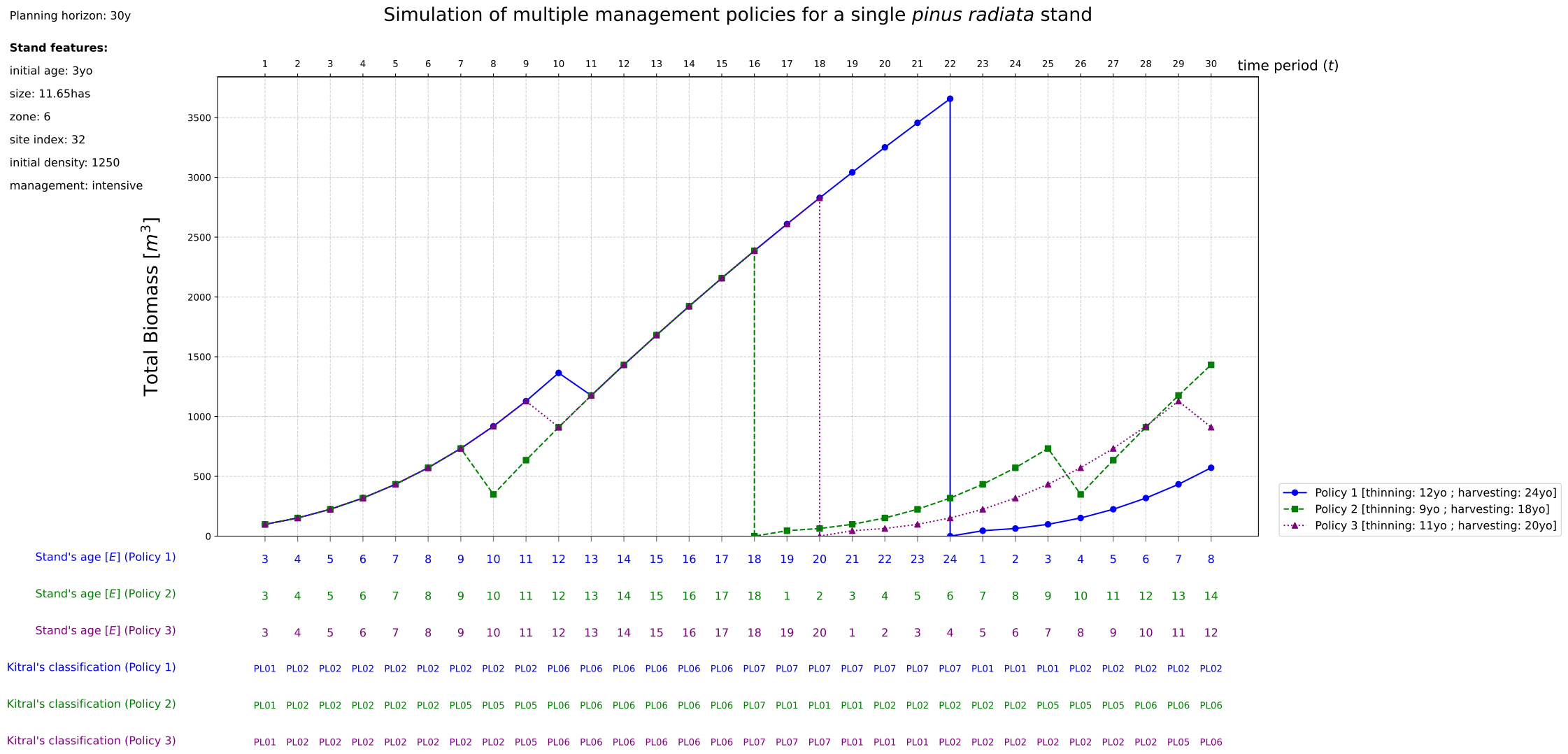
The figure shows three management policies applied to a single Pinus radiata stand:
- Policy 1: Thinning at 12 years, harvest at 24 years (longer rotation)
- Policy 2: Thinning at 9 years, harvest at 18 years (intensive management)
- Policy 3: Thinning at 11 years, harvest at 20 years (intermediate strategy)
Each policy produces different biomass trajectories, affecting both total yield and temporal distribution of harvests.
Eucalyptus globulus Stand Simulation
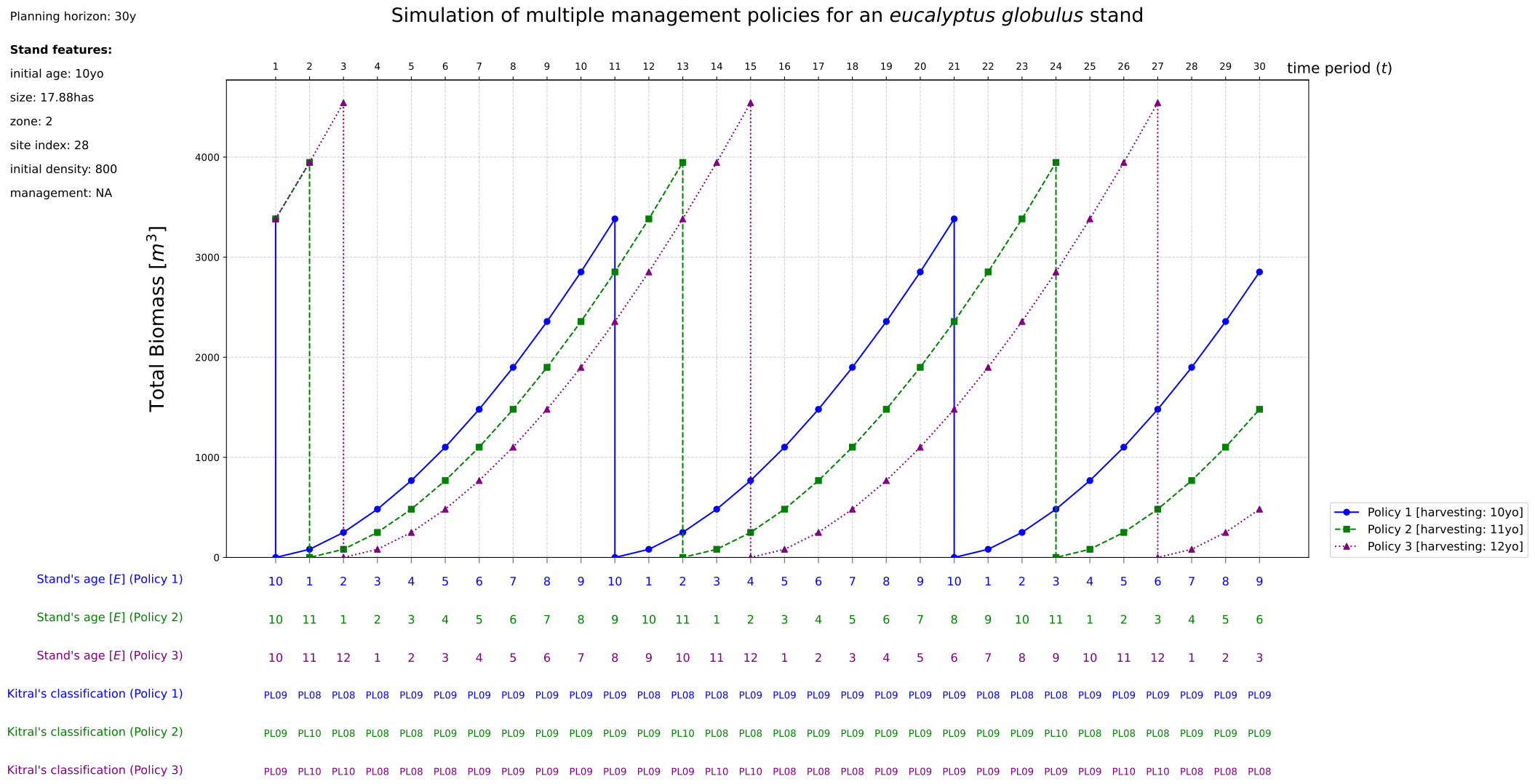
The figure demonstrates three harvest-only policies for an Eucalyptus globulus stand:
- Policy 1: 10-year rotations (frequent short rotations)
- Policy 2: 11-year rotations (moderate cycle)
- Policy 3: 12-year rotations (longer maturation period)
The visualization shows how rotation length affects cumulative biomass production and harvest timing across the planning horizon.
These examples demonstrate the package's capability to simulate complex stand dynamics under different management regimes, providing the foundation data for optimization models.
This framework's ability to model forest stand age progression, which incorporates post-harvest regeneration, also enables the annual tracking of each stand's fuel class. This dynamic assessment is based on the Chilean KITRAL fuel model (Julio et al., 1997). The following table lists the specific fuel codes associated with each of the plantation forest species under consideration.
KITRAL Fuel Classification
| Species | Age Range | Unmanaged | Managed |
|---|---|---|---|
| Pinus radiata | ≤ 3 | PL01 | - |
| Pinus radiata | 3 < age ≤ 11 | PL02 | PL05 |
| Pinus radiata | 11 < age ≤ 17 | PL03 | PL06 |
| Pinus radiata | > 17 | PL04 | PL07 |
| Eucalyptus globulus | ≤ 3 | PL08 | - |
| Eucalyptus globulus | 3 < age ≤ 10 | PL09 | - |
| Eucalyptus globulus | > 10 | PL10 | - |
Advanced Usage
Loading Forest from File
You can load your own forest stands from a CSV or TXT file instead of generating them randomly:
import treemun_sim as tm

# Load forest from CSV file
forest, summary, final_biomass, collected_biomass = tm.simular_bosque(
    archivo_rodales="my_forest.csv",  # Load from file
    policies_pino=[(9, 18), (10, 20), (11, 22)],
    policies_eucalyptus=[(9,), (10,), (11,)],
    horizonte=30
)
Required CSV columns:
id_rodal: Stand identifier (string)hectareas: Stand area in hectares (float)especie: Species - 'Pinus' or 'Eucalyptus' (string, case-insensitive; also accepts 'Eucapyltus', 'Pino', 'Eucalipto')edad_inicial: Initial stand age in years (int)zona: Geographic zone (int: 1, 2, 6, 7)site_index: Site index (int, e.g., 23-32 for Pinus, 24-32 for Eucalyptus)manejo: Management type (string, see valid combinations below)condicion: Stand condition (string, see valid combinations below)densidad_inicial: Initial tree density per ha (int, e.g., 800, 1250)
Valid combinations for Pinus (validated equations only): Only the following combinations are accepted for Pinus stands:
| zona | site_index | manejo | condicion |
|---|---|---|---|
| 6 | 32 | Intensivo | PostRaleo1250-700 |
| 7 | 32 | Intensivo | PostRaleo1250-700 |
| 6 | 29 | Intensivo2 | PostRaleo1250-700 |
| 7 | 29 | Intensivo2 | PostRaleo1250-700 |
| 6 | 26 | Multipropósito | PostRaleo1250-700 |
| 7 | 26 | Multipropósito | PostRaleo1250-700 |
Note: These correspond to validated equation IDs [21, 22, 25, 26, 29, 30] in the lookup table.
Valid combinations for Eucalyptus:
- zona: 1 or 2
- site_index: 24, 26, 28, 30, 32
- manejo: 'NA'
- condicion: 'SinManejo'
- densidad_inicial: 800 or 1250
Example CSV file (my_forest.csv):
id_rodal,hectareas,especie,edad_inicial,zona,site_index,manejo,condicion,densidad_inicial
stand1,15.5,Pinus,5,Z6,26,Multipropósito,con manejo,1250
stand2,8.3,Eucapyltus,3,Z01,28,NA,SinManejo,1250
stand3,12.7,Pinus,8,Z7,29,Intensivo,con manejo,1250
See examples/ejemplo_rodales.csv and examples/load_from_file.py for complete examples.
Custom Simulation Parameters
import treemun_sim as tm

# Custom simulation
forest, summary, final_biomass, collected_biomass = tm.simular_bosque(
    policies_pino=[(9, 18), (10, 20), (11, 22)],  # (thinning, harvest)
    policies_eucalyptus=[(9,), (10,), (11,)],     # (harvest,)
    horizonte=15,
    num_rodales=100,
    semilla=1234
)

# Results analysis
for i, df in enumerate(forest[:3]):  # First 3 stands
    print(f"Stand {i+1}:")
    print(f"  - Species: {df['Especie'].iloc[0]}")
    print(f"  - Policy: {df['politica'].iloc[0]}")
    print(f"  - Final biomass: {df['biomasa'].iloc[-1]:.2f} tons")
Variable Revenue in Optimization
# Variable revenue over time
pine_revenues = [10, 11, 12, 13, 14]  # Increasing revenues for 5-year horizon
eucalyptus_revenues = [8, 9, 10, 11, 12]

model = tm.forest_management_optimization_model(
    bosque=forest,
    a_i_j_T=final_biomass,
    a_i_j_t=collected_biomass,
    horizon=15,
    pine_revenue=pine_revenues,        # Variable revenue
    eucalyptus_revenue=eucalyptus_revenues,
    min_ending_biomass=25000,
    discount_rate=0.08
)
API Reference
Simulation Function
simular_bosque()
| Parameter | Type | Default | Description |
|---|---|---|---|
archivo_rodales |
str |
None | Path to CSV/TXT file with stand data. If provided, num_rodales is ignored |
policies_pino |
List[Tuple[int, int]] |
16 policies | Pine policies: [(thinning_age, harvest_age), ...] |
policies_eucalyptus |
List[Tuple[int]] |
4 policies | Eucalyptus policies: [(harvest_age,), ...] |
horizonte |
int |
30 | Time horizon in years |
num_rodales |
int |
100 | Number of stands to generate (ignored if archivo_rodales is provided) |
semilla |
int |
5555 | Seed for reproducibility |
Optimization Functions
forest_management_optimization_model()
| Parameter | Type | Description |
|---|---|---|
bosque |
List[pd.DataFrame] |
Forest simulation data |
a_i_j_T |
Dict |
Final standing biomass by stand-policy |
a_i_j_t |
Dict |
Harvestable biomass by period |
horizon |
int |
Planning horizon in years |
pine_revenue |
float or List[float] |
Pine biomass revenue ($/m³) |
eucalyptus_revenue |
float or List[float] |
Eucalyptus biomass revenue ($/m³) |
min_ending_biomass |
float |
Minimum final period biomass guaranteed |
discount_rate |
float |
Annual discount rate for NPV |
solve_model()
| Parameter | Type | Description |
|---|---|---|
model |
ConcreteModel |
Pyomo optimization model |
solver_name |
str |
Solver name ('cbc', 'cplex') |
gap |
float |
Relative optimality gap (default: 0.01) |
executable_path |
str |
Path to solver executable (optional) |
tee |
bool |
Display solver output (default: True) |
extract_results()
Returns a dictionary with:
objective_value: Optimal NPV for the planningtotal_harvest_per_period: Schedule for collected biomasspinus_stand_plan: Policy assignments for pine standseucalyptus_stand_plan: Policy assignments for eucalyptus standstotal_pinus_stand_treated: Count of pine standstotal_eucalyptus_stand_treated: Count of eucalyptus stands
Output Data Structure
Forest DataFrame
Each element in forest contains:
periodo: Time period (1 to horizonte)edad_rodal: Stand age in each periodbiomasa: Total biomass in tonsbioOPT: biomass collected in tons (considers only thinned and harvested biomass amounts)condición: Management status ("sin manejo" (no managed) / "con manejo" (managed)kitral_class: Classification according to Kitral's System (Chilean fuel model)politica: Applied policy identifier
Optimization Dictionaries
`collected_biomass structure:
{
    (period, species, policy, stand_id): biomass_value,
    ...
}
`final_biomass structure:
{
    (stand_id, policy): biomass_value,
    ...
}
Supported Species
Pinus
- Policies: Thinning + Harvest
- Constraint: Thinning age < harvest age
- Default policies: 16 combinations (thinning ages: 9-12 years; harvest ages: 18-24 years)
Eucalyptus
- Policies: Harvest only
- Harvest ages: Any year
- Default policies: 4 options (9-12 years)
Use Cases
- Forest research: Analysis of different management strategies
- Tactical and Strategic planning: Mid/Long-term forest management optimization
- Sustainability assessment: Balancing economic and ecological objectives
- Policy evaluation: Comparing management alternatives performances
- Education: Teaching forest management and optimization concepts
Solver Installation Guide
Free Solvers
# CBC (recommended - included with treemun-sim[solvers])
pip install pulp
Commercial Solvers
# CPLEX (requires IBM license)
pip install cplex
Contributing
Contributions are welcome. To contribute:
- Fork the repository
- Create a feature branch
- Commit your changes
- Push to the branch
- Open a Pull Request
License
This project is licensed under the MIT License - see the LICENSE file for details.
Author
Felipe Ulloa-Fierro
- Email: felipe.ulloa@utalca.cl
- Institution: Universidad de Talca
Reference
A. Miranda, B. Mola-Yudego, and V. Hinojosa. Stand-level biomass prediction models in Eucalyptus Globulus and Pinus Radiata plantations in south-central Chile. Technical report, University of Eastern Finland, September 2023.
Johnson, K. N., & Scheurman, H. L. (1977). Techniques for prescribing optimal timber harvest and investment under different objectives—discussion and synthesis. Forest Science, 23(suppl_1), a0001–z0001. https://doi.org/10.1093/FORESTSCIENCE/23.S1.A0001
Citation
If you use Treemun in your research, you can cite it as:
Ulloa-Fierro, F. (2025). Treemun: A Growth and Yield Simulator for Chilean Plantation Forest.
Python Package Version 1.1.5 https://pypi.org/project/treemun-sim/
Acknowledgements
Author thanks to European Union’s Horizon 2020 Research and Innovation Programme under grant agreements Nos. 101037419–FIRE-RES and 101007950–DecisionES, and the support of National Agency for Research and Development (ANID, Chile) through the grant FONDECYT N.1220830, through the Complex Engineering Systems Institute PIA/PUENTE AFB230002.
Release history Release notifications | RSS feed


Download files
Download the file for your platform. If you're not sure which to choose, learn more about installing packages.
Source Distribution
Built Distribution
Filter files by name, interpreter, ABI, and platform.
If you're not sure about the file name format, learn more about wheel file names.
Copy a direct link to the current filters
File details
Details for the file treemun_sim-1.2.0.tar.gz.
File metadata
- Download URL: treemun_sim-1.2.0.tar.gz
- Upload date:
- Size: 36.3 kB
- Tags: Source
- Uploaded using Trusted Publishing? No
- Uploaded via: twine/6.2.0 CPython/3.9.7
File hashes
| Algorithm | Hash digest | |
|---|---|---|
| SHA256 |
c29f727762c51bd9a6c2031f71d8d94c66c6f993d14c70af3f0ecf57c2da37af
|
|
| MD5 |
af32799878554dec17cbec796194c949
|
|
| BLAKE2b-256 |
8bc741f3bef63d591a7992198e5e72c05b56827835f009053f5b999e80f0cf17
|
File details
Details for the file treemun_sim-1.2.0-py3-none-any.whl.
File metadata
- Download URL: treemun_sim-1.2.0-py3-none-any.whl
- Upload date:
- Size: 29.5 kB
- Tags: Python 3
- Uploaded using Trusted Publishing? No
- Uploaded via: twine/6.2.0 CPython/3.9.7
File hashes
| Algorithm | Hash digest | |
|---|---|---|
| SHA256 |
13da2f746c405410e60eff7e2423fb2de932491957ed7ec49f09fc4240c72f82
|
|
| MD5 |
cbd183a14188b5ea6d6d679cd1e69553
|
|
| BLAKE2b-256 |
b3c70fd54ea3c25415747e72844373b22698931b143784f3370fdd6ea7f14429
|






