
Truceptor (Python SDK)
Truceptor — trusted intercept for agent tool calls: preflight allow/deny/escalate; your runtime executes tools after allow.
CLI:
acp up,acp init(alsotruceptor up). Install:pip install truceptor.
Import:
from truceptor import governed_tool, ACPClient. Env vars useACP_*(ACP_INTERCEPTOR_URL, etc.). User data dir stays~/.acp/.
Add governance, approvals, policy enforcement, and execution visibility to AI agents in minutes.
Works with CrewAI, LangGraph, Strands, Google ADK, MCP tools, and custom Python workflows.
Requires: Docker Desktop (Compose v2).
Full integration guide: docs/INTEGRATION.md (setup vs runtime, Rego → Postgres, pip paths, who owns what).
Quick start
Make sure Docker Desktop is already running before you start Truceptor (acp up).
pip install truceptor
acp init          # ~/.acp/policies + ~/.acp/agents.json
acp up            # Open mode (default)
acp dashboard
| Mode | Command |
|---|---|
| Open (default) | acp up |
| Seeded | acp up --register |
| Enforced | AGENT_REGISTRY_ENFORCE=true acp up |
| Check mode | acp mode |
| Step | Command |
|---|---|
| Install | pip install truceptor |
| Initialize policies | acp init |
| Start stack | acp up |
| Open UI | acp dashboard → http://localhost:3090/dashboard/ |
| Stop | acp down |
For a real local integration, the usual sequence is:
acp init- start Docker Desktop
acp upexport ACP_INTERCEPTOR_URL=http://localhost:8080export ACP_BEARER_TOKEN=...- run your governed agent
If Docker is not already running, acp up will fail with Docker daemon / compose connection errors.
What acp init and acp up actually do
| Step | What you get |
|---|---|
acp init |
Creates ~/.acp/policies/ with starter Rego (router.rego, rbac.rego, …) and HOW_TO_ADD_RULES.md. You edit these files — Truceptor does not generate rules from your agent code. |
acp up |
Starts Postgres, OPA, interceptor, dashboard. On startup the interceptor loads your ~/.acp/policies, upserts them into Postgres, and pushes them to OPA. |
| Your agent | Sends only agent_id, tool, action, and context to POST /tool-call — never Rego text. |
After changing any .rego file: acp down && acp up. The dashboard Policies tab is read-only and shows plain-English rule summaries (Rego bundle and Policy Studio policies). Business users can author rules in the Policy Studio tab (Save & activate); compiled Rego lands in the same Postgres policy_versions pipeline.
Policy Studio (dashboard)
| Step | What you get |
|---|---|
| Policy Studio → New rule | Wizard: rule type → configure thresholds → simulate → Save & activate |
| Activate | Compiler writes studio/*.rego + studio_router.rego into policy_versions and syncs OPA |
| Policies tab | Same catalog API — studio policies tagged Policy Studio, engineer modules tagged Rego bundle |
Where your policies live (pip install)
The Python package installs into your virtualenv (.venv). Your editable Rego files do not — they live in your home directory:
| What | Location |
|---|---|
| Installed package (read-only) | .venv/.../site-packages/truceptor/ |
| Your policy folder | ~/.acp/policies/ (created by acp init) |
| Dev JWT keys | ~/.acp/jwt/ |
| Docker runtime bundle | ~/.acp/runtime/<version>/ |
acp init copies starter templates from the package into ~/.acp/policies/. You edit those files for your tools, roles, and allow/deny/escalate rules.
acp up bind-mounts ~/.acp/policies into the interceptor container. On startup Truceptor upserts them into Postgres, then pushes to OPA. Nothing is uploaded from your agent at runtime.
Use a client repo instead of ~/.acp/policies:
export ACP_POLICIES_DIR=/path/to/my-project/policies
acp init && acp up
Two phases: (1) Setup — write Rego, run acp up; (2) Runtime — SDK sends agent_id, tool, action only. See the integration guide.
Why Truceptor?
Most agents call tools, APIs, and other agents directly. Teams then scatter rules across Python, workflows, and frameworks:
if supplier_risk_score > threshold:
    require_human_approval()
That becomes inconsistent, hard to audit, easy to bypass, and duplicated everywhere.
Truceptor centralizes governance outside agent code:
| Capability | What you get |
|---|---|
| Centralized governance | One place for rules, not copy-paste per team |
| Policy enforcement | OPA/Rego evaluates every governed call |
| Approvals | Escalate high-risk actions to humans |
| A2A governance | Governed agent-to-agent calls |
| A2T governance | Governed agent-to-tool calls |
| Audit & visibility | Decisions, traces, registry in one dashboard |
Architecture

Agent runtime -> Truceptor SDK -> Interceptor / Gateway -> OPA / Rego -> allow | deny | escalate -> governed execution

Policy lifecycle (startup): PostgreSQL policy_versions -> interceptor -> PUT /v1/policies -> OPA in-memory cache
Runtime audit: decisions and traces -> PostgreSQL; dashboard reads catalog and forensics from interceptor APIs
SETUP (acp init + acp up)
  ~/.acp/policies/*.rego  ──mount──►  interceptor container
        │
        ▼
  Upsert → Postgres (policy_versions) → push → OPA

RUNTIME (every tool call)
  Agent + SDK  ──POST /tool-call──►  Interceptor  ──►  OPA  ──►  allow | deny | escalate
        (agent_id, tool, action — no Rego in request)
Truceptor sits at the execution boundary:
- agent frameworks keep reasoning and orchestration
- PostgreSQL is the source of truth for Rego policies, audit events, agents, and approvals
- on startup the interceptor loads your
~/.acp/policiesplus built-in platform samples, upserts to Postgres, then syncs to OPA - the interceptor validates identity, routes policy, and records audit traces
- OPA / Rego returns deterministic allow, deny, or escalate decisions against synced rules
- only allowed or approved requests reach tools, APIs, MCP servers, or other agents
Request sequence
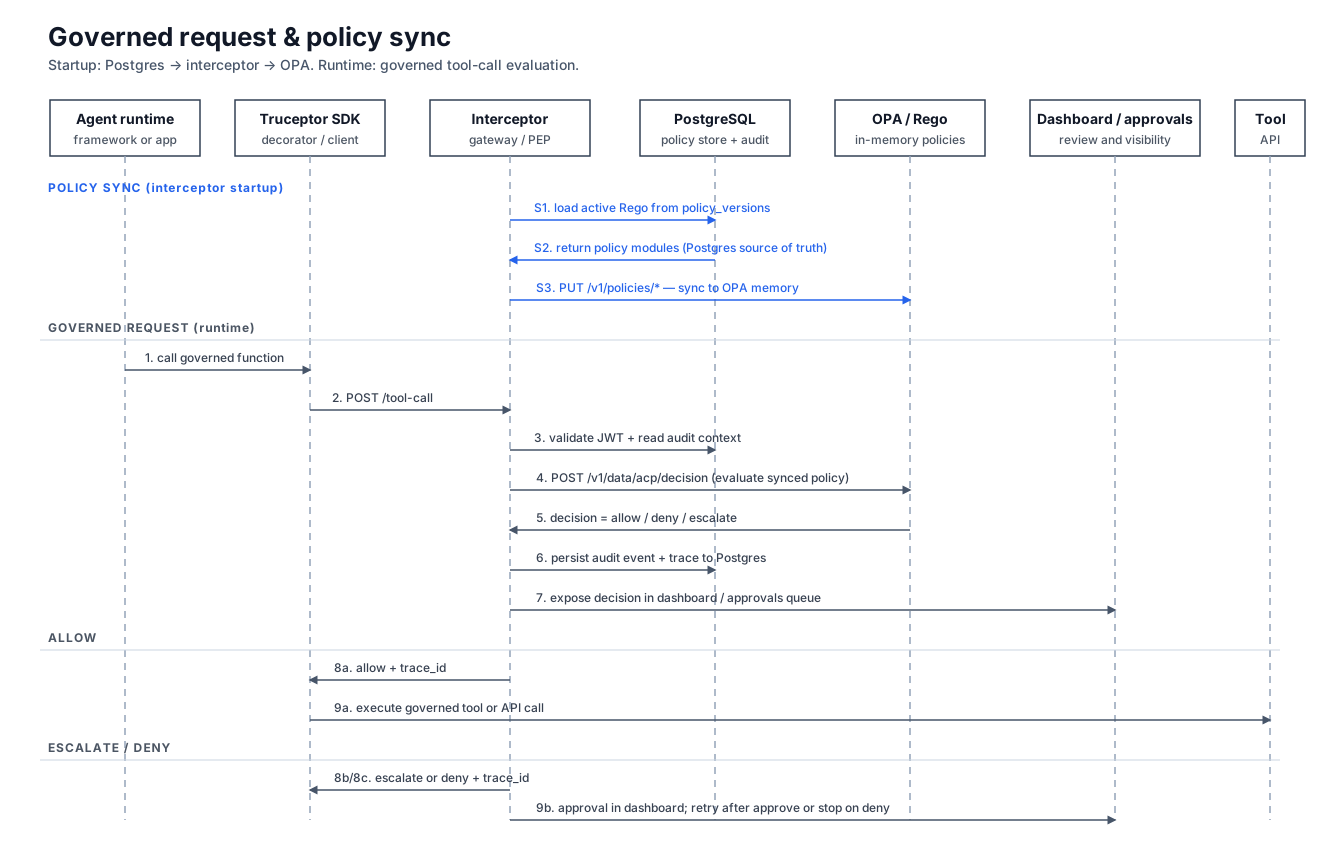
Typical governed flow:
- On interceptor startup: load active Rego from Postgres and sync to OPA via the Policy API
- the agent calls a governed function through the Truceptor SDK
- the interceptor validates JWT identity and normalizes the request
- OPA / Rego evaluates policy for the tool, action, and claims (in-memory rules synced from Postgres)
- Truceptor records the decision in Postgres and exposes it in the dashboard
- the SDK executes only on
allow, waits for review onescalate, and blocks ondeny
Dashboard
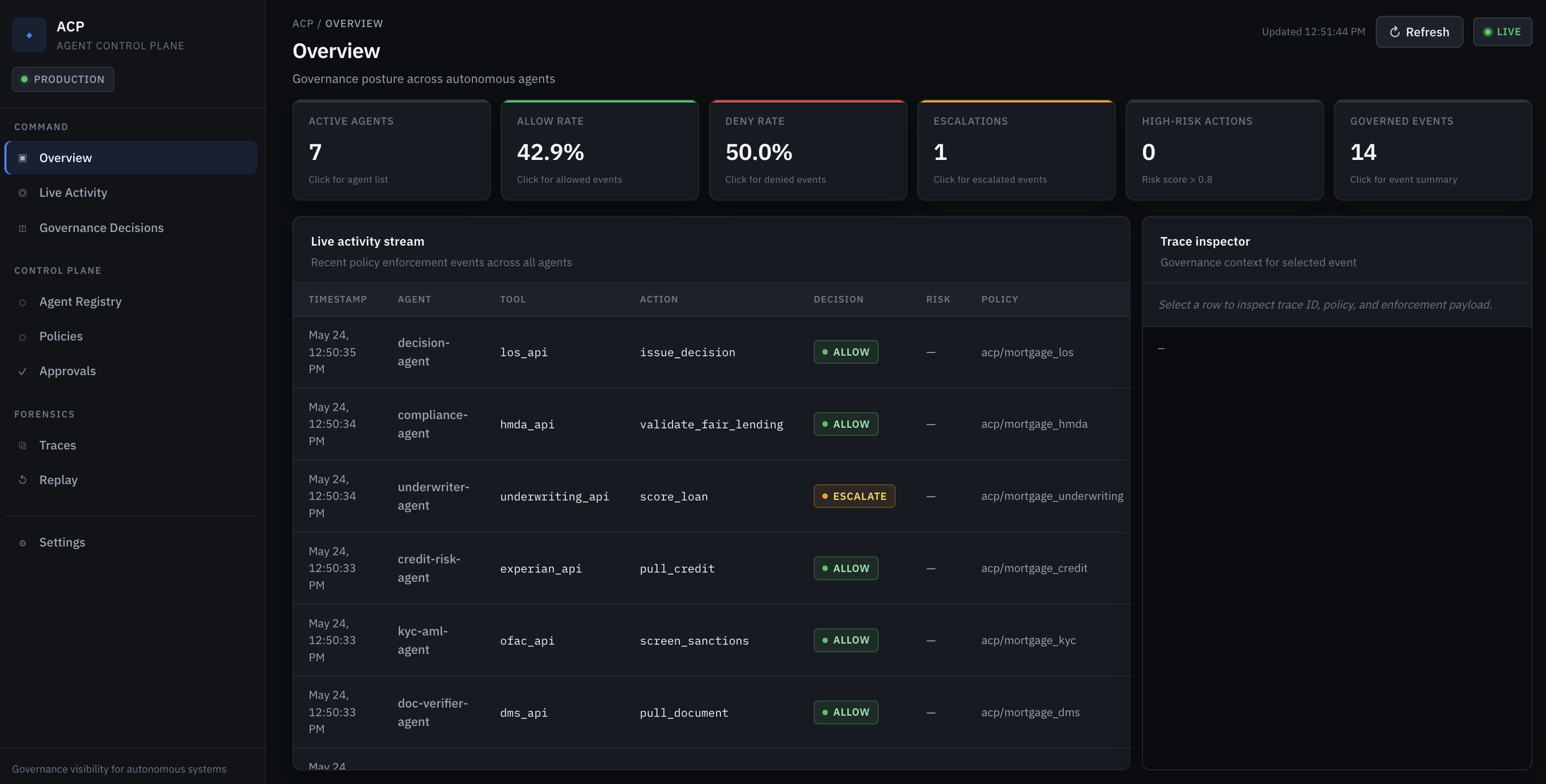
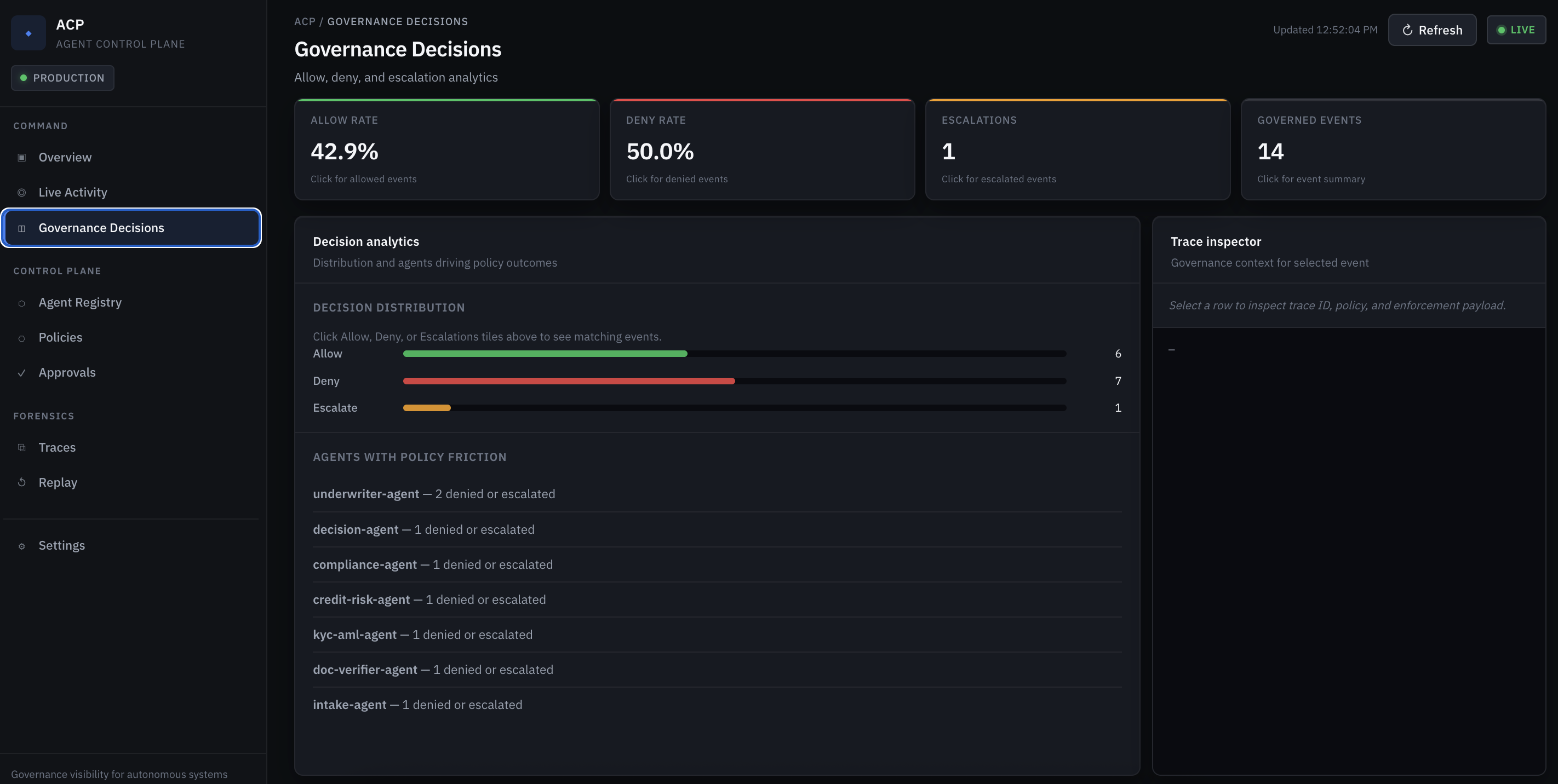
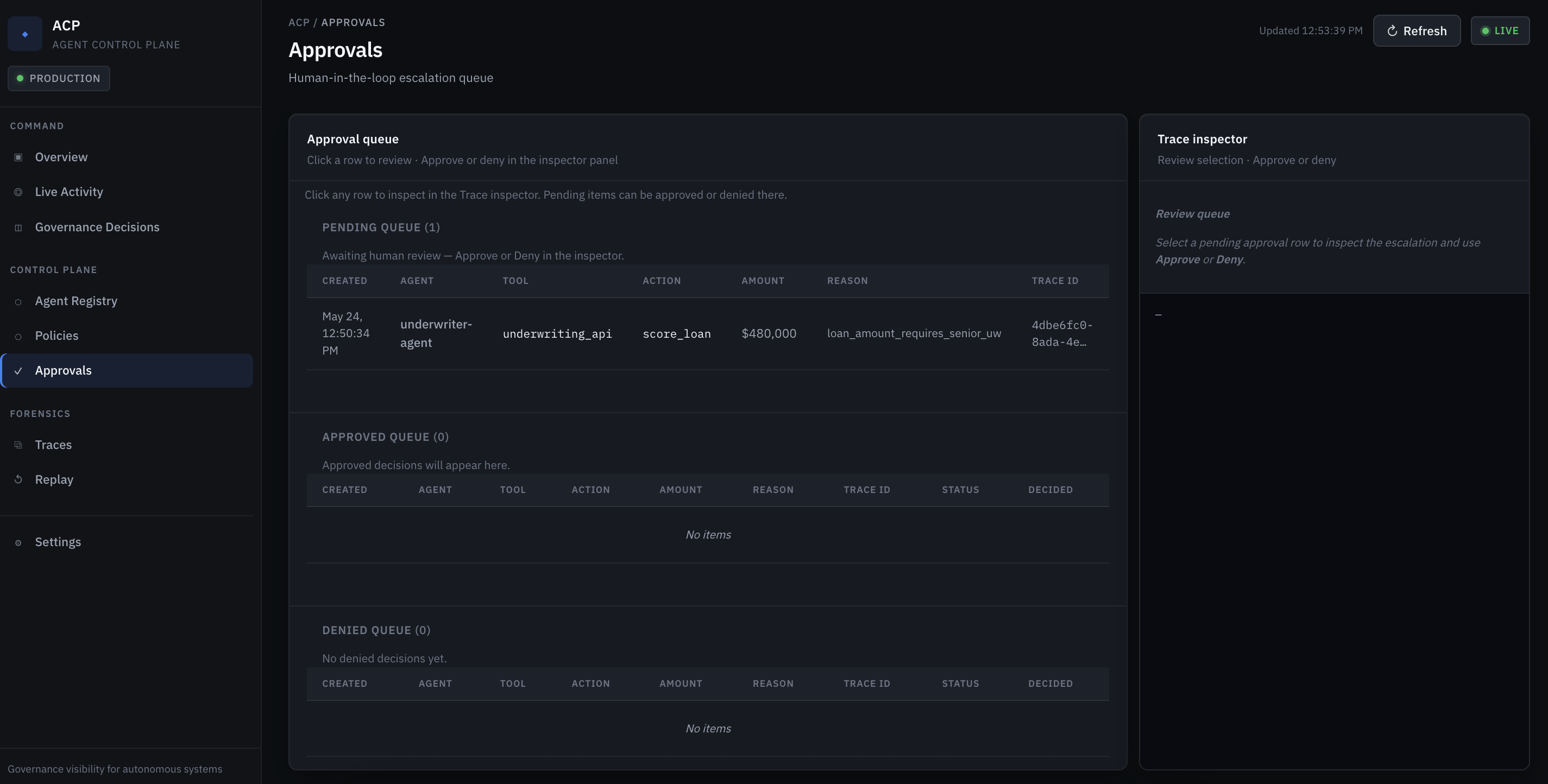
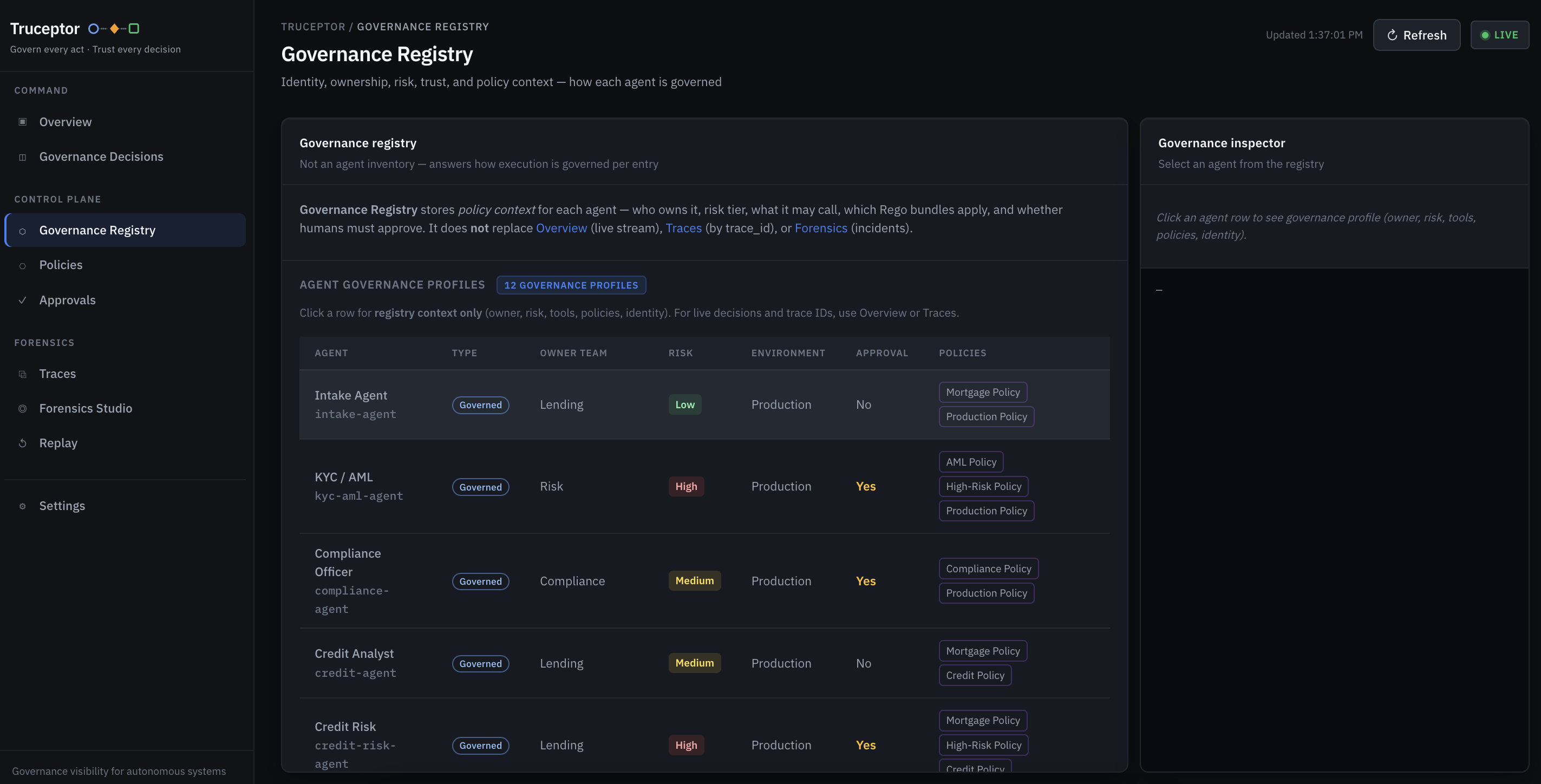
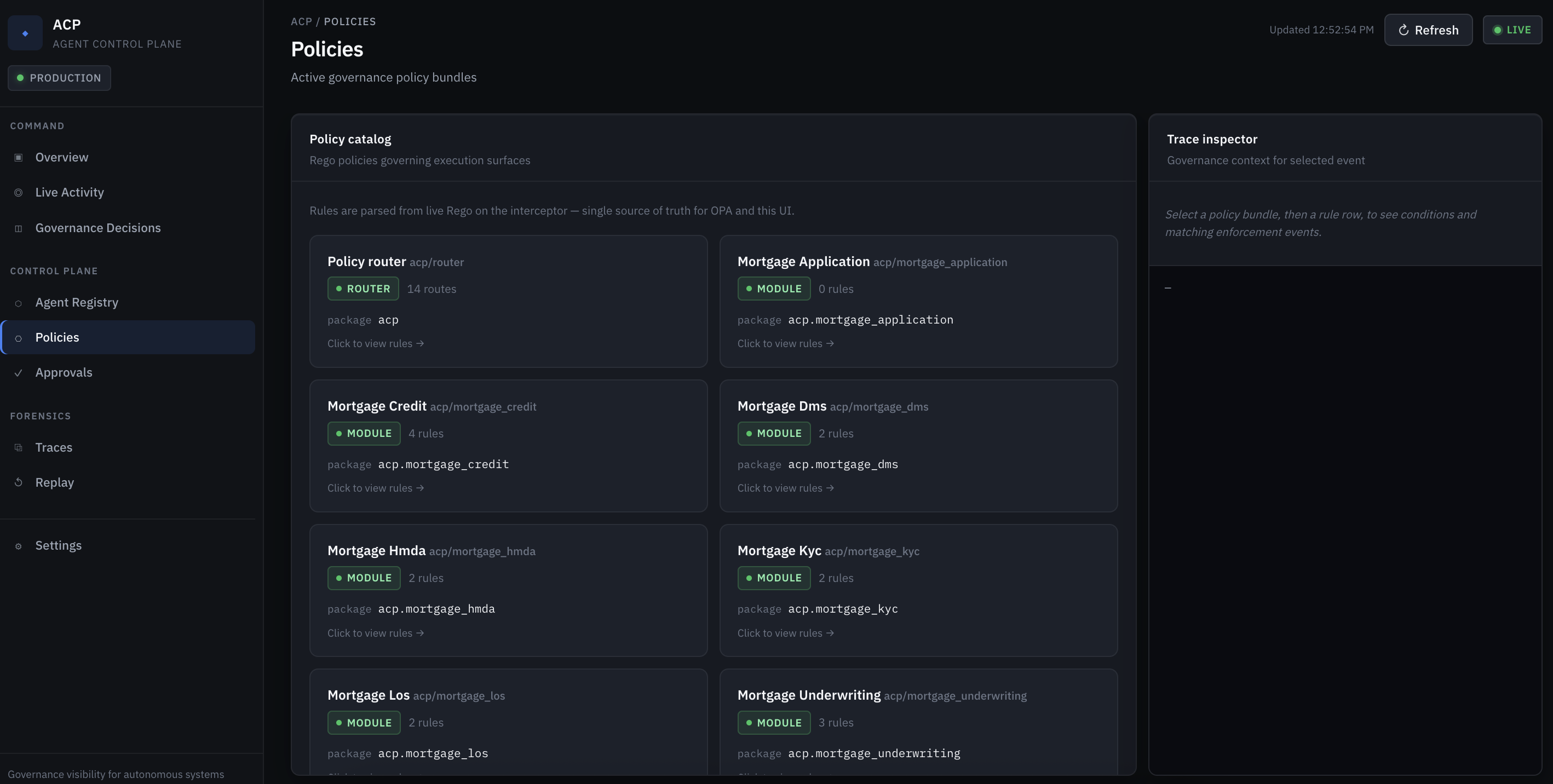
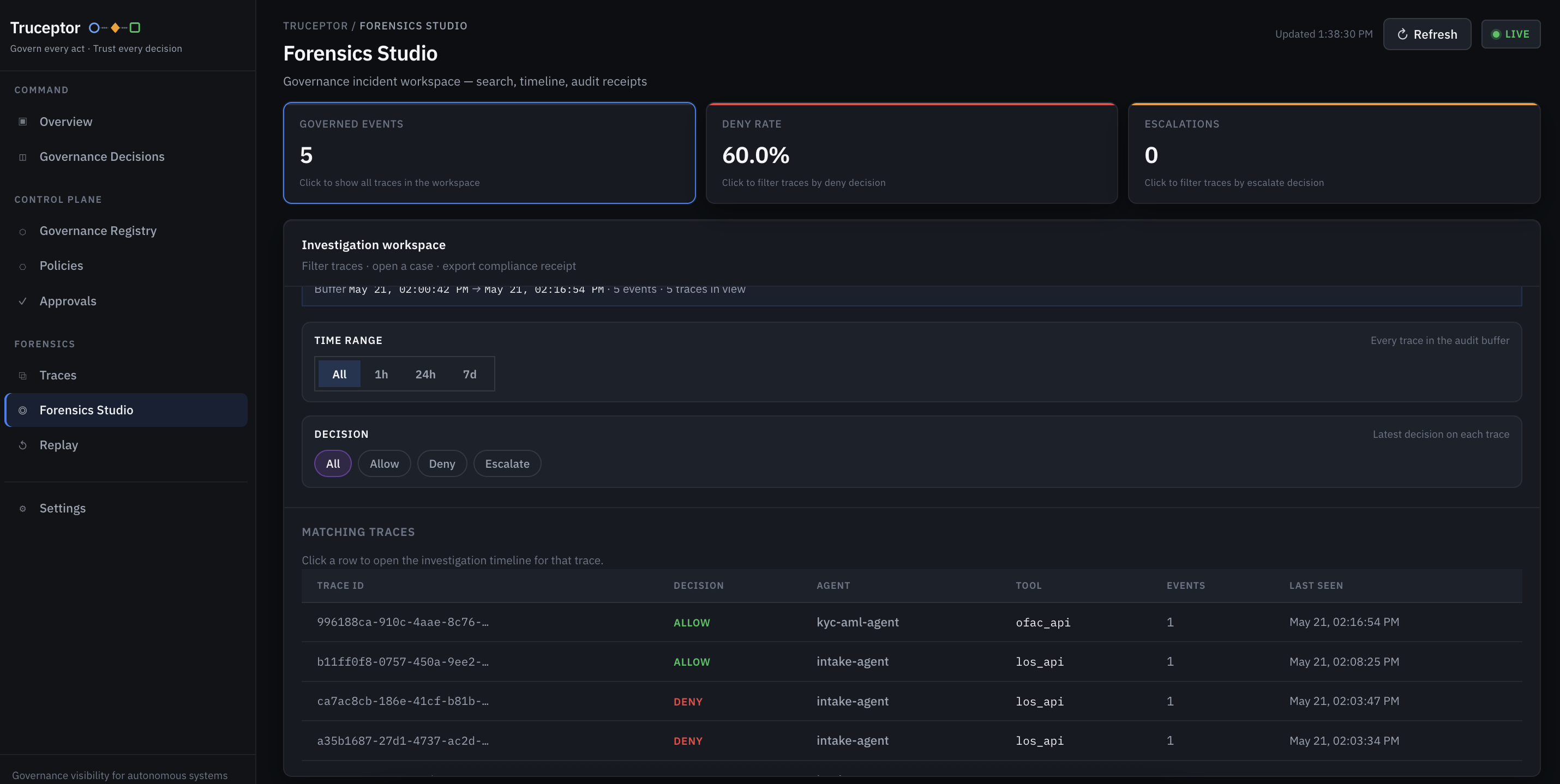
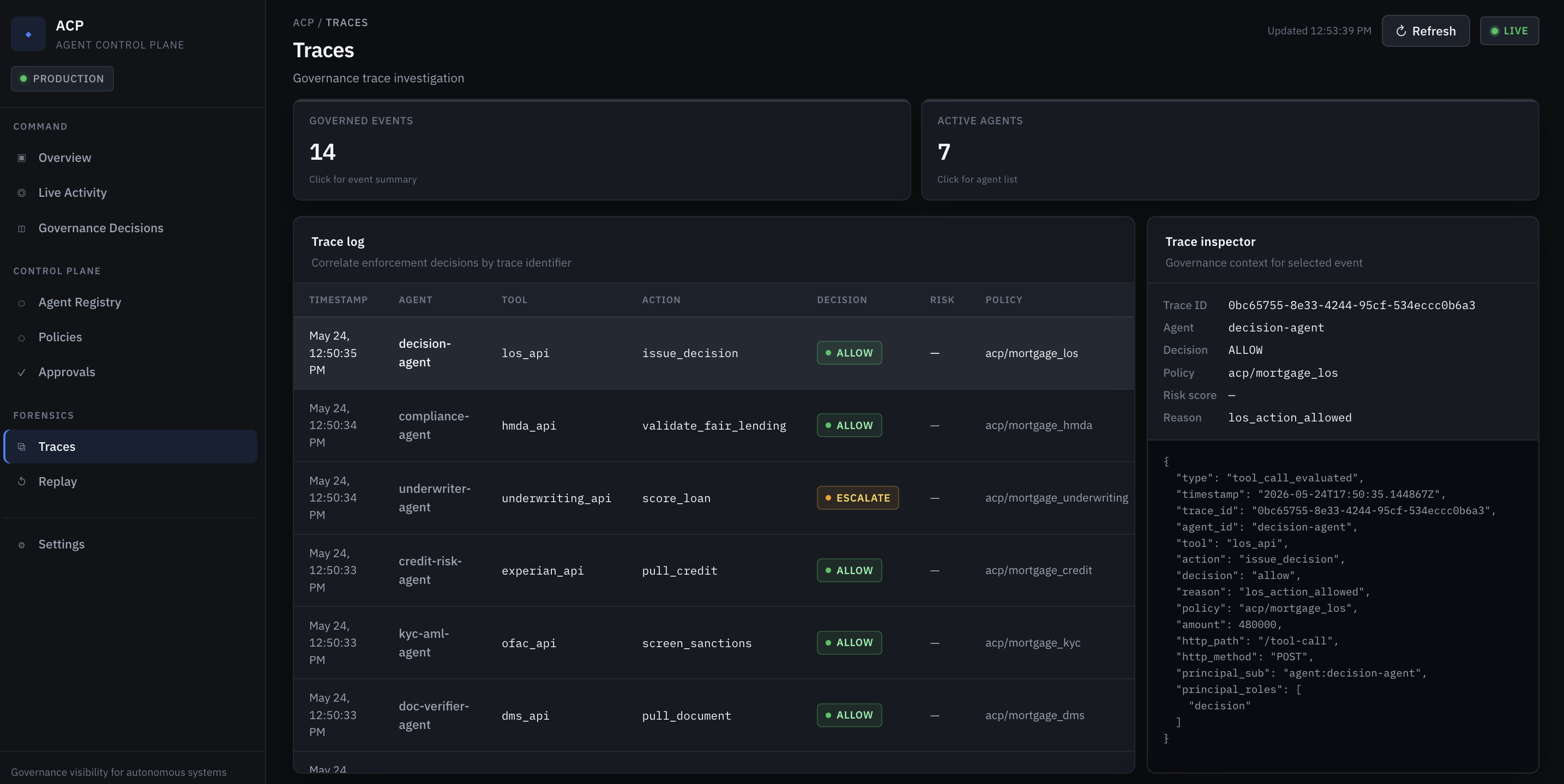
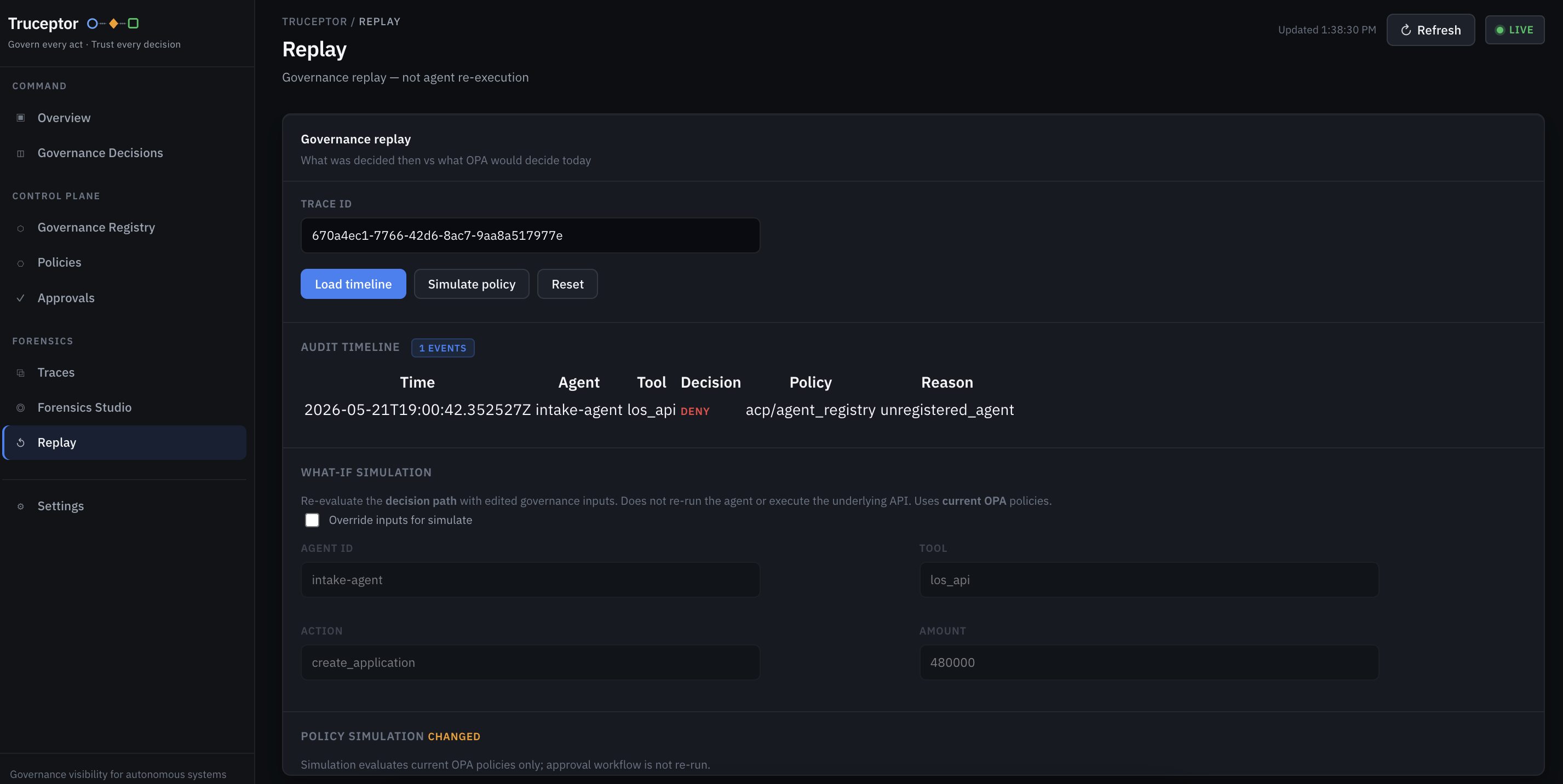
The Truceptor governance dashboard is a core differentiator: live allow/deny/escalate decisions, approvals, agent registry, and policy catalog. Open http://localhost:3090/dashboard/ after acp up.
Overview & activity
Decisions & approvals
Registry & policies
Forensics & replay
Deployment modes
| Mode | How | Best for |
|---|---|---|
| Local | acp up via pip + Docker |
Demos, dev, quickstart |
| SDK | @governed_tool in your agent code |
CrewAI, LangGraph, Strands, custom Python |
| Gateway | Single origin on :3090 (dashboard + API proxy) |
Local unified URL; pattern for prod ingress |
| Cloud / self-hosted | Docker Compose, Kubernetes, ECS/EKS on AWS/Azure/GCP | Team or enterprise rollout |
Local endpoints
| URL | Purpose |
|---|---|
| http://localhost:3090/dashboard/ | Governance dashboard |
| http://localhost:8080 | Interceptor API (/tool-call, /api/v1/*) |
Self-hosted (example)
https://acp.your-company.example
Example: governed tool
Set ACP_INTERCEPTOR_URL and ACP_BEARER_TOKEN before defining a @governed_tool.
The decorator constructs its client at decoration time, so setting those env vars later inside main() is too late.
import os
from truceptor import governed_tool

# Set env vars before decorator evaluation.
os.environ.setdefault("ACP_INTERCEPTOR_URL", "http://localhost:8080")
os.environ.setdefault("ACP_BEARER_TOKEN", "<dev-jwt>")

@governed_tool(
    agent_id="texas-weather-agent",
    tool="weather_api",
    action="read_weather",
)
def get_texas_weather(city: str):
    return {"city": city, "status": "pending_review"}
Truceptor intercepts the call, evaluates policy, then allows, denies, or escalates.
tool="weather_api" is the governed tool id. It does not have to match the Python function name (get_texas_weather). Policy keys on tool, not the Python symbol name.
The JWT agent_id claim must match agent_id="texas-weather-agent" in @governed_tool(...).
Example: policy (Rego)
package acp.policy

allow {
    input.identity.role == "supply-chain-manager"
    input.action.tool == "supplier_approval"
    input.risk_score < 70
}
Edit policies in ~/.acp/policies/ after acp init, then restart with acp down && acp up so the interceptor upserts them into Postgres and syncs to OPA. See HOW_TO_ADD_RULES.md in that folder after init.
Adding a new governed tool
acp init creates starter policy files in ~/.acp/policies/, but you still need to wire new tools into policy yourself.
For a brand-new governed tool, update all of these:
- choose a governed tool id, for example
weather_api - add tool-to-role mapping in
~/.acp/policies/rbac.rego - route the tool in
~/.acp/policies/router.rego - add or reuse a domain policy file such as
weather.rego - mint and export
ACP_BEARER_TOKEN - make sure the JWT
agent_idclaim matches@governed_tool(agent_id=...) - restart:
acp down && acp up(loads Rego into Postgres + OPA) - run the agent
Two valid patterns:
Pattern 1: reuse a governed tool bucket
Use one tool id for multiple Python functions in the same policy domain.
@governed_tool(
    agent_id="texas-weather-agent",
    tool="weather_api",
    action="read_weather",
)
def get_texas_weather(city: str):
    ...
~/.acp/policies/rbac.rego
"weather_api": ["weather"],
~/.acp/policies/router.rego
decision = weather.decision {
    input.tool == "weather_api"
    rbac.decision.decision == "allow"
}
~/.acp/policies/weather.rego
package acp.weather

default decision = {
    "decision": "allow",
    "reason": "weather_action_allowed",
    "policy": "acp/weather",
}

decision = {
    "decision": "deny",
    "reason": "weather_action_not_permitted",
    "policy": "acp/weather",
} {
    not input.action == "read_weather"
    not input.action == "read_weather_batch"
}
Pattern 2: add a brand-new governed tool id
If you want policy to key directly on a new id such as get_texas_weather, add that id to both rbac.rego and router.rego, then route it to the right domain policy file.
If your starter router.rego or rbac.rego references a tool id, make sure the corresponding domain policy file also exists.
Local JWT dev example
Local governed /tool-call requests require a bearer token when JWT auth is enabled. ACP_INTERCEPTOR_URL alone is not enough.
Set:
ACP_INTERCEPTOR_URL=http://localhost:8080ACP_BEARER_TOKEN=<signed-jwt>
If ACP_BEARER_TOKEN is missing, governed calls may fail with 401 Unauthorized / missing bearer token.
One dev-friendly way to mint a token is:
python -m pip install pyjwt cryptography

export ACP_BEARER_TOKEN="$(
python - <<'PY'
from pathlib import Path
import time
import jwt

private_key = (Path.home() / ".acp" / "jwt" / "private.pem").read_text()
token = jwt.encode(
    {
        "sub": "agent:texas-weather-agent",
        "agent_id": "texas-weather-agent",
        "roles": ["weather"],
        "iss": "acp-dev",
        "aud": "acp-interceptor",
        "exp": int(time.time()) + 3600,
    },
    private_key,
    algorithm="RS256",
)
print(token)
PY
)"
Use these claims for local development:
sub=agent:texas-weather-agentagent_id=texas-weather-agentroles=["weather"]iss=acp-devaud=acp-interceptor
agent_id in the JWT must match the agent_id passed to @governed_tool(...).
Example: governance flow
Supply Chain Agent
    → Truceptor validates identity (JWT)
    → OPA evaluates policy
    → Decision: ESCALATE
    → Human approves in dashboard
    → Execution resumes
What Truceptor provides
- Policy enforcement — OPA/Rego (Cedar on roadmap)
- Identity — JWT from Okta, Auth0, Keycloak, or your IdP
- Approvals — human-in-the-loop for risky actions
- Observability — dashboard for decisions, traces, agents, tools
- Agent registry — lightweight catalog of agents and capabilities
- Framework-friendly — keep CrewAI / LangGraph / Strands for reasoning; govern execution here
Philosophy
Orchestration frameworks handle reasoning, planning, and workflows.
Truceptor handles governance, trust, approvals, policy, and auditability.
Reasoning stays autonomous. Execution stays governed.
Roadmap
- Policy Studio — MVP shipped in 0.5.0: Approval, Risk, and Compliance threshold rules via dashboard wizard; compiles to Rego in
policy_versions; human-readable Policies tab for all modules. - Access rules and agent-to-agent rules (Policy Studio)
- Enterprise topology views
- Multi-cloud deployment templates
Release notes
0.5.0
- Breaking (Python import): package directory renamed
acp→truceptor. Usefrom truceptor import governed_tool, ACPClient. CLI unchanged (acp up,acp init); env vars stillACP_*; user dir still~/.acp/. - Policy Studio MVP in bundled interceptor + dashboard: business rules → Rego → same Postgres/OPA pipeline.
- Policies catalog: human-readable rule summaries for engineer-authored and Policy Studio modules.
- Bundled runtime sync excludes monorepo-only
deployments/dev scripts from the PyPI wheel.
0.4.x
- PyPI package
truceptor; integration docs; bundled Docker runtime viaacp up.
License
MIT License
1 maintainer

Release files for truceptor 0.5.0
For a detailed explanation of source distributions (sdists) and built distributions (wheels), please see the package formats documentation.
Source distribution (sdist)
| File | Size | Uploaded | |
|---|---|---|---|
| truceptor-0.5.0.tar.gz | 166.9 kB | Details |
Built distribution (wheel)
| File | Interpreter | ABI | Platform | Reset |
|---|---|---|---|---|
| truceptor-0.5.0-py3-none-any.whl | Python 3 | none | any | Details |
Total release size: 388.6 kB
Release files / truceptor-0.5.0.tar.gz
| Download URL | truceptor-0.5.0.tar.gz |
|---|---|
| Size | 166.9 kB |
| Tags | Source |
|
SHA-256 checksum How to use checksums |
c9fbdf6a4b074f22aec1fb852455f99d23bd8551913cca518dadb7c99b940a64
|
|
BLAKE2b-256 checksum How to use checksums |
00973a4a8e2e366a61477ebbd18e0910a6d7297ca3c6ab88d2f83b1bab520f45
|
| Upload date | |
|
Uploaded using Trusted Publishing? What is trusted publishing? |
No |
| Uploaded via |
twine/6.2.1.dev37+g4f20c0dc3 CPython/3.11.6
|
Release files / truceptor-0.5.0-py3-none-any.whl
| Download URL | truceptor-0.5.0-py3-none-any.whl |
|---|---|
| Size | 221.7 kB |
| Tags | Python 3 |
|
SHA-256 checksum How to use checksums |
a090cae5850259bcf3f5b41405916b93c65df2a74804249eaad0bf37974df30a
|
|
BLAKE2b-256 checksum How to use checksums |
60dda30b6e6852dcb50b7abaa9134aea4bb60b3c68209f1e77195dcf798eec56
|
| Upload date | |
|
Uploaded using Trusted Publishing? What is trusted publishing? |
No |
| Uploaded via |
twine/6.2.1.dev37+g4f20c0dc3 CPython/3.11.6
|














