










Time Series Feature Extraction Library
Intuitive time series feature extraction
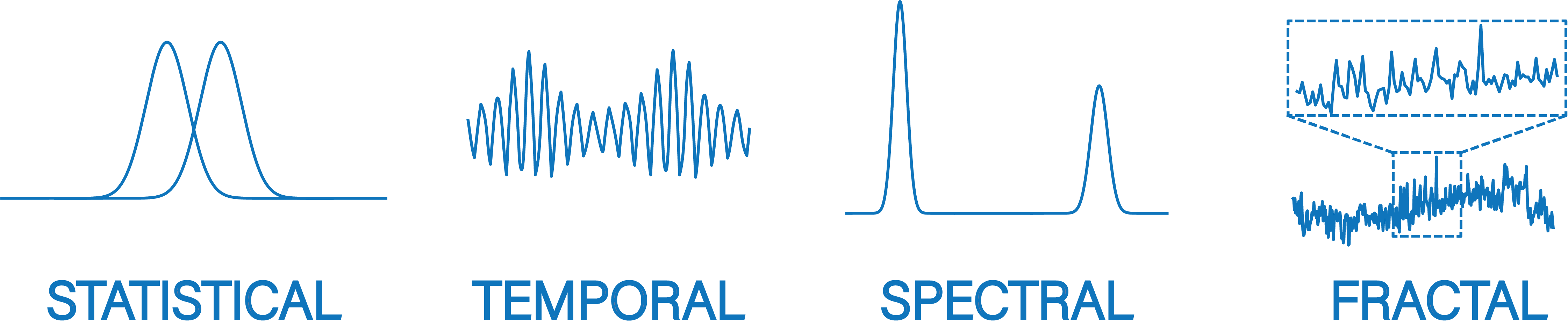
TSFEL is an open-source Python library for time series analysis. It centralizes a large and powerful feature set of
several feature extraction methods from statistical, temporal, spectral, and fractal domains.
The documentation is available here.
You can install TSFEL via pip using the following:
pip install tsfel
TSFEL requires Python 3.11 or newer. On older Python versions, pip installs TSFEL 0.2.0, the last release that
supports them.
A release on conda-forge is coming soon.
Getting started
Below is a quick example of how to use TSFEL for time series feature extraction:
import tsfel

# Loads a 10 s single lead ECG
data = tsfel.datasets.load_biopluxecg()

# Set up the default configuration using the statistical, temporal and spectral feature sets.
cfg = tsfel.get_features_by_domain()

# Extract features
X = tsfel.time_series_features_extractor(cfg, data)
For a more detailed walk-through — including input/output data formats, extraction routine configuration, and how to implement your custom features — refer to the documentation here.
Highlights
- Intuitive, fast deployment, and reproducible: Easily configure your feature extraction pipeline and store the configuration file to ensure reproducibility.
- Computational complexity evaluation: Estimate the computational time required for feature extraction in advance.
- Comprehensive documentation: Each feature extraction method is accompanied by a detailed explanation.
- Unit tested: We provide an extensive suite of unit tests for each feature to ensure accurate and reliable feature calculation.
- Easily extended: Adding new features is straightforward, and we encourage contributions of custom features to the community.
Available features
TSFEL automatically extracts more than 65 distinct features across statistical, temporal, spectral, and fractal
domains.
Statistical domain
| Features | Computational Cost |
|---|---|
| Absolute energy | 1 |
| Average power | 1 |
| ECDF | 1 |
| ECDF Percentile | 1 |
| ECDF Percentile Count | 1 |
| Entropy | 1 |
| Histogram | 1 |
| Interquartile range | 1 |
| Kurtosis | 1 |
| Max | 1 |
| Mean | 1 |
| Mean absolute deviation | 1 |
| Median | 1 |
| Median absolute deviation | 1 |
| Min | 1 |
| Root mean square | 1 |
| Skewness | 1 |
| Standard deviation | 1 |
| Variance | 1 |
Temporal domain
| Features | Computational Cost |
|---|---|
| Area under the curve | 1 |
| Autocorrelation | 2 |
| Centroid | 1 |
| Lempel-Ziv-Complexity* | 2 |
| Mean absolute diff | 1 |
| Mean diff | 1 |
| Median absolute diff | 1 |
| Median diff | 1 |
| Negative turning points | 1 |
| Peak to peak distance | 1 |
| Positive turning points | 1 |
| Signal distance | 1 |
| Slope | 1 |
| Sum absolute diff | 1 |
| Zero crossing rate | 1 |
| Neighbourhood peaks | 1 |
* Disabled by default due to its longer execution time compared to other features.
Spectral domain
| Features | Computational Cost |
|---|---|
| FFT mean coefficient | 1 |
| Fundamental frequency | 1 |
| Human range energy | 1 |
| LPCC | 1 |
| MFCC | 1 |
| Max power spectrum | 1 |
| Maximum frequency | 1 |
| Median frequency | 1 |
| Power bandwidth | 1 |
| Spectral centroid | 2 |
| Spectral decrease | 1 |
| Spectral distance | 1 |
| Spectral entropy | 1 |
| Spectral kurtosis | 2 |
| Spectral positive turning points | 1 |
| Spectral roll-off | 1 |
| Spectral roll-on | 1 |
| Spectral skewness | 2 |
| Spectral slope | 1 |
| Spectral spread | 2 |
| Spectral variation | 1 |
| Wavelet absolute mean | 2 |
| Wavelet energy | 2 |
| Wavelet standard deviation | 2 |
| Wavelet entropy | 2 |
| Wavelet variance | 2 |
Fractal domain
| Features | Computational Cost |
|---|---|
| Detrended fluctuation analysis (DFA) | 3 |
| Higuchi fractal dimension | 3 |
| Hurst exponent | 3 |
| Maximum fractal length | 3 |
| Multiscale entropy (MSE) | 1 |
| Petrosian fractal dimension | 1 |
Fractal domain features are typically applied to relatively longer signals to capture meaningful patterns, and it's usually unnecessary to previously divide the signal into shorter windows. Therefore, this domain is disabled in the default feature configuration files.
Support & General discussion
For bug reports, please use the GitHub issue tracker. To make feature requests, share ideas, engage in general discussions, or receive announcements, you're welcome to join our Slack community.
Citing
If you use TSFEL in your work, please cite the following publication:
Barandas, Marília and Folgado, Duarte, et al. "TSFEL: Time Series Feature Extraction Library." SoftwareX 11 ( 2020). https://doi.org/10.1016/j.softx.2020.100456
Acknowledgements
We gratefully acknowledge the financial support received from the Center for Responsible AI and the Total Integrated and Predictive Manufacturing System Platform for Industry 4.0 projects.
3 maintainers


Metadata
3 maintainers
Release files for tsfel 0.3.0
For a detailed explanation of source distributions (sdists) and built distributions (wheels), please see the package formats documentation.
Source distribution (sdist)
| File | Size | Uploaded | Provenance | Actions |
|---|---|---|---|---|
| tsfel-0.3.0.tar.gz | 53.0 kB | Without provenance | Details for tsfel-0.3.0.tar.gz |
Built distribution (wheel)
| File | Interpreter | ABI | Platform | Actions Reset |
|---|---|---|---|---|
| tsfel-0.3.0-py3-none-any.whl | Python 3 | none | any | Details for tsfel-0.3.0-py3-none-any.whl |
Total release size: 91.6 kB
Release files / tsfel-0.3.0.tar.gz
| Download URL | tsfel-0.3.0.tar.gz |
|---|---|
| Size | 53.0 kB |
| Tags | Source |
|
SHA-256 checksum How to use checksums |
7dcd33bb8e4b219675bf1b2059372f7f09a15430f1db027a575d7c692bd4c2f9
|
|
BLAKE2b-256 checksum How to use checksums |
dff99e07d1ec3aa3ac4ceca386e445eab821f7dd00f589a31611eaa3479ad73b
|
| Upload date | |
|
Uploaded using Trusted Publishing? What is trusted publishing? |
No |
| Uploaded via |
twine/7.0.0 CPython/3.14.10
|
Release files / tsfel-0.3.0-py3-none-any.whl
| Download URL | tsfel-0.3.0-py3-none-any.whl |
|---|---|
| Size | 38.6 kB |
| Tags | Python 3 |
|
SHA-256 checksum How to use checksums |
99cc21062b7362441c1d20a4f8eebc6ddd1deb1707eb02d7d67af43f068278a9
|
|
BLAKE2b-256 checksum How to use checksums |
64a3276a350a51fb14a64bb8235423edd1a3abd9459fe37f817f4a12d341c48f
|
| Upload date | |
|
Uploaded using Trusted Publishing? What is trusted publishing? |
No |
| Uploaded via |
twine/7.0.0 CPython/3.14.10
|
Security for tsfel 0.3.0
Provenance
Provenance describes where a file came from. On PyPI, provenance is shared via attestations, which provide a verifiable record of the build or publishing details. View details, limitations and caveats.
No provenance found
None of the files in this release were uploaded with provenance metadata.
A note on package security
PyPI is a repository for distributing packages, not a service for auditing them. While third-party security researchers and our staff do their best to detect and remove malicious packages, PyPI cannot guarantee the quality, security or suitability of any given package.
To learn more about protecting yourself from malicious actors, visit our package security documentation.














