
TL;DR: This converts a file like this (config file at ~/.config/ttally.py):
from datetime import datetime
from typing import NamedTuple, Optional


class Weight(NamedTuple):
    when: datetime
    pounds: float


class Food(NamedTuple):
    when: datetime
    calories: int
    food: str
    quantity: float
    water: int  # how much ml of water was in this

    # specify a special way to prompt for quantity
    @staticmethod
    def attr_validators() -> dict:
        # https://purarue.xyz/d/ttally_types.py?redirect
        from my.config.pura.ttally_types import prompt_float_default  # type: ignore

        # if I don't supply a quantity, default to 1
        return {"quantity": lambda: prompt_float_default("quantity")}


class Event(NamedTuple):
    """e.g. a concert or something"""

    event_type: str
    when: datetime
    description: str
    score: Optional[int]
    comments: Optional[str]

    @staticmethod
    def attr_validators() -> dict:
        from my.config.pura.ttally_types import edit_in_vim  # type: ignore

        return {"comments": edit_in_vim}


import os
from enum import Enum

# dynamically create an enum using each line of the file as an option
with open(os.path.expanduser("~/Documents/.self_types.txt")) as f:
    SelfT = Enum("SelfT", [s.rstrip().upper() for s in f])


class Self(NamedTuple):
    when: datetime
    what: SelfT  # type: ignore
to (shell aliases)...
alias event='python3 -m ttally prompt event'
alias event-now='python3 -m ttally prompt-now event'
alias event-recent='python3 -m ttally recent event'
alias food='python3 -m ttally prompt food'
alias food-now='python3 -m ttally prompt-now food'
alias food-recent='python3 -m ttally recent food'
alias self='python3 -m ttally prompt self'
alias self-now='python3 -m ttally prompt-now self'
alias self-recent='python3 -m ttally recent self'
alias weight='python3 -m ttally prompt weight'
alias weight-now='python3 -m ttally prompt-now weight'
alias weight-recent='python3 -m ttally recent weight'
Whenever I run any of those aliases, it inspects the model in the config file, and on-the-fly creates and runs an interactive interface like this:
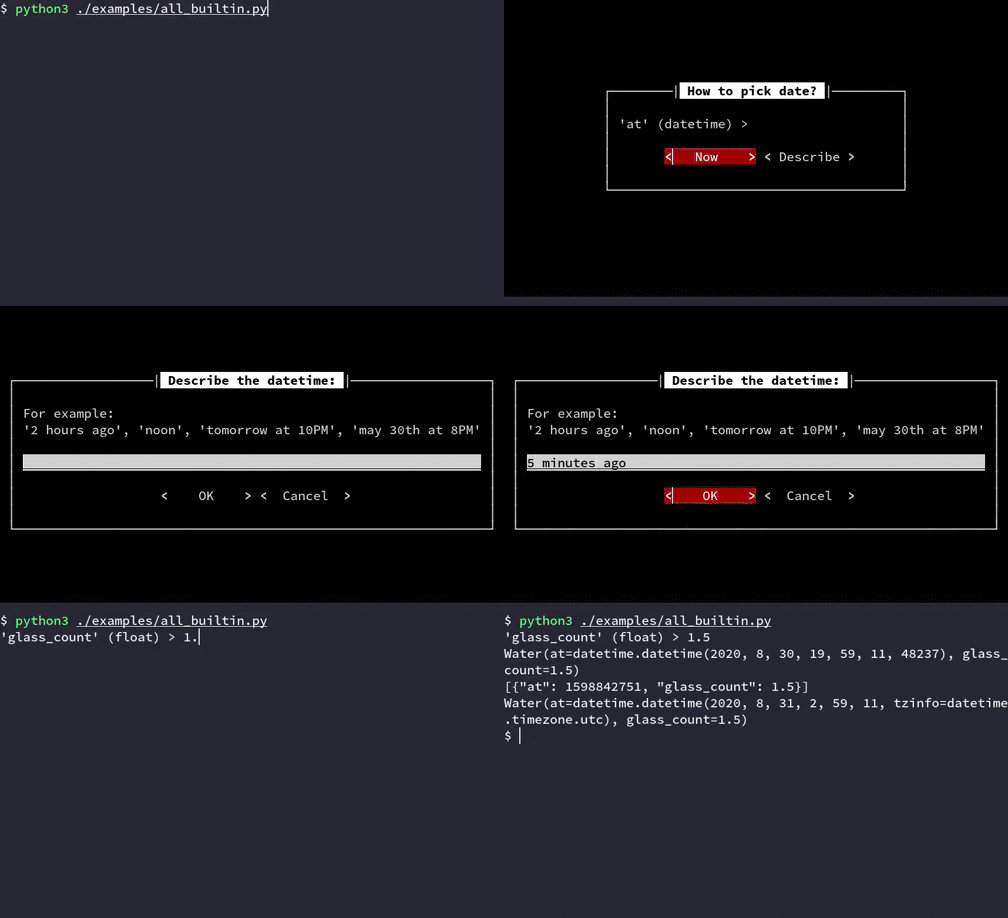
... which saves what I enter to a file:
- when: 1598856786,
  glasses": 2.0
ttally
ttally is an interactive module using autotui to save things I do often to YAML/JSON
Currently, I use this to store info like whenever I eat something/drink water/my current weight/thoughts on concerts
Given a NamedTuple defined in ~/.config/ttally.py, this creates interactive interfaces which validates my input and saves it to a file
The {tuple}-now aliases set the any datetime values for the prompted tuple to now
This also gives me {tuple}-recent aliases, which print recent items I've logged. For example:
$ water-recent 5
2021-03-20 18:23:24     2.0
2021-03-20 01:28:27     1.0
2021-03-19 23:34:12     1.0
2021-03-19 22:49:05     1.5
2021-03-19 16:05:34     1.0
The -recent aliases can accept all to print all items, or a duration like 1d or 6h to print data from the last few hours/days.
Why/How
Goals
- validates my user input to basic types
- stores it as a user-editable format (YAML)
- can be loaded into python as typed objects
- minimal boilerplate to add a new model
- can be synced across multiple machines without conflicts
- allow completely custom types or prompts - see autotui docs, my custom prompts
This intentionally uses YAML and doesn't store the info into a single "merged" database. That way:
- you can just open the YAML file and quickly change/edit some item, no need to re-invent a CRUD interface (though
ttally edit-recentdoes exist) - files can be synced across machines and to my phone using syncthing without file conflicts
- prevents issues with trying to merge multiple databases from different machines together (I've tried)
The YAML files are versioned with the date/OS/platform, so I'm able to add items on my linux, mac, or android (using termux) and sync them across all my devices using SyncThing. Each device creates its own file it adds items to, like:
food-darwin-mbp.localdomain-2021-03.yaml
food-linux-bastion-2021-03.yaml
food-linux-localhost-2021-04.yaml
... which can then be combined back into python, like:
>>> from more_itertools import take  # just to grab a few items
>>> from ttally.__main__ import ext
>>> from ttally.config import Food
>>> take(3, ext.glob_namedtuple(Food))

[Food(when=datetime.datetime(2020, 9, 27, 6, 49, 34, tzinfo=datetime.timezone.utc), calories=440, food='ramen, egg'),
Food(when=datetime.datetime(2020, 9, 27, 6, 52, 16, tzinfo=datetime.timezone.utc), calories=160, food='2 eggs'),
Food(when=datetime.datetime(2020, 9, 27, 6, 53, 44, tzinfo=datetime.timezone.utc), calories=50, food='ginger chai')]
... or into JSON using ttally export food
The from-json command can be used to send this JSON which matches a model, i.e. providing a non-interactive interface to add items, in case I want to call this from a script
hpi query from HPI can be used with the ttally.__main__ module, like:
# how many calories in the last day
$ hpi query ttally.__main__.food --recent 1d -s | jq -r '(.quantity)*(.calories)' | datamash sum 1
2252
If you'd prefer to use JSON files, you can set the TTALLY_EXT=json environment variable.
This can load data from YAML or JSON (or both at the same time), every couple months I'll combine all the versioned files to a single merged file using the merge command:
ttally merge food
Installation
pip install ttally # can use 'pip install ttally[optional]' for extra features
Usage: ttally [OPTIONS] COMMAND [ARGS]...

  Tally things that I do often!

  Given a few namedtuples, this creates serializers/deserializers and an
  interactive interface using 'autotui', and aliases to:

  prompt using default autotui behavior, writing to the ttally datafile, same
  as above, but if the model has a datetime, set it to now, query the 10 most
  recent items for a model

Options:
  --help  Show this message and exit.

Commands:
  datafile      print the datafile location
  drop-last     drop the last n items
  edit          edit the datafile
  edit-recent   fuzzy select/edit recent items
  export        export all data from a model
  from-json     add item by piping JSON
  generate      generate shell aliases
  merge         merge all data for a model into one file
  models        list models
  prompt        tally an item
  prompt-now    tally an item (now)
  recent        print recently tallied items
  update-cache  cache export data
Configuration
You need to setup a ~/.config/ttally.py file. You can use the block above as a starting point, or with mine:
curl -s 'https://purarue.xyz/d/ttally.py' > ~/.config/ttally.py
To setup aliases; You can do it each time you launch you terminal like:
eval "$(python3 -m ttally generate)"
Or, 'cache' the generated aliases by putting a block like this in your shell config:
TTALLY_ALIASES="${HOME}/.cache/ttally_aliases"
if [[ ! -e "${TTALLY_ALIASES}" ]]; then  # alias file doesn't exist
	python3 -m ttally generate >"${TTALLY_ALIASES}"  # generate and save the aliases
fi
source "${TTALLY_ALIASES}"  # make aliases available in your shell
i.e., it runs the first time I open a terminal, but then stays the same until I remove the file
You can set the TTALLY_DATA_DIR environment variable to the directory that ttally should save data to, defaults to ~/.local/share/ttally. If you want to use a different path for configuration, you can set the TTALLY_CFG to the absolute path to the file.
For shell completion to autocomplete options/model names:
eval "$(_TTALLY_COMPLETE=bash_source ttally)"  # in ~/.bashrc
eval "$(_TTALLY_COMPLETE=zsh_source ttally)"  # in ~/.zshrc
eval "$(_TTALLY_COMPLETE=fish_source ttally)"  # in ~/.config/fish/config.fish
Caching
ttally update-cache can be used to speedup the export and recent commands:
Usage: ttally update-cache [OPTIONS]

  Caches data for 'export' and 'recent' by saving the current data and an
  index to ~/.cache/ttally

  exit code 0 if cache was updated, 2 if it was already up to date

Options:
  --print-hashes  print current filehash debug info
  --help          Show this message and exit.
I run this using entr whenever the data files change. In the background, like:
find ~/data/ttally -type f | entr -n ttally update-cache
Default cache directory can be overwritten with the TTALLY_CACHE_DIR environment variable
Subclassing/Extension
The entire ttally library/CLI can also be subclassed/extended for custom usage, by using ttally.core.Extension class and wrap_cli to add additional click commands. For an example, see flipflop.py
Shell Scripts
cz lets me fuzzy select something I've eaten in the past using fzf, like:

1 maintainer

Metadata
1 maintainer
Release files for ttally 0.1.5
For a detailed explanation of source distributions (sdists) and built distributions (wheels), please see the package formats documentation.
Source distribution (sdist)
| File | Size | Uploaded | |
|---|---|---|---|
| ttally-0.1.5.tar.gz | 24.5 kB | Details |
Built distribution (wheel)
| File | Interpreter | ABI | Platform | Reset |
|---|---|---|---|---|
| ttally-0.1.5-py3-none-any.whl | Python 3 | none | any | Details |
Total release size: 46.8 kB
Release files / ttally-0.1.5.tar.gz
| Download URL | ttally-0.1.5.tar.gz |
|---|---|
| Size | 24.5 kB |
| Tags | Source |
|
SHA-256 checksum How to use checksums |
a8e372dd3e55fd23f03b3af439a063a8a97261cd437cfa0cecf899f89cb8c047
|
|
BLAKE2b-256 checksum How to use checksums |
f17f4216690b63ca66258bc4ca4fc09940855b41982659b1e25055286495adc2
|
| Upload date | |
|
Uploaded using Trusted Publishing? What is trusted publishing? |
No |
| Uploaded via |
twine/6.2.0 CPython/3.13.13
|
Release files / ttally-0.1.5-py3-none-any.whl
| Download URL | ttally-0.1.5-py3-none-any.whl |
|---|---|
| Size | 22.3 kB |
| Tags | Python 3 |
|
SHA-256 checksum How to use checksums |
df628a527ff9025432e9f80182d77550ec7bb9c622b3e0f67f52d4f1df26b8e0
|
|
BLAKE2b-256 checksum How to use checksums |
afaedebfc803e29edbee4aa36d81acd56f362ae44270e052ad6523a51b977dc6
|
| Upload date | |
|
Uploaded using Trusted Publishing? What is trusted publishing? |
No |
| Uploaded via |
twine/6.2.0 CPython/3.13.13
|














