
This release has been yanked by its maintainers, and will be ignored by installers, except when explicitly specified.
Reason given by maintainers: The issues have been fixed in upstream hangups and this fork is discontinued


This is a fork of https://github.com/tdryer/hangups
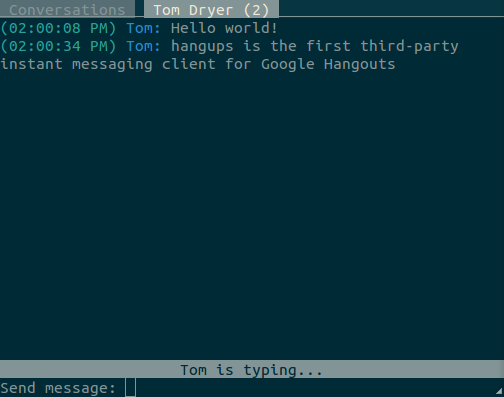
hangups is the first third-party instant messaging client for Google Hangouts. It includes both a Python library and a reference client with a text-based user interface.
Unlike its predecessor Google Talk, Hangouts uses a proprietary, non-interoperable protocol. hangups is implemented by reverse-engineering this protocol, which allows it to support features like group messaging that aren’t available in clients that connect via XMPP.
hangups is still in an early stage of development. The reference client is usable for basic chatting, but the API is undocumented and subject to change. Bug reports and pull requests are welcome!
Documentation
See the documentation for installation and usage instructions.
Projects using hangups
HangupsBot: Bot for Google Hangouts
Hubot Hangouts Adapter: Hubot adapter using hangups
QHangups: Alternative client for Google Hangouts written in PyQt
Ubuntu Hangups: Unofficial Google Hangouts client for Ubuntu Touch
bastardbot: A bot to follow and interact with Google Hangouts conversations
hangoutsbot/hangoutsbot: Google Hangouts bot
hangups.el: Hangouts interface for Emacs
pickups: IRC gateway for hangups (prototype)
telepathy-hangups: Telepathy bindings for Google Chat via hangups library
wardellchandler/HangoutsBot: Python 3 Bot for Hangouts
jabber-hangouts-transport: A Jabber/XMPP transport/gateway to Hangouts.
ovkulkarni/hangoutsbot: Google Hangouts Bot using SQL
defund/pearl: Google Hangouts bot framework
HangupsDroid: Unofficial Google Hangouts client for Android
chat-archive: Easy to use offline chat archive
SoulSen/Hanger: Modern, Simple, Asynchronous bot framework for Google Hangouts
1 maintainer

Metadata
1 maintainer
Release files for tulir-hangups 0.4.12
For a detailed explanation of source distributions (sdists) and built distributions (wheels), please see the package formats documentation.
Source distribution (sdist)
| File | Size | Uploaded | Provenance | |
|---|---|---|---|---|
| tulir-hangups-0.4.12.tar.gz | 97.5 kB | Without provenance | Details |
Built distribution (wheel)
| File | Interpreter | ABI | Platform | Reset |
|---|---|---|---|---|
| tulir_hangups-0.4.12-py3-none-any.whl | Python 3 | none | any | Details |
Total release size: 191.7 kB
Release files / tulir-hangups-0.4.12.tar.gz
| Download URL | tulir-hangups-0.4.12.tar.gz |
|---|---|
| Size | 97.5 kB |
| Tags | Source |
|
SHA-256 checksum How to use checksums |
64445b54f0d8cbf85fa7bea27fcc70cccc53a91afced64f55373b48f11446feb
|
|
BLAKE2b-256 checksum How to use checksums |
c9f81446e62a01a7fee0fdd50c57df12a7fff0b74fc58223b1697878b1d965d0
|
| Upload date | |
|
Uploaded using Trusted Publishing? What is trusted publishing? |
No |
| Uploaded via |
twine/3.1.1 pkginfo/1.4.2 requests/2.22.0 setuptools/49.6.0 requests-toolbelt/0.8.0 tqdm/4.30.0 CPython/3.8.2
|
Release files / tulir_hangups-0.4.12-py3-none-any.whl
| Download URL | tulir_hangups-0.4.12-py3-none-any.whl |
|---|---|
| Size | 94.2 kB |
| Tags | Python 3 |
|
SHA-256 checksum How to use checksums |
06bb2b985bb98bed64709fcef7fa8f66e62fe9cd45df1631311effaebb2d0ee5
|
|
BLAKE2b-256 checksum How to use checksums |
c3614986ec204b93ddee2c8bc33c9caea9ce25f52b9262852abfce428a8aeb28
|
| Upload date | |
|
Uploaded using Trusted Publishing? What is trusted publishing? |
No |
| Uploaded via |
twine/3.1.1 pkginfo/1.4.2 requests/2.22.0 setuptools/49.6.0 requests-toolbelt/0.8.0 tqdm/4.30.0 CPython/3.8.2
|
Security for tulir-hangups 0.4.12
Provenance
Provenance describes where a file came from. On PyPI, provenance is shared via attestations, which provide a verifiable record of the build or publishing details. View details, limitations and caveats.
No provenance found
None of the files in this release were uploaded with provenance metadata.
A note on package security
PyPI is a repository for distributing packages, not a service for auditing them. While third-party security researchers and our staff do their best to detect and remove malicious packages, PyPI cannot guarantee the quality, security or suitability of any given package.














