
turboquant-torch


Unofficial PyTorch reference implementation of TurboQuant from Google Research (ICLR 2026).
Paper: TurboQuant: Redefining AI Efficiency with Extreme Compression Blog: Google Research Blog
TurboQuant is a two-stage online (data-oblivious) vector quantizer that achieves near information-theoretic optimal distortion. No training data needed — just plug in and compress.
Overview
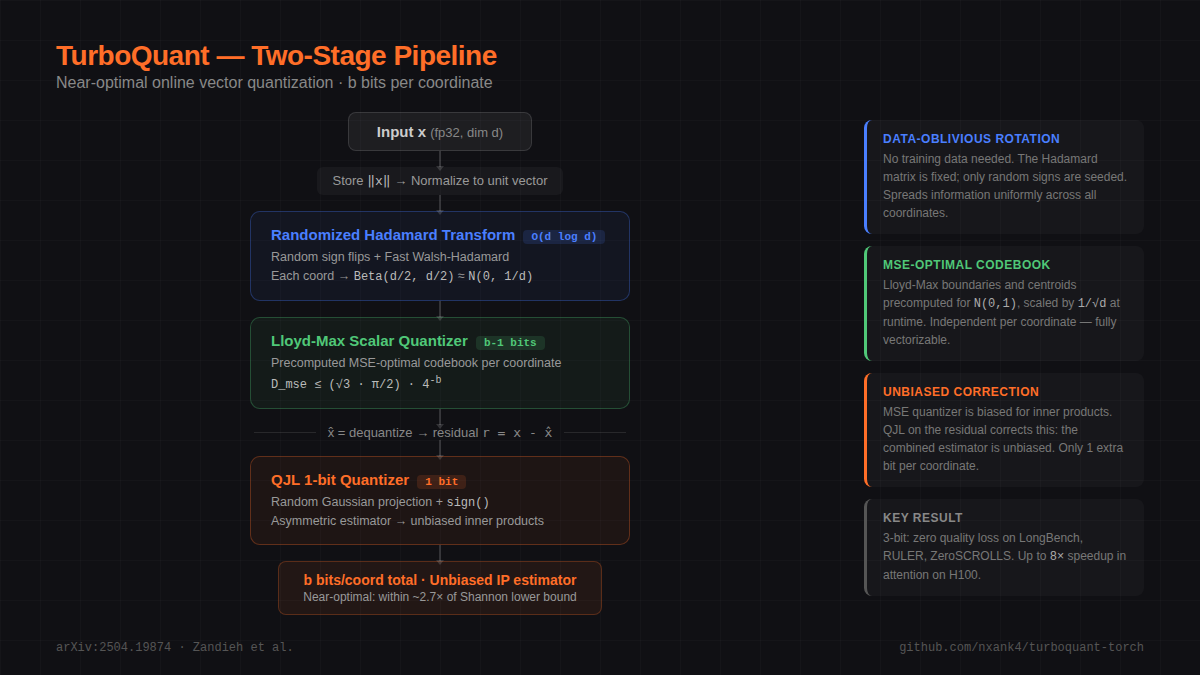
How It Works
flowchart TD
    X["Input x"] --> Norm["Store ‖x‖"]

    subgraph S1["Stage 1: MSE-Optimal Quantizer (b−1 bits)"]
        Norm --> Normalize["Normalize to unit vector"]
        Normalize --> RHT["Randomized Hadamard Transform\n(random sign flip + FWHT)"]
        RHT --> LM["Lloyd-Max Scalar Quantizer"]
        LM --> Codes["codes (b−1 bits/coord) + norm (32 bits)"]
    end

    Codes --> Deq["x̂ = dequantize(codes, norm)"]
    X --> Res
    Deq --> Res["Residual r = x − x̂"]

    subgraph S2["Stage 2: QJL 1-bit on Residual"]
        Res --> Proj["Random Gaussian Projection"]
        Proj --> Sign["sign()"]
        Sign --> Bits["sign bits (1 bit/coord)"]
    end

    Codes --> Out["Total: b bits per coordinate\n(unbiased inner product estimator)"]
    Bits --> Out
Key Properties
- Online / data-oblivious — no training, no calibration data, no k-means
- Near-optimal — within ~2.7x of Shannon lower bound
- Accelerator-friendly — all ops are vectorizable (no branching)
- Zero indexing time — vs Product Quantization which needs k-means training
Installation
pip install turboquant-torch
From source (development)
git clone https://github.com/codepawl/turboquant-torch.git
cd turboquant-torch
pip install -e ".[dev]"
3 Lines to Compress Any LLM
import turboquant
from transformers import AutoModelForCausalLM, AutoTokenizer

model = AutoModelForCausalLM.from_pretrained("Qwen/Qwen3-0.6B")
tokenizer = AutoTokenizer.from_pretrained("Qwen/Qwen3-0.6B")

model = turboquant.wrap(model)  # <-- one line
output = model.generate(**tokenizer("Hello", return_tensors="pt"), max_new_tokens=50)
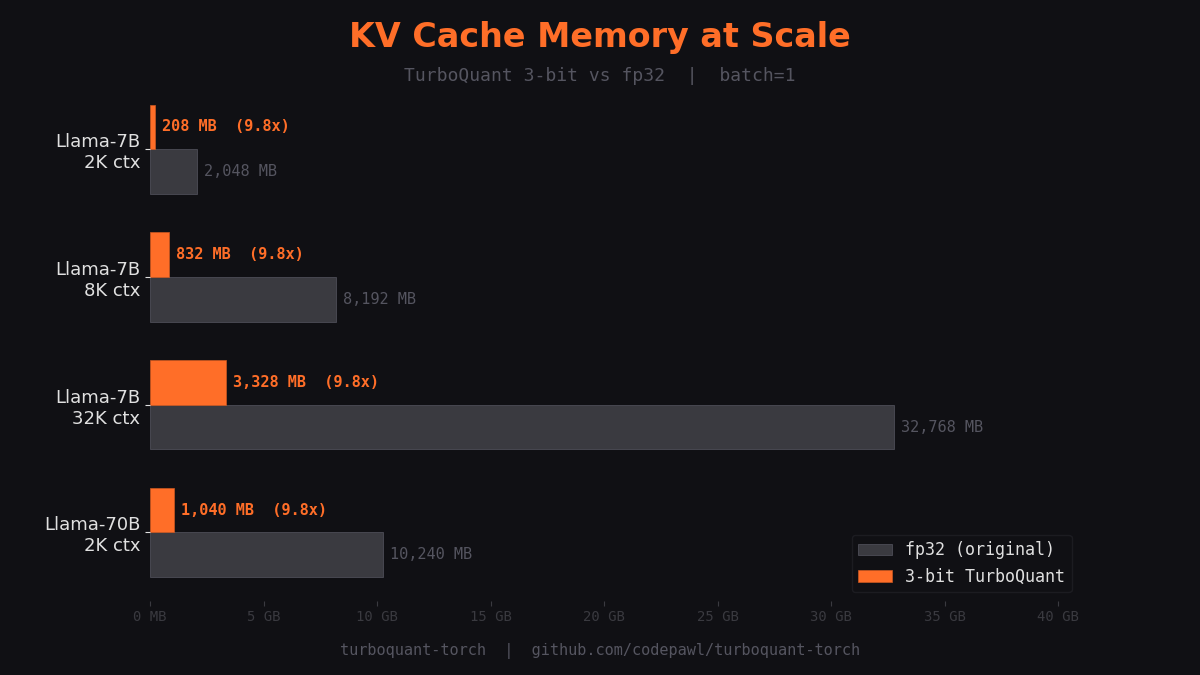
KV cache automatically compressed to 3-bit. ~10x less memory.
For more control:
model = turboquant.wrap(
    model,
    bit_width=3,              # 2, 3, or 4
    residual_length=128,      # sliding window
    n_outlier_channels=8,     # outlier routing
    verbose=True,             # print stats
)
Or use the cache directly:
from turboquant import TurboQuantDynamicCache

cache = TurboQuantDynamicCache.from_model(model)
output = model.generate(**inputs, past_key_values=cache, max_new_tokens=50)
Low-Level API
Basic Quantize / Dequantize
import torch
from turboquant import TurboQuant

tq = TurboQuant(dim=128, bit_width=3, unbiased=True)

x = torch.randn(100, 128)
output = tq.quantize(x)
x_hat = tq.dequantize(output)

print(f"Compression: {tq.compression_ratio():.1f}x")  # ~10.7x
KV Cache Compression
from turboquant import TurboQuantKVCache

cache = TurboQuantKVCache(head_dim=128, bit_width=3, residual_length=128)

# Compress KV tensors (batch, heads, seq, dim)
keys = torch.randn(2, 32, 2048, 128)
values = torch.randn(2, 32, 2048, 128)
compressed = cache.compress(keys, values)

# Attention with compressed cache
query = torch.randn(2, 32, 1, 128)
output = cache.attention(query, compressed)

orig_mb, comp_mb, ratio = cache.memory_savings(2, 32, 2048)
print(f"Memory: {orig_mb:.0f} MB -> {comp_mb:.0f} MB ({ratio:.1f}x)")
Real Model Example
import torch
from transformers import AutoModelForCausalLM, AutoTokenizer
from turboquant import TurboQuantKVCache

model = AutoModelForCausalLM.from_pretrained("Qwen/Qwen3-0.6B", dtype=torch.float32)
tokenizer = AutoTokenizer.from_pretrained("Qwen/Qwen3-0.6B")

with torch.no_grad():
    out = model(**tokenizer("The quick brown fox", return_tensors="pt"), use_cache=True)

kv = out.past_key_values
k, v = kv.layers[0].keys, kv.layers[0].values  # layer 0 KV cache
cache = TurboQuantKVCache(head_dim=k.shape[-1], bit_width=3)
compressed = cache.compress(k.float(), v.float())
Sliding Window (Residual Buffer)
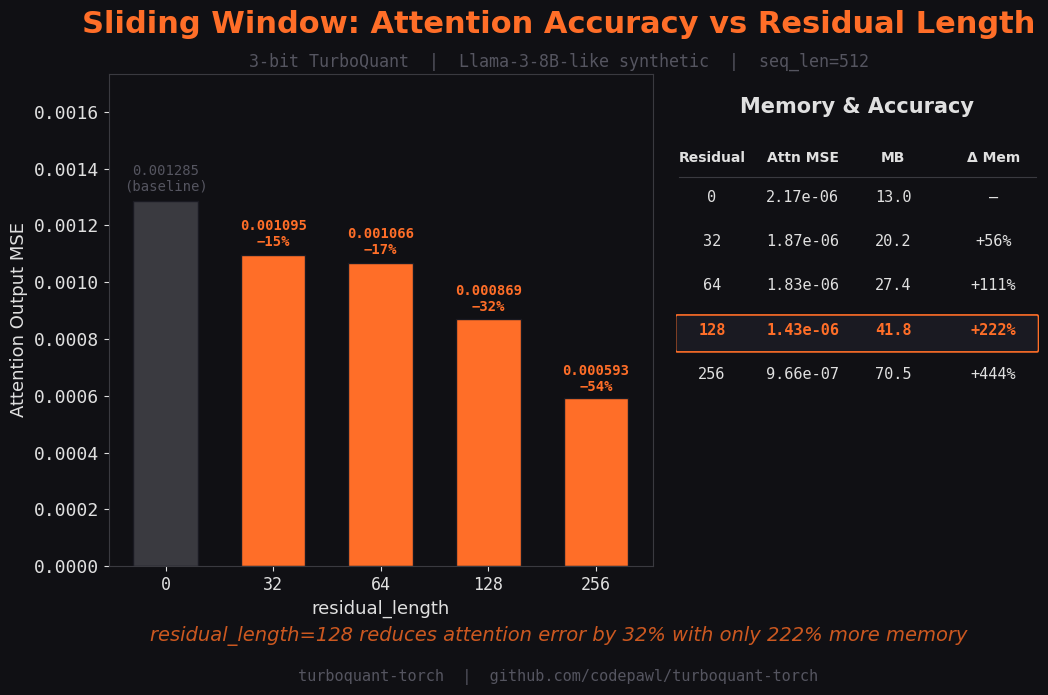
Keep recent tokens in fp16 for higher accuracy on local context:
cache = TurboQuantKVCache(
    head_dim=128,
    bit_width=3,
    residual_length=128,  # last 128 tokens stay in fp16
)
GQA/MQA Support
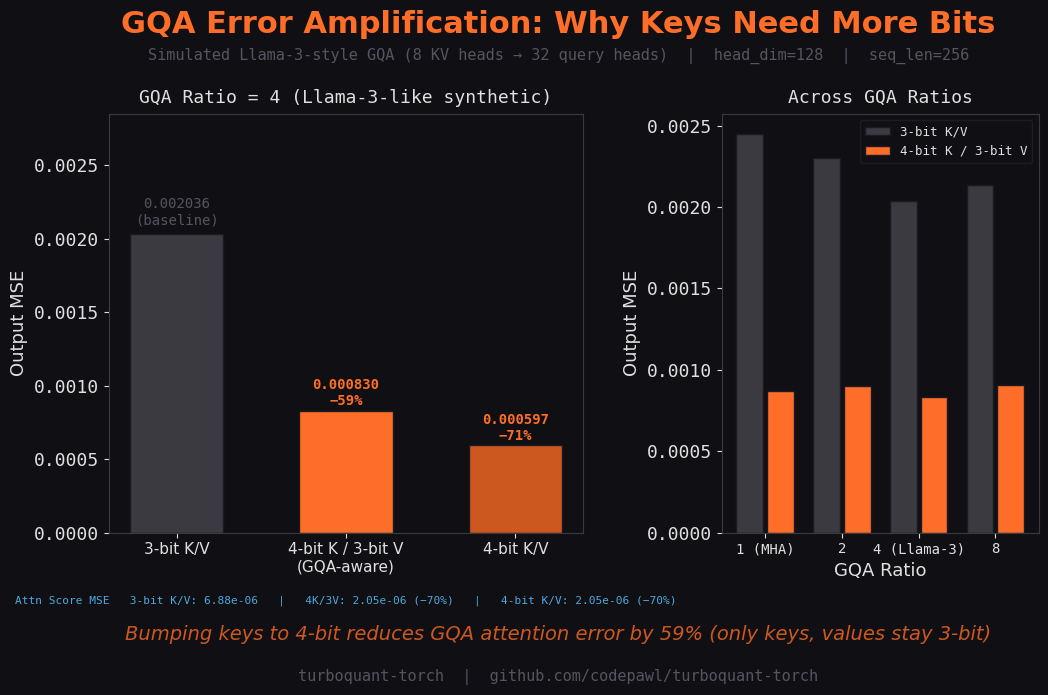
For models with grouped query attention (Llama-3, Mistral, etc.):
cache = TurboQuantKVCache.for_gqa(
    head_dim=128,
    num_kv_heads=8,       # Llama-3-8B
    num_query_heads=32,
    bit_width=3,
    residual_length=128,
)
# Keys auto-bumped to 4-bit to compensate for GQA error amplification
Outlier Channel Routing
Preserve high-magnitude channels in full precision (inspired by KVQuant/GEAR):
cache = TurboQuantKVCache(
    head_dim=128,
    bit_width=3,
    n_outlier_channels=8,   # top-8 channels kept in fp16
    residual_length=128,
)
Adaptive Per-Layer Bit Allocation
Different layers get different bit budgets:
from turboquant import AdaptiveKVCache, gradient_allocation

# Manual: 2-bit for early layers, 4-bit for late layers
cache = AdaptiveKVCache(
    head_dim=128,
    layer_bits=[2]*10 + [3]*12 + [4]*10,  # 32 layers total
)

# Gradient allocation: smooth 2→4 bit ramp
bits = gradient_allocation(n_layers=32, min_bits=2, max_bits=4, strategy="linear")
cache = AdaptiveKVCache(head_dim=128, layer_bits=bits)

# Auto-calibrated from model (requires HuggingFace model)
cache = AdaptiveKVCache.from_model(
    model, tokenizer,
    head_dim=128,
    target_avg_bits=3.0,
)
print(cache.summary())
Vector Search
from turboquant import TurboQuantIndex

index = TurboQuantIndex(dim=128, bit_width=3, metric="ip")
index.add(database_vectors)  # Near-instant, no training!
scores, indices = index.search(query, k=10)
Real-World Usage
Compress a live model's KV cache
import torch
from transformers import AutoModelForCausalLM, AutoTokenizer
from turboquant import TurboQuantKVCache

model = AutoModelForCausalLM.from_pretrained("Qwen/Qwen3-0.6B", dtype=torch.float32)
tokenizer = AutoTokenizer.from_pretrained("Qwen/Qwen3-0.6B")

inputs = tokenizer("Explain quantum computing in simple terms:", return_tensors="pt").to(model.device)
with torch.no_grad():
    out = model(**inputs, use_cache=True)

past_kv = out.past_key_values
head_dim = past_kv.layers[0].keys.shape[-1]
cache = TurboQuantKVCache(head_dim=head_dim, bit_width=3, residual_length=0)

for i in range(len(past_kv.layers)):
    k, v = past_kv.layers[i].keys.float(), past_kv.layers[i].values.float()
    compressed = cache.compress(k, v)
    k_hat = cache.decompress_keys(compressed)
    print(f"Layer {i}: MSE={((k - k_hat)**2).mean():.6f}")
Generate text with compressed KV cache
from transformers import DynamicCache

with torch.no_grad():
    out = model(**inputs, use_cache=True)

new_cache = DynamicCache()
for i in range(len(out.past_key_values.layers)):
    k = out.past_key_values.layers[i].keys.float()
    v = out.past_key_values.layers[i].values.float()
    compressed = cache.compress(k, v)
    k_hat = cache.decompress_keys(compressed).to(k.dtype)
    v_hat = cache.decompress_values(compressed).to(v.dtype)
    new_cache.update(k_hat, v_hat, i)

outputs = model.generate(
    **inputs, past_key_values=new_cache,
    max_new_tokens=50, do_sample=False,
)
print(tokenizer.decode(outputs[0], skip_special_tokens=True))
Multi-layer adaptive compression
from turboquant import AdaptiveKVCache

adaptive = AdaptiveKVCache.from_model(
    model, tokenizer, head_dim=head_dim, target_avg_bits=3.0
)
print(adaptive.summary())

for i in range(adaptive.n_layers):
    k = past_kv.layers[i].keys.float()
    v = past_kv.layers[i].values.float()
    compressed = adaptive.compress_layer(i, k, v)
Compatibility
Works with any standard transformer KV cache:
| Model Family | Status | Notes |
|---|---|---|
| Llama-3 / 3.1 / 3.2 | Full support | GQA-aware mode recommended |
| Mistral / Mixtral | Full support | Sliding window auto-detected |
| Gemma / Gemma 2 | Full support | |
| Qwen2.5 / Qwen3 | Full support | |
| Phi-3 / Phi-4 | Full support | |
| Command-R | Full support | |
| DeepSeek-V2/V3 | Skip MLA layers | KV already compressed by MLA |
| Qwen3.5 / Jamba | Attention layers only | Non-attention layers skipped |
| T5 / BART / mBART | Partial | Self-attention KV only |
| Mamba / RWKV | Not applicable | No KV cache (SSM/RNN) |
Use compress_model_kv() for automatic handling:
from turboquant.compat import compress_model_kv

compressed_cache = compress_model_kv(past_key_values, model, bit_width=3)
outputs = model.generate(**inputs, past_key_values=compressed_cache, max_new_tokens=50)
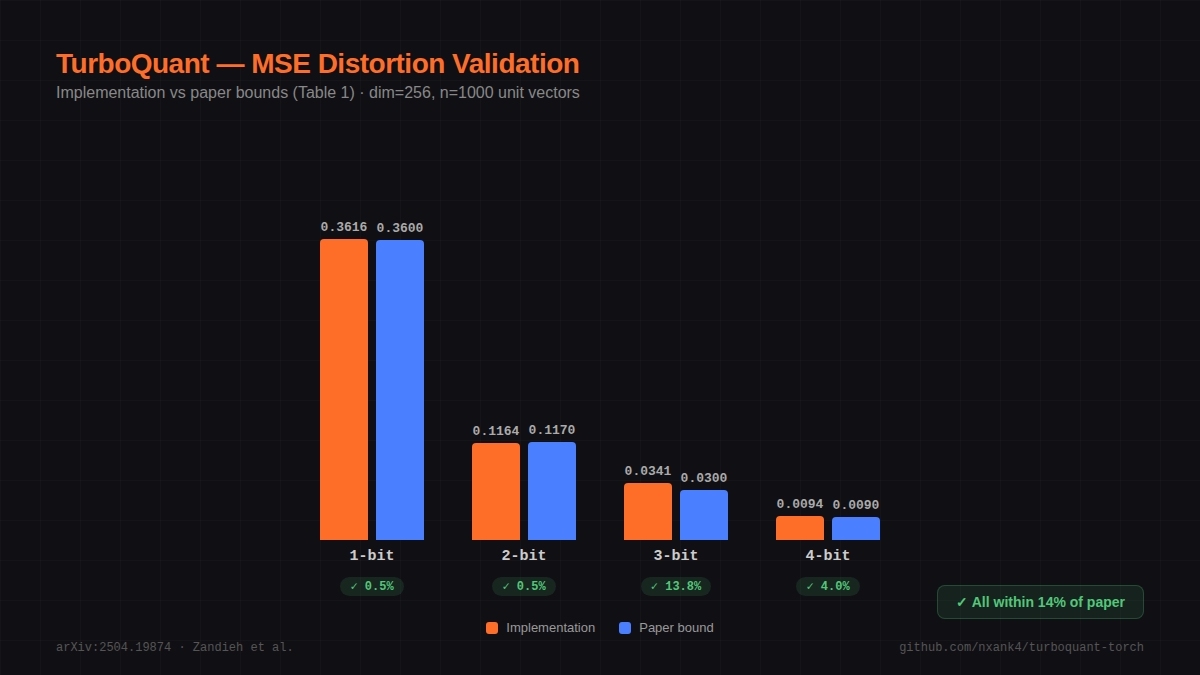
Distortion vs Bit Width
From paper Table 1 (MSE distortion on unit vectors):
| Bits/coord | MSE Distortion | Compression Ratio |
|---|---|---|
| 1 | ~0.36 | 32x |
| 2 | ~0.117 | 16x |
| 3 | ~0.03 | 10.7x |
| 4 | ~0.009 | 8x |
3-bit achieves zero quality loss on LongBench, Needle-in-Haystack, ZeroSCROLLS, RULER, and L-Eval benchmarks.
KV Cache Memory Savings
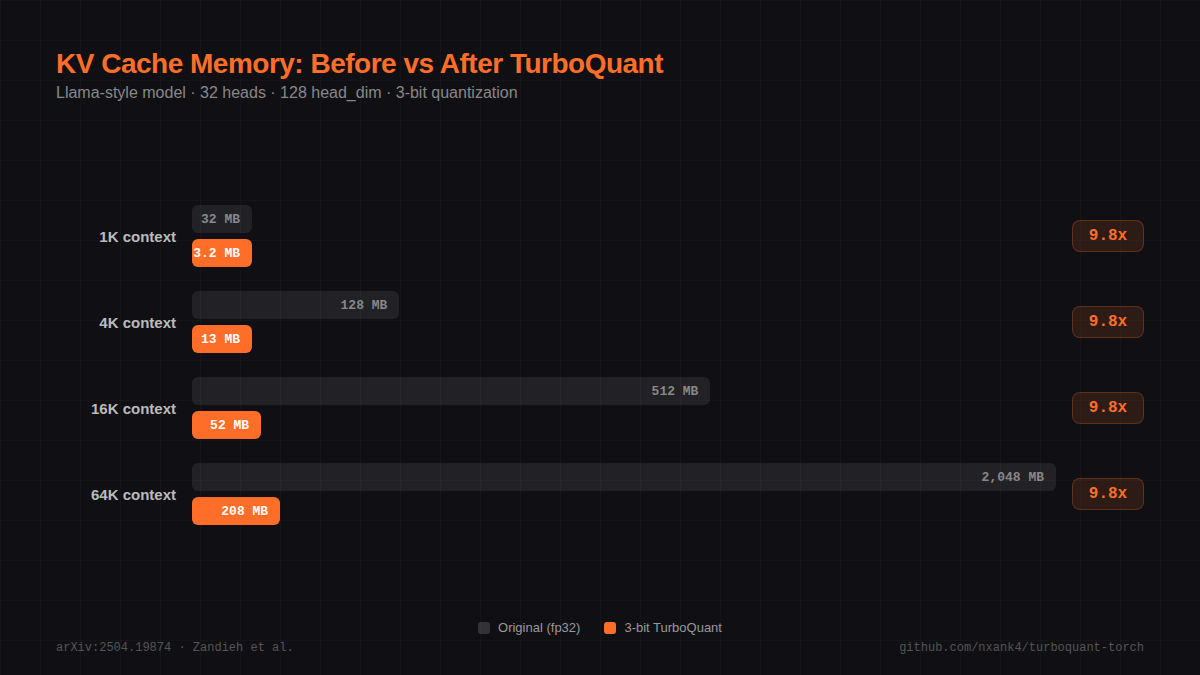
Benchmarks on Real Models
Tested on SmolLM2-135M KV cache (30 layers, 3 KV heads, head_dim=64):
| Bit-width | Key MSE | Attn Score MSE | Memory | Ratio |
|---|---|---|---|---|
| 2-bit | 1.8732 | 0.01798362 | 0.03 MB | 12.8x |
| 3-bit | 0.5902 | 0.00741907 | 0.04 MB | 9.1x |
| 4-bit | 0.1740 | 0.00249073 | 0.06 MB | 7.1x |
Full benchmark results: benchmarks/results.md
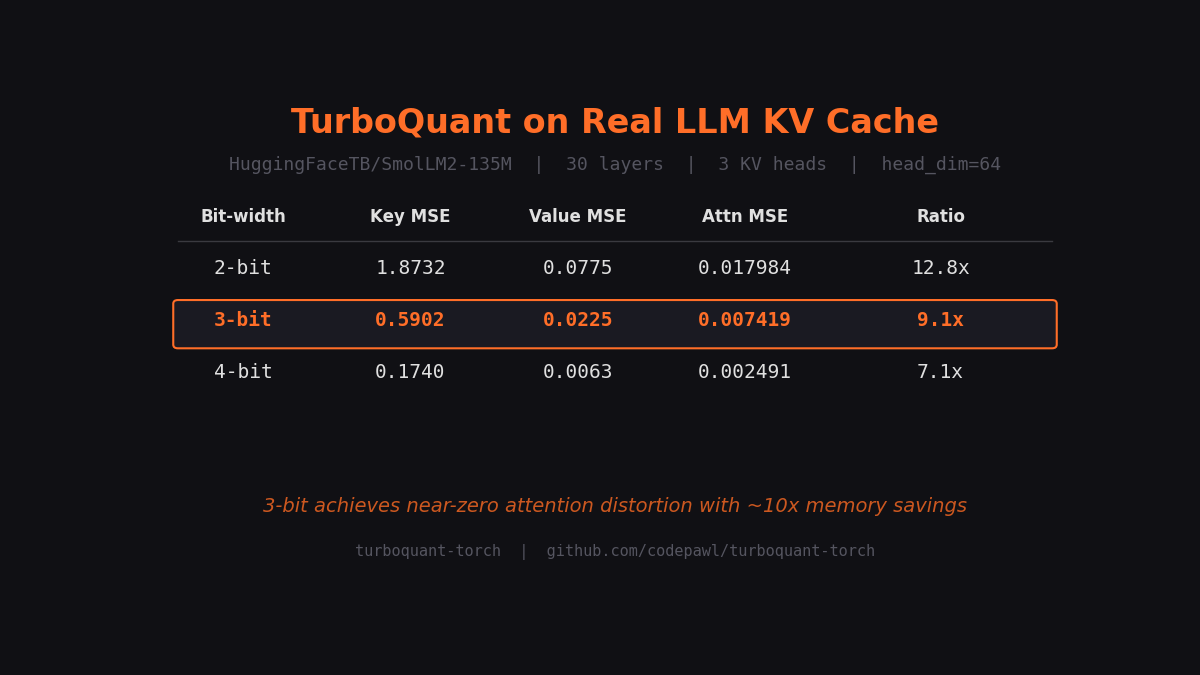
KV Cache Memory at Scale
Downstream Task Evaluation
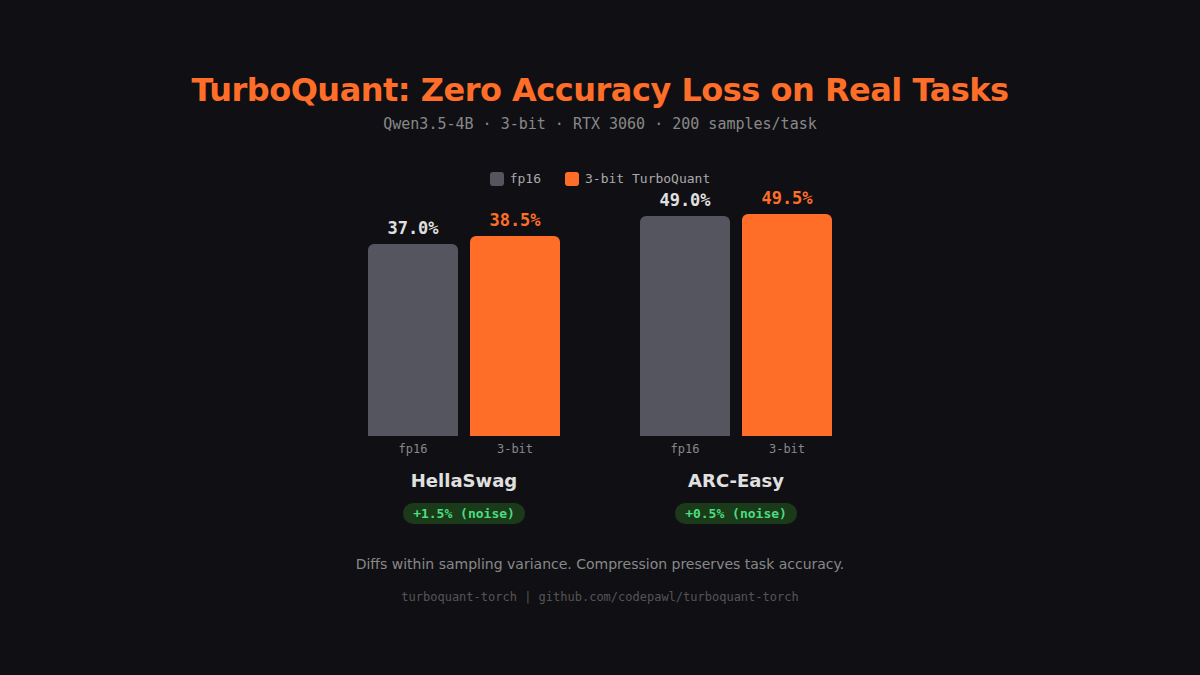
Tested on Qwen3.5-4B (head_dim=256, 3-bit, RTX 3060, 200 samples/task):
| Task | fp16 | 3-bit | Diff |
|---|---|---|---|
| HellaSwag | 37.0% | 38.5% | +1.5% |
| ARC-Easy | 49.0% | 49.5% | +0.5% |
Differences are within sampling variance, confirming compression preserves task accuracy.
Sliding Window Effect
GQA Error Amplification
Project Structure
turboquant/
├── __init__.py          # Public API
├── hadamard.py          # Fast Walsh-Hadamard Transform + random rotation
├── codebook.py          # Lloyd-Max optimal scalar quantizer codebooks
├── qjl.py               # Quantized Johnson-Lindenstrauss (1-bit)
├── mse_quantizer.py     # MSE-optimal quantizer (rotation + Lloyd-Max)
├── core.py              # TurboQuant two-stage pipeline
├── kv_cache.py          # KV cache compression for transformers
├── outlier.py           # Outlier channel detection and routing
├── adaptive.py          # Adaptive per-layer bit allocation
├── compat.py            # Model architecture compatibility detection
└── vector_search.py     # Approximate nearest neighbor index
Differences from Paper
| Aspect | Paper | This Repo |
|---|---|---|
| Framework | JAX/XLA | PyTorch |
| CUDA kernels | Custom fused kernels for H100 | Pure PyTorch (no custom CUDA) |
| Entropy coding | Optional (Section 3.1) | Not implemented |
| HuggingFace | N/A | KV cache compression (examples/) |
| Codebook | Exact precomputed | Lloyd-Max iterative (equivalent) |
Custom CUDA kernels for fused Hadamard + quantize operations would be a valuable future contribution.
Examples
| Notebook | What it shows |
|---|---|
| 01_quickstart.ipynb | 3-line compression, before/after comparison |
| 02_long_context.ipynb | Memory scaling, sliding window, outlier routing |
| 03_adaptive_compression.ipynb | Per-layer sensitivity, adaptive bit allocation |
Each notebook has an "Open in Colab" badge and runs on CPU (free tier).
Running Tests
pip install -e ".[dev]"
pytest tests/unit/ -v              # fast, isolated
pytest tests/integration/ -v       # multi-module
pytest tests/unit/ tests/integration/ -v  # all
Contributing
We welcome contributions! Here's how to get started:
- Fork the repo and create a feature branch from
staging - Install dev dependencies:
pip install -e ".[dev]" - Make changes and add tests
- Run checks:
   ruff check turboquant/ tests/
   ruff format turboquant/ tests/
   mypy turboquant/
   pytest tests/ -v
- Open a PR against
staging(notmain)
See our branching strategy: feature branches → staging → main.
Areas where help is needed
- CUDA/Triton kernels — fused Hadamard + quantize for 10x speedup
- vLLM integration — PagedAttention compatibility
- More model benchmarks — Llama-3, Mistral, Gemma on downstream tasks
- Entropy coding — optional compression from paper Section 3.1
Community
- GitHub Issues: github.com/codepawl/turboquant-torch/issues
- Discord: discord.gg/7fydHgK6kA
- X: @codepawl
Citation
@inproceedings{turboquant2026,
  title={TurboQuant: Redefining AI Efficiency with Extreme Compression},
  author={Zandieh, Amir and Daliri, Majid and Hadian, Majid and Mirrokni, Vahab},
  booktitle={International Conference on Learning Representations (ICLR)},
  year={2026},
  url={https://arxiv.org/abs/2504.19874}
}
Related Work
- QJL: 1-Bit Quantized JL Transform — the 1-bit quantizer used in Stage 2. The official QJL implementation by the paper authors is available at github.com/amirzandieh/QJL.
- PolarQuant — related polar coordinate quantization approach
Documentation
License
MIT
1 maintainer

Metadata
1 maintainer
Release files for turboquant-torch 0.4.0
For a detailed explanation of source distributions (sdists) and built distributions (wheels), please see the package formats documentation.
Source distribution (sdist)
| File | Size | Uploaded | |
|---|---|---|---|
| turboquant_torch-0.4.0.tar.gz | 676.3 kB | Details |
Built distribution (wheel)
| File | Interpreter | ABI | Platform | Reset |
|---|---|---|---|---|
| turboquant_torch-0.4.0-py3-none-any.whl | Python 3 | none | any | Details |
Total release size: 720.1 kB
Release files / turboquant_torch-0.4.0.tar.gz
| Download URL | turboquant_torch-0.4.0.tar.gz |
|---|---|
| Size | 676.3 kB |
| Tags | Source |
|
SHA-256 checksum How to use checksums |
1ef40476844bafb0e5ab12aa41a814fbf9074eadb8303bbb8a076ac771b72792
|
|
BLAKE2b-256 checksum How to use checksums |
fc60c2a38b98ed8b0820b43f5170925ff89fc76ae9f11958122e57b86edfe124
|
| Upload date | |
|
Uploaded using Trusted Publishing? What is trusted publishing? |
Yes |
| Uploaded via |
twine/6.1.0 CPython/3.13.7
|
Provenance
Provenance describes where a file came from. On PyPI, provenance is shared via attestations, which provide a verifiable record of the build or publishing details. View details, limitations and caveats.


PyPI Publish Attestation
PyPI verified that this artifact, at this checksum, originated from the publisher listed below.
Signed by GitHub Actions, verified by PyPI on Mar 31, 2026.
Transparency logRelease files / turboquant_torch-0.4.0-py3-none-any.whl
| Download URL | turboquant_torch-0.4.0-py3-none-any.whl |
|---|---|
| Size | 43.8 kB |
| Tags | Python 3 |
|
SHA-256 checksum How to use checksums |
91c2de4bba6dce37367c063957952cd8d187796d4cdc5bffc9cdf528298c62be
|
|
BLAKE2b-256 checksum How to use checksums |
c7c032b949801939083d3f0127c7b33fb629ba4c39a5e1784ec0d4fb6019d459
|
| Upload date | |
|
Uploaded using Trusted Publishing? What is trusted publishing? |
Yes |
| Uploaded via |
twine/6.1.0 CPython/3.13.7
|
Provenance
Provenance describes where a file came from. On PyPI, provenance is shared via attestations, which provide a verifiable record of the build or publishing details. View details, limitations and caveats.
PyPI Publish Attestation
PyPI verified that this artifact, at this checksum, originated from the publisher listed below.
Signed by GitHub Actions, verified by PyPI on Mar 31, 2026.
Transparency log













