





A 10 million document corpus takes 31 GB of RAM as float32. turbovec fits it in 4 GB - and searches it faster than FAISS.
turbovec is a Rust vector index with Python bindings, built on Google Research's TurboQuant algorithm — a data-oblivious quantizer with near-optimal distortion and no separate training phase.
- Online ingest. Add vectors, they're indexed — no train step, no parameter tuning, no rebuilds as the corpus grows.
- Fast SIMD search. Hand-written kernels — NEON SDOT/SMMLA on ARM, AVX-512 VNNI and
vpermbon x86, with AVX2 and scalar fallbacks — beat FAISS IndexPQFastScan in every measured config, averaging 4.4× at 4-bit and 2.2× at 2-bit across the eight cells of each width, on both architectures. - Incremental saves.
sync(path)persists just what changed since the last sync — one fsync per call, crash-safe at any byte, and a removal or a small append costs milliseconds however large the index.write/loadstay for whole-file snapshots. - Filter at search time. Pass an id allowlist (or a slot bitmask) to
search()and the kernel honours it directly. You always get up tokresults from the allowed set — no over-fetching, no recall hit on selective filters. - Pure local. No managed service, no data leaving your machine or VPC. Pair with any open-source embedding model for a fully air-gapped RAG stack.
Building RAG where privacy, memory, or latency matters? You're in the right place.
Python
pip install turbovec
from turbovec import TurboQuantIndex

index = TurboQuantIndex(dim=1536, bit_width=4)
index.add(vectors)
index.add(more_vectors)

scores, indices = index.search(query, k=10)

index.write("my_index.tv")
loaded = TurboQuantIndex.load("my_index.tv")

index.sync("my_index.tv")   # after more changes: durable incremental save
vectors and query are 2-D float32 arrays of shape (n, dim) — other dtypes are rejected rather than silently converted, so cast with np.asarray(x, dtype=np.float32) first if needed.
Need stable ids that survive deletes? Use IdMapIndex:
import numpy as np
from turbovec import IdMapIndex

index = IdMapIndex(dim=1536, bit_width=4)
index.add_with_ids(vectors, np.array([1001, 1002, 1003], dtype=np.uint64))

scores, ids = index.search(query, k=10)   # ids are your uint64 external ids
index.remove(1002)                         # O(1) by id

index.write("my_index.tvim")
loaded = IdMapIndex.load("my_index.tvim")

index.sync("my_index.tvim")   # durable incremental save, ids included
Hybrid retrieval (filtered search)
Restrict results to a candidate set produced by another system (SQL, BM25, ACL, time window, …):
import numpy as np
from turbovec import IdMapIndex

idx = IdMapIndex(dim=1536, bit_width=4)
idx.add_with_ids(vectors, ids)

# Stage 1: external system narrows to candidate ids.
allowed = np.array(db.execute("SELECT id FROM docs WHERE tenant=?", (t,)).fetchall(),
                   dtype=np.uint64)

# Stage 2: dense rerank within the candidate set.
scores, ids = idx.search(query, k=10, allowlist=allowed)
Filtering happens inside the SIMD kernel at 32-vector block granularity: blocks with no allowed slots are short-circuited before any LUT lookup or scoring work, and individual non-allowed slots inside scored blocks are dropped at heap-insert. Selective allowlists (small fraction of the index allowed) therefore avoid most of the SIMD cost rather than paying it and discarding the result afterwards.
The output length is min(k, n_allowed), where n_allowed counts distinct allowed vectors — when fewer vectors are allowed than k you get exactly that many results rather than padded fallbacks.
See docs/api.md for the full reference.
Framework integrations
Drop-in replacements for the in-tree reference vector / document stores in each framework. Same public surface, same persistence semantics, same retriever and pipeline wiring — swap the import and keep your pipeline.
- LangChain —
pip install turbovec[langchain]· replaceslangchain_core.vectorstores.InMemoryVectorStore - LlamaIndex —
pip install turbovec[llama-index]· replacesllama_index.core.vector_stores.SimpleVectorStore - Haystack —
pip install turbovec[haystack]· replaceshaystack.document_stores.in_memory.InMemoryDocumentStore - Agno —
pip install turbovec[agno]· replacesagno.vectordb.lancedb.LanceDb
Rust
cargo add turbovec
use turbovec::TurboQuantIndex;

let mut index = TurboQuantIndex::new(1536, 4).unwrap();
index.add(&vectors);
let results = index.search(&queries, 10);
index.write("index.tv").unwrap();
let loaded = TurboQuantIndex::load("index.tv").unwrap();
For stable external ids that survive deletes:
use turbovec::IdMapIndex;

let mut index = IdMapIndex::new(1536, 4).unwrap();
index.add_with_ids(&vectors, &[1001, 1002, 1003]).unwrap();
let (scores, ids) = index.search(&queries, 10);
index.remove(1002);
index.write("index.tvim").unwrap();
let loaded = IdMapIndex::load("index.tvim").unwrap();
Recall
TurboQuant vs FAISS IndexPQ (LUT256, nbits=8) — the paper's Section 4.4 baseline. 100K vectors, k=64. FAISS PQ sub-quantizer counts sized to match TurboQuant's bit rate (m=d/4 at 2-bit, m=d/2 at 4-bit).
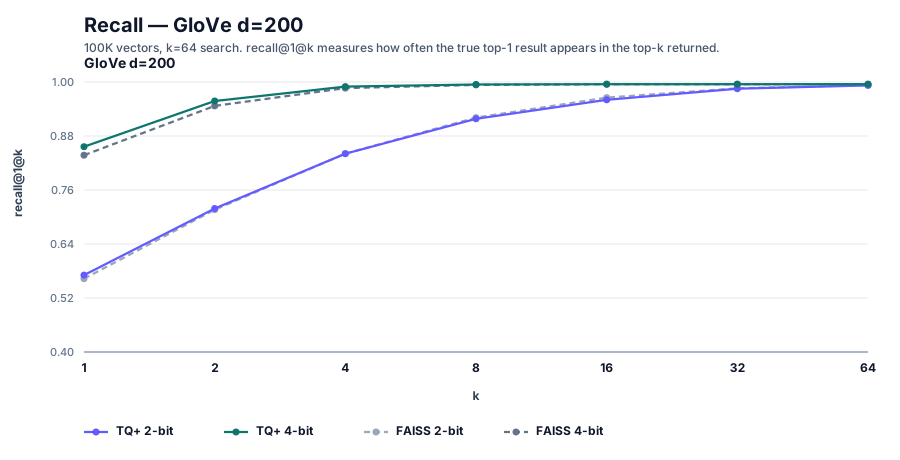
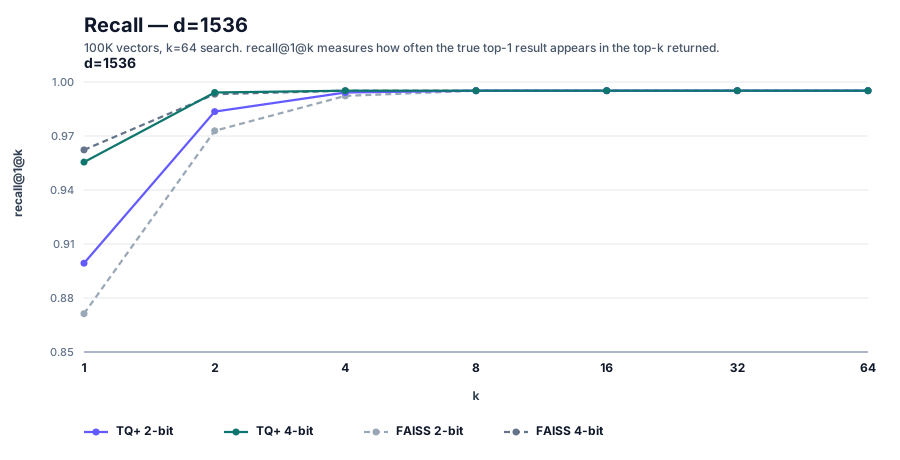
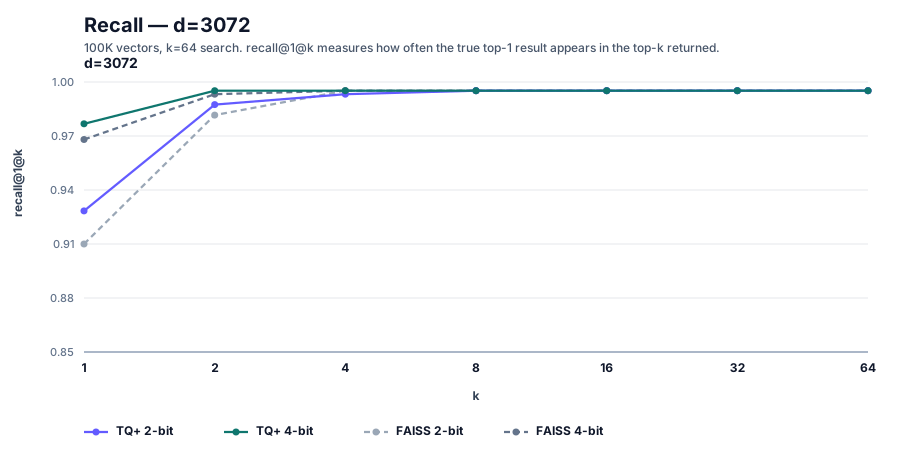
The charts plot calibrated TurboQuant (TQ+). Across OpenAI d=1536 and d=3072, TQ+ beats FAISS at R@1 on three of four cells (by 1.0–2.5 points; d=1536 4-bit trails by 0.7), and both reach 1.0 by k=8 (≥0.998 already at k≤4). GloVe d=200 is the harder regime — at low dim the asymptotic Beta assumption is looser. TQ+ lands ahead of FAISS at R@1 at both bit widths (+1.8 at 4-bit, +0.8 at 2-bit), with FAISS keeping a slim edge at 2-bit from k≈8. Uncalibrated numbers are in the JSONs (tq_recalls).
A note on baselines. We compare against FAISS IndexPQ (LUT256, nbits=8, float32 LUT) because it's the default production-grade PQ most users would reach for. This is a stronger baseline than the custom u8-LUT PQ in the TurboQuant paper — FAISS uses a higher-precision LUT at scoring time and k-means++ for codebook training. We reproduce the paper's TurboQuant numbers on OpenAI d=1536 / d=3072 and hit similar numbers to other community reference implementations on low-dim embeddings (see turboquant-py at d=384). On GloVe (d=200) — the low-dim regime where the asymptotic Beta assumption is loosest — TurboQuant lands ahead of FAISS at 4-bit but trails it at 2-bit; TQ+ calibration recovers the 2-bit deficit at R@1 (0.572 vs FAISS's 0.564), with FAISS keeping a slim edge at deeper k.
Full results: d=1536 2-bit, d=1536 4-bit, d=3072 2-bit, d=3072 4-bit, GloVe 2-bit, GloVe 4-bit.
Compression
Search Speed
All benchmarks: 100K vectors, 1K queries, k=64, median of 5 runs.
ARM (GCP c4a-standard-8, Google Axion, 8 vCPUs)
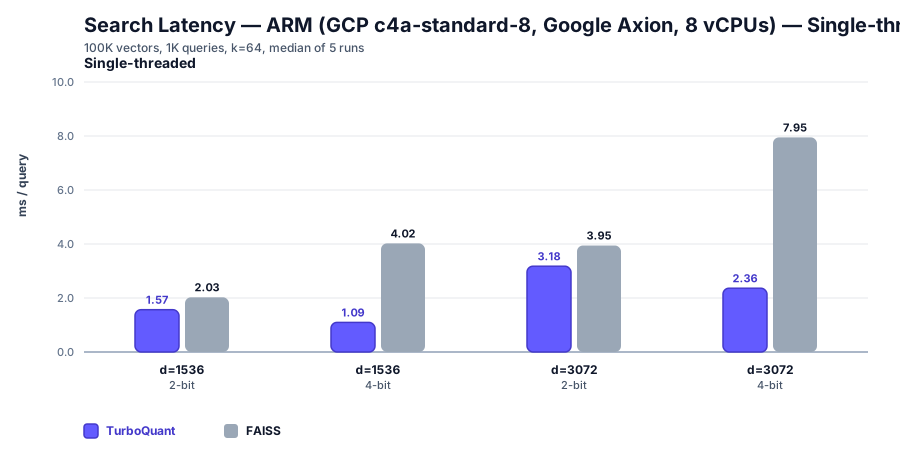
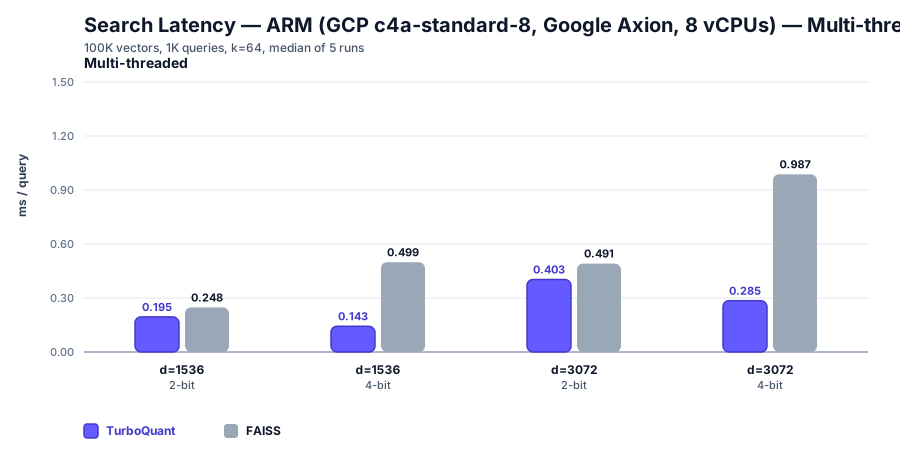
On ARM, TurboQuant beats FAISS FastScan in every config, averaging 4.0× at 4-bit (3.8–4.2× across cells — a staged search: the sign plane scanned with the table kernel, the shortlist ranked on the lower planes, the best rescored exactly) and 2.05× at 2-bit (1.8–2.2× — the same two-stage search over the sign and magnitude planes).
x86 (Intel Xeon Platinum 8481C / Sapphire Rapids, 8 vCPUs)
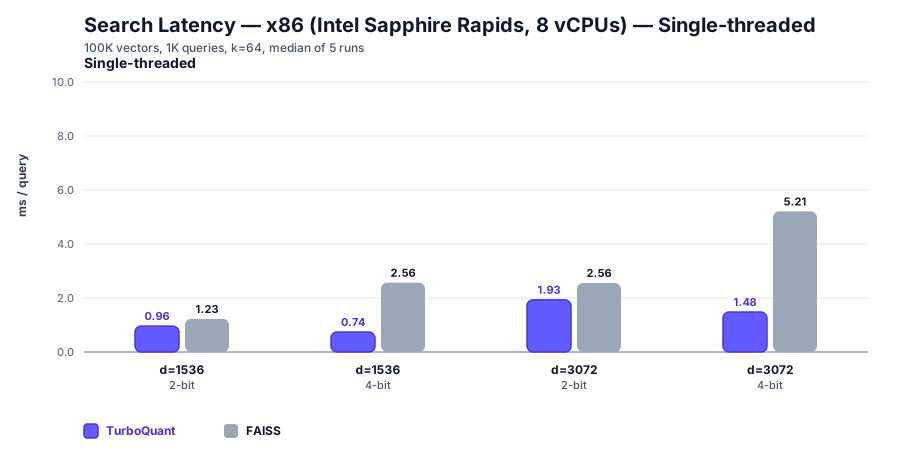
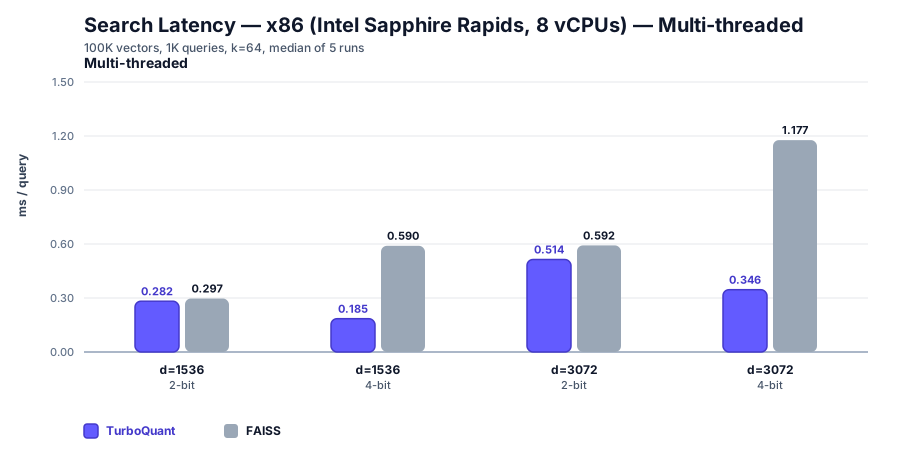
On x86, TurboQuant wins every config, averaging 4.9× at 4-bit (4.6–5.1× across cells — a staged search: the sign plane scanned with the AVX-512 VNNI kernel, the shortlist ranked by bit counts on the lower planes, the best rescored exactly) and 2.35× at 2-bit (2.2–2.5×, two-stage over the sign and magnitude planes, the vpermb LUT scan carrying the first stage).
Insertion & Removal Latency
Same corpus as the search cells: 100K OpenAI vectors, median of 5 runs, timed loops including the Python-call overhead a caller actually pays per op. Insertion measures per-vector add() latency on a warm, populated index (built untimed) at n=1 — a single-vector add() — and n=100 — a 100-vector batch, showing how far batching amortizes the per-call overhead — against add() into the trained, populated FAISS IndexPQFastScan (training untimed). A single add() lands in 7.9–21.7 µs depending on the cell (6.3–12.6× faster than a FAISS single add), and a 100-vector batch amortizes TurboQuant to 5.6–17.8 µs/vector (4.5–13.8× faster than the same batch into FAISS). Removal measures per-op remove-by-id latency at n=1 (the steady per-op rate over 1000 removes) and n=100 (the first 100 removes on a fresh index): IdMapIndex.remove(id) — O(1) swap-and-pop plus the id-map bookkeeping — lands at 1.3–5.9 µs and 1.5–6.3 µs per op across the cells (since 1.0.0 a built index keeps the search layout alone, so a remove patches that layout in place; the planes layouts' rows patch cheaply). The FAISS column is the same user-visible operation, remove_ids on an IndexIDMap over IndexPQFastScan, which repacks the stored codes on every call: 0.19–1.03 s per single remove at 100K, with cost doubling alongside code size — which is why the removal charts use a log-scale axis. Charts show the single-threaded cells (RAYON_NUM_THREADS=1); the _mt cells are measured too and match at n=1, since a single add is serial. Scripts: benchmarks/suite/.
ARM (GCP c4a-standard-8, Google Axion, 8 vCPUs)
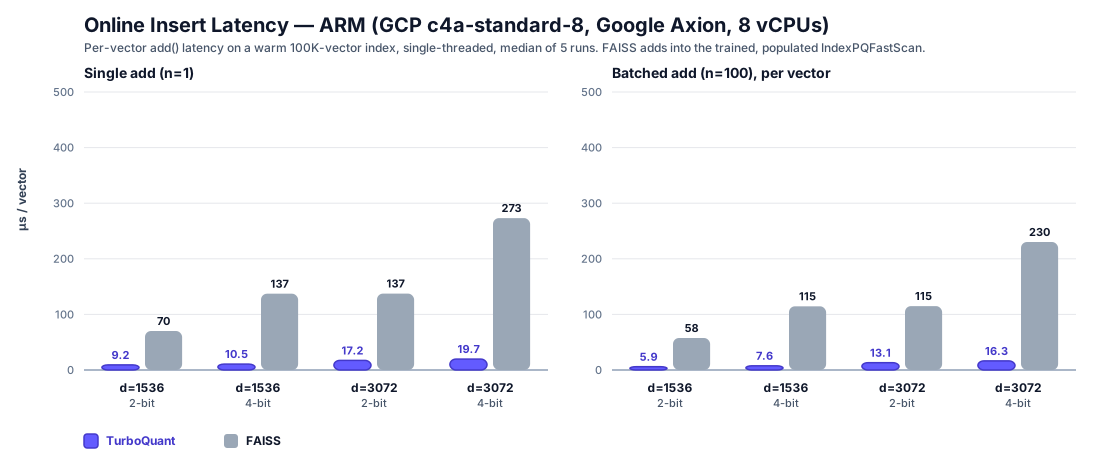
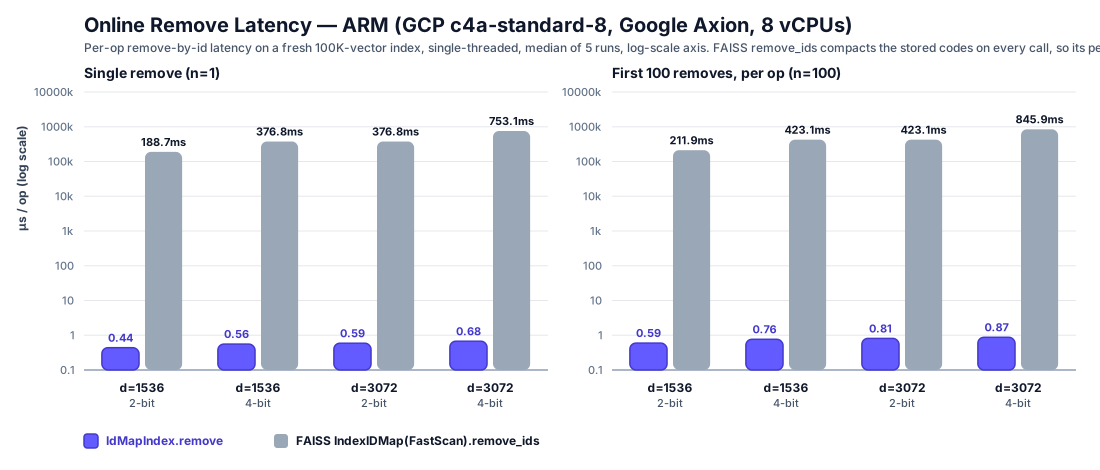
Full results: d=1536 2-bit insert, d=1536 4-bit insert, d=3072 2-bit insert, d=3072 4-bit insert, and the matching speed_remove_* and _mt files.
x86 (Intel Xeon Platinum 8481C / Sapphire Rapids, 8 vCPUs)
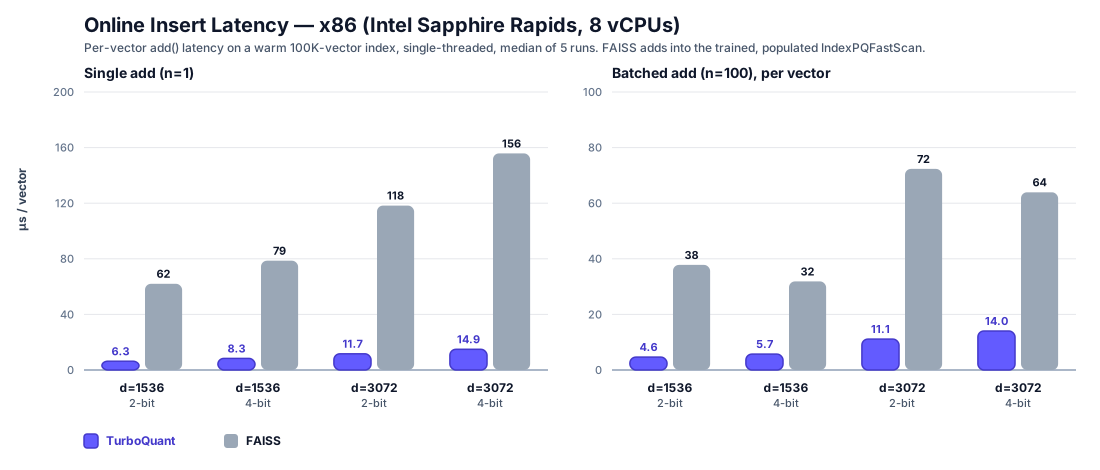
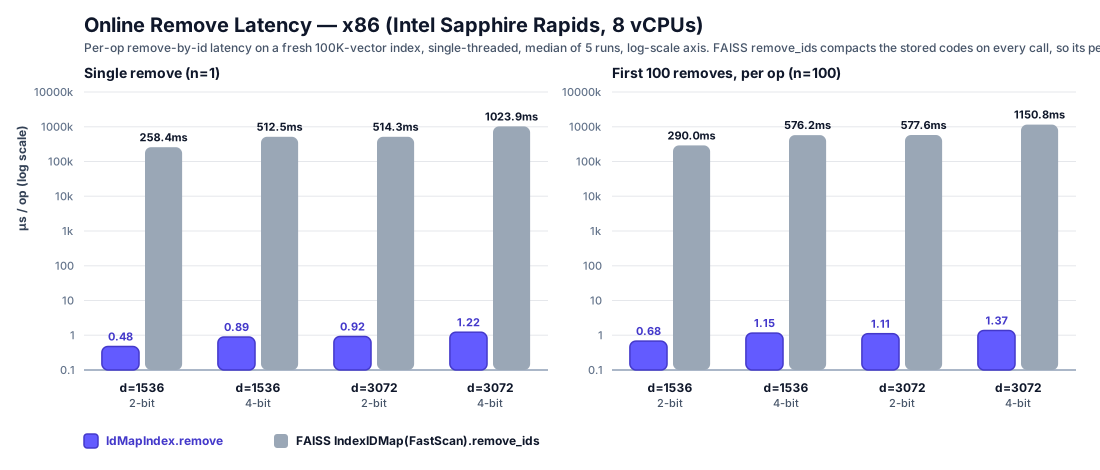
Full results: d=1536 2-bit insert, d=1536 4-bit insert, d=3072 2-bit insert, d=3072 4-bit insert, and the matching speed_remove_* and _mt files.
Save & Load
Same corpus as the search cells: 100K OpenAI vectors, median of 5 runs. TurboQuant serializes to a single .tv file with an fsync + atomic rename; FAISS is write_index / read_index on the precision-matched IndexPQFastScan (sub-quantizer count matched to TurboQuant's bit rate, as in the search cells). Save (warm) is a write after a search has run, so the blocked layout cache is populated. Load → first search opens a fresh index and times the first query — separating bare deserialization (the page cache is warm throughout, so this is layout work, not cold-storage I/O) from the first-query cost. Round-trip chains the checkpoint/resume cycle an embedding store actually pays — mutate 1K vectors → save → reopen → serve the first query; FAISS has no measured equivalent for this path, so it is shown for TurboQuant only. On the smaller payloads the round-trip can come in below the isolated post-mutation ("dirty") write: the two are timed in separate suite steps, and at small file sizes the standalone fsync in the dirty-write step dominates and inflates it — a measurement artifact of the harness, not a repack win in the combined path. Single-threaded cells pin RAYON_NUM_THREADS=1. Scripts: benchmarks/suite/.
ARM (GCP c4a-standard-8, Google Axion, 8 vCPUs)
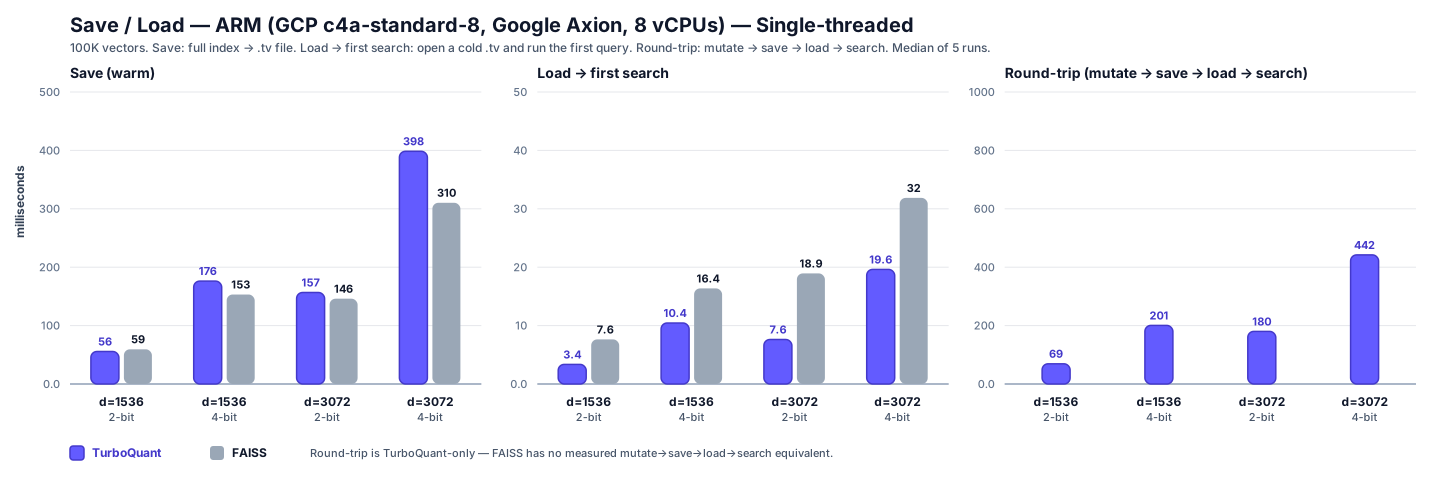
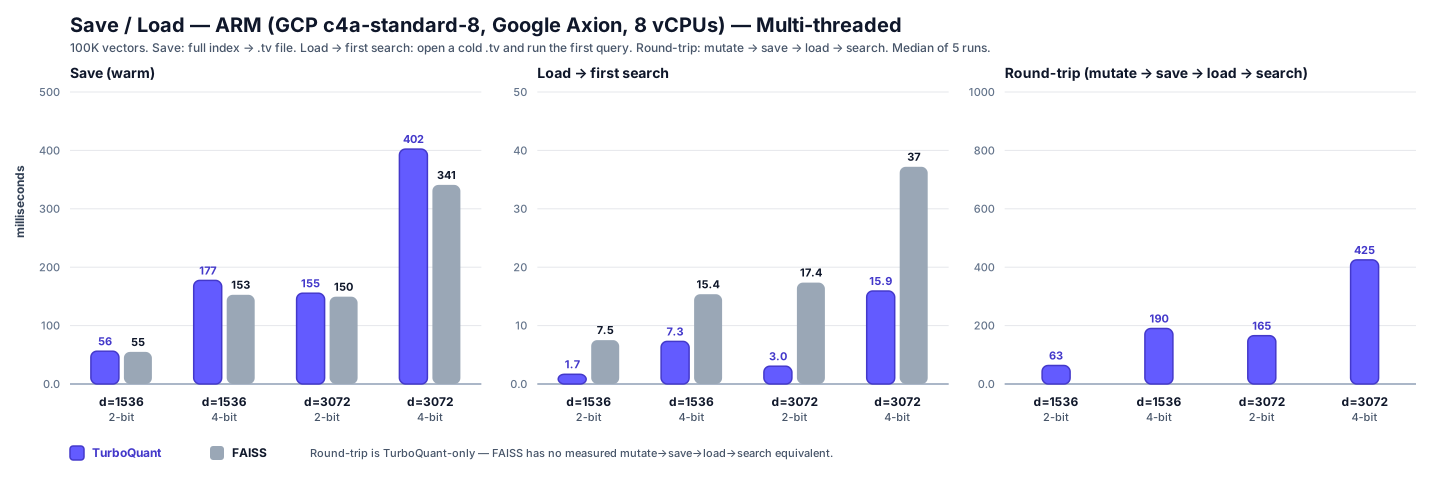
Full results: d=1536 2-bit persist ST, MT, d=1536 4-bit persist ST, MT, d=3072 2-bit persist ST, MT, d=3072 4-bit persist ST, MT.
x86 (Intel Xeon Platinum 8481C / Sapphire Rapids, 8 vCPUs)
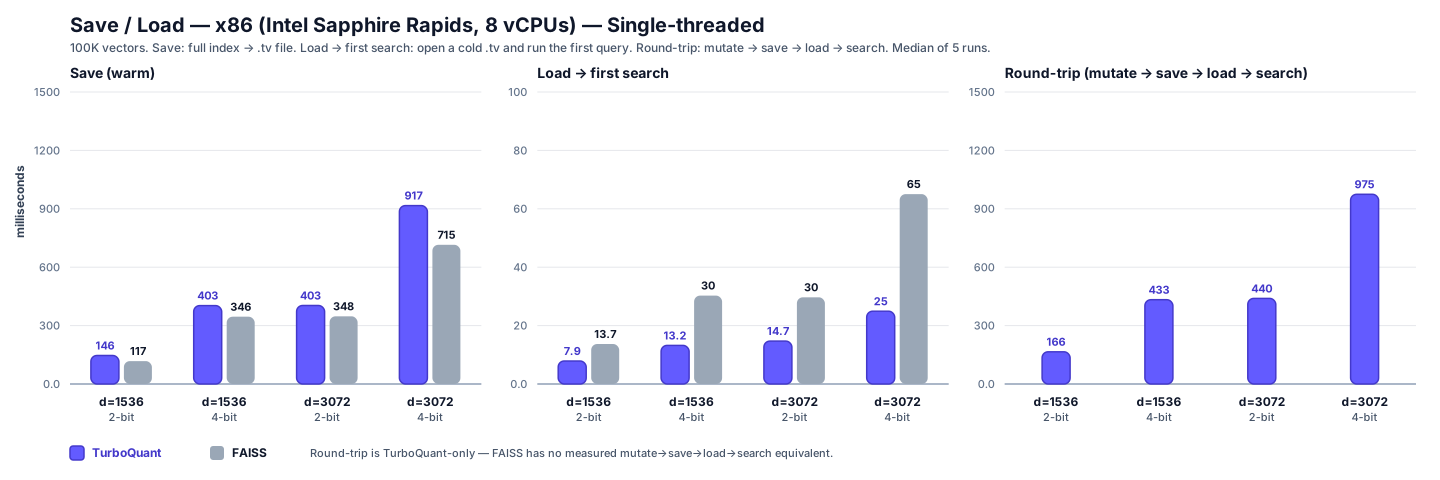
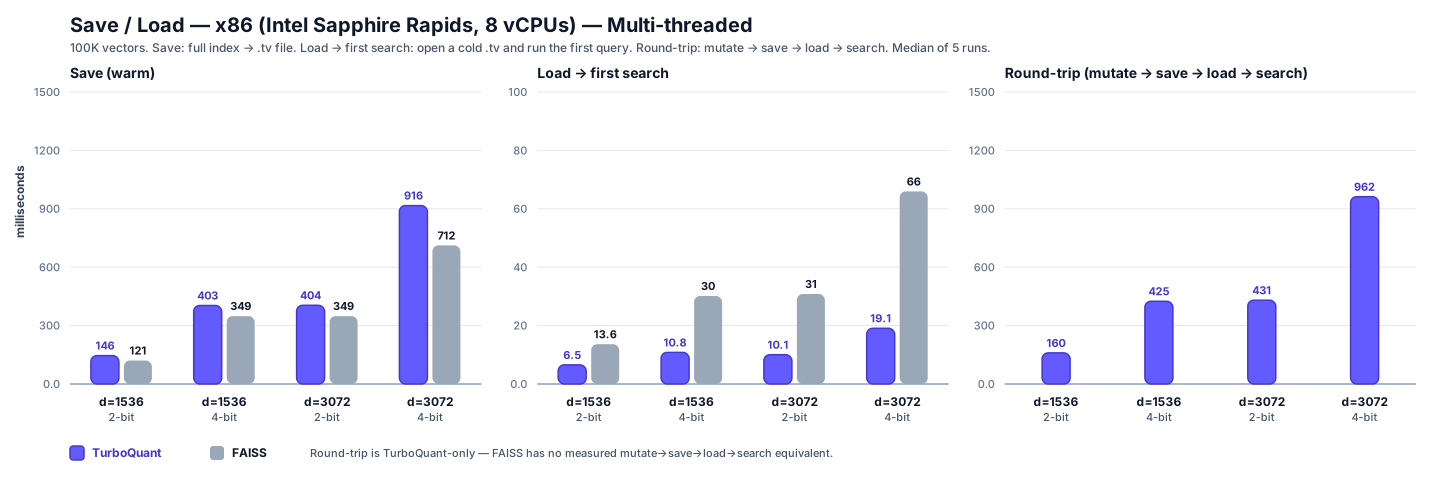
Full results: d=1536 2-bit persist ST, MT, d=1536 4-bit persist ST, MT, d=3072 2-bit persist ST, MT, d=3072 4-bit persist ST, MT.
How it works
Each vector is a direction on a high-dimensional hypersphere. TurboQuant compresses these directions using a simple insight: after applying a random rotation, every coordinate follows a known distribution -- regardless of the input data.
1. Normalize. Strip the length (norm) from each vector and store it as a single float. Now every vector is a unit direction on the hypersphere.
2. Random rotation. Multiply all vectors by the same random orthogonal matrix. After rotation, each coordinate independently follows a Beta distribution that converges to Gaussian N(0, 1/d) in high dimensions. This holds for any input data -- the rotation makes the coordinate distribution predictable.
3. Per-coordinate calibration (TQ+). The Beta distribution from step 2 is asymptotic — at finite dimensions, individual coordinates drift from the canonical shape (especially low-bit and word-vector-style embeddings). TQ+ fits two scalars per coordinate — a shift and a scale — mapping each coordinate's empirical quantiles onto the codebook's outermost centroids. The probability level comes from the codebook, so it tracks the bit width (~0.933 at 2-bit, ~0.996 at 4-bit) rather than being fixed. The Lloyd-Max codebook then quantizes against the target distribution it was designed for. The fit is explicit: call index.calibrate(sample) once with a random, representative sample of your vectors (~1024 rows is enough — a draw of that size matches fitting on the whole corpus) before adding; afterwards the calibration is committed and reused by every add — no retraining, no rebuilds, no separate train phase. An index you never calibrate is plain TurboQuant. index.calibration_state reports "uncalibrated" or "calibrated". Recall gain: up to +2.2pp at @1 on the cells that drift most (e.g. GloVe at 2-bit).
4. Lloyd-Max scalar quantization. Since the distribution is known, we can precompute the optimal way to bucket each coordinate. For 2-bit, that's 4 buckets; for 4-bit, 16 buckets. The Lloyd-Max algorithm finds bucket boundaries and centroids that minimize mean squared error. These are computed once from the math, not from the data.
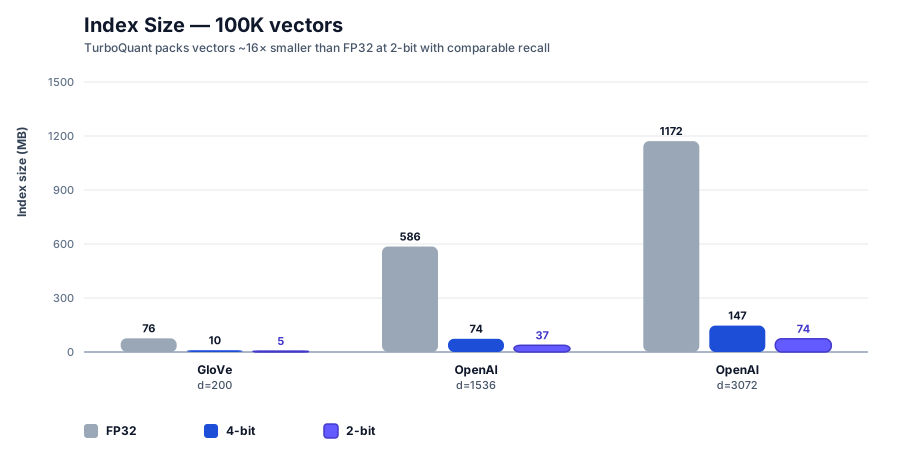
5. Bit-pack. Each coordinate is now a small integer (0-3 for 2-bit, 0-15 for 4-bit). Pack these tightly into bytes. A 1536-dim vector goes from 6,144 bytes (FP32) to 384 bytes (2-bit). That's 16x compression.
6. Length-renormalized scoring. Scalar quantization systematically underestimates inner products — the reconstructed unit direction is a little shorter than the original. We compute one scalar per vector at encode time — the inner product of the rotated unit vector with its own centroid reconstruction — and store ||v|| / ⟨u, x̂⟩ alongside each compressed vector. The search kernel multiplies the per-candidate score by this scalar before heap insertion, turning the inner-product estimator from downward-biased into unbiased at zero search-time cost and zero extra storage. The recall gain shows up most at low bit widths, where the quantization shrinkage is largest.
Encoding cost: one extra d-dimensional dot product per vector to compute ⟨u, x̂⟩. On 1M vectors at d=1536 this is sub-second of additional encode time — a one-shot price paid at ingest, not at query.
Search. Instead of decompressing every database vector, we rotate the query once into the same domain and score directly against the codebook values. The scoring kernel uses SIMD intrinsics (NEON on ARM; AVX-512BW on modern x86, falling back to AVX2, then to a scalar path on pre-AVX2 CPUs) with nibble-split lookup tables for maximum throughput.
The Lloyd-Max codebook achieves distortion within a factor of 2.7x of the information-theoretic lower bound (Shannon's distortion-rate limit); the length-renormalization step removes the residual bias the Lloyd-Max codebook introduces on the inner-product estimator itself.
Building
Python (via maturin)
pip install maturin
cd turbovec-python
maturin build --release
pip install target/wheels/*.whl
Rust
cargo build --release
All x86_64 builds target x86-64-v2 (SSE4.2 baseline, Nehalem 2008+) via .cargo/config.toml, so any x86-64-v2 CPU can run the whole crate. The AVX-512 and AVX2 kernels are #[target_feature]-gated and selected at runtime via is_x86_feature_detected!, so they kick in on hardware that supports them regardless of the compile baseline; CPUs with neither run the scalar fallback.
Running benchmarks
Download datasets:
python3 benchmarks/download_data.py all            # all datasets
python3 benchmarks/download_data.py glove          # GloVe d=200
python3 benchmarks/download_data.py openai-1536    # OpenAI DBpedia d=1536
python3 benchmarks/download_data.py openai-3072    # OpenAI DBpedia d=3072
Each benchmark is a self-contained script in benchmarks/suite/. Run any one individually:
python3 benchmarks/suite/speed_d1536_2bit_arm_mt.py
python3 benchmarks/suite/recall_d1536_2bit.py
python3 benchmarks/suite/compression.py
Run all benchmarks for a category:
for f in benchmarks/suite/speed_*arm*.py; do python3 "$f"; done    # all ARM speed
for f in benchmarks/suite/speed_*x86*.py; do python3 "$f"; done    # all x86 speed
for f in benchmarks/suite/recall_*.py; do python3 "$f"; done       # all recall
python3 benchmarks/suite/compression.py                            # compression
Results are saved as JSON to benchmarks/results/. Regenerate charts:
python3 benchmarks/create_diagrams.py
Quick harness for optimization work
The suite above is the source of every published number — real embeddings, FAISS comparator, fixed shapes, run on the two official environments. For the inner loop of an optimization pass there's also a Rust harness that reproduces the four mutation metrics (cold bulk add, warm append, single add, remove) on deterministic synthetic vectors, so a hypothesis can be measured in seconds on any machine with no dataset and no FAISS:
cargo run --release --example insert_bench -- --dim 1536 --bits 2
RAYON_NUM_THREADS=1 cargo run --release --example insert_bench
It is a screening tool, not a source of published numbers.
examples/encode_hash prints a per-stage hash of the encode pipeline for a
fixed input; CI runs it on every OS in the matrix and fails if they disagree,
which is how cross-platform byte identity of the encode is checked.
References
- TurboQuant: Online Vector Quantization with Near-optimal Distortion Rate (ICLR 2026) -- the paper this implements
- RaBitQ: Quantizing High-Dimensional Vectors with a Theoretical Error Bound for Approximate Nearest Neighbor Search (SIGMOD 2024) -- the source of the per-vector length-renormalization correction adapted in step 5
- FAISS Fast accumulation of PQ and AQ codes -- turbovec's x86 SIMD kernel adapts FastScan's pack layout, nibble-LUT scoring, and u16 accumulator strategy
1 maintainer

Metadata
1 maintainer
Release files for turbovec 1.1.1
For a detailed explanation of source distributions (sdists) and built distributions (wheels), please see the package formats documentation.
Source distribution (sdist)
| File | Size | Uploaded | |
|---|---|---|---|
| turbovec-1.1.1.tar.gz | 764.9 kB | Details |
Built distributions (wheels)
| File | Reset | |||
|---|---|---|---|---|
| turbovec-1.1.1-cp39-abi3-win_amd64.whl | CPython 3.9 | abi3 | Windows x86-64 | Details |
| turbovec-1.1.1-cp39-abi3-manylinux_2_28_x86_64.whl | CPython 3.9 | abi3 | Linux glibc 2.28+ x86-64 | Details |
| turbovec-1.1.1-cp39-abi3-manylinux_2_28_aarch64.whl | CPython 3.9 | abi3 | Linux glibc 2.28+ ARM64 | Details |
| turbovec-1.1.1-cp39-abi3-macosx_11_0_arm64.whl | CPython 3.9 | abi3 | macOS 11.0+ ARM64 | Details |
Total release size: 3.9 MB
Release files / turbovec-1.1.1.tar.gz
| Download URL | turbovec-1.1.1.tar.gz |
|---|---|
| Size | 764.9 kB |
| Tags | Source |
|
SHA-256 checksum How to use checksums |
a51571d1d6912f2d22a136374121cad6e34df2609600f643a429cd00fb957855
|
|
BLAKE2b-256 checksum How to use checksums |
a1532e07e0801fbc260dfe4859f4c925a5888b28e65892396bc03bd689dec39d
|
| Upload date | |
|
Uploaded using Trusted Publishing? What is trusted publishing? |
Yes |
| Uploaded via |
twine/6.1.0 CPython/3.13.14
|
Provenance
Provenance describes where a file came from. On PyPI, provenance is shared via attestations, which provide a verifiable record of the build or publishing details. View details, limitations and caveats.


PyPI Publish Attestation
PyPI verified that this artifact, at this checksum, originated from the publisher listed below.
Signed by GitHub Actions, verified by PyPI on Oct 4, 2026.
Transparency logRelease files / turbovec-1.1.1-cp39-abi3-win_amd64.whl
| Download URL | turbovec-1.1.1-cp39-abi3-win_amd64.whl |
|---|---|
| Size | 724.9 kB |
| Tags | CPython 3.9 Windows x86-64 abi3 |
|
SHA-256 checksum How to use checksums |
673de627a8ee6e81271305c1f11fee43d809282e1713cc382c6673d3336ea652
|
|
BLAKE2b-256 checksum How to use checksums |
6052adee7678182faa272a31158d7a8e6cd3918cef79e62010ee6ebb88016a45
|
| Upload date | |
|
Uploaded using Trusted Publishing? What is trusted publishing? |
Yes |
| Uploaded via |
twine/6.1.0 CPython/3.13.14
|
Provenance
Provenance describes where a file came from. On PyPI, provenance is shared via attestations, which provide a verifiable record of the build or publishing details. View details, limitations and caveats.
PyPI Publish Attestation
PyPI verified that this artifact, at this checksum, originated from the publisher listed below.
Signed by GitHub Actions, verified by PyPI on Oct 4, 2026.
Transparency logRelease files / turbovec-1.1.1-cp39-abi3-manylinux_2_28_x86_64.whl
| Download URL | turbovec-1.1.1-cp39-abi3-manylinux_2_28_x86_64.whl |
|---|---|
| Size | 831.5 kB |
| Tags | CPython 3.9 Linux glibc 2.28+ x86-64 abi3 |
|
SHA-256 checksum How to use checksums |
5c55f9839df926abb1fe89054b13ca3c0a5937a6a69582a1a03b7603791aa3b1
|
|
BLAKE2b-256 checksum How to use checksums |
330c09fca6d9db53db8ad6b497e883c090e5ab4f2412c8f28b588ff7e0805042
|
| Upload date | |
|
Uploaded using Trusted Publishing? What is trusted publishing? |
Yes |
| Uploaded via |
twine/6.1.0 CPython/3.13.14
|
Provenance
Provenance describes where a file came from. On PyPI, provenance is shared via attestations, which provide a verifiable record of the build or publishing details. View details, limitations and caveats.
PyPI Publish Attestation
PyPI verified that this artifact, at this checksum, originated from the publisher listed below.
Signed by GitHub Actions, verified by PyPI on Oct 4, 2026.
Transparency logRelease files / turbovec-1.1.1-cp39-abi3-manylinux_2_28_aarch64.whl
| Download URL | turbovec-1.1.1-cp39-abi3-manylinux_2_28_aarch64.whl |
|---|---|
| Size | 812.1 kB |
| Tags | CPython 3.9 Linux glibc 2.28+ ARM64 abi3 |
|
SHA-256 checksum How to use checksums |
d0fd9951321ce9fc700d5197ccb086ab50a8a4a4f5aa59f1c062f694d7290953
|
|
BLAKE2b-256 checksum How to use checksums |
4906fb4b2737a8ba96845d99adc88cf21758e0681545180f90b9bd776e579c4c
|
| Upload date | |
|
Uploaded using Trusted Publishing? What is trusted publishing? |
Yes |
| Uploaded via |
twine/6.1.0 CPython/3.13.14
|
Provenance
Provenance describes where a file came from. On PyPI, provenance is shared via attestations, which provide a verifiable record of the build or publishing details. View details, limitations and caveats.
PyPI Publish Attestation
PyPI verified that this artifact, at this checksum, originated from the publisher listed below.
Signed by GitHub Actions, verified by PyPI on Oct 4, 2026.
Transparency logRelease files / turbovec-1.1.1-cp39-abi3-macosx_11_0_arm64.whl
| Download URL | turbovec-1.1.1-cp39-abi3-macosx_11_0_arm64.whl |
|---|---|
| Size | 772.8 kB |
| Tags | CPython 3.9 abi3 macOS 11.0+ ARM64 |
|
SHA-256 checksum How to use checksums |
e96eb34568def2b167798bc1f9691c4d953cb9d842b8e37cc6395a62832ca7c0
|
|
BLAKE2b-256 checksum How to use checksums |
56416efa40e3100d6f56cc0fcc48acd8bcebefcb34ddf363f5a814487c8ed549
|
| Upload date | |
|
Uploaded using Trusted Publishing? What is trusted publishing? |
Yes |
| Uploaded via |
twine/6.1.0 CPython/3.13.14
|
Provenance
Provenance describes where a file came from. On PyPI, provenance is shared via attestations, which provide a verifiable record of the build or publishing details. View details, limitations and caveats.
PyPI Publish Attestation
PyPI verified that this artifact, at this checksum, originated from the publisher listed below.
Signed by GitHub Actions, verified by PyPI on Oct 4, 2026.
Transparency log













