
NLP toolkit for Turkic languages
Project description

TurkicNLP
NLP toolkit for 20+ Turkic languages — a pip-installable Python library inspired by Stanza, with adaptations for the low-resource, morphologically rich Turkic language family.
Maintained by Sherzod Hakimov




Citation
If you use TurkicNLP in your research, please cite:
@software{turkicnlp,
  title = {TurkicNLP: An Open-Source NLP Toolkit for Turkic Languages},
  author = {Sherzod Hakimov},
  year = {2026},
  url = {https://github.com/turkic-nlp/turkicnlp},
  license = {Apache-2.0},
}
Features
- 24 Turkic languages from Turkish to Sakha, Kazakh to Uyghur
- Script-aware from the ground up — Latin, Cyrillic, Perso-Arabic, Old Turkic Runic
- Automatic script detection and bidirectional transliteration
- Apertium FST morphology for ~20 Turkic languages via Python-native
hfstbindings (no system install) - Stanza/UD integration — pretrained tokenization, POS tagging, lemmatization, dependency parsing, and NER via Stanza models trained on Universal Dependencies treebanks
- NLLB embeddings + translation backend — sentence/document vectors and MT via NLLB-200
- Multiple backends — choose between rule-based, Apertium FST, or Stanza neural backends per processor
- License isolation — library is Apache-2.0; Apertium GPL-3.0 data downloaded separately
- Stanza-compatible API —
Pipeline,Document,Sentence,Word
Installation
pip install turkicnlp
To install all required dependencies at once:
pip install "turkicnlp[all]"
With optional dependencies:
pip install "turkicnlp[stanza]"        # Stanza/UD neural models
pip install "turkicnlp[all]"           # Everything: stanza, NLLB embeddings & translations
pip install "turkicnlp[dev]"           # Development tools
Quick Start
import turkicnlp

# Download models for a language
turkicnlp.download("kaz")

# Build a pipeline
nlp = turkicnlp.Pipeline("kaz", processors=["tokenize", "pos", "lemma", "ner", "depparse"])

# Process text
doc = nlp("Мен мектепке бардым")

# Access annotations
for sentence in doc.sentences:
    for word in sentence.words:
        print(f"{word.text}\t{word.lemma}\t{word.upos}\t{word.feats}")

# Export to CoNLL-U
print(doc.to_conllu())
Embeddings (NLLB)
import math
import turkicnlp

turkicnlp.download("tur", processors=["embeddings"])
nlp = turkicnlp.Pipeline("tur", processors=["embeddings"])

doc1 = nlp("Bugün hava çok güzel ve parkta yürüyüş yaptım.")
doc2 = nlp("Parkta yürüyüş yapmak bugün çok keyifliydi çünkü hava güzeldi.")

def cosine_similarity(a, b):
    dot = sum(x * y for x, y in zip(a, b))
    norm_a = math.sqrt(sum(x * x for x in a))
    norm_b = math.sqrt(sum(y * y for y in b))
    return dot / (norm_a * norm_b)

print(len(doc1.embedding), len(doc2.embedding))
print(f"cosine = {cosine_similarity(doc1.embedding, doc2.embedding):.4f}")
print(doc1._processor_log)  # ['embeddings:nllb']
Machine Translation (NLLB)
import turkicnlp

# Downloads once into ~/.turkicnlp/models/huggingface/facebook--nllb-200-distilled-600M
turkicnlp.download("tur", processors=["translate"])

nlp = turkicnlp.Pipeline(
    "tur",
    processors=["translate"],
    translate_tgt_lang="eng",
)

doc = nlp("Bugün hava çok güzel ve parkta yürüyüş yaptım.")
print(doc.translation)
print(doc._processor_log)  # ['translate:nllb']
translate_tgt_lang accepts either ISO-639-3 ("eng", "tuk", "kaz") or explicit Flores-200 codes ("eng_Latn", "kaz_Cyrl").
Using the Stanza Backend
from turkicnlp.processors.stanza_backend import (
    StanzaTokenizer, StanzaPOSTagger, StanzaLemmatizer, StanzaNERProcessor, StanzaDepParser
)
from turkicnlp.models.document import Document

# Models are downloaded automatically on first use
doc = Document(text="Merhaba dünya.", lang="tur")

for Proc in [StanzaTokenizer, StanzaPOSTagger, StanzaLemmatizer, StanzaNERProcessor, StanzaDepParser]:
    proc = Proc(lang="tur")
    proc.load()
    doc = proc.process(doc)

for word in doc.words:
    print(f"{word.text:12} {word.upos:6} {word.lemma:12} head={word.head} {word.deprel}")

# Export to CoNLL-U
print(doc.to_conllu())
Mixed Backends
from turkicnlp.processors.tokenizer import RegexTokenizer
from turkicnlp.processors.stanza_backend import StanzaPOSTagger, StanzaNERProcessor, StanzaDepParser
from turkicnlp.models.document import Document

doc = Document(text="Мен мектепке бардым.", lang="kaz")

# Rule-based tokenizer + Stanza POS/parsing (pretokenized mode)
tokenizer = RegexTokenizer(lang="kaz")
tokenizer.load()
doc = tokenizer.process(doc)

pos = StanzaPOSTagger(lang="kaz")
pos.load()
doc = pos.process(doc)

ner = StanzaNERProcessor(lang="kaz")
ner.load()
doc = ner.process(doc)

parser = StanzaDepParser(lang="kaz")
parser.load()
doc = parser.process(doc)
Multi-Script Support
# Kazakh — auto-detects Cyrillic vs Latin
doc = nlp("Мен мектепке бардым")    # Cyrillic
doc = nlp("Men mektepke bardym")     # Latin

# Explicit script selection
nlp_cyrl = turkicnlp.Pipeline("kaz", script="Cyrl")
nlp_latn = turkicnlp.Pipeline("kaz", script="Latn")

# Transliteration bridge — run Cyrillic model on Latin input
nlp = turkicnlp.Pipeline("kaz", script="Latn", transliterate_to="Cyrl")
Uyghur (Perso-Arabic)
nlp_ug = turkicnlp.Pipeline("uig", script="Arab")
doc = nlp_ug("مەن مەكتەپكە باردىم")
Transliteration
The Transliterator class converts text between scripts for any supported language pair:
from turkicnlp.scripts import Script
from turkicnlp.scripts.transliterator import Transliterator

# Kazakh Cyrillic → Latin (2021 official alphabet)
t = Transliterator("kaz", Script.CYRILLIC, Script.LATIN)
print(t.transliterate("Қазақстан Республикасы"))
# → Qazaqstan Respublıkasy

# Uzbek Latin → Cyrillic
t = Transliterator("uzb", Script.LATIN, Script.CYRILLIC)
print(t.transliterate("O'zbekiston Respublikasi"))
# → Ўзбекистон Республикаси

# Uyghur Perso-Arabic → Latin (ULY)
t = Transliterator("uig", Script.PERSO_ARABIC, Script.LATIN)
print(t.transliterate("مەكتەپ"))
# → mektep

# Azerbaijani Latin → Cyrillic
t = Transliterator("aze", Script.LATIN, Script.CYRILLIC)
print(t.transliterate("Azərbaycan"))
# → Азәрбайҹан

# Turkmen Latin → Cyrillic
t = Transliterator("tuk", Script.LATIN, Script.CYRILLIC)
print(t.transliterate("Türkmenistan"))
# → Түркменистан

# Tatar Cyrillic → Latin (Zamanälif)
t = Transliterator("tat", Script.CYRILLIC, Script.LATIN)
print(t.transliterate("Татарстан Республикасы"))
# → Tatarstan Respublikası
Old Turkic Runic Script
TurkicNLP supports transliteration of Old Turkic runic inscriptions (Orkhon-Yenisei script, Unicode block U+10C00–U+10C4F) to Latin:
from turkicnlp.scripts import Script
from turkicnlp.scripts.transliterator import Transliterator

t = Transliterator("otk", Script.OLD_TURKIC_RUNIC, Script.LATIN)

# Individual runic characters
print(t.transliterate("\U00010C34\U00010C07\U00010C2F\U00010C19"))
# → törk  (Türk)

# The transliterator maps each runic character to its standard
# Turkological Latin equivalent, handling both Orkhon and Yenisei
# variant forms (e.g., separate glyphs for consonants with
# back vs. front vowel contexts).
Supported Languages and Components
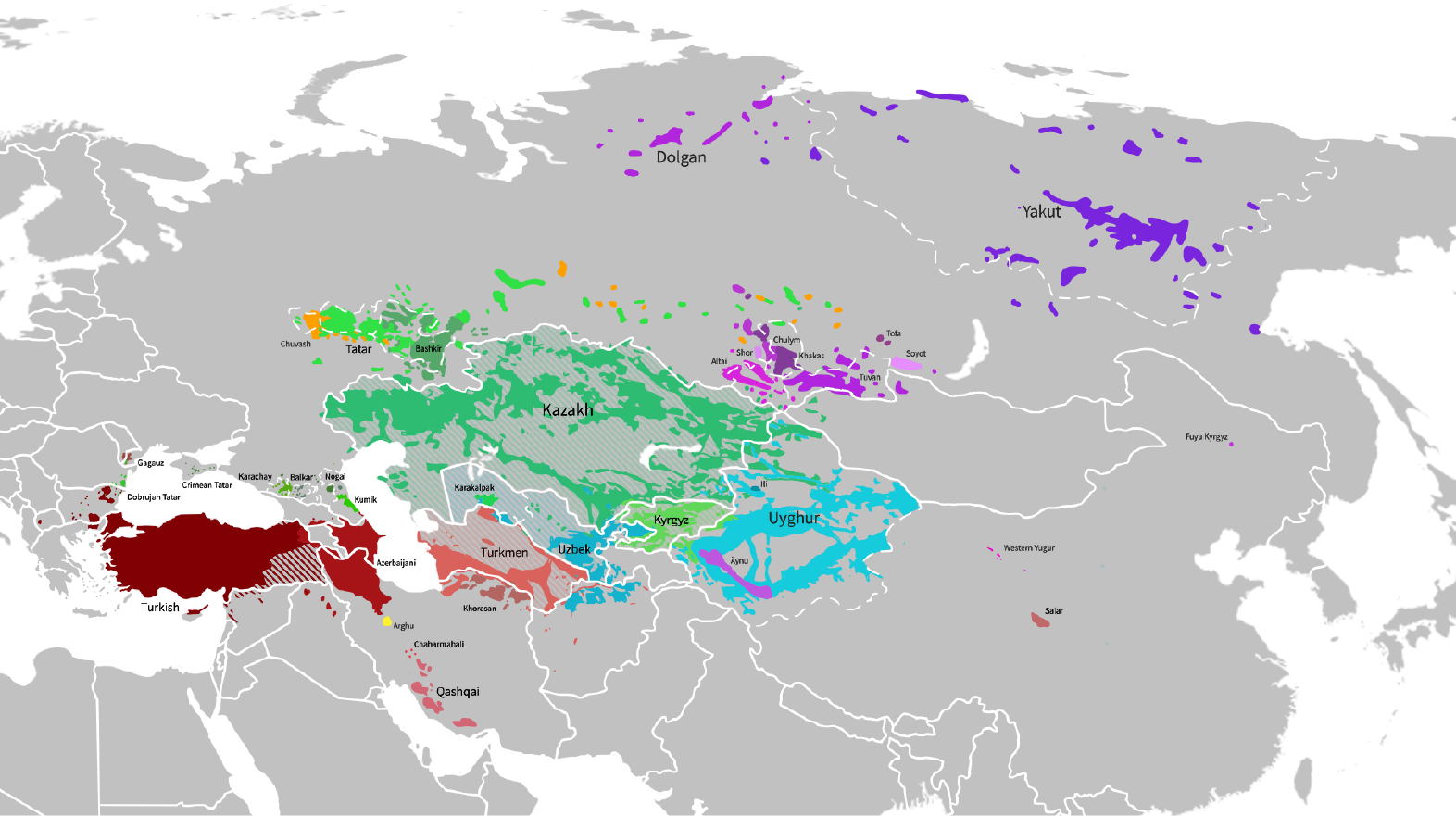
Geographic distribution of Turkic languages (source: Wikimedia Commons)
The table below shows all supported languages with their available scripts and processor status.
Backend legend:
- rule — Rule-based (regex tokenizer, abbreviation lists)
- Apertium — Finite-state transducers via Apertium +
hfst(GPL-3.0, downloaded separately) - Stanza/UD — Neural models from Stanza trained on Universal Dependencies treebanks (Apache-2.0)
- NLLB — Shared NLLB-200-distilled-600M backend for embeddings and machine translation
Status legend:
- ✅ Available
- 🔧 Planned
- — Not available (yet)
Oghuz Branch
| Language | Code | Script(s) | Tokenize | Morph (FST) | POS | Lemma | DepParse | NER | Embeddings | Translation |
|---|---|---|---|---|---|---|---|---|---|---|
| Turkish | tur |
Latn | ✅ rule, ✅ Stanza/UD | ✅ Apertium | ✅ Stanza/UD | ✅ Stanza/UD | ✅ Stanza/UD | ✅ Stanza | ✅ NLLB | ✅ NLLB |
| Azerbaijani | aze |
Latn, Cyrl | ✅ rule | ✅ Apertium | 🔧 | 🔧 | 🔧 | — | ✅ NLLB | ✅ NLLB |
| Iranian Azerbaijani | azb |
Arab | 🔧 rule_arabic | — | — | — | — | — | ✅ NLLB | ✅ NLLB |
| Turkmen | tuk |
Latn, Cyrl | ✅ rule | ✅ Apertium (beta) | 🔧 | 🔧 | 🔧 | — | ✅ NLLB | ✅ NLLB |
| Gagauz | gag |
Latn | ✅ rule | ✅ Apertium (proto) | — | — | — | — | — | — |
Kipchak Branch
| Language | Code | Script(s) | Tokenize | Morph (FST) | POS | Lemma | DepParse | NER | Embeddings | Translation |
|---|---|---|---|---|---|---|---|---|---|---|
| Kazakh | kaz |
Cyrl, Latn | ✅ rule, ✅ Stanza/UD | ✅ Apertium | ✅ Stanza/UD | ✅ Stanza/UD | ✅ Stanza/UD | ✅ Stanza | ✅ NLLB | ✅ NLLB |
| Kyrgyz | kir |
Cyrl | ✅ rule | ✅ Apertium | ✅ Stanza/UD | ✅ Stanza/UD | ✅ Stanza/UD | — | ✅ NLLB | ✅ NLLB |
| Tatar | tat |
Cyrl, Latn | ✅ rule | ✅ Apertium | 🔧 | 🔧 | 🔧 | — | ✅ NLLB | ✅ NLLB |
| Bashkir | bak |
Cyrl | ✅ rule | ✅ Apertium (beta) | — | — | — | — | ✅ NLLB | ✅ NLLB |
| Crimean Tatar | crh |
Latn, Cyrl | ✅ rule | ✅ Apertium (beta) | — | — | — | — | ✅ NLLB | ✅ NLLB |
| Karakalpak | kaa |
Latn, Cyrl | ✅ rule | ✅ Apertium (proto) | — | — | — | — | — | — |
| Nogai | nog |
Cyrl | ✅ rule | ✅ Apertium (proto) | — | — | — | — | — | — |
| Kumyk | kum |
Cyrl | ✅ rule | ✅ Apertium (proto) | — | — | — | — | — | — |
| Karachay-Balkar | krc |
Cyrl | ✅ rule | ✅ Apertium (proto) | — | — | — | — | — | — |
Karluk Branch
| Language | Code | Script(s) | Tokenize | Morph (FST) | POS | Lemma | DepParse | NER | Embeddings | Translation |
|---|---|---|---|---|---|---|---|---|---|---|
| Uzbek | uzb |
Latn, Cyrl | ✅ rule | ✅ Apertium | 🔧 | 🔧 | 🔧 | — | ✅ NLLB | ✅ NLLB |
| Uyghur | uig |
Arab, Latn | 🔧 rule_arabic, ✅ Stanza/UD | ✅ Apertium (beta) | ✅ Stanza/UD | ✅ Stanza/UD | ✅ Stanza/UD | — | ✅ NLLB | ✅ NLLB |
Siberian Branch
| Language | Code | Script(s) | Tokenize | Morph (FST) | POS | Lemma | DepParse | NER | Embeddings | Translation |
|---|---|---|---|---|---|---|---|---|---|---|
| Sakha (Yakut) | sah |
Cyrl | ✅ rule | ✅ Apertium (proto) | — | — | — | — | — | — |
| Altai | alt |
Cyrl | ✅ rule | ✅ Apertium (proto) | — | — | — | — | — | — |
| Tuvan | tyv |
Cyrl | ✅ rule | ✅ Apertium (proto) | — | — | — | — | — | — |
| Khakas | kjh |
Cyrl | ✅ rule | ✅ Apertium (proto) | — | — | — | — | — | — |
Oghur Branch
| Language | Code | Script(s) | Tokenize | Morph (FST) | POS | Lemma | DepParse | NER | Embeddings | Translation |
|---|---|---|---|---|---|---|---|---|---|---|
| Chuvash | chv |
Cyrl | ✅ rule | ✅ Apertium (beta) | — | — | — | — | — | — |
Arghu Branch
| Language | Code | Script(s) | Tokenize | Morph (FST) | POS | Lemma | DepParse | NER | Embeddings | Translation |
|---|---|---|---|---|---|---|---|---|---|---|
| Khalaj | klj |
Arab | - | - | — | — | — | — | — | — |
Historical Languages
| Language | Code | Script(s) | Tokenize | Morph (FST) | POS | Lemma | DepParse | NER | Embeddings | Translation |
|---|---|---|---|---|---|---|---|---|---|---|
| Ottoman Turkish | ota |
Arab, Latn | - | — | - | - | - | — | — | — |
| Old Turkish | otk |
Orkh, Latn | 🔧 rule | — | — | — | — | — | — | — |
Stanza/UD Model Details
The Stanza backend provides neural models trained on Universal Dependencies treebanks. The table below lists the UD treebanks and NER datasets powering each language, along with the available Stanza processors.
| Language | Stanza Code | UD Treebank(s) | Stanza Processors | NER Dataset |
|---|---|---|---|---|
| Turkish | tr |
IMST (default), BOUN, FrameNet, KeNet, ATIS, Penn, Tourism | tokenize, mwt, pos, lemma, depparse, ner | Starlang NER |
| Kazakh | kk |
KTB | tokenize, mwt, pos, lemma, depparse, ner | KazNERD |
| Uyghur | ug |
UDT | tokenize, pos, lemma, depparse | — |
| Kyrgyz | ky |
KTMU | tokenize, pos, lemma, depparse | — |
| Ottoman Turkish | ota |
BOUN | tokenize, mwt, pos, lemma, depparse | — |
Transliteration Support
Bidirectional script conversion is available for all multi-script languages. The transliterator uses a greedy longest-match algorithm with per-language mapping tables.
| Language | Direction | Scripts | Standard |
|---|---|---|---|
| Kazakh | ↔ Bidirectional | Cyrillic ↔ Latin | 2021 official Latin alphabet |
| Uzbek | ↔ Bidirectional | Cyrillic ↔ Latin | 1995 official Latin alphabet |
| Azerbaijani | ↔ Bidirectional | Cyrillic ↔ Latin | 1991 official Latin alphabet |
| Tatar | ↔ Bidirectional | Cyrillic ↔ Latin | Zamanälif |
| Turkmen | ↔ Bidirectional | Cyrillic ↔ Latin | 1993 official Latin alphabet |
| Karakalpak | ↔ Bidirectional | Cyrillic ↔ Latin | 2016 Latin alphabet |
| Crimean Tatar | ↔ Bidirectional | Cyrillic ↔ Latin | Standard Crimean Tatar Latin |
| Uyghur | ↔ Bidirectional | Perso-Arabic ↔ Latin | Uyghur Latin Yéziqi (ULY) |
| Ottoman Turkish | → One-way | Latin → Perso-Arabic | Academic transcription |
| Old Turkic | → One-way | Runic → Latin | Turkological convention |
Apertium FST Quality Levels
| Level | Description | Languages |
|---|---|---|
| Production | >90% coverage on news text | Turkish, Kazakh, Tatar |
| Stable | Good coverage, actively maintained | Azerbaijani, Kyrgyz, Uzbek |
| Beta | Reasonable coverage, some gaps | Turkmen, Bashkir, Uyghur, Crimean Tatar, Chuvash |
| Prototype | Limited coverage, experimental | Gagauz, Sakha, Karakalpak, Nogai, Kumyk, Karachay-Balkar, Altai, Tuvan, Khakas |
Model Catalog and Apertium Downloads
TurkicNLP uses a model catalog to define download sources per language/script/processor. The catalog lives in:
turkicnlp/resources/catalog.json(packaged default)- Remote override:
ModelRegistry.CATALOG_URL(orTURKICNLP_CATALOG_URL)
For each language, the catalog stores the Apertium source repo and the expected FST script. When turkicnlp.download() is called, it reads the catalog and downloads precompiled .hfst binaries from the url fields. If a language has no URL configured, download will fail with a clear error until the catalog is populated with hosted binaries (for example, a turkic-nlp/apertium-data releases repository).
Download folder
All models and resources are downloaded into this folder: ~/.turkicnlp.
Architecture
TurkicNLP follows Stanza's modular pipeline design:
Pipeline("tur", processors=["tokenize", "morph", "pos", "ner", "depparse"])
    │
    ▼
  Document ─── text: "Ben okula vardım"
    │
    ├── script_detect    → script = "Latn"
    ├── tokenize         → sentences, tokens, words
    ├── morph (Apertium) → lemma, pos, feats (via HFST)
    ├── pos (neural)     → refined UPOS, XPOS, feats
    ├── ner (neural)     → BIO tags and entity spans
    └── depparse         → head, deprel
    │
    ▼
  Document ─── annotated with all layers
Pipeline("azb", processors=["embeddings", "translate"], translate_tgt_lang="eng")
    │
    ▼
  Document ─── text: "من کتاب اوخویورام"
    │
    ├── script_detect          → script = "Arab"
    ├── embeddings (NLLB)      → sentence/document vectors
    └── translate (NLLB)       → sentence/document translation
           (src resolved from FLORES map: azb -> azb_Arab,
            tgt resolved from ISO-3: eng -> eng_Latn)
    │
    ▼
  Document ─── annotated with all layers
Key Abstractions
- Document → Sentence → Token → Word hierarchy (maps to CoNLL-U)
- Processor ABC with
PROVIDES,REQUIRES,NAMEclass attributes - Pipeline orchestrator with dependency resolution and script-aware model loading
- ProcessorRegistry for pluggable backends (rule, Apertium, Stanza, NLLB)
- ModelRegistry with remote catalog and local caching at
~/.turkicnlp/models/ - NLLB FLORES language map for ISO-3 to NLLB code resolution in translation (e.g.
tuk->tuk_Latn)
Model Storage Layout
~/.turkicnlp/models/
├── kaz/
│   ├── Cyrl/
│   │   ├── tokenize/rule/
│   │   ├── morph/apertium/    ← GPL-3.0 (downloaded separately)
│   │   │   ├── kaz.automorf.hfst
│   │   │   ├── LICENSE
│   │   │   └── metadata.json
│   │   ├── pos/neural/
│   │   └── depparse/neural/
│   └── Latn/
│       └── tokenize/rule/
├── tur/
│   └── Latn/
│       └── ...
├── huggingface/
│   └── facebook--nllb-200-distilled-600M/
│       ├── config.json
│       ├── model.safetensors (or pytorch_model.bin)
│       ├── tokenizer.json
│       └── ...
└── catalog.json

# Stanza models are managed by Stanza at ~/stanza_resources/
Notes:
- NLLB embeddings and translation use a shared Hugging Face model under
~/.turkicnlp/models/huggingface/. - The NLLB model is downloaded once and reused across supported Turkic languages.
- Unlike Apertium/Stanza components, NLLB artifacts are not duplicated per language/script directory.
License
- Library code: Apache License 2.0
- Stanza models: Apache License 2.0 — managed by Stanza's own download mechanism
- Apertium FST data: GPL-3.0 — downloaded separately at runtime, never bundled in the pip package
- NLLB-200 model weights/tokenizer: CC-BY-NC-4.0 — downloaded from Hugging Face at runtime and reused from
~/.turkicnlp/models/huggingface/(non-commercial license terms apply)
Development
git clone https://github.com/turkic-nlp/turkicnlp.git
cd turkicnlp
pip install -e ".[dev]"
pytest
Contributing
Contributions are welcome, especially:
- New language support — tag mappings, abbreviation lists, test data
- Neural model training — POS taggers, parsers, NER models
- Apertium FST improvements — better coverage for prototype-level languages
- Other - any other aspect that you want
Create issues, Pull Requests etc.
Acknowledgements
TurkicNLP builds on the work of many researchers and communities. We gratefully acknowledge the following:
Stanza
Stanza provides the pretrained neural models for tokenization, POS tagging, lemmatization, dependency parsing, and NER.
Peng Qi, Yuhao Zhang, Yuhui Zhang, Jason Bolton, and Christopher D. Manning. 2020. Stanza: A Python Natural Language Processing Toolkit for Many Human Languages. In Proceedings of the 58th Annual Meeting of the Association for Computational Linguistics: System Demonstrations. [paper]
Universal Dependencies Treebanks
The Stanza models are trained on Universal Dependencies treebanks created by the following teams:
Turkish (UD_Turkish-IMST)
Umut Sulubacak, Memduh Gokirmak, Francis Tyers, Cagri Coltekin, Joakim Nivre, and Gulsen Cebiroglu Eryigit. Universal Dependencies for Turkish. COLING 2016. [paper]
Turkish (UD_Turkish-BOUN)
Utku Turk, Furkan Atmaca, Saziye Betul Ozates, Gozde Berk, Seyyit Talha Bedir, Abdullatif Koksal, Balkiz Ozturk Basaran, Tunga Gungor, and Arzucan Ozgur. Resources for Turkish Dependency Parsing: Introducing the BOUN Treebank and the BoAT Annotation Tool. Language Resources and Evaluation 56(1), 2022. [paper]
Turkish (UD_Turkish-FrameNet, KeNet, ATIS, Penn, Tourism)
Busra Marsan, Neslihan Kara, Merve Ozcelik, Bilge Nas Arican, Neslihan Cesur, Asli Kuzgun, Ezgi Saniyar, Oguzhan Kuyrukcu, and Olcay Taner Yildiz. Starlang Software and Ozyegin University. These treebanks cover diverse domains including FrameNet frames, WordNet examples, airline travel, Penn Treebank translations, and tourism reviews.
Kazakh (UD_Kazakh-KTB)
Aibek Makazhanov, Jonathan North Washington, and Francis Tyers. Towards a Free/Open-source Universal-dependency Treebank for Kazakh. TurkLang 2015. [paper]
Uyghur (UD_Uyghur-UDT)
Marhaba Eli (Xinjiang University), Daniel Zeman (Charles University), and Francis Tyers. [treebank]
Kyrgyz (UD_Kyrgyz-KTMU)
Ibrahim Benli. [treebank]
Ottoman Turkish (UD_Ottoman_Turkish-BOUN)
Saziye Betul Ozates, Tarik Emre Tiras, Efe Eren Genc, and Esma Fatima Bilgin Tasdemir. Dependency Annotation of Ottoman Turkish with Multilingual BERT. LAW-XVIII, 2024. [paper]
NER Datasets
Turkish NER (Starlang)
B. Ertopcu, A. B. Kanburoglu, O. Topsakal, O. Acikgoz, A. T. Gurkan, B. Ozenc, I. Cam, B. Avar, G. Ercan, and O. T. Yildiz. A New Approach for Named Entity Recognition. UBMK 2017. [paper]
Kazakh NER (KazNERD)
Rustem Yeshpanov, Yerbolat Khassanov, and Huseyin Atakan Varol (ISSAI, Nazarbayev University). KazNERD: Kazakh Named Entity Recognition Dataset. LREC 2022. [paper]
NLLB Embeddings & Machine Translation
TurkicNLP embeddings backend uses encoder pooling on:
Reference:
NLLB Team, Marta R. Costa-jussà, et al. 2022. No Language Left Behind: Scaling Human-Centered Machine Translation. [paper]
Other Organisations
- Apertium — morphological transducers covering 20+ Turkic languages
- SIGTURK — ACL Special Interest Group on Turkic Languages
- ISSAI — Institute of Smart Systems and Artificial Intelligence, Nazarbayev University, for Kazakh NLP resources
- Universal Dependencies — the framework and community behind Turkic treebanks
- Turkic Interlingua — resources for machine translation for Turkic languages
Project details
Release history Release notifications | RSS feed


Download files
Download the file for your platform. If you're not sure which to choose, learn more about installing packages.
Source Distribution
Built Distribution
Filter files by name, interpreter, ABI, and platform.
If you're not sure about the file name format, learn more about wheel file names.
Copy a direct link to the current filters
File details
Details for the file turkicnlp-0.1.4.tar.gz.
File metadata
- Download URL: turkicnlp-0.1.4.tar.gz
- Upload date:
- Size: 135.3 kB
- Tags: Source
- Uploaded using Trusted Publishing? No
- Uploaded via: twine/6.2.0 CPython/3.13.5
File hashes
| Algorithm | Hash digest | |
|---|---|---|
| SHA256 |
f1322a2a2910be94b6afb0bc17ceade224fb2496409149a5c4aa22ec8470b4c5
|
|
| MD5 |
8ea38a0b373337090f0191e5528b7f23
|
|
| BLAKE2b-256 |
c0abaf7925ca4929ee4f3764bd50859a0c57ce8a9ff5e1382a395789c2159d6e
|
File details
Details for the file turkicnlp-0.1.4-py3-none-any.whl.
File metadata
- Download URL: turkicnlp-0.1.4-py3-none-any.whl
- Upload date:
- Size: 167.4 kB
- Tags: Python 3
- Uploaded using Trusted Publishing? No
- Uploaded via: twine/6.2.0 CPython/3.13.5
File hashes
| Algorithm | Hash digest | |
|---|---|---|
| SHA256 |
cdff8b108c59c084e806eaecfb3cd814333f1a23437f366897a0408cf77fdfd5
|
|
| MD5 |
0aee9588a5484088441b8d981e82d9a9
|
|
| BLAKE2b-256 |
d84107d7bf6485f154337d18adf4f0adc5592f6c1d3647b5a373f683126a9274
|







