
turnaround
The showtime grid, solved — and proven. A constraint solver for the cinema week: every screen, every session, every distributor term, and the turnaround between them.


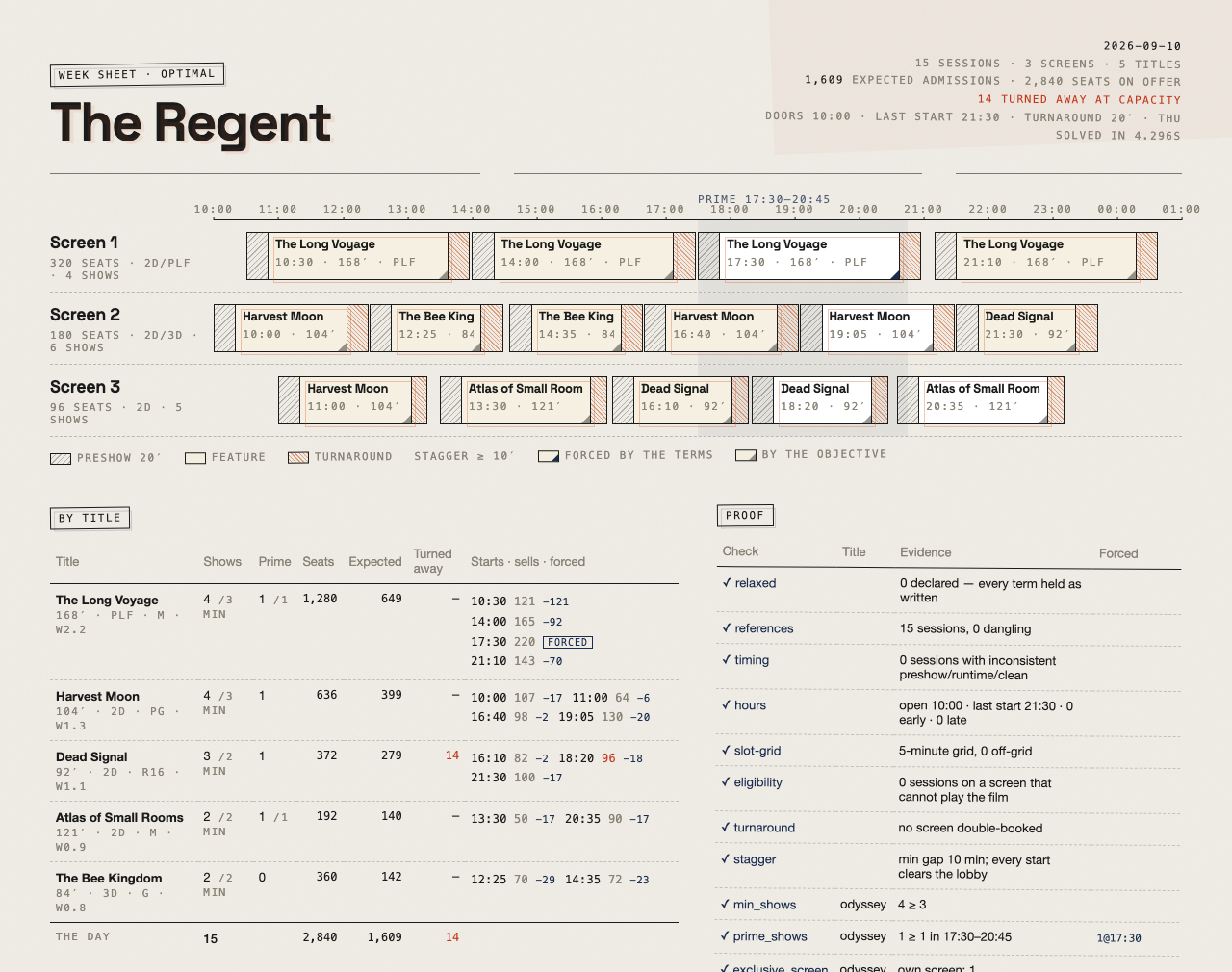
The Regent. Three screens, five titles, a PLF exclusive with a prime guarantee, a kids' title that must start by 17:00, a horror held to 16:00 or later. Proven OPTIMAL in about five seconds. Every check green.
The problem
Every Wednesday, in every cinema, someone builds next week's grid in a spreadsheet, holding the rules in their head: one thing per screen, twenty minutes to turn the room, no two starts inside ten minutes, and a distributor who was promised three shows a day, one in prime, its own screen.
The grid they arrive at is one they can live with. It is not one they can prove — and the first anyone hears of a missed term is the distributor's report.
turnaround takes the house, the slate and the terms as a JSON brief, and returns the grid with its proof. When the terms cannot all hold, it says so and gives you nothing.
Thirty seconds
uv tool install turnaround        # or: pipx install turnaround · pip install turnaround
curl -O https://raw.githubusercontent.com/brunohart/turnaround/v0.1.1/examples/regent.json
turnaround plan regent.json --html sheet.html
                         The Regent · OPTIMAL · 5.063s
 Screen 1   10:40 The Long Voyage · 14:15 The Long Voyage · 17:45 The Long Voyage · 21:20 The Long Voyage
 Screen 2   10:00 Harvest Moon · 12:25 The Bee Kingdom · 14:30 The Bee Kingdom · 16:35 Harvest Moon · …
 Screen 3   10:10 Atlas of Small Rooms · 13:15 Harvest Moon · 16:00 Dead Signal · 18:25 Dead Signal · …

 expected admissions 1,609 of 2,840 seats on offer · 14 turned away at capacity (Dead Signal)

 ✓ turnaround         no screen double-booked
 ✓ stagger            min gap 10 min; every start clears the lobby
 ✓ min_shows          odyssey   4 ≥ 3
 ✓ prime_shows        odyssey   1 ≥ 1 in 17:30–20:45
 ✓ exclusive_screen   odyssey   own screen: 1
 ✓ earliest_start     signal    0 before 16:00
 ✓ latest_start       bees      0 after 17:00
 ✓ admissions         1,608.6 claimed · 1,608.6 re-counted
sheet.html is the picture above: paper-first, prints as an A3 pin-up plus an A4 booth strip per screen, and turns into the booth strips on a phone.
The best thing it does is refuse
Double the minimums and ask again:
$ turnaround plan regent-overbooked.json
INFEASIBLE — this cannot hold on its own: The Long Voyage min_shows 6 — the house has
3 screens (1 PLF), doors 10:00 to last start 21:30 and a 17:30–20:45 prime window
Exit code 2. No grid. Not a grid with a distributor's minimum quietly dropped.
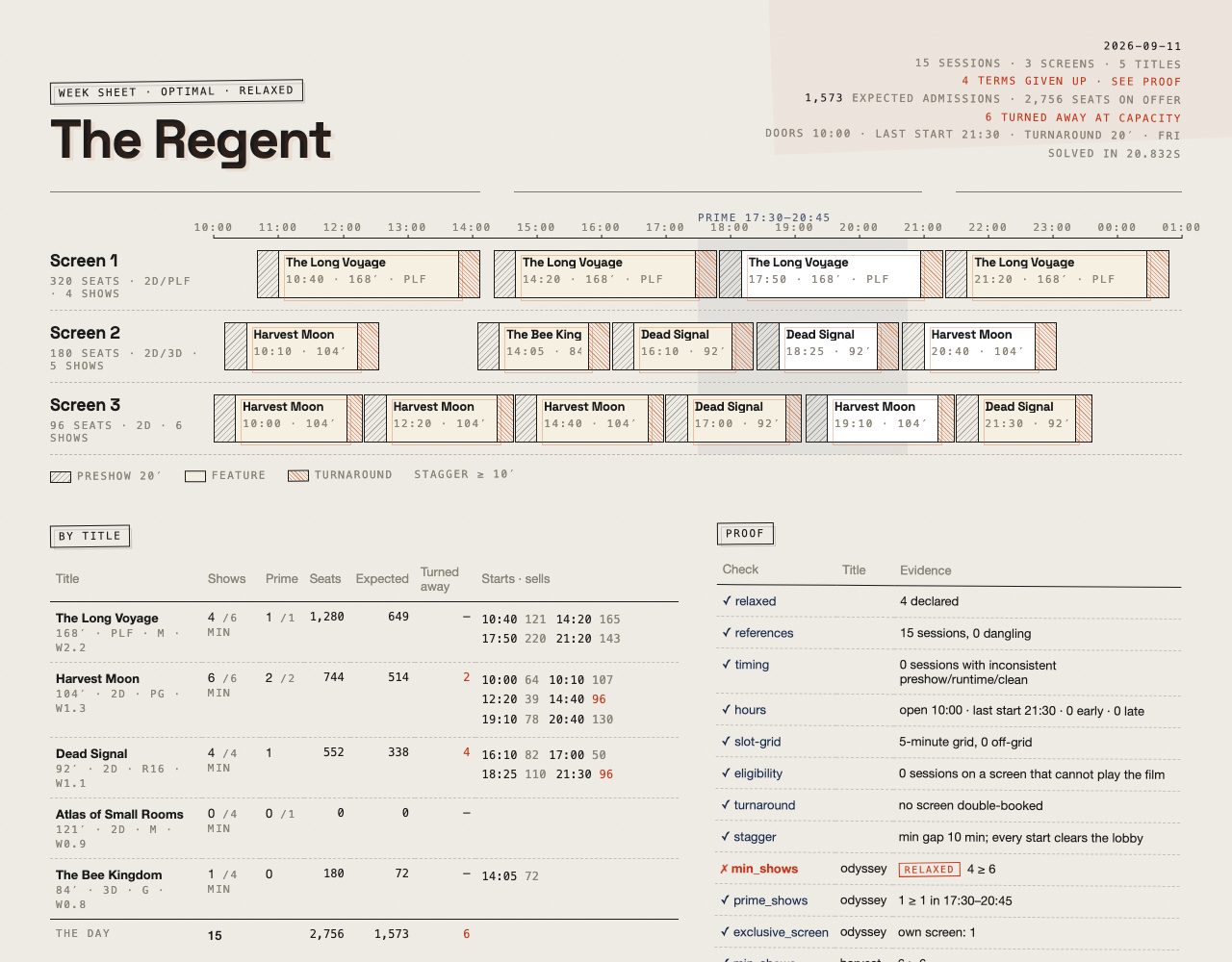
Every term sits behind its own assumption literal, so an infeasible week comes back as the smallest set of terms that cannot hold together, in the trade's words. If you want a grid anyway, --relax drops terms one at a time, in a fixed order, out loud — and stamps every one of them on the sheet.
Two readings, not one
A solver's OPTIMAL is a statement about a model — written by the same hand that might have misread the term. So every grid is re-verified by a checker that shares no code with the solver. Two readings that agree are evidence; one is an assertion.
It also means you can check a grid you made by hand, before trusting the solver with anything:
$ turnaround import --csv thursday.csv --brief regent.json --out hand.json
$ turnaround check regent.json hand.json
 ✗ turnaround       2: harvest@19:10 clears 21:34 but signal starts 21:30
 ✗ stagger          min gap 10 min; 1 windows too busy, first 17:40 with 2 starts
 ✗ earliest_start   signal   1 before 16:00
 ✗ min_shows        atlas    1 ≥ 2
 ✗ prime_shows      atlas    0 ≥ 1 in 17:30–20:45
Five slips in a Thursday a manager typed. None of them visible in a spreadsheet.
What is in the box
plan |
Solve a day, a seven-day week, or a festival of up to 21 days. Exit 2 if the terms conflict, 4 if the clock ran out — which is never a reason to relax a term. |
check |
Verify any grid — the solver's or yours — against its brief. |
explain |
Why a session is where it is, and whether the terms or the objective force it. |
what-if |
The day without a title, or under a changed policy, beside the day as it stands. |
diff |
The Thursday re-plan: what moved, what came, what went. Symmetric and composable. |
terms |
One page per title: every term, what was delivered day by day — the sheet you send the distributor. |
import / export |
A four-column showtimes CSV in; calendars per screen, signage CSV and JSON out. |
render |
The sheet, from any grid. |
The model. OR-Tools CP-SAT. One boolean per (screen, title, start) on a five-minute grid; an interval per session with the preshow and the turnaround inside the block under NoOverlap; floor staff as a cumulative; every distributor term a linear constraint. The objective is expected admissions under capacity — demand stated per daypart with the programmer's assumptions in words beside it, a second show in a daypart drawing less than the first, no room selling more seats than it holds.
Terms it speaks. min_shows · max_shows · prime_shows · exclusive_screen · exclusive_until · earliest_start · latest_start · screens · min_capacity · plf_lock · min_shows_per_week · prime_shows_per_week · and for festivals screenings, a guest who can attend only some days, and a print that is only available for part of the run.
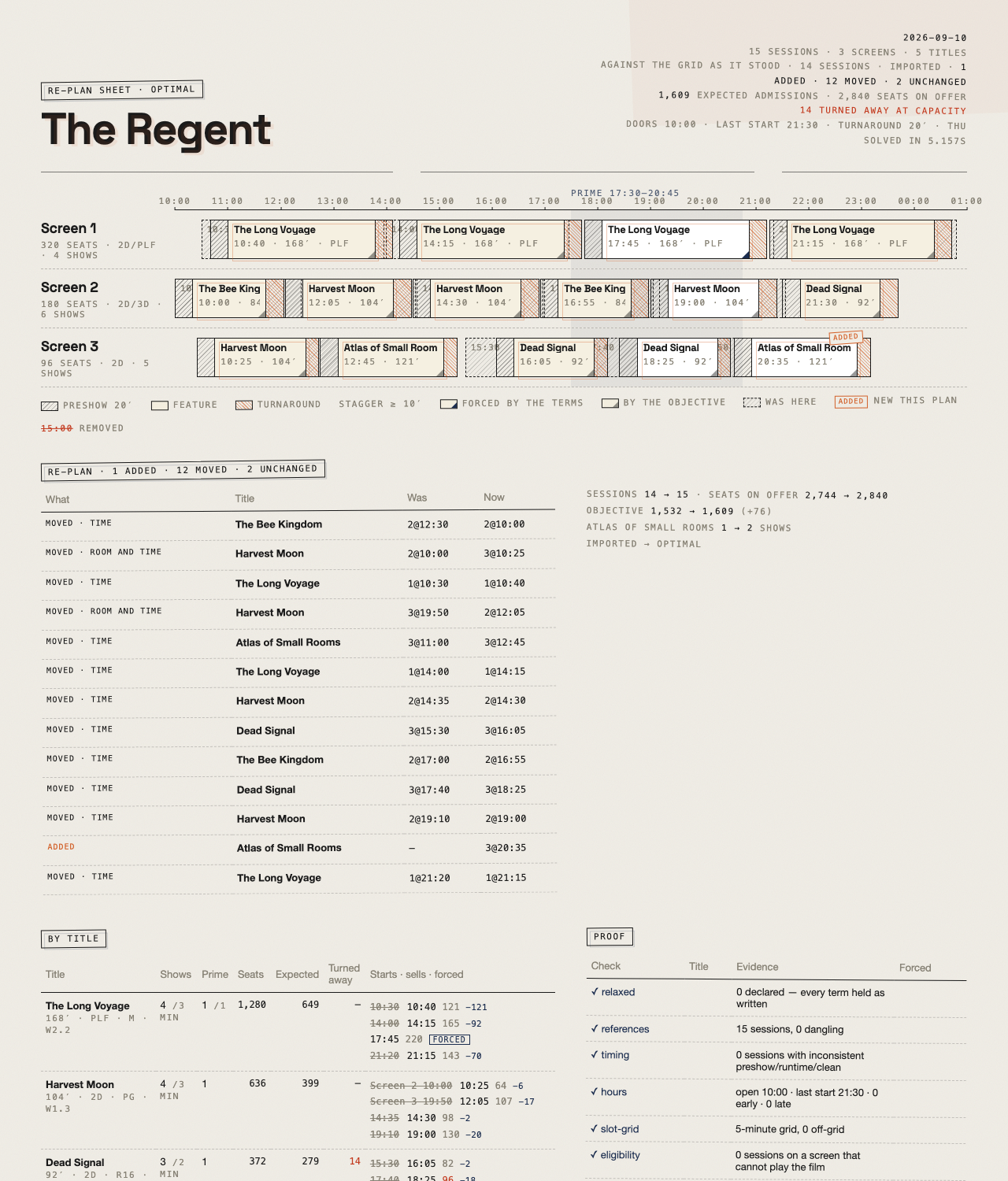
turnaround diff: a moved session leaves a ghost where it was.
The board
No install at all: turnaround-tau.vercel.app. Drop a grid JSON on it, and its brief beside it, and the sheet is drawn in your browser. No server, no accounts, no tracking, nothing in the address — a content-security policy lets nothing leave the page. It draws and does nothing else; the proof stays the checker's.
Honest numbers
The target for sixteen screens was written down before optimising — one day in under 60 s, proven optimal or within 2 % — and it was missed.
| house | status | time | gap |
|---|---|---|---|
| The Regent — 3 screens, 5 titles, one day | OPTIMAL |
5 s | proven |
| The Regent — a full week, titles holding their times | OPTIMAL ×7 |
22 s | proven |
| A festival — 3 venues, 10 days, guests and prints in town | OPTIMAL ×10 |
6 s | proven |
| The Palladium — 16 screens, 22 titles, one day | FEASIBLE |
60 s | 13.4 % |
Big houses get good, checkable grids that say not proven best, gap 13 % in their own header. The one inexact step the solver ever takes — a 10-minute start grid when the 5-minute one is too large — is printed on the grid, the CLI and the sheet. The full bench, including the two clever reformulations that made things worse.
What it will not do
- Relax a term silently. Ever.
- Call a grid optimal it has not proven.
- Forecast. Demand is what your brief states; the report says who is turned away under those numbers.
- Colour-code films, carry a vendor's name, run a server, or send your grid anywhere.
Read on
- The full README — the brief format, every term, the week, the booth's realities
- The answer was no — the essay: CP-SAT for exhibition scheduling, evidence first
- Twenty decisions and the day-by-day log — built in fourteen days, each one ending with what was still rough
Python 3.13+. MIT. Built by designedbybruno. Not affiliated with any cinema software vendor; the brief is the tool's own format.
1 maintainer

Release files for turnaround 0.1.1
For a detailed explanation of source distributions (sdists) and built distributions (wheels), please see the package formats documentation.
Source distribution (sdist)
| File | Size | Uploaded | |
|---|---|---|---|
| turnaround-0.1.1.tar.gz | 80.7 kB | Details |
Built distribution (wheel)
| File | Interpreter | ABI | Platform | Reset |
|---|---|---|---|---|
| turnaround-0.1.1-py3-none-any.whl | Python 3 | none | any | Details |
Total release size: 171.6 kB
Release files / turnaround-0.1.1.tar.gz
| Download URL | turnaround-0.1.1.tar.gz |
|---|---|
| Size | 80.7 kB |
| Tags | Source |
|
SHA-256 checksum How to use checksums |
0edb9b9e5072dfdfc4b373bba4abd73d89a5ab5671fc8fd5e71234616d5194b7
|
|
BLAKE2b-256 checksum How to use checksums |
1776fbd7e3dfa369a079d0853004ed2489b893507833def283a4b7a594173ae6
|
| Upload date | |
|
Uploaded using Trusted Publishing? What is trusted publishing? |
No |
| Uploaded via |
uv/0.11.11 {"installer":{"name":"uv","version":"0.11.11","subcommand":["publish"]},"python":null,"implementation":{"name":null,"version":null},"distro":{"name":"macOS","version":null,"id":null,"libc":null},"system":{"name":null,"release":null},"cpu":null,"openssl_version":null,"setuptools_version":null,"rustc_version":null,"ci":null}
|
Release files / turnaround-0.1.1-py3-none-any.whl
| Download URL | turnaround-0.1.1-py3-none-any.whl |
|---|---|
| Size | 91.0 kB |
| Tags | Python 3 |
|
SHA-256 checksum How to use checksums |
a7c781d11e8d4dd593d7e276b708fec2c12a51a80214ba47b5cf87df1c463577
|
|
BLAKE2b-256 checksum How to use checksums |
1667a06f9d029bfd8913ea8cdd8b1e09878c6cee3beda842bda66bcd3766afd6
|
| Upload date | |
|
Uploaded using Trusted Publishing? What is trusted publishing? |
No |
| Uploaded via |
uv/0.11.11 {"installer":{"name":"uv","version":"0.11.11","subcommand":["publish"]},"python":null,"implementation":{"name":null,"version":null},"distro":{"name":"macOS","version":null,"id":null,"libc":null},"system":{"name":null,"release":null},"cpu":null,"openssl_version":null,"setuptools_version":null,"rustc_version":null,"ci":null}
|














