
Expert Prior injection for AI sessions — eliminates cold-start friction at Turn 0 for any domain

Project description
TurnZero
Expert Priors for AI sessions — injected automatically at Turn 0.
Every time you open a new AI session, you start from zero. The AI knows nothing about your domain's specific rules, your stack's gotchas, or the corrections you've had to make a hundred times before. TurnZero fixes that.
It embeds your opening prompt, finds the most relevant Expert Priors for your domain, and injects them before the AI responds — so the model already knows the right answer before it has a chance to get it wrong.
Works for any domain: software, law, medicine, finance, design, writing, research — anywhere the AI makes the same domain-specific mistakes without context.
No cold starts. No mid-session corrections. No copy-pasting context.
Raw prompt text is never stored. Injection is always client-side.
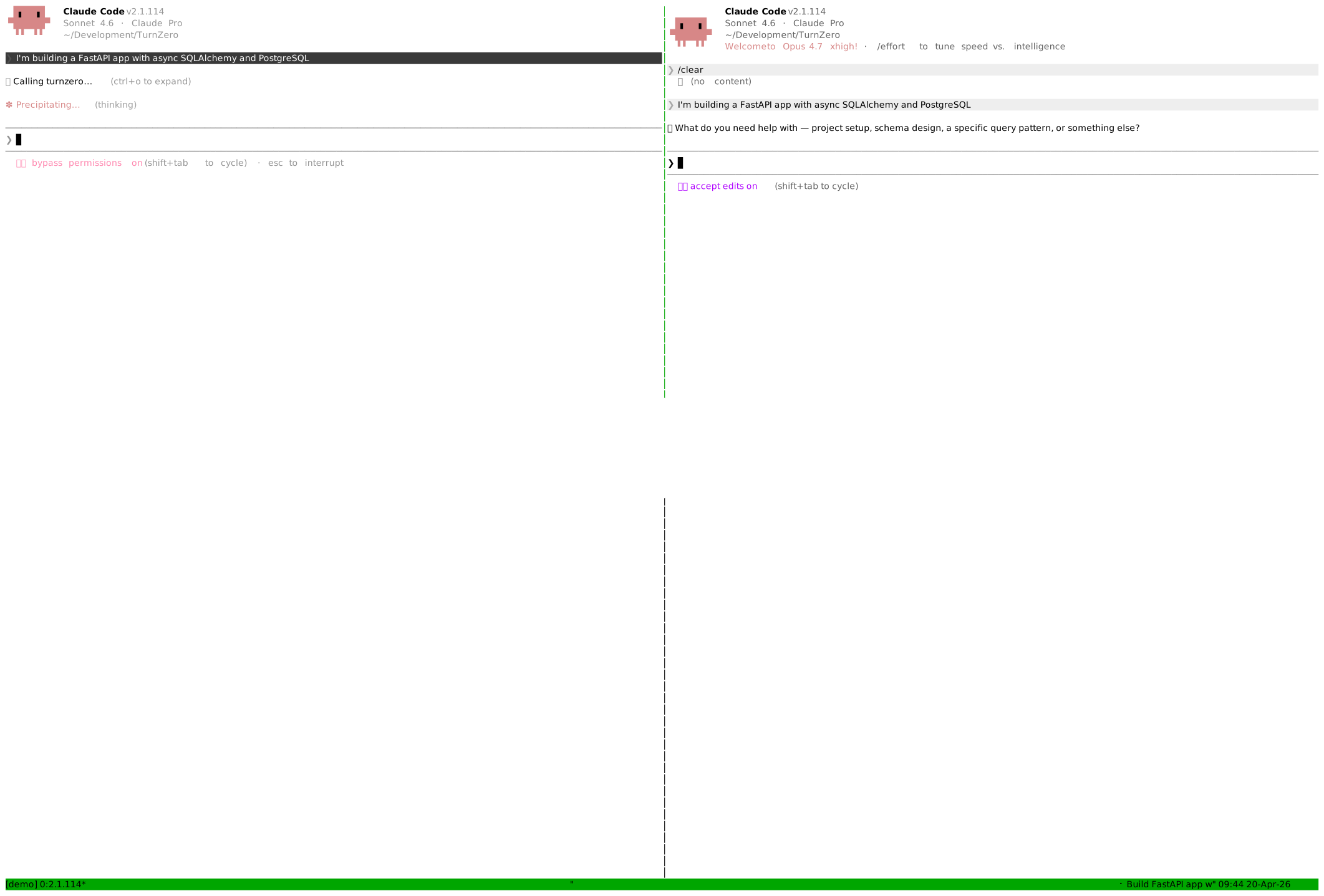
How it works
TurnZero identifies the "Expert Priors" — the specific constraints and patterns an expert would add to a prompt — and ensures the AI knows them before it even starts to answer.
You type: "I'm building a FastAPI async API with PostgreSQL"
                            │
                            ▼
           TurnZero identifies the relevant Expert Priors
               (Heuristics + Vector Similarity)
                            │
                            ▼
         Injected before the AI responds:
         ✓ Use async def — sync def blocks the event loop
         ✓ expire_on_commit=False with AsyncSession (prevents MissingGreenlet)
         ✓ lifespan= not @app.on_event (deprecated since 0.93)
         ✓ Pydantic v2: model_config = ConfigDict(...), not inner class Config
An Expert Prior is the delta between a naive prompt and an expert prompt — what a senior developer would silently add before hitting send.
Install
pip install turnzero
turnzero setup
turnzero setup registers the TurnZero MCP server globally. Any MCP-compatible AI client — Claude Code, Cursor, Claude Desktop — will automatically call list_suggested_blocks on Turn 0 and inject the relevant Expert Priors. No further configuration needed.
Embedding backend — pick one:
| Option | Setup |
|---|---|
| ollama (local, free, private) | ollama pull nomic-embed-text |
| sentence-transformers (local, no server) | pip install -e ".[local]" |
| OpenAI API | export OPENAI_API_KEY=sk-... |
IDE Integration
Claude Code
turnzero setup
The MCP server is registered globally. Open a new session — TurnZero calls list_suggested_blocks automatically on Turn 0.
# Optional: also install the UserPromptSubmit hook for guaranteed injection
# regardless of model behaviour
turnzero setup --with-hook
Claude Code (manual)
claude mcp add turnzero /path/to/.venv/bin/turnzero-mcp --scope user
Cursor
See docs/cursor-setup.md — register the MCP server and add the global rule that triggers auto-injection on Turn 0.
Any other MCP-compatible client
Register the MCP server however that client supports it. The server's instructions field tells the AI to call list_suggested_blocks at the start of every session. If the client surfaces MCP server instructions to the model, injection is automatic.
How the library grows
TurnZero learns from your sessions. When the AI gets something wrong and you correct it mid-session, that correction is a high-signal "Expert Prior" candidate.
"No, use asyncpg not psycopg2 — psycopg2 blocks the event loop"
              │
              ▼
    AI detects correction, suggests a new Expert Prior
              │
              ▼
    Candidate is reviewed or auto-added to the library
              │
              ▼
    Injected in every future session matching that stack
No background daemons required. The AI used in the session performs the extraction, identifying the exact moments where domain-specific knowledge saved the day.
CLI
turnzero setup                                             # register MCP, build index
turnzero preview "build a Next.js 15 app with Supabase"   # preview what would inject
turnzero query   "build a Next.js 15 app with Supabase"   # ranked block list
turnzero inject  "build a Next.js 15 app with Supabase"   # formatted output for any AI
turnzero show    nextjs15-approuter-build                  # full block content
turnzero stats                                             # library + session stats
turnzero review                                            # review pending candidates
Expert Prior schema
id: nextjs15-approuter-build
domain: nextjs
intent: build                    # build | debug | migrate | review
tags: [nextjs, react, approuter]
context_weight: 900              # estimated tokens when injected
constraints:
  - "Use App Router (app/) — all new projects default to App Router in Next.js 13+"
  - "fetch() in Next.js 15 is not cached by default — add { cache: 'force-cache' } explicitly"
anti_patterns:
  - "Do not use getServerSideProps — Pages Router only, does not exist in App Router"
  - "Do not use next/router — use next/navigation in App Router"
doc_anchors:
  - url: "https://nextjs.org/docs/app/building-your-application/rendering/server-components"
    verified: "2026-04-19"
Knowledge domains
121 Expert Priors across 25 domains — currently software-heavy since that's where the library started, but the system is domain-agnostic. Law, medicine, finance, design, writing, research — any field where the AI makes the same mistakes without context is a valid domain. The library grows from your sessions via submit_candidate.
Design constraints
- No raw prompts stored. Only embeddings persist — raw text is discarded immediately after embedding.
- Client-side injection only. TurnZero never sits in the request path between user and AI provider.
- Provider neutral. Works with any MCP-compatible client — Claude Code, Cursor, Claude Desktop, and others.
- Token budget aware. Warns when selected blocks exceed 4000 tokens (configurable).
What makes a good Expert Prior
The test: Would a stranger on the same stack, facing the same problem, be better off knowing this before Turn 0?
| Good | Bad |
|---|---|
Do not use getServerSideProps in App Router — API removed in Next.js 13 |
"Use PyCharm" — personal preference |
expire_on_commit=False required with AsyncSession — raises MissingGreenlet without it |
"Don't commit API keys" — generic noise |
Supabase RLS is disabled by default on new tables — silently breaks auth |
"Use Docker Compose for local dev" — workflow choice |
Swiss non-compete clauses unenforceable beyond 3 years — jurisdiction-specific rule |
"Be more concise" — personal style feedback |
eGFR staging differs between CKD-EPI 2009 and 2021 — clinically significant threshold |
"Always double-check your sources" — generic |
Options Delta accelerates near expiration (gamma effect) — mispricing risk without it |
"Our team reviews PRs within 24 hours" — team convention |
High-signal source: mid-session corrections. When the AI gets it wrong and you say "remember this" — that's exactly what TurnZero should inject next time.
Roadmap
See ROADMAP.md.
Contributing
See CONTRIBUTING.md. The most valuable contribution is a new Expert Prior.


Download files
Download the file for your platform. If you're not sure which to choose, learn more about installing packages.
Source Distribution
Built Distribution
Filter files by name, interpreter, ABI, and platform.
If you're not sure about the file name format, learn more about wheel file names.
Copy a direct link to the current filters
File details
Details for the file turnzero-0.2.2.tar.gz.
File metadata
- Download URL: turnzero-0.2.2.tar.gz
- Upload date:
- Size: 1.1 MB
- Tags: Source
- Uploaded using Trusted Publishing? No
- Uploaded via: Hatch/1.16.5 cpython/3.14.3 HTTPX/0.28.1
File hashes
| Algorithm | Hash digest | |
|---|---|---|
| SHA256 |
db23c8d2e06b1c3ece31c5d9774b074d0f3c072c504d09eddd6a3d17dc8ae5d7
|
|
| MD5 |
d64afde579339779e979157a4e98d070
|
|
| BLAKE2b-256 |
a66871a72754b912313cb9618fe6f464c174dde264075870ca445bca61bfe186
|
File details
Details for the file turnzero-0.2.2-py3-none-any.whl.
File metadata
- Download URL: turnzero-0.2.2-py3-none-any.whl
- Upload date:
- Size: 645.1 kB
- Tags: Python 3
- Uploaded using Trusted Publishing? No
- Uploaded via: Hatch/1.16.5 cpython/3.14.3 HTTPX/0.28.1
File hashes
| Algorithm | Hash digest | |
|---|---|---|
| SHA256 |
49d427dab48760ffba50d011ecfab3bf3f7e2aa0674ed067a28ffb2a4c58ce57
|
|
| MD5 |
5b9e7d58cb0e941cf858554aac120518
|
|
| BLAKE2b-256 |
f387b0e1eb7dc8e9d4c4a303182413fa39e15d99ee7301e4b8a658d470bc55be
|






