
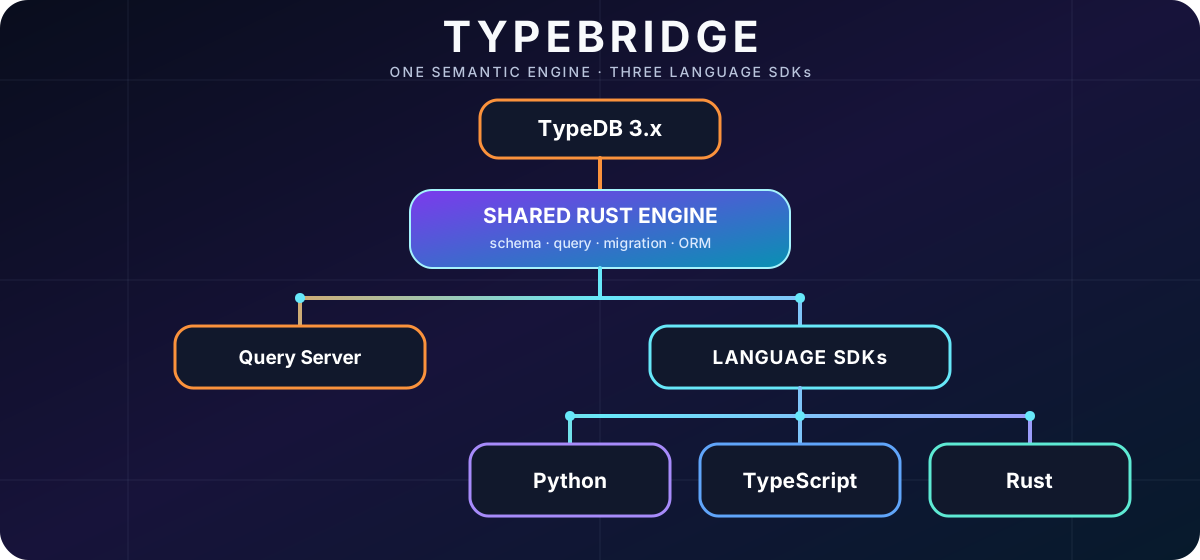





TypeBridge is a typed application toolkit for TypeDB. It defines and evolves schemas, generates application models, and provides native Python, TypeScript/Node, and Rust data APIs. One Rust semantic engine owns schema, query, migration, validation, and ORM behavior across every SDK and the standalone query server.
One system, several ways in
2.0.2 is a compatibility-notice and dependency-security maintenance release. Read the exact expanded 2.1 inventory and safe pins before upgrading beyond 2.0.x. No API is removed or new warning added here.
| Surface | Use it for | Distribution |
|---|---|---|
| Python | Declarative Pydantic models, CRUD, queries, schema management | type-bridge |
| TypeScript / Node | Branded models, typed managers, queries, native runtime | @type-bridge/node |
| Rust | Generated schema crates, async CRUD and immutable queries | type-bridge |
| CLI and generators | Split-YAML schemas, migrations, Python/Node/Rust projections | Included with the Python package |
| Server | Remote V2 query execution over the same contracts | ghcr.io/ds1sqe/type-bridge-server |
TypeBridge is designed around TypeDB rather than flattened into a relational ORM shape:
- attributes remain independent types owned by entities and relations;
- roles, inheritance, cardinality, ordering,
@key, and@uniquestay typed; - schema generation and migration use the same rules as runtime queries;
- direct and remote immutable queries preserve typed, owner-aware results;
- Python and Node are thin facades over the shared Rust runtime.
Start with Python
Requires Python 3.12–3.14 and a supported TypeDB 3.x server.
pip install type-bridge
from type_bridge import Database, Entity, Flag, Integer, Key, SchemaManager, String

class PersonId(String):
    pass

class Age(Integer):
    pass

class Person(Entity):
    person_id: PersonId = Flag(Key)
    age: Age | None = None

db = Database(address="localhost:1729", database="example")
db.connect()
db.create_database()

schema = SchemaManager(db)
schema.register(Person)
schema.sync_schema()

ada = Person(person_id=PersonId("ada"), age=Age(36))
Person.manager(db).put(ada)
people = Person.manager(db).filter(age__gte=18).all()
Continue with the Python quick start, then choose the model, data, or schema workflow.
TypeScript / Node
npm install @type-bridge/node
import { Entity, Key, attr, field } from "@type-bridge/node";

class PersonId extends attr.String("person-id") {}
class Person extends Entity("person", {
  personId: field(PersonId, Key),
}) {}

const ada = new Person({ personId: new PersonId("ada") });
See the TypeScript/Node guide for native targets, database lifecycle, managers, queries, and generation.
Schema-first and Rust workflows
The V2 workspace makes a versioned Split-YAML schema the authority and projects it into each configured SDK:
type-bridge --manifest typebridge.yaml schema check
type-bridge --manifest typebridge.yaml schema generate
type-bridge --manifest typebridge.yaml migration make --name initial
type-bridge --manifest typebridge.yaml migration apply --environment development
The generated Rust SDK requires Rust 1.88+ and, starting with 2.0.1, resolves
from crates.io with type-bridge = "2". TypeBridge 2.0.0 remains available
from its exact Git revision. Follow the
Rust client guide and
Split-YAML reference
for the reproducible setup.
Documentation
- Install a surface
- Choose an SDK
- Model TypeDB data
- Read and write data
- Manage schemas and migrations
- Run the server
- Upgrade to 2.0
- Python API reference
TypeBridge 2.0.x supports TypeDB 3.8–3.12. Support for 3.8 and 3.10 is deprecated and scheduled for removal in 2.1; consult the compatibility matrix and deprecation inventory before upgrading production deployments.
Development
PYO3_USE_ABI3_FORWARD_COMPATIBILITY=1 uv sync --extra dev
uv run pytest
./test.sh
./scripts/check.sh all
uv run --extra docs mkdocs build --strict
See DEVELOPMENT.md for repository layout, test tiers, docs architecture, and contribution checks.
License
TypeBridge-authored code is MIT licensed. Native artifacts also include
third-party TypeDB components under Apache-2.0 and MPL-2.0; exact notices ship
with each artifact and are documented in
type-bridge-core/vendor/README.md.
1 maintainer

Metadata
1 maintainer
Release files for type-bridge 2.0.2
For a detailed explanation of source distributions (sdists) and built distributions (wheels), please see the package formats documentation.
Source distribution (sdist)
| File | Size | Uploaded | |
|---|---|---|---|
| type_bridge-2.0.2.tar.gz | 255.2 kB | Details |
Built distribution (wheel)
| File | Interpreter | ABI | Platform | Reset |
|---|---|---|---|---|
| type_bridge-2.0.2-py3-none-any.whl | Python 3 | none | any | Details |
Total release size: 575.8 kB
Release files / type_bridge-2.0.2.tar.gz
| Download URL | type_bridge-2.0.2.tar.gz |
|---|---|
| Size | 255.2 kB |
| Tags | Source |
|
SHA-256 checksum How to use checksums |
4f8da4945c923d7da0171da53aefa27fb9c5d78cd07615dd5795b41444fc9357
|
|
BLAKE2b-256 checksum How to use checksums |
d311d1d02eb70a5f6b7c7c69c654dc53cb3846b78d61274177a9c92be33045a6
|
| Upload date | |
|
Uploaded using Trusted Publishing? What is trusted publishing? |
Yes |
| Uploaded via |
twine/7.0.0 CPython/3.13.14
|
Provenance
Provenance describes where a file came from. On PyPI, provenance is shared via attestations, which provide a verifiable record of the build or publishing details. View details, limitations and caveats.


PyPI Publish Attestation
PyPI verified that this artifact, at this checksum, originated from the publisher listed below.
Signed by GitHub Actions, verified by PyPI on Sep 7, 2026.
Transparency logRelease files / type_bridge-2.0.2-py3-none-any.whl
| Download URL | type_bridge-2.0.2-py3-none-any.whl |
|---|---|
| Size | 320.6 kB |
| Tags | Python 3 |
|
SHA-256 checksum How to use checksums |
32de7653ae89a7a33ecfee26c7390d42025297c310d44f04f1b71608c950cf91
|
|
BLAKE2b-256 checksum How to use checksums |
a670f9b9189bab1ff14f9e6e3bb1072dc0b220ebe5d7e8e2a8a3d8b9ecdb5d00
|
| Upload date | |
|
Uploaded using Trusted Publishing? What is trusted publishing? |
Yes |
| Uploaded via |
twine/7.0.0 CPython/3.13.14
|
Provenance
Provenance describes where a file came from. On PyPI, provenance is shared via attestations, which provide a verifiable record of the build or publishing details. View details, limitations and caveats.
PyPI Publish Attestation
PyPI verified that this artifact, at this checksum, originated from the publisher listed below.
Signed by GitHub Actions, verified by PyPI on Sep 7, 2026.
Transparency log













