
TypedRank
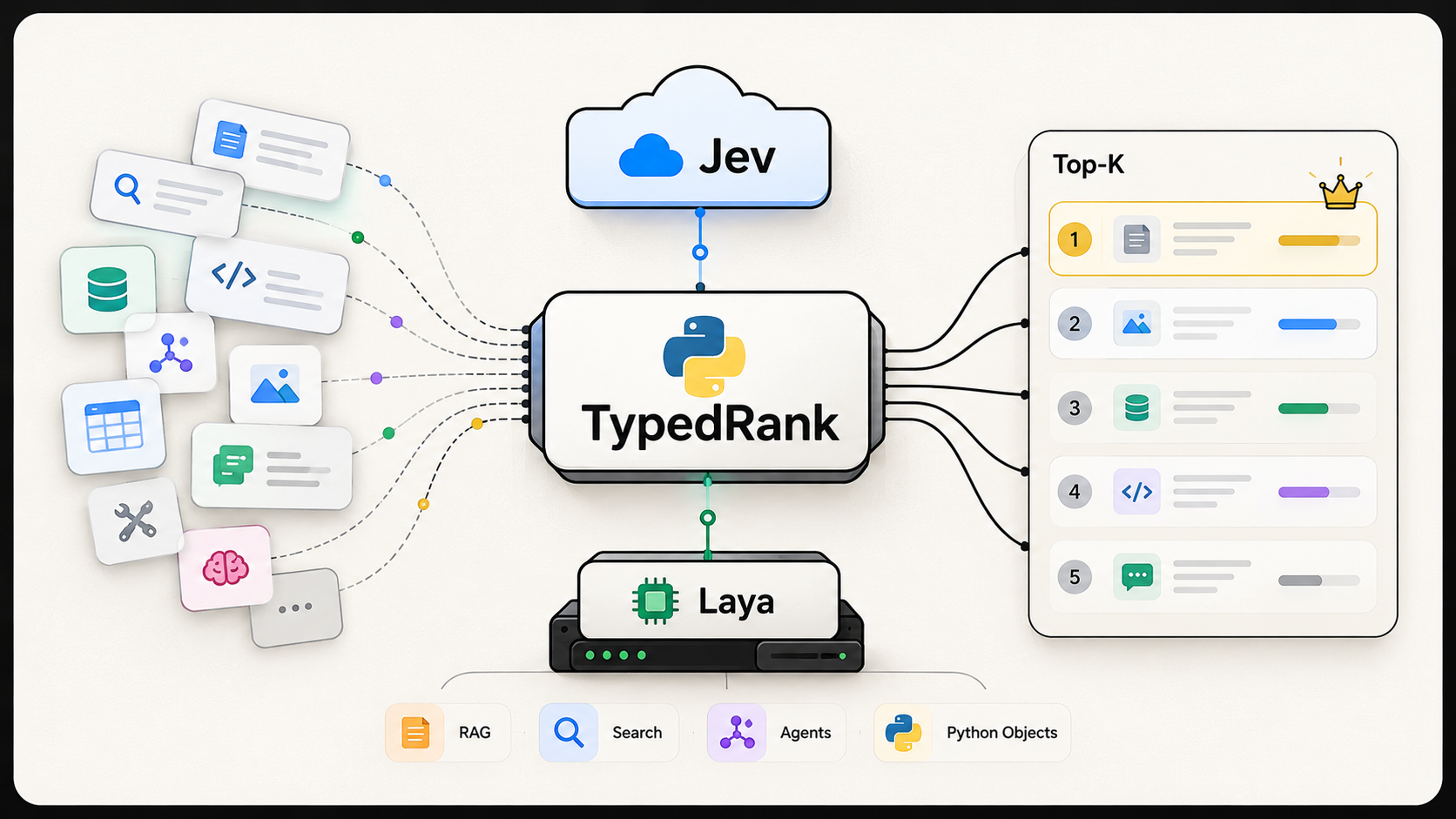
Universal typed reranking for RAG, search, agents and arbitrary Python objects.
Install
python -m pip install typedrank
python -m pip install "typedrank[jev]"  # Jev's optional HTTP transport
python -m pip install "typedrank[laya]"  # optional local Laya and Torch runtime
python -m pip install "typedrank[http]"  # self-hosted Laya HTTP transport
python -m pip install "typedrank[embeddings]"  # optional Sentence Transformers
The core has no runtime dependencies and does not import Torch. Jev requests use the TypeSafe System One endpoint and TYPESAFE_API_KEY; the credential and Jev model IDs remain provider-specific.
Quick start
from typedrank import Reranker
from typedrank.backends import JevBackend

backend = JevBackend()
ranker = Reranker(backend=backend)
response = await ranker.rerank(
    query="How can I reset my password?",
    candidates=[
        "Open account settings and select Reset password.",
        "Our office is closed on Sunday.",
    ],
    top_k=2,
)
for result in response.results:
    print(result.rank, result.score, result.item)
await backend.aclose()
Configure TYPESAFE_API_KEY in the process environment before making a live Jev request. Calls can incur provider charges. No live requests run in the test suite by default.
For local Laya inference, install the Laya extra and keep one backend instance per service:
from typedrank import AutoReranker
from typedrank.backends import LayaBackend

backend = LayaBackend(model="auto", device="cuda", preload=True)
async with AutoReranker(backend=backend) as reranker:
    response = await reranker.rerank(query="billing help", candidates=documents, top_k=10)
await backend.aclose()
preload=True loads checkpoints on the first use of the backend. Laya 0.3.7 uses one inference worker per Router; TypedRank rejects higher concurrency values. Laya is imported lazily, and normal tests use fakes rather than downloading weights. Local results leave monetary cost unknown.
For a self-hosted Laya server, use LayaHTTPBackend(endpoint="http://localhost:8000/v1/systemone", context_policy="allow_provider_truncation"). This explicit opt-in marks context validation unverified and results approximate; strict mode requires a deployment validator. Authentication is optional; pass api_key when the server requires a bearer token. Pass model="english", "multilingual", or "typed-decisions" to pin a checkpoint.
To fall back from a local model to Jev, compose explicit backends:
from typedrank.backends import BackendRouter, JevBackend, LayaBackend

backend = BackendRouter(
    primary=LayaBackend(model="auto"),
    fallback=JevBackend(model="jev-1.13.0"),
)
reranker = AutoReranker(backend=backend)
BackendRouter chooses where a model stage runs. AutoReranker chooses the ranking strategy and shortlist. The route, fallback count, resolved model, and backend metadata are available in response.execution_plan and response.statistics. Auto shortlist limits are configurable in RerankerConfig; evaluate them against your own data.
Without a model backend, Reranker() uses deterministic lexical ranking. Custom Python objects remain intact in results; provide text_fn or a CandidateAdapter to select text explicitly.
response = await Reranker().rerank(
    query="billing issue",
    candidates=tickets,
    text_fn=lambda ticket: f"{ticket.title}\n{ticket.description}",
    top_k=5,
)
Included
TypedRank includes generic candidate preparation, pointwise and listwise strategies, metrics, BM25, embeddings, reciprocal-rank fusion, diversity selection, pipelines, budgets, caching, observability, evaluation, and Jev and Laya backends. The generic model pipeline stage is ModelReranker.
See backend comparison, Jev, Laya, backend routing, migration from Jev Rankkit, usage guide, integration adapters, evaluation, and benchmarks. Examples cover RAG, entities, tools, SQL schemas, memory, custom objects and metrics, hybrid pipelines, and evaluation. Thresholds and synthetic benchmarks are starting points; measure ranking quality on your own held-out data.
Development
python -m pip install -e ".[dev]"
pytest
ruff check .
ruff format --check .
mypy src/typedrank
python -m build
TypedRank is distributed under the MIT License. Source notices from the original Jev Rankkit project are preserved in the license.
1 maintainer

Release files for typedrank 0.1.1
For a detailed explanation of source distributions (sdists) and built distributions (wheels), please see the package formats documentation.
Source distribution (sdist)
| File | Size | Uploaded | |
|---|---|---|---|
| typedrank-0.1.1.tar.gz | 1.9 MB | Details |
Built distribution (wheel)
| File | Interpreter | ABI | Platform | Reset |
|---|---|---|---|---|
| typedrank-0.1.1-py3-none-any.whl | Python 3 | none | any | Details |
Total release size: 2.0 MB
Release files / typedrank-0.1.1.tar.gz
| Download URL | typedrank-0.1.1.tar.gz |
|---|---|
| Size | 1.9 MB |
| Tags | Source |
|
SHA-256 checksum How to use checksums |
67056f727b042ce241df5b21e7622eaf802307d4e57c70877ffa8babd4d54457
|
|
BLAKE2b-256 checksum How to use checksums |
f9a46d8dbd6a8726bf18762afda5a1356093f22d2400a6bd2bdfec93edcad52d
|
| Upload date | |
|
Uploaded using Trusted Publishing? What is trusted publishing? |
No |
| Uploaded via |
twine/7.0.0 CPython/3.11.11
|
Release files / typedrank-0.1.1-py3-none-any.whl
| Download URL | typedrank-0.1.1-py3-none-any.whl |
|---|---|
| Size | 73.4 kB |
| Tags | Python 3 |
|
SHA-256 checksum How to use checksums |
b4df278f96a0a7a7f67c22a3acc6d7a8774821b49ef7019116b76ba1ce528d53
|
|
BLAKE2b-256 checksum How to use checksums |
52dcace68087a1a926035a53a503d5b513cb47ad263503b6e0c0d6addb628d40
|
| Upload date | |
|
Uploaded using Trusted Publishing? What is trusted publishing? |
No |
| Uploaded via |
twine/7.0.0 CPython/3.11.11
|














