
⚡️ tzap





Installation · Using tzap | Qiskit integration · PennyLane integration
A super fast, Rust-based optimizer for large Clifford+T/Rz circuits, with optional conversion to optimized Pauli-based computation (PBC) circuits.
- tzap is state-of-the-art in speed, scalability, and gate-count reduction.
- tzap minimizes T-count with a new linear-time phase folding algorithm, based on this paper.
- tzap implements a new and fast superoptimization pass, based on this paper.
- A formally verified Lean port of tzap is available in
lean.
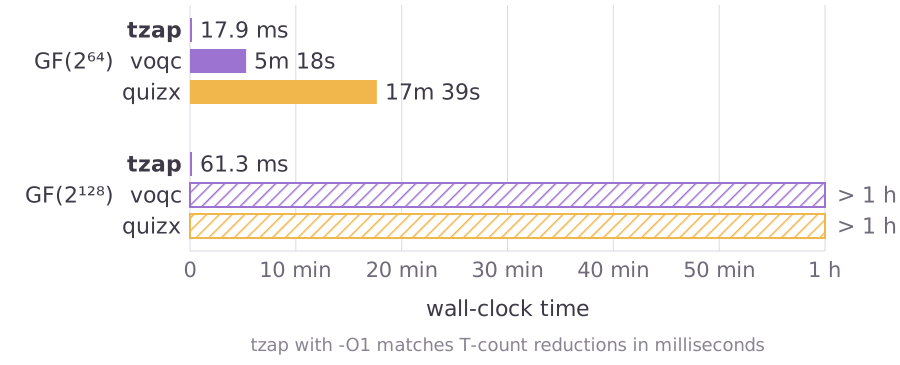
tzap is multiple orders of magnitude faster than other optimizers—and linearly scales to millions of gates! Here's a runtime comparison to two powerful optimizers on increasingly larger circuits.
Installation
You can use tzap as a command-line utility or a library.
Install the binary
These options install the standalone native tzap executable.
Homebrew (macOS/Linux):
brew install qqq-wisc/tap/tzap
Prebuilt release binary (macOS/Linux):
curl -LsSf https://github.com/qqq-wisc/tzap/releases/latest/download/tzap-opt-installer.sh | sh
You can also build and install tzap from crates.io (cargo install tzap-opt) or build from source (cargo install --path .).
You can also use tzap through the Rust API; see the Rust API documentation.
Integrations with Qiskit and PennyLane
You can also use tzap as a Python library and apply it as a Qiskit optimization pass or PennyLane transform. See the Qiskit API guide or PennyLane API guide for framework-specific setup.
Running tzap
The standard command-line workflow is described below.
Optimize a circuit
tzap input.qasm -o output.qasm
For example, using a benchmark in this repo:
$ tzap benchmarks/feynman/hwb12.qasm -o optimized.qasm
⚡️ tzap v0.7.0
  Parsed benchmarks/feynman/hwb12.qasm (5.5 MB) in 0.079s
	├─ 20 qubits · 514,412 gates
	└─ Circuit gates: {h, x, t, tdg, cx}
  Optimizing input circuit
  Loaded MURM in 0.039s
	└─ Synthesis basis: {h, x, z, s, sdg, t, tdg, cx}

  Converged after 6 rounds

  ┌─ Final result · 44.6% fewer gates · 1.379s ────────────────┐
  │ Gates    ━━━━━━━━━╸──────────── ↓44.6% · 514,412 → 284,848 │
  │ 2q gates ━━━━╸───────────────── ↓22.1% · 191,803 → 149,500 │
  │ T/Tdg    ━━━━━━━━━━╸─────────── ↓49.9% · 171,465 →  85,889 │
  │ Depth    ━━━━━━╸─────────────── ↓28.4% · 274,781 → 196,865 │
  └────────────────────────────────────────────────────────────┘
  wrote optimized.qasm
Optimization levels
| Level | Description |
|---|---|
-O1 |
phase folding (PhaseFoldRand, then PhaseFoldPauli) + basic gate cancellation. Fastest; captures most of the T-gate reduction. |
-O2 |
Adds superoptimization to -O1. |
-O3 |
Default. Repeats -O2 until reaching a fixpoint. |
-Osuper |
Like -O3, but with more superoptimization power (slower on first use). |
tzap benchmarks/feynman/hwb12.qasm -O1 -o optimized.qasm
PhaseFoldPauli folds native P/RX/RY/RZ rotations across commuting operations.
It retains exact pi fractions and declines numeric sums that add rounding.
Optional decomposition
CCX, CCZ, CZ, phase gates, and ordinary/controlled rotations stay native by default. To decompose them, use:
--decompose-ccxto decompose CCX and CCZ--decompose-czto decompose CZ into CX+H--decompose-rotationsto decompose P, Rz/Rx/Ry, CP, and CRz/CRx/CRy via gridsynth (--decompose-rzremains a compatibility alias)
PBC circuits
Use --to-pbc to convert a circuit to PBC and optimize its Pauli rotations:
tzap input.qasm --to-pbc -o output.pbc
Use --decompose-rotations for phase gates and rotations before PBC conversion.
Native Y/SX/SWAP/CY/CH/CSWAP and resets are unsupported by PBC.
See the PBC guide for the format, options, and examples.
Circuit support
tzap supports a subset of OpenQASM 2.0:
- Gates:
h,x,z,s,sdg,t,tdg,p(u1),y,sx,rx,ry,rz,swap,cx,cy,ch,cp(cu1),crx,cry,crz,cswap,ccx,ccz,cz,measure,reset - Declarations:
qreg,creg - Not supported: classical conditionals (
if), custom gate definitions (gate), barriers,includefiles (besidesqelib1.inc, which is ignored) - Unrecognized lines produce an error
Correctness
- Fuzzing and equivalence verification on small random circuits and benchmark circuits.
- Lean port: the core optimizer is implemented and proven sound in Lean 4 — see
lean/.
The new native gate families and generalized rotation synthesis are currently implemented in Rust and Python; the Lean gate model has not been extended.
Citation
If you use tzap in your research, please cite the following papers:
@misc{albarghouthi2026tzap,
      title={Linear-Time T-Gate Optimization via Random Abstraction},
      author={Aws Albarghouthi},
      year={2026},
      eprint={2605.13929},
      archivePrefix={arXiv},
      primaryClass={cs.PL},
      url={https://arxiv.org/abs/2605.13929},
}
@misc{cryptoeprint:2026/2115,
      author = {Aws Albarghouthi},
      title = {Fast Quantum-Circuit Superoptimization},
      howpublished = {Cryptology {ePrint} Archive, Paper 2026/2115},
      year = {2026},
      url = {https://eprint.iacr.org/2026/2115}
}
1 maintainer

Metadata
1 maintainer
Release files for tzap 0.8.0
For a detailed explanation of source distributions (sdists) and built distributions (wheels), please see the package formats documentation.
Source distribution (sdist)
| File | Size | Uploaded | Provenance | Actions |
|---|---|---|---|---|
| tzap-0.8.0.tar.gz | 880.3 kB | Without provenance | Details for tzap-0.8.0.tar.gz |
Built distributions (wheels)
Total release size: 8.7 MB
Release files / tzap-0.8.0.tar.gz
| Download URL | tzap-0.8.0.tar.gz |
|---|---|
| Size | 880.3 kB |
| Tags | Source |
|
SHA-256 checksum How to use checksums |
9ebe581824f94f14c6a76b4825ea1039582323fc2d3bbe0482278a66c04a7df9
|
|
BLAKE2b-256 checksum How to use checksums |
6d015e9fdb593184ca1223ffe8571b42511b5bc4892f7190281fc8290a719238
|
| Upload date | |
|
Uploaded using Trusted Publishing? What is trusted publishing? |
No |
| Uploaded via |
twine/7.0.0 CPython/3.13.14
|
Release files / tzap-0.8.0-cp310-abi3-win_amd64.whl
| Download URL | tzap-0.8.0-cp310-abi3-win_amd64.whl |
|---|---|
| Size | 1.1 MB |
| Tags | CPython 3.10 Windows x86-64 abi3 |
|
SHA-256 checksum How to use checksums |
8d4f9a4dc2225f87d2922586f93afddc7d1717945b1c78c1d8789a4b7fc3521d
|
|
BLAKE2b-256 checksum How to use checksums |
cf8a7948217e1c678baa57e5ca54665225d39ab12e1cf67fae69e2f957150d72
|
| Upload date | |
|
Uploaded using Trusted Publishing? What is trusted publishing? |
No |
| Uploaded via |
twine/7.0.0 CPython/3.13.14
|
Release files / tzap-0.8.0-cp310-abi3-musllinux_1_2_x86_64.whl
| Download URL | tzap-0.8.0-cp310-abi3-musllinux_1_2_x86_64.whl |
|---|---|
| Size | 1.3 MB |
| Tags | CPython 3.10 Linux musl 1.2+ x86-64 abi3 |
|
SHA-256 checksum How to use checksums |
79173276d0e95bfab9af6202ecc7ccf4c2bd59769ae9f32fcbfb00dc864c2d16
|
|
BLAKE2b-256 checksum How to use checksums |
17bbe8537196a047b5fff43ca2274433eb393abee43bb1aedb91a950ab9628da
|
| Upload date | |
|
Uploaded using Trusted Publishing? What is trusted publishing? |
No |
| Uploaded via |
twine/7.0.0 CPython/3.13.14
|
Release files / tzap-0.8.0-cp310-abi3-musllinux_1_2_aarch64.whl
| Download URL | tzap-0.8.0-cp310-abi3-musllinux_1_2_aarch64.whl |
|---|---|
| Size | 1.2 MB |
| Tags | CPython 3.10 Linux musl 1.2+ ARM64 abi3 |
|
SHA-256 checksum How to use checksums |
4abdc17ebda7c15653334707f44918572c31d87929c4027cc79a165d75d977bc
|
|
BLAKE2b-256 checksum How to use checksums |
ce5873498c083ef20ca7193fab9c5bdf1c5885b3d4766205e74cc85e2e836cd5
|
| Upload date | |
|
Uploaded using Trusted Publishing? What is trusted publishing? |
No |
| Uploaded via |
twine/7.0.0 CPython/3.13.14
|
Release files / tzap-0.8.0-cp310-abi3-manylinux_2_17_x86_64.manylinux2014_x86_64.whl
| Download URL | tzap-0.8.0-cp310-abi3-manylinux_2_17_x86_64.manylinux2014_x86_64.whl |
|---|---|
| Size | 1.1 MB |
| Tags | CPython 3.10 Linux glibc 2.17+ x86-64 abi3 |
|
SHA-256 checksum How to use checksums |
9aae7df71f82031ed12d777a05db669976c9cc3a4b6fb6abff6a88f9d921b2a2
|
|
BLAKE2b-256 checksum How to use checksums |
e2b9df0dc19dcc50b9ea3dfe3e6053245d246ba0a70970bfa1d80dcd41046eaf
|
| Upload date | |
|
Uploaded using Trusted Publishing? What is trusted publishing? |
No |
| Uploaded via |
twine/7.0.0 CPython/3.13.14
|
Release files / tzap-0.8.0-cp310-abi3-manylinux_2_17_aarch64.manylinux2014_aarch64.whl
| Download URL | tzap-0.8.0-cp310-abi3-manylinux_2_17_aarch64.manylinux2014_aarch64.whl |
|---|---|
| Size | 1.0 MB |
| Tags | CPython 3.10 Linux glibc 2.17+ ARM64 abi3 |
|
SHA-256 checksum How to use checksums |
0fa34ca29a923088b3c673049029f0b7cd2b80a2657268f83158140365eb3aab
|
|
BLAKE2b-256 checksum How to use checksums |
6fa0eb57af8916f25b5982cd120d2fb830eee5984a2e499a3f95ed410a9482a9
|
| Upload date | |
|
Uploaded using Trusted Publishing? What is trusted publishing? |
No |
| Uploaded via |
twine/7.0.0 CPython/3.13.14
|
Release files / tzap-0.8.0-cp310-abi3-macosx_11_0_arm64.whl
| Download URL | tzap-0.8.0-cp310-abi3-macosx_11_0_arm64.whl |
|---|---|
| Size | 1.0 MB |
| Tags | CPython 3.10 abi3 macOS 11.0+ ARM64 |
|
SHA-256 checksum How to use checksums |
fc3befc237804776e6dfdd07a3a6ceb0000650a05797fd9fdfb5a98b7c61b91c
|
|
BLAKE2b-256 checksum How to use checksums |
ca5401bd31323601c673b9c1741309511a746fd5a0ea85da3f65d39f066b5bb3
|
| Upload date | |
|
Uploaded using Trusted Publishing? What is trusted publishing? |
No |
| Uploaded via |
twine/7.0.0 CPython/3.13.14
|
Release files / tzap-0.8.0-cp310-abi3-macosx_10_12_x86_64.whl
| Download URL | tzap-0.8.0-cp310-abi3-macosx_10_12_x86_64.whl |
|---|---|
| Size | 1.0 MB |
| Tags | CPython 3.10 abi3 macOS 10.12+ x86-64 |
|
SHA-256 checksum How to use checksums |
aab02b1b6d5825063310fdc2f5137433c35a5584ced5060a80767c554382772d
|
|
BLAKE2b-256 checksum How to use checksums |
46bca4b9a72202f0462576c7d7184188fd8ec6e43fd6185de39a7770fee75f01
|
| Upload date | |
|
Uploaded using Trusted Publishing? What is trusted publishing? |
No |
| Uploaded via |
twine/7.0.0 CPython/3.13.14
|
Security for tzap 0.8.0
Provenance
Provenance describes where a file came from. On PyPI, provenance is shared via attestations, which provide a verifiable record of the build or publishing details. View details, limitations and caveats.
No provenance found
None of the files in this release were uploaded with provenance metadata.
A note on package security
PyPI is a repository for distributing packages, not a service for auditing them. While third-party security researchers and our staff do their best to detect and remove malicious packages, PyPI cannot guarantee the quality, security or suitability of any given package.
To learn more about protecting yourself from malicious actors, visit our package security documentation.














