
uccap
Process Capability Analysis, Risk-Calibrated Approval and Hybrid Statistical Learning Decision Support with Finite Samples
Reference implementation of three published articles and one accepted article in
The International Journal of Advanced Manufacturing Technology (2026)






Quick start · Data format · User manual (PDF) · Validation · Citing
Capability approval is usually a fixed rule: approve if the estimated Cpk is at least 1.33. With the 20 to 50 parts of a typical approval study, the estimate can easily be 0.2 above or below the true value, so near the threshold the rule approves incapable processes and rejects capable ones almost at random.
uccap turns raw measurements into a capability study and an approval decision that accounts for that
uncertainty:
- Correct indices for real data. Outlier screening, normality testing, best-fit distributions for skewed characteristics, one-sided and asymmetric tolerances, within and overall sigma.
- Risk-calibrated approval. Accept only when the probability that the true capability is below the requirement is acceptably small, set directly or from the relative cost of a wrong approval.
- Learned risk score. The UC-Cap model adds a trained correction to the statistical risk and returns a 0–100 score with a Low / Medium / High level, for one dimension or every row of a batch. Its trained parameters are not included in this release (see below).
- Sample-size planning. Before the study: how many parts are needed so that a capable process is actually approved.
- Monitoring after approval. Subgroup by subgroup, the posterior probability that the released process still meets its conformance target, with a continue / monitor / intervene zone.
- Built for production files. One call analyses every dimension of an Excel or CSV file and writes coloured HTML and Excel reports. Everything runs locally.
Risk-calibrated approval and the UC-Cap score are decision aids for small samples, where the estimate is uncertain. They do not replace the capability requirement or the engineer's judgement. The UC-Cap score is meant for studies with hundreds or thousands of dimensions: it quickly sorts out the dimensions that need attention instead of a single 1.33 or 1.67 cut-off for all of them. The thresholds and decision rules in the examples and defaults (C0 = 1.33, cost ratio 19, risk bands 0.40 / 0.70, the mechanism signals of the UC-Cap decision layer, the monitoring settings q0 = 0.997, γA = 0.95, γR = 0.80) illustrate the methods, as in the articles. They are not general standards for every scenario; set them for your application.
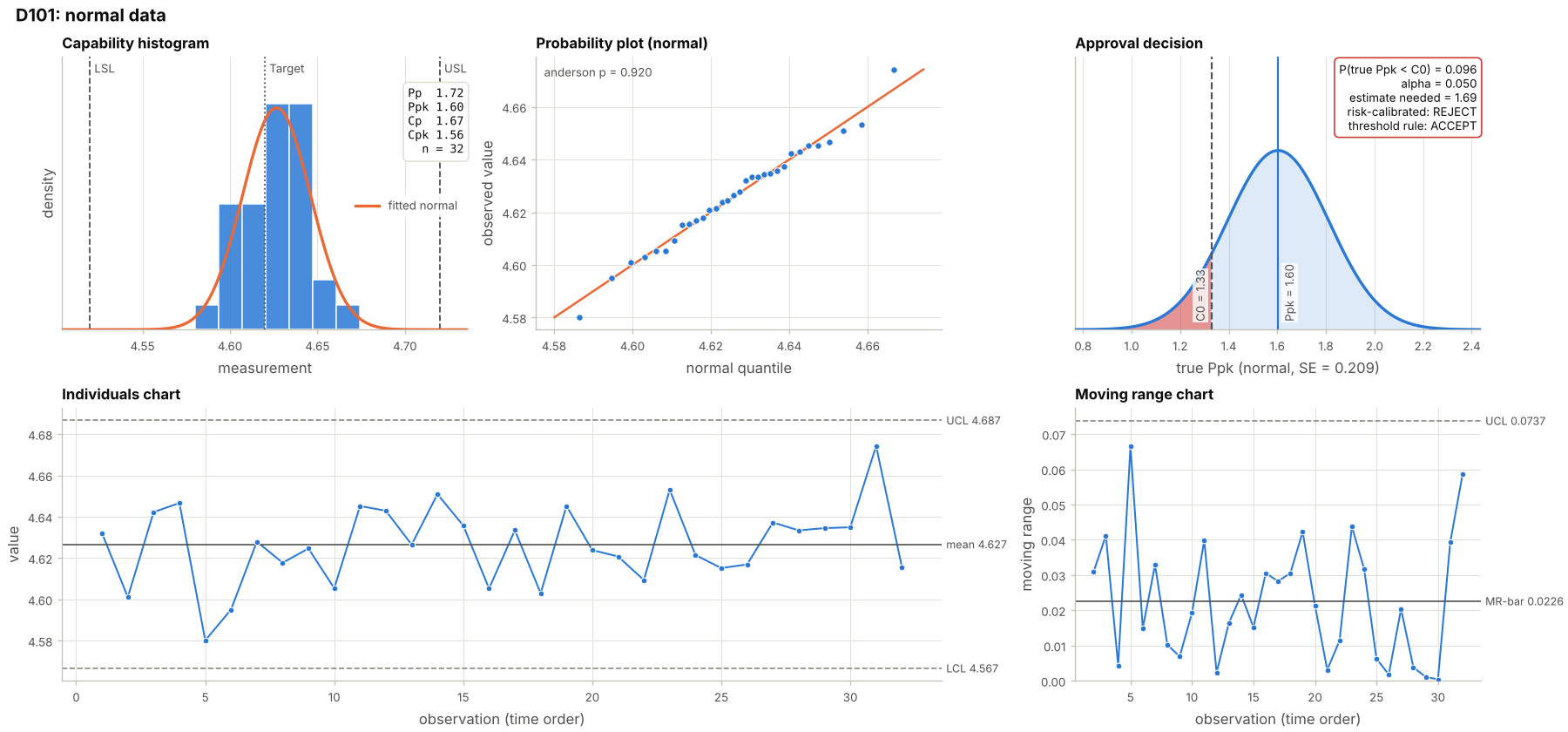
Ppk = 1.60 clears 1.33, but with 32 parts there is still a 9.6 % chance (red area) that the true Ppk is below 1.33. At a 5 % risk the calibrated rule asks for more evidence.
Quick start
pip install uccap                  # core: numpy, scipy, pandas
pip install "uccap[excel,plot]"    # optional: Excel files and plots
One dimension
import numpy as np
from uccap import capability_study, risk_decision

x = np.random.default_rng(42).normal(4.625, 0.023, 32)   # 32 parts in production order
study = capability_study(x, lsl=4.52, usl=4.72, target=4.62)
decision = risk_decision(study, c0=1.33, cost_ratio=19)   # a false accept costs 19x a false reject
print(decision.report())
        Ppk estimate : 1.603
      Standard error : 0.209
        P(true < C0) : 0.096   (analytic)
   Required estimate : 1.674   (C0 + 1.645 x SE at this estimate)
   Smallest accepted : 1.691   (estimate that just passes with n = 32)
      Threshold rule : ACCEPT  (estimate >= C0)
     Risk-calibrated : REJECT  (P = 0.096 > alpha)
The requirement C0 = 1.33 is unchanged. The calibrated rule does not replace it: it shows how much evidence a small sample gives that the requirement is met, and helps decide when the estimate is close to C0 (here, collect more parts or use the actual cost ratio).
A whole measurement file
import uccap

results = uccap.batch_study("measurements.xlsx", c0=1.33, cost_ratio=19)
results.table(["dimension", "yield", "normality", "Ppk", "p_fail", "decision", "risk_score", "risk_level"])
results.to_html("results.html")      # coloured, sortable table
results.to_excel("results.xlsx")     # coloured workbook with a full report per dimension
UC-Cap risk score
import numpy as np
import uccap.hybrid
from uccap import hybrid_risk

x = np.random.default_rng(11).normal(10.012, 0.011, 20)   # 20 parts of another dimension
uccap.hybrid.set_model_path("uccap_v4_2.json")             # trained parameters, not included in this release
r = hybrid_risk(x, lsl=9.95, usl=10.05, nominal=10.0)
r.p, r.score, r.level                 # probability, score 0-100, Low / Medium / High
Planning a study
from uccap import sample_size

sample_size(1.67, c0=1.33, cost_ratio=19, power=0.8).n   # 80 parts for an 80 % chance of approval
Monitoring after approval
import uccap

r = uccap.monitor_study(x, lsl=9.95, usl=10.05, nominal=10.0)   # measurements in production order
r.pi_final, r.zone, r.intervention     # P(still acceptable), continue / monitor / intervene, first intervention
monitor = uccap.batch_monitor("production.xlsx")                # every dimension of a file
monitor.to_html("monitor.html")
From the command line
uccap measurements.xlsx --c0 1.33 --cost-ratio 19          # writes measurements_uccap.html
uccap measurements.csv --html --excel --csv --out results  # results.html, .xlsx, .csv
uccap measurements.xlsx --plots all                        # every figure of every dimension as PNG
uccap plan 1.5 1.67 2.0 --cost-ratio 19                    # parts needed for each assumed true Cpk
uccap monitor production.xlsx --plots                      # monitoring after approval
uccap --cite                                               # BibTeX for the articles
What is included
| Module | Implements | Main functions |
|---|---|---|
uccap.workflow |
Practical process capability indices workflows | capability_study: data checks, outlier screen, Anderson–Darling test, AMR / MMR / SRMSSD / pooled within sigma, Cp, Cpk, Pp, Ppk, Cpm, Cpmk (bilateral, asymmetric, one-sided), 10 + 10 candidate distributions ranked by AICc, percentile indices CNp, CNpk |
uccap.risk |
Risk-calibrated process capability approval with finite samples | risk_decision: accept if Ĉ ≥ C₀ + k·SE(Ĉ), k from a risk α or a cost ratio λ; analytic for normal data, bootstrap for non-normal data. sample_size: parts needed for a wanted probability of approval |
uccap.hybrid |
A hybrid statistical learning framework for capability-based decision support in manufacturing | hybrid_risk: π = σ(z + f(x)) with the anchor z = (1.33 − Ppk)/SE and the network of the article (V4.2); NumPy only |
uccap.monitor |
Bayesian operational acceptability monitoring for manufacturing process control (accepted) | monitor_study, batch_monitor: discounted Normal–Inverse-Gamma posterior per subgroup, π_t = P(q(θ_t) ≥ q₀ | data), zones continue / monitor / intervene; HTML and Excel output with every trajectory |
uccap.batch, uccap.io, uccap.export |
Production use | batch_study (with the UC-Cap score per dimension), read_table, HTML and Excel export with colour rules |
uccap.plot |
Figures by question | outlier screen, stability (I-MR), capability, risk-calibrated approval, UC-Cap score; overview, batch overview, sample-size curves; monitoring trajectory and overview |
The trained UC-Cap parameters (weights and preprocessing) are not included in this release. Give
their location with uccap.hybrid.set_model_path(path), the
environment variable UCCAP_MODEL or uccap --model PATH. Without them hybrid_risk raises a clear
error, the batch and the command line leave out the UC-Cap columns with a warning, and everything else,
including the model inputs and the mechanism signals of the decision layer, works as usual. The industrial
data used for training are not public.
Preparing your data
Start from a template in templates/: uccap_template.xlsx,
multiple_dimensions.csv or
single_dimension.csv. Specifications go on top, measurements below:
| Dimension | D101 | D102 | D103 | D104 |
|---|---|---|---|---|
| Nominal | 4.62 | 50.78 | 12.00 | |
| USL | 4.72 | 50.88 | 12.10 | 0.12 |
| LSL | 4.52 | 50.70 | 11.90 | |
| 1 | 4.618 | 50.781 | 12.04 | 0.021 |
| 2 | 4.627 | 50.779 | 12.06 | 0.018 |
| … | … | … | … | … |
- Limits are absolute values. Leave USL or LSL empty for a one-sided tolerance (D104). Rows UpperTol / LowerTol (or +Tol / −Tol, or Tol for ±) are converted with the nominal.
- Measurements are one row per part, in production order; at least 8 per dimension, 30 to 50 is typical for an approval.
- Labels ignore case and units (
usl,Upper Limit,USL (mm)); the usual Chinese labels work too. Missing cells, title rows, summary rows (Mean, Cpk, …), decimal commas and GBK-encoded CSV are handled. print(uccap.read_table("file.xlsx").summary())shows how a file was read before anything is computed.
Wide, long (database export) and transposed layouts, and separate specification tables, are also recognised; see Chapter 4 of the manual.
Documentation
| User manual (PDF) | The complete manual: workflow diagrams, every option, how to read the reports, warnings, API reference, formulas |
| Manual (Markdown version) | The full manual for reading on GitHub, generated from the PDF source |
| Validation | Comparison with R and the NIST/SEMATECH handbook, reproduction of the articles' published results, Minitab check package |
| Notebooks | One per article: workflow, risk-calibrated approval, UC-Cap risk score, monitoring |
| Examples | quickstart.py, batch_example.py, hybrid_example.py, plots_example.py, planning_example.py, monitor_example.py |
| Changelog · Contributing |
Validation
Every numerical building block is checked against independent software: distribution fits, normality
tests, sigma estimators, percentiles and control-chart constants against R (fitdistrplus, MASS,
nortest), and the indices against the NIST/SEMATECH e-Handbook. 127 of 127 comparisons agree.
The published results of the articles are reproduced as well: the constants and case study of the
workflow article and Tables 1 and 2 of the risk article's simulation study, both with the test suite, and
the operating characteristics of the monitoring article (Tables 4 and 11) with
validation/monitor_simulation.py, of which the test suite runs a short version. The UC-Cap model parameters reproduced the test metrics of their article (Table 10) when they were
exported, on the original data, which are not public; that check is therefore not part of the test
suite. See docs/validation.md.
Citing
Please cite the article behind each module you use (CITATION.cff lists them).
uccap.cite() (or uccap --cite) prints the BibTeX below; uccap.cite("risk") gives one entry.
@article{jiang2026practical,
  author = {Jiang, Fei and Yang, Lei},
  title = {Practical Process Capability Indices Workflows},
  journal = {The International Journal of Advanced Manufacturing Technology},
  year = {2026}, volume = {143}, number = {7--8}, pages = {3581--3599},
  publisher = {Springer}, doi = {10.1007/s00170-026-17782-7}
}
@article{jiang2026risk,
  author = {Jiang, Fei and Yang, Lei},
  title = {Risk-Calibrated Process Capability Approval with Finite Samples},
  journal = {The International Journal of Advanced Manufacturing Technology},
  year = {2026}, volume = {144}, number = {9--10}, pages = {7189--7206},
  publisher = {Springer}, doi = {10.1007/s00170-026-18284-2}
}
@article{jiang2026hybrid,
  author = {Jiang, Fei and Yang, Lei},
  title = {A Hybrid Statistical Learning Framework for Capability-Based Decision Support in Manufacturing},
  journal = {The International Journal of Advanced Manufacturing Technology},
  year = {2026}, publisher = {Springer}, doi = {10.1007/s00170-026-18833-9}
}
@article{jiang2026bayesian,
  author = {Jiang, Fei and Yang, Lei},
  title = {Bayesian Operational Acceptability Monitoring for Manufacturing Process Control},
  journal = {The International Journal of Advanced Manufacturing Technology},
  year = {2026}, publisher = {Springer}, note = {Accepted}
}
Free preprints: arXiv:2604.15544 (workflow), arXiv:2603.14479 (risk), arXiv:2604.13352 (hybrid). Related: Finite-sample decision instability in threshold-based process capability approval, arXiv:2603.11315.
Authors and contributions
Fei Jiang and Lei Yang contributed equally to uccap.
| Area | Main files | Lead |
|---|---|---|
| Risk-calibrated approval and sample-size planning | src/uccap/risk/ |
Lei Yang |
| Batch processing, data input, templates, HTML and Excel export | src/uccap/batch.py, io.py, export.py, templates/ |
Lei Yang |
| Hybrid UC-Cap risk score | src/uccap/hybrid/ |
Lei Yang |
| Operational acceptability monitoring | src/uccap/monitor/, validation/monitor_simulation.py |
Fei Jiang and Lei Yang, equally |
| Testing, continuous integration and release | tests/, .github/, pyproject.toml |
Lei Yang |
| Capability workflow: sigma estimators, indices, normality tests, outlier screening, distribution fitting | src/uccap/workflow/ |
Fei Jiang |
| External validation against R and NIST, Minitab check package; reproduction of the articles' results; notebooks | validation/, tests/test_validation.py, tests/test_paper_reproduction.py, docs/validation.md, examples/notebooks/ |
Fei Jiang |
| Plots | src/uccap/plot.py |
Fei Jiang |
| User manual and README | docs/MANUAL.md, docs/manual_tex/, README.md |
Fei Jiang |
The commit history records every change and its author.
License
MIT License, see LICENSE.
1 maintainer

Metadata
1 maintainer
Release files for uccap 0.1.0
For a detailed explanation of source distributions (sdists) and built distributions (wheels), please see the package formats documentation.
Source distribution (sdist)
| File | Size | Uploaded | Provenance | Actions |
|---|---|---|---|---|
| uccap-0.1.0.tar.gz | 143.8 kB | With provenance | Details for uccap-0.1.0.tar.gz |
Built distribution (wheel)
| File | Interpreter | ABI | Platform | Actions Reset |
|---|---|---|---|---|
| uccap-0.1.0-py3-none-any.whl | Python 3 | none | any | Details for uccap-0.1.0-py3-none-any.whl |
Total release size: 245.5 kB
Release files / uccap-0.1.0.tar.gz
| Download URL | uccap-0.1.0.tar.gz |
|---|---|
| Size | 143.8 kB |
| Tags | Source |
|
SHA-256 checksum How to use checksums |
06dffdad0358a2cdf2d3aa23c4a1b3e617c3dfd47bfacb86d179929e12b8674c
|
|
BLAKE2b-256 checksum How to use checksums |
92fc3755c75d7607c720f0d448b9c8b0d3c24614e2ec7b1d6adadd05a739a024
|
| Upload date | |
|
Uploaded using Trusted Publishing? What is trusted publishing? |
Yes |
| Uploaded via |
twine/7.0.0 CPython/3.13.16
|
Provenance
Provenance describes where a file came from. On PyPI, provenance is shared via attestations, which provide a verifiable record of the build or publishing details. View details, limitations and caveats.


PyPI Publish Attestation
PyPI verified that this artifact, at this checksum, originated from the publisher listed below.
Signed by GitHub Actions, verified by PyPI on Nov 9, 2026.
Transparency logRelease files / uccap-0.1.0-py3-none-any.whl
| Download URL | uccap-0.1.0-py3-none-any.whl |
|---|---|
| Size | 101.7 kB |
| Tags | Python 3 |
|
SHA-256 checksum How to use checksums |
7537af0b34cc84923be7a7d0b5b881720eb7696665c4dba0cd789987c6c2b06d
|
|
BLAKE2b-256 checksum How to use checksums |
b79e7d3428bf2d87cd680f7520b7ed86a873f2aea7c7679013afc9a97cf04c82
|
| Upload date | |
|
Uploaded using Trusted Publishing? What is trusted publishing? |
Yes |
| Uploaded via |
twine/7.0.0 CPython/3.13.16
|
Provenance
Provenance describes where a file came from. On PyPI, provenance is shared via attestations, which provide a verifiable record of the build or publishing details. View details, limitations and caveats.
PyPI Publish Attestation
PyPI verified that this artifact, at this checksum, originated from the publisher listed below.
Signed by GitHub Actions, verified by PyPI on Nov 9, 2026.
Transparency logSecurity for uccap 0.1.0
Provenance
Provenance describes where a file came from. On PyPI, provenance is shared via attestations, which provide a verifiable record of the build or publishing details. View details, limitations and caveats.
Full provenance
Both files in this release have been uploaded with provenance metadata.
Attestation for uccap-0.1.0.tar.gz
PyPI Publish Attestation
PyPI verified that this artifact, at this checksum, originated from the publisher listed below.
Signed by GitHub Actions, verified by PyPI on Nov 9, 2026.
Transparency logA note on package security
PyPI is a repository for distributing packages, not a service for auditing them. While third-party security researchers and our staff do their best to detect and remove malicious packages, PyPI cannot guarantee the quality, security or suitability of any given package.
To learn more about protecting yourself from malicious actors, visit our package security documentation.













