
⚡ UClone-X
Open-source, self-hosted AI agents that run on your own machine — chat with them one-to-one or in a group, and let them remember, read your files, search and draw.




UClone-X is an open-source local AI workspace: a multi-agent chat app for your own computer. You install it, open the dashboard in your browser, and talk to clones — AI agents with their own instructions, long-term memory and tools. A local LLM through Ollama works with no account and no API key; a Gemini, Claude or OpenAI key works too.
- Private by default — no account and no server of its own; with a local model, nothing leaves your machine.
- Group chat with AI agents — several clones in one conversation, each addressable by name.
- Tools — files in your workspace, web search, local image generation (SDXL), and any MCP server you connect.
- Any model — Ollama, vLLM, Gemini, Claude or OpenAI.
Underneath is an event-driven agent runtime you can also use on its own: see For developers.
What it looks like
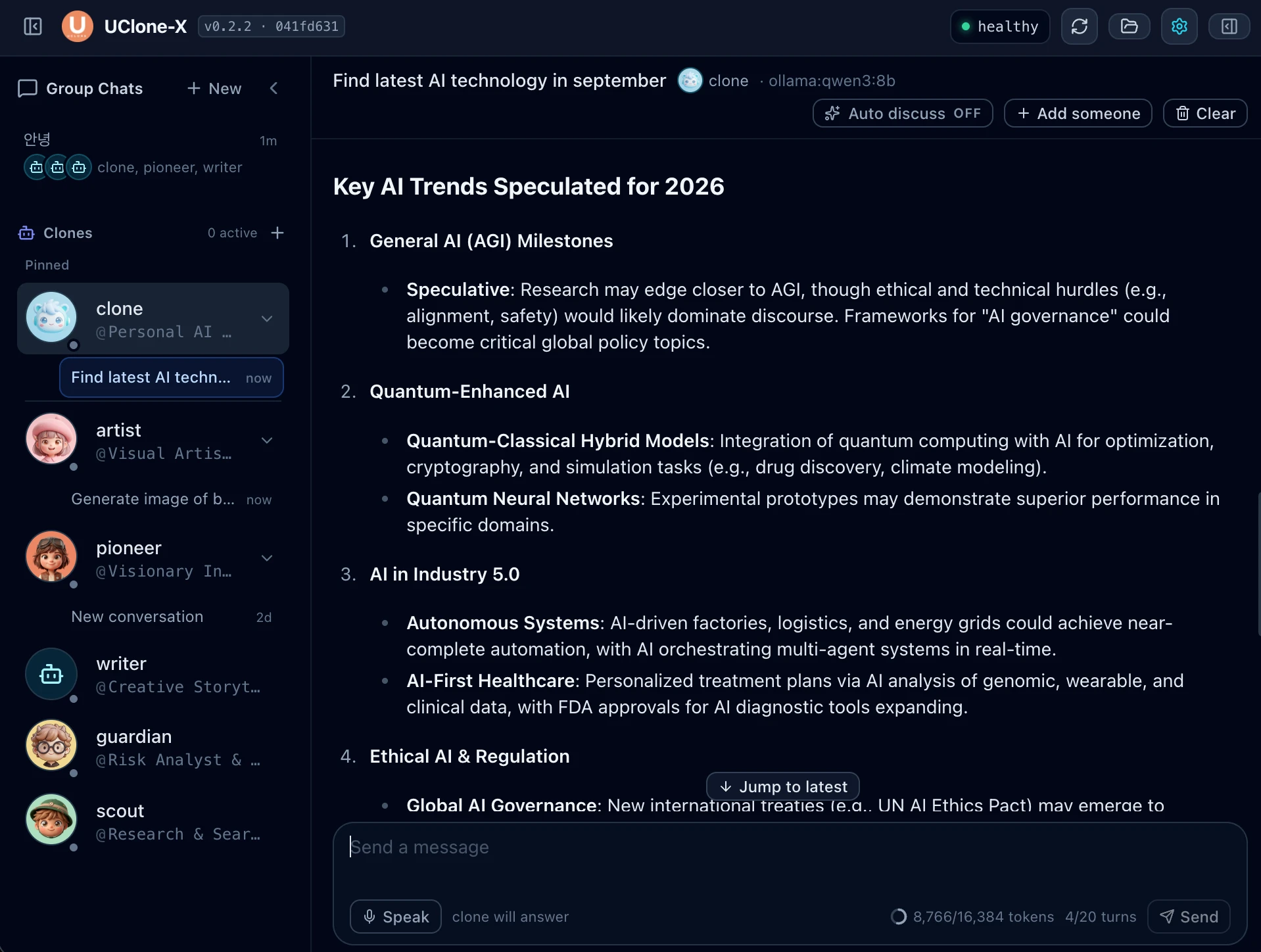
Ask a clone a question. Here the default clone answers with a structured
summary on a local model (ollama:qwen3:8b):
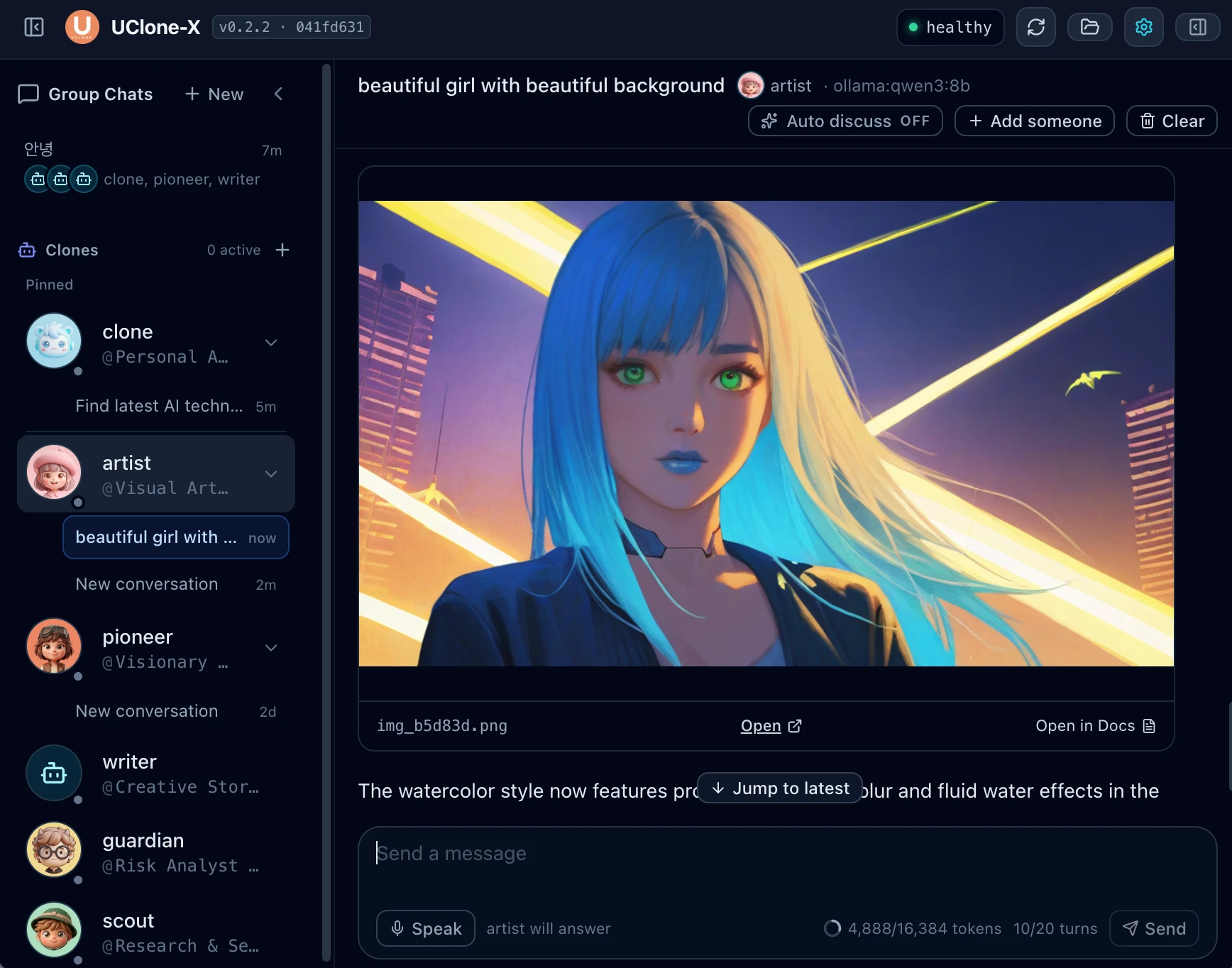
Or ask the artist clone for a picture. The image appears in the conversation, with links to open it in the browser or in Docs:
Install
On PyPI? The
pip install uclone-xline PyPI prints at the top of the page installs the library only, without theucxcommand. Use one of the installs below; with pip, that ispip install "uclone-x[cli,http]".
On macOS or Linux, paste this into a terminal:
curl -fsSL https://raw.githubusercontent.com/UClone-AI/uclone-x/main/install.sh | bash
That is the whole install. It needs nothing but curl — no Python, Homebrew or
admin rights of its own. It installs the core (~31 MB), then asks before each
larger download: a private Python 3.12 when your machine has nothing newer than
3.10, then a local AI model through Ollama (~1.4–5.2 GB, depending on memory; say
no to use an API key instead). Ollama's own installer may ask for your password.
At the end it asks Start UClone-X now? — press Enter, answer any remaining
setup question, and the dashboard opens in your browser at
http://127.0.0.1:5180. The agents work in the folder you ran it from.
To answer, UClone-X needs a model: the local one above, which needs no account, or an API key for OpenAI, Anthropic or Gemini, pasted into the dashboard's Settings. Nothing needs editing in a file.
Next time, start it with:
ucx start
If your shell says command not found, the installer printed one export PATH=…
line at the end; add it to ~/.zshrc (or ~/.bashrc) and open a new terminal.
Until then, ~/.local/bin/ucx start works.
UClone-X itself lives in ~/.uclone-x and the ucx link in ~/.local/bin;
rm -rf ~/.uclone-x ~/.local/bin/ucx removes it. What the installer fetched
alongside it stays: uv (~/.local/bin/uv, uvx) and the Python it downloaded
(uv python uninstall 3.12 removes that), and Ollama with its models.
Other ways to install
If you already use uv:
uv tool install --managed-python --python 3.12 "uclone-x[cli,http]"
ucx start
Keep both flags: without --python 3.12 uv uses the first python3 on PATH,
which on macOS is 3.9, and the install fails; without --managed-python it still
runs that python3 to check its version, and on a Mac without the Xcode Command
Line Tools that opens an install dialog.
With pip, into a Python 3.11+ environment of your own:
pip install "uclone-x[cli,http]". The two extras are not optional in practice:
cli is the ucx shell and http serves the dashboard. The base install is the
runtime without a shell — what you want if you are importing uclone_x as a
library (see examples/single_agent.py). Model providers need no extra: every
connector speaks HTTP directly. The heavier stacks are the genuinely optional extras:
pip install "uclone-x[ontology]"    # LinkML, rdflib, networkx
pip install "uclone-x[code_intel]"  # tree-sitter AST parsing
pip install "uclone-x[all]"
Every extra resolves on Python 3.11, 3.12 and 3.13.
Models
ucx install downloads the local language model and the image checkpoint and
checks that each one actually works; it reports a partial setup as incomplete
rather than as success. You can also do this later from the dashboard.
As a rough guide to what fits, from the installer's own advice:
| Memory | Local model | Image generation |
|---|---|---|
| under 8 GB | use a cloud model (API key) | no |
| 8–16 GB | qwen3:1.7b, or a cloud model |
no |
| 16–24 GB | qwen3:8b |
512 px |
| 24 GB and up | qwen3:8b |
768 px |
Connecting a model
Pick one of these:
-
Local, no key. Install Ollama.
ucx startfinds it and offers a model that fits; models can also be added and removed from Settings, or withucx llm pullanducx llm rm. -
In the dashboard. Open Settings, choose Gemini, Anthropic, OpenAI, vLLM or Ollama, and enter the key or server address there. It is remembered for the next start, in
~/.uclone/sessions/settings.jsonas plain text — treat that file like the key itself. -
From the environment.
ucxreads provider settings from environment variables, which take precedence over what Settings saved:export ANTHROPIC_API_KEY=... # or GEMINI_API_KEY, OPENAI_API_KEY ucx start
ucxdoes not read a.envfile by itself. The repository's.env.examplelists every variable it understands; if you keep yours in a.env, load it into the shell first (set -a; . ./.env; set +a).
ucx llm status shows which providers it can reach.
What you can do
- Clones. Six ship built in — clone (the default), writer, artist, guardian, pioneer and scout. Create your own, or edit one, from Settings; the connected model can draft its instructions for you. Each clone is a YAML file in your workspace.
- Conversations. One-to-one chats and group chats with several clones,
listed most recent first, with pinning, rename and delete. Replies stream as
they are written, including each tool call; messages render Markdown and math.
Group conversations can also be driven from the terminal with
ucx room. - Memory. Every clone can record, look up and retract facts, and remembers them across conversations. The dock's Remembers tab lists what each clone saved.
- Files and images. Clones read files in your workspace and in folders you mark read-only, write only inside the workspace, and generate images in-process (or through ComfyUI when one is running). What each turn produced appears in the dock beside the conversation.
- Tools from elsewhere. Connect MCP servers from Settings — a remote one by
URL, a local one by command, or by pasting a vendor's
mcpServerssnippet. - The terminal.
ucx runis the same agent as an interactive REPL, with streaming, tool calls and slash commands;ucx run --prompt "…"answers once. - Your editor.
ucx acp servelets an editor that speaks the Agent Client Protocol talk to a clone.
ucx --help lists every command.
Where your data lives
UClone-X has no server of its own and no account. Conversations and dashboard
settings are kept under ~/.uclone/sessions/ (UCLONE_SESSION_DIR moves them),
each clone's memory under ~/.uclone/agents/ (UCLONE_AGENTS_DIR), and clone
definitions are YAML files in the workspace folder.
What leaves the machine is what you connect it to: your messages go to the model provider you chose, a web search goes to the search service, and an MCP server you add receives what its tools are called with. With a local model and no remote tools, nothing leaves at all.
Something went wrong?
ucx keeps a record of what failed, on your machine, and only if you allow it:
ucx report --enable     # start recording failures locally
ucx report              # show what has been recorded
ucx report --open       # open a pre-filled bug report in your browser
Nothing is uploaded on its own. There is no telemetry server and no account
to sign into. ucx report prints the exact text that would be sent; --open
fills in a GitHub issue form that you still have to submit yourself. If you have
the GitHub CLI, ucx report --submit files it through your own gh login.
What gets recorded: the error type, the code path it failed on, your UClone-X,
Python and OS versions, and the error message. Your prompts and the contents of
your files are never included, and paths are reduced — code paths to the file
name, home directories to ~.
Masking is pattern-based, like every credential scrubber: it recognises the
shapes that occur in practice — sk-…, ghp_…, home directories on Linux,
macOS and Windows — and cannot promise to catch a token shape or a path layout
nobody has seen. That is why ucx report shows you the text before anything is
sent, and why the text is the last word on what leaves your machine.
Turn it off with ucx report --disable and delete what was recorded with
ucx report --clear.
Common first-run problems:
- "No active LLM provider connected." No model is reachable. Start Ollama
(
ollama serve), or set a key in Settings or the environment — see Connecting a model.ucx llm statussays which providers answered. - A key in
.envis ignored.ucxreads the environment, not.env; load the file into your shell first. ucx: command not foundafter the installer. It is not on your PATH yet; add theexport PATH=…line the installer printed to~/.zshrc(or~/.bashrc), or run it as~/.local/bin/ucxuntil then — see Install.
For developers
The runtime
An agent runtime built around a non-blocking reactive event loop rather than a blocking request/response cycle. Agents yield when idle and wake on tool returns, interrupts or messages from other agents. The same event bus carries single-agent execution and multi-agent collaboration on one machine, without an external broker.
- Event-driven agent core — a six-stage reactive state machine over an in-memory priority event bus with backpressure policies and immutable event envelopes.
- LLM-agnostic — Gemini, Claude, OpenAI and local models (Ollama, vLLM) behind one interface, with schema translation and fallback routing.
- Dynamic personas and sub-agents — agents create, supervise and terminate child agents with their own prompts and strict tool boundaries.
- Workspace sandboxing — tool calls are confined to the workspace by default; container and WASM levels are defined but not yet built.
- Ontology grounding — LinkML domain schemas and a semantic graph the agent reasons against instead of inventing structure per prompt.
- OpenTelemetry native — traces, metrics and OTLP export built in.
Implementation status
UClone-X is pre-1.0 and under active development. Read this section before depending on it.
| Area | State |
|---|---|
| Event bus, agent state machine, sessions | Implemented |
| Tool runtime, MCP client, built-in tools | Implemented |
| LLM connectors (Gemini, Claude, OpenAI, Ollama, vLLM) | Implemented |
| Dashboard: conversations, clones, memory, settings | Implemented |
| Local image generation | Implemented |
| Sandbox isolation modes | Implemented (host and workspace); container and WASM are configuration only |
| Ontology engine, skills, code intelligence | Implemented, evolving |
| A2A and ACP servers | Partial: HTTP+JSON A2A and stdio ACP, no authentication. No conformance is claimed |
Documentation
- Documentation index
- Architecture overview — layers, agents, rooms, and what each subsystem implements today
- Getting started with a checkout
- CLI reference
- A2A and ACP
- Security — what is protected and what is not
- Core principles P0–P9 — the normative rules every part of the runtime is built against
Working on UClone-X
An installed build is for using the agent. To change it, work from a checkout:
the development commands — setup, test, dev — exist only there, because
each of them assumes the repository. ucx --help in an installed build says so
rather than leaving you to guess.
git clone https://github.com/UClone-AI/uclone-x.git
cd uclone-x
uv sync --all-extras
npm ci --prefix frontend   # the gate runs the frontend's vitest suite
./ucx test check      # ruff format + lint, pyright strict, pytest with branch coverage, vitest
./ucx test check is the whole gate: zero ruff findings, zero pyright errors in
strict mode, the test suite at or above 70% branch coverage, and a passing
frontend vitest suite. A change that does not pass it is not ready.
See CONTRIBUTING.md for how patches reach this repository, and getting started with a checkout for the longer setup walkthrough.
About this repository
This repository is the UClone-X runtime, its dashboard and its documentation. It
is published from a private development repository, in periodic snapshots rather
than as a mirror of that repository's history. The evaluation suites and
multi-agent build tooling used to develop it are not part of the published
subset; the runtime detects their absence and degrades cleanly, so ucx eval
reports that no evaluation backend is installed rather than failing to start.
License
1 maintainer

Metadata
1 maintainer
Release files for uclone-x 0.4.0
For a detailed explanation of source distributions (sdists) and built distributions (wheels), please see the package formats documentation.
Source distribution (sdist)
| File | Size | Uploaded | |
|---|---|---|---|
| uclone_x-0.4.0.tar.gz | 4.7 MB | Details |
Built distribution (wheel)
| File | Interpreter | ABI | Platform | Reset |
|---|---|---|---|---|
| uclone_x-0.4.0-py3-none-any.whl | Python 3 | none | any | Details |
Total release size: 9.7 MB
Release files / uclone_x-0.4.0.tar.gz
| Download URL | uclone_x-0.4.0.tar.gz |
|---|---|
| Size | 4.7 MB |
| Tags | Source |
|
SHA-256 checksum How to use checksums |
5d987f544fe93694f8c51206db663b1a442d489976d02bf667c8c30200cac43e
|
|
BLAKE2b-256 checksum How to use checksums |
61e20cb55743d862357358f37a89d7160edd10cdd965336dbde6bf84a9a3e585
|
| Upload date | |
|
Uploaded using Trusted Publishing? What is trusted publishing? |
Yes |
| Uploaded via |
twine/7.0.0 CPython/3.13.14
|
Provenance
Provenance describes where a file came from. On PyPI, provenance is shared via attestations, which provide a verifiable record of the build or publishing details. View details, limitations and caveats.


PyPI Publish Attestation
PyPI verified that this artifact, at this checksum, originated from the publisher listed below.
Signed by GitHub Actions, verified by PyPI on Oct 8, 2026.
Transparency logRelease files / uclone_x-0.4.0-py3-none-any.whl
| Download URL | uclone_x-0.4.0-py3-none-any.whl |
|---|---|
| Size | 5.0 MB |
| Tags | Python 3 |
|
SHA-256 checksum How to use checksums |
cb9b51ab52af33c9d7546440cd82c19f3f14a71e5f7eebaf1ba64ff3da1bd73d
|
|
BLAKE2b-256 checksum How to use checksums |
51ca5b06a3dfd7efaad9783d2a651c891846aef9695235843d383714c07af85b
|
| Upload date | |
|
Uploaded using Trusted Publishing? What is trusted publishing? |
Yes |
| Uploaded via |
twine/7.0.0 CPython/3.13.14
|
Provenance
Provenance describes where a file came from. On PyPI, provenance is shared via attestations, which provide a verifiable record of the build or publishing details. View details, limitations and caveats.
PyPI Publish Attestation
PyPI verified that this artifact, at this checksum, originated from the publisher listed below.
Signed by GitHub Actions, verified by PyPI on Oct 8, 2026.
Transparency log













