
Ultra-Fast Proxy Fetcher & Tester
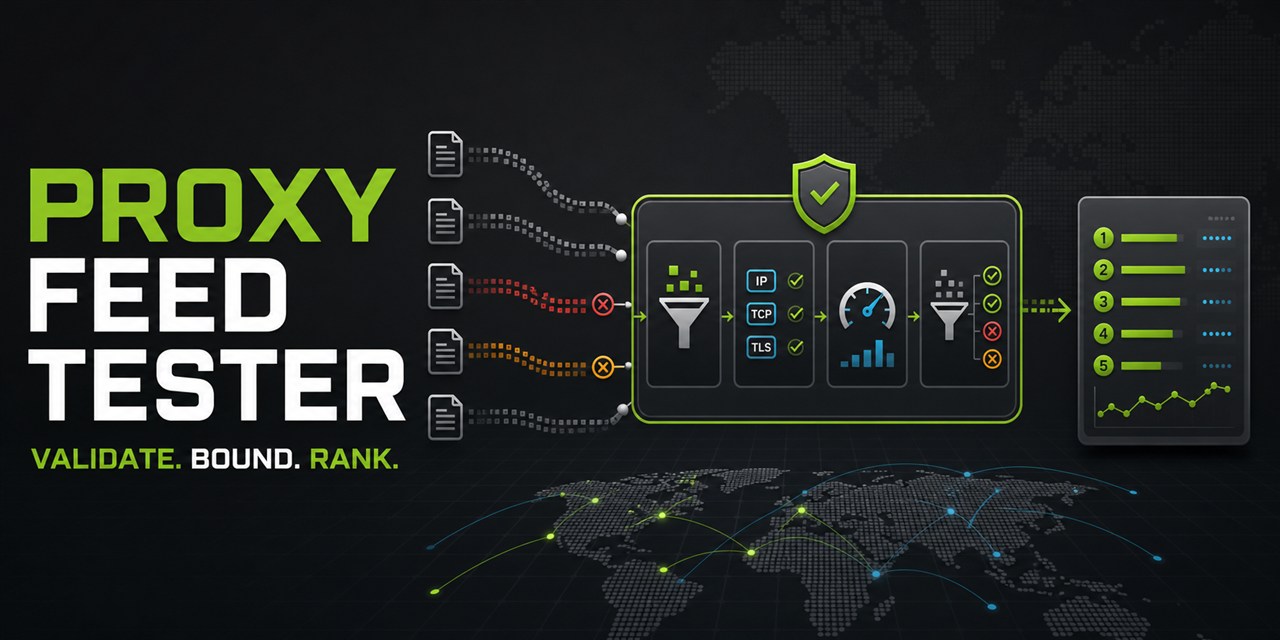



Fetch, validate, rank, and save public HTTP, SOCKS4, and SOCKS5 proxy endpoints with one Python script. The engine uses bounded asynchronous concurrency, strict public-address filtering, and an end-to-end HTTPS connectivity check.

This project is intended for authorized network testing, software development, and research. Public proxies are untrusted. Never send credentials, personal information, proprietary data, or other sensitive traffic through an endpoint produced by this tool.
Version 2.0.2 is the current release version of this source tree. A successful check establishes bounded reachability and measured latency to the configured test endpoint. Public proxies are untrusted and should never carry sensitive traffic.
Find the standalone runtime, Python distributions, and integrity files under published releases.
Why this version is different
- Fetches concurrently from 52 curated HTTPS sources validated on 2026-08-12.
- Rejects private, loopback, link-local, multicast, reserved, malformed, and invalid-port entries before attempting a proxy connection.
- Validates HTTP CONNECT, SOCKS4, and SOCKS5 transports against a fixed HTTPS endpoint that must return exactly
204. - Blocks unsafe source URLs and redirects, verifies source TLS, checks DNS destinations, and caps decompressed response sizes.
- Uses bounded worker pools, source concurrency, timeouts, and a default 5,000-candidate safety cap.
- Caps every source at 5 MiB and 10,000 unique endpoints to constrain hostile or malformed feeds.
- Does not display third-party proxy addresses in live progress output.
- Atomically invalidates stale output before testing and replaces it with the completed report, including when no proxies work.
- Keeps all application logic in
proxy_fetcher_ultimate.py.
Requirements
- Python 3.12 through 3.14
- Internet access to the configured source hosts and HTTPS connectivity endpoint
Installation
Install the published package for the proxy-fetcher-tester command:
python -m pip install ultra-fast-proxy-fetcher-tester
proxy-fetcher-tester --help
For an exact install, use python -m pip install ultra-fast-proxy-fetcher-tester==2.0.2 once it appears in the PyPI release history.
To work from the standalone source, clone the repository:
git clone https://github.com/fusiontechstrategies/Ultra-Fast-Proxy-Fetcher-Tester.git
cd Ultra-Fast-Proxy-Fetcher-Tester
python -m venv .venv
Activate the environment on Windows:
.venv\Scripts\Activate.ps1
Activate it on Linux or macOS:
source .venv/bin/activate
Install the runtime dependencies:
python -m pip install --upgrade pip
python -m pip install -r requirements.txt
Usage
Run with safe defaults:
python proxy_fetcher_ultimate.py
Fetch and validate source data without testing or saving proxy endpoints:
python proxy_fetcher_ultimate.py --fetch-only
Test a smaller HTTP-only sample:
python proxy_fetcher_ultimate.py --protocol http --max-candidates 500 --concurrent 50
Choose a different output file and hide live progress:
python proxy_fetcher_ultimate.py --output results/proxies.txt --quiet
Show every option and its enforced bounds:
python proxy_fetcher_ultimate.py --help
Show the stable product version:
python proxy_fetcher_ultimate.py --version
Important defaults
| Setting | Default | Enforced maximum |
|---|---|---|
| Proxy checks | 100 concurrent | 500 |
| Source downloads | 12 concurrent | 32 |
| Candidates tested | 5,000 | 50,000 |
| Proxy timeout | 8 seconds | 30 seconds |
| Source timeout | 12 seconds | 30 seconds |
Actual throughput depends on network conditions, operating-system limits, candidate quality, protocol mix, and timeout settings. The project deliberately makes no fixed checks-per-second promise.
Output
Working endpoints are sorted by measured response time and grouped into speed categories. The following addresses are documentation-only examples and are never shipped as a usable proxy list:
# LIGHTNING FAST (under 200ms)
http://192.0.2.10:8080              # 142.18ms

# VERY FAST (200-499ms)
socks5://198.51.100.20:1080         # 318.42ms
Generated proxy files are excluded by .gitignore. Treat them as transient operational data.
Exit codes
| Code | Meaning |
|---|---|
0 |
Completed successfully and, unless using --fetch-only, found at least one working proxy |
1 |
Output or application failure |
2 |
No valid public candidates were collected |
3 |
Candidates were tested but none passed validation |
130 |
Interrupted by the user |
Security model and limitations
Address filtering uses a fixed conservative policy across Python 3.12 through
3.14. It rejects every special-purpose block in the
IANA IPv4 registry
and IANA IPv6 registry
snapshot reviewed on October 2, 2026, including globally reachable protocol
anycast exceptions. IPv6 permits ordinary addresses in 2000::/3 and excludes
special allocations inside that space. Translation, transition, documentation,
benchmarking, private, link-local and reserved destinations stay blocked even
when an older Python patch classifies them differently. This intentionally
trades some special-purpose reachability for a narrower public-proxy boundary.
- The fixed HTTPS
204check validates connectivity and TLS tunneling. It does not prove anonymity, trustworthiness, geographic location, uptime, or ownership. - A proxy can become malicious or unavailable immediately after a successful test.
- Third-party source availability and content can change without notice.
- Source entries are data from independent projects. This repository does not redistribute a current proxy snapshot.
- The application ignores system proxy environment variables for source retrieval and test traffic.
- Adding custom target URLs is intentionally unsupported to reduce misuse and accidental traffic against third parties.
Read SECURITY.md for vulnerability reporting and RESPONSIBLE_USE.md before operating the tool.
Release integrity
Installable distributions bind the description, author, project URLs, classifiers, README content and wheel generator to reviewed source. Source archives reject unreviewed empty directories and nonportable paths. After environment approval, PyPI promotion rechecks the original tag and signed commit, main ancestry, and the same public stable release before publication. Python 3.10 reached end of life on October 1, 2026; repository source and future releases require Python 3.12 through 3.14. The already-published v2.0.1 metadata cannot be changed in place and still records its historical Python 3.10 compatibility. Release jobs use Python 3.12's standard-library TOML parser in isolated mode.
The release process is designed to produce exactly seven files:
- an exact standalone copy of
proxy_fetcher_ultimate.py - a deterministic source and documentation ZIP
- a verified Python wheel
- a verified Python source archive
- an SPDX 2.3 direct-dependency SBOM
SHA256SUMS.txt- commit-bound
release-evidence.json
The builder uses a fixed file allowlist, canonical ZIP order, timestamps, permissions, and metadata. It rejects mismatched versions, tags, dependencies, source files, commits, or output sets. GitHub Actions builds the assets twice, compares every byte, exercises the exact standalone runtime without network access, and attests every asset before creating a draft. The workflow cannot publish the draft and does not publish to a package registry.
See RELEASING.md for the exact contract and TESTING.md for offline, live, and release validation boundaries.
Related Fusion projects
- IDS Rule Converter is a separate, fail-safe network detection engineering utility.
- Explore the complete Fusion Technology Strategies public portfolio.
Development
Install the development checks:
python -m pip install -r requirements-dev.txt
Run the same offline checks used by GitHub Actions:
python -m pip check
python -m ruff check .
python -m ruff format --check .
python -m unittest discover -s tests -v
python -m mypy proxy_fetcher_ultimate.py
python -m bandit -q -r proxy_fetcher_ultimate.py
python -m pip_audit -r requirements.txt
python -m pip_audit -r requirements-dev.txt
See CONTRIBUTING.md for source-review and pull-request requirements.
License
Released under the MIT License.
Immutable publication prerequisite
Further PyPI promotion requires a public stable GitHub release whose REST API
reports immutable: true. GitHub locks that release's tag and assets, closing
the tag-mutation window between sequential authorization queries. Existing
mutable releases are rejected rather than silently grandfathered in. Enable
immutable releases before publishing the next fully assembled draft, following
GitHub's immutable release workflow.
The final job checks release identity and stable/public flags again after
approval. GitHub still permits prerelease metadata changes; these flags are
verified snapshots, not an atomic transaction spanning GitHub and PyPI.
Additional source, output and publication boundaries
Source parsing counts every candidate validation, including duplicate and rejected records, with a 20,000-attempt limit. The asynchronous download path yields every 64 candidates so dense source text cannot suppress the source deadline.
Output publication uses the requested lexical filename, rejects existing links and special files, and retains no-follow directory handles during creation, replacement and cleanup. POSIX parents must be owned by the current user and not writable by others; unsafe non-sticky ancestors are rejected. Windows locks all directory ancestors against replacement and rejects reparse points. Elevated runs require a private output parent with a trusted owner/DACL. Do not use a shared, attacker-writable output directory as a trusted long-term result store.
Distribution verification caps compressed archives at 8 MiB, expanded streams and aggregate members at 8 MiB, individual members at 1 MiB, and members at 256. Wheel central-directory metadata is bounded before allocation. Only stored and DEFLATE ZIP entries are accepted. TAR headers, including PAX metadata, pass through a bounded gzip reader. These limits intentionally exceed the reviewed small single-module packages and should be reconsidered with source growth.
PyPI dispatch must use protected main. Verification code is taken from a verified protected-main commit and the same exact revision revalidates distributions in the OIDC publication job. Release tags are checked immediately before and after draft creation and again during publication. Update/deletion protection for v* tags is an external repository control required to close concurrent tag races; sequential checks alone do not lock GitHub state.
1 maintainer

Metadata
1 maintainer
Release files for ultra-fast-proxy-fetcher-tester 2.0.2
For a detailed explanation of source distributions (sdists) and built distributions (wheels), please see the package formats documentation.
Source distribution (sdist)
| File | Size | Uploaded | Provenance | Actions |
|---|---|---|---|---|
| ultra_fast_proxy_fetcher_tester-2.0.2.tar.gz | 184.4 kB | With provenance | Details for ultra_fast_proxy_fetcher_tester-2.0.2.tar.gz |
Built distribution (wheel)
| File | Interpreter | ABI | Platform | Actions Reset |
|---|---|---|---|---|
| ultra_fast_proxy_fetcher_tester-2.0.2-py3-none-any.whl | Python 3 | none | any | Details for ultra_fast_proxy_fetcher_tester-2.0.2-py3-none-any.whl |
Total release size: 249.0 kB
Release files / ultra_fast_proxy_fetcher_tester-2.0.2.tar.gz
| Download URL | ultra_fast_proxy_fetcher_tester-2.0.2.tar.gz |
|---|---|
| Size | 184.4 kB |
| Tags | Source |
|
SHA-256 checksum How to use checksums |
655e8319083b0bc6740e6c63bf52d06d53b161486bc3d572f0327e6327ddb326
|
|
BLAKE2b-256 checksum How to use checksums |
fb68c7d733a434c40d3b8b7e39d16ebcf5ddf5ebe8192acd1fa4fafa0d0d8d76
|
| Upload date | |
|
Uploaded using Trusted Publishing? What is trusted publishing? |
Yes |
| Uploaded via |
twine/7.0.0 CPython/3.13.16
|
Provenance
Provenance describes where a file came from. On PyPI, provenance is shared via attestations, which provide a verifiable record of the build or publishing details. View details, limitations and caveats.


PyPI Publish Attestation
PyPI verified that this artifact, at this checksum, originated from the publisher listed below.
Signed by GitHub Actions, verified by PyPI on Nov 18, 2026.
Transparency logRelease files / ultra_fast_proxy_fetcher_tester-2.0.2-py3-none-any.whl
| Download URL | ultra_fast_proxy_fetcher_tester-2.0.2-py3-none-any.whl |
|---|---|
| Size | 64.6 kB |
| Tags | Python 3 |
|
SHA-256 checksum How to use checksums |
dc54e27c884da50080a3d8a8eb5b0fb2e5cdfb3b5dbf9be4d1798be87e8ebadc
|
|
BLAKE2b-256 checksum How to use checksums |
e7e1b407745cbf4d4298da9251cfb90e89a73dde5d592374314dbea9ca91e52e
|
| Upload date | |
|
Uploaded using Trusted Publishing? What is trusted publishing? |
Yes |
| Uploaded via |
twine/7.0.0 CPython/3.13.16
|
Provenance
Provenance describes where a file came from. On PyPI, provenance is shared via attestations, which provide a verifiable record of the build or publishing details. View details, limitations and caveats.
PyPI Publish Attestation
PyPI verified that this artifact, at this checksum, originated from the publisher listed below.
Signed by GitHub Actions, verified by PyPI on Nov 18, 2026.
Transparency logSecurity for ultra-fast-proxy-fetcher-tester 2.0.2
Provenance
Provenance describes where a file came from. On PyPI, provenance is shared via attestations, which provide a verifiable record of the build or publishing details. View details, limitations and caveats.
Full provenance
Both files in this release have been uploaded with provenance metadata.
Attestation for ultra_fast_proxy_fetcher_tester-2.0.2.tar.gz
PyPI Publish Attestation
PyPI verified that this artifact, at this checksum, originated from the publisher listed below.
Signed by GitHub Actions, verified by PyPI on Nov 18, 2026.
Transparency logA note on package security
PyPI is a repository for distributing packages, not a service for auditing them. While third-party security researchers and our staff do their best to detect and remove malicious packages, PyPI cannot guarantee the quality, security or suitability of any given package.
To learn more about protecting yourself from malicious actors, visit our package security documentation.














