
unalloc
Find the AI spend nobody owns. Joins OpenCost allocation data with LLM provider bills and reports what's unattributed.





Project site: timurista.github.io/unalloc, with the findings, case studies, paper (PDF), blog post, GPU addendum and ledger explorer.
OpenCost tells you what your Kubernetes workloads cost. Your provider dashboard tells you what your OpenAI and Anthropic calls cost. Getting both into one view is possible today — OpenCost has an OpenAI plugin — but the answer still depends on a join nobody checks: the same dollar can arrive through both your gateway and your provider bill, and the labels that say who owns it are set per workload, not per pod template. unalloc pulls all four sources into one normalized ledger, joins them on a label dimension you choose, and reports the number your finance team keeps asking for: how much of this month's AI spend can't be attributed to any team — and how much of the rest was only rescued by a fallback key.
The output
$ unalloc report --fixtures --dimension team

╭──────────────────────────── unalloc ─────────────────────────────╮
│ 73.5% of $66,630.38 AI spend is unattributed                     │
│ $48,983.14 has no 'team' label                                   │
╰──────────────────────────────────────────────────────────────────╯

                        Spend by team
┏━━━━━━━━━━━━━━━━━┳━━━━━━━━━━━━━┳━━━━━━━┳━━━━━━━━━━━━━━━━━━━━━━━━━━━━━━━━━━━━━┳━━━━━━┓
┃ team            ┃        Cost ┃ Share ┃ Sources                               ┃ Rows ┃
┡━━━━━━━━━━━━━━━━━╇━━━━━━━━━━━━━╇━━━━━━━╇━━━━━━━━━━━━━━━━━━━━━━━━━━━━━━━━━━━━━━━╇━━━━━━┩
│ platform        │  $13,166.02 │ 19.8% │ litellm, opencost                     │    2 │
│ search          │   $4,481.22 │  6.7% │ litellm, opencost                     │    2 │
│ <unallocated>   │  $48,983.14 │ 73.5% │ anthropic, litellm, opencost, openai  │   11 │
└─────────────────┴─────────────┴───────┴───────────────────────────────────────┴──────┘
Then the actionable half: a labeling backlog sorted by dollars.
$ unalloc labels --fixtures --dimension team

      Labeling backlog — rows missing 'team', by cost
┏━━━━┳━━━━━━━━━━┳━━━━━━━━━━━━━━━━━━━━━━━━━━━┳━━━━━━━━━━━━┳━━━━━━━━━━━━━━━━━━━━━━━━━━━━┓
┃  # ┃ Source   ┃ Cost object               ┃       Cost ┃ Labels it does have        ┃
┡━━━━╇━━━━━━━━━━╇━━━━━━━━━━━━━━━━━━━━━━━━━━━╇━━━━━━━━━━━━╇━━━━━━━━━━━━━━━━━━━━━━━━━━━━┩
│  1 │ opencost │ inference/vllm-llama-70b  │ $19,147.10 │ cluster, controller, ...   │
│  2 │ opencost │ __idle__                  │  $6,070.00 │ cluster                    │
│  3 │ litellm  │ claude-opus-5             │  $5,412.75 │ environment, model         │
└────┴──────────┴───────────────────────────┴────────────┴────────────────────────────┘
inference/vllm-llama-70b is the whole pitch: $19K of GPU spend carrying a costCenter label but no team, sitting next to $5K of Claude API spend on an unlabeled legacy key. Two systems, one gap, no existing tool that shows them in the same table.
Add a fallback and unalloc says how much of the "allocated" spend only got there through it, so a fallback onto something that is not an owner can't hide inside the headline:
$ unalloc report --fixtures -D team --fallback namespace
│ 37.9% of $66,630.38 AI spend is unattributed                     │
│ $25,237.54 has no 'team' label                                   │
│ $23,745.60 attributed only via fallback (namespace)              │
Install
pip install unalloc          # or: uv tool install unalloc
unalloc report --fixtures    # works immediately, no infrastructure needed
From a clone:
make dev      # editable install with test + lint tooling
make demo     # all three commands against bundled fixtures
make check    # ruff + pytest, same as CI
Or as a container, which needs no Python on the host:
docker build -t unalloc:0.2.0 .
docker run --rm unalloc:0.2.0 report --fixtures -D team

# against real systems, reachable from the container
docker run --rm --network host --env-file .env unalloc:0.2.0 report -D team
Copy .env.example to .env for the source configuration. unalloc stores
nothing: no database, no state directory, no cached credentials.
Usage
# What percentage of spend has no owner?
unalloc report --dimension team --days 30

# Accept a second-best key before declaring a row unallocated
unalloc report -D team --fallback namespace --fallback cost_center

# Fail a CI job when more than 10% of spend is unowned
unalloc report -D team --budget 10

# Which label keys does my data actually have?
unalloc labels --available

# The backlog honours the same fallbacks as the report
unalloc labels -D team --fallback namespace

# Does the ledger tie out to the invoice?
unalloc reconcile --invoice openai=4031.36 --invoice anthropic=8737.03

# Pipe it into something else
unalloc report --json | jq '.unallocated_pct, .fallback_usd'
Configure sources by environment variable:
| Variable | Purpose |
|---|---|
UNALLOC_OPENCOST_URL |
OpenCost API root, e.g. http://opencost.opencost:9003 |
UNALLOC_LITELLM_URL |
LiteLLM proxy root |
UNALLOC_LITELLM_KEY |
LiteLLM master or admin key |
OPENAI_ADMIN_KEY |
OpenAI org admin key (costs endpoint) |
ANTHROPIC_ADMIN_KEY |
Anthropic org admin key (cost report endpoint, sent as x-api-key) |
UNALLOC_OPENAI_URL, UNALLOC_ANTHROPIC_URL |
Optional overrides for the public API roots, e.g. a proxy |
Restrict the run with --source to avoid double counting: if your traffic goes through LiteLLM, prefer --source opencost --source litellm and skip the direct provider adapters, since the same tokens appear in both. The end-to-end case study measures exactly how much that costs you if you forget.
How it works
  OpenCost /allocation ─┐
  LiteLLM /spend/logs  ─┤
  OpenAI  org costs    ─┼──▶ normalize (label canonicalization + aliases)
  Anthropic cost report ┘              │
                                       ▼
                                    CostRow[]
                                       │
                      ┌────────────────┼────────────────┐
                      ▼                ▼                ▼
                  attribute        reconcile          labels
              (unallocated %)   (vs invoice)     (backlog by $)
Everything rests on one dataclass. An adapter's only job is turning a provider payload into CostRows; it never aggregates, filters or decides anything about attribution. Adding a provider is one file and one fixture.
Two design choices worth calling out:
Money is Decimal, never float. Attribution that disagrees with the invoice by a cent per row is how you lose an argument with finance.
Label canonicalization is the actual hard part. OpenCost gives you label_costCenter. LiteLLM gives you team_id or a team:platform request tag. OpenAI gives you a project ID. None of those join on a naive dict lookup, so every adapter runs its labels through normalize.py first, which strips provider prefixes (repeatedly, so label_app_kubernetes_io_name and app.kubernetes.io/name agree), converts camelCase, and applies an alias table you can extend per-org. When two raw keys land on the same canonical key, a fixed precedence decides - explicit key, then alias, then rewritten key, then path-derived key - so the result never depends on the order a provider serialized its labels in.
Case studies and paper
Six studies push real (or realistically simulated) inference workloads through unalloc's own adapters, including a run with vLLM on an NVIDIA H100. They exposed nine defects in the tool along the way, all fixed with regression tests, and they're written up as a paper: paper/unalloc-case-studies.pdf. For the readable version, see the blog post and the GPU addendum on the project site.
| Study | What runs | Headline |
|---|---|---|
kv_cache |
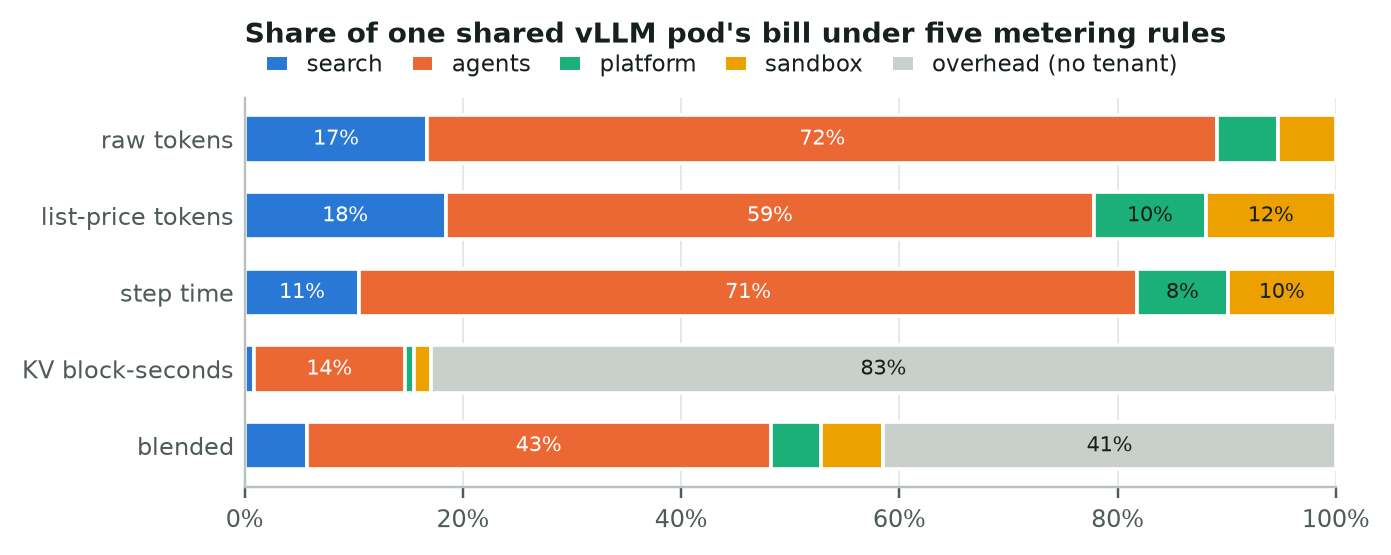
Discrete-event vLLM-style engine: paged KV blocks, prefix caching, continuous batching, preemption | Step-time metering shows ~0% idle once any request is in flight; KV-memory metering leaves a large share of the bill unowned |
torch_kv |
A from-scratch PyTorch decoder with a real KV cache serving a 4-tenant trace | Per-token showback over-charges a RAG tenant by 33 points of the pool ($5.7K/month) vs measured compute |
distributed |
Tensor and pipeline parallel on torch.distributed (gloo), verified against a single-process reference |
Owner label on LeaderWorkerSet leaders only: 66% unallocated; falling back to name "fixes" it by sending 61% to a Helm chart name |
hybrid_e2e |
The real CLI as a subprocess against live mock OpenCost / LiteLLM / OpenAI / Anthropic APIs (Postgres-backed LiteLLM in the dev container) | Enabling every source double counts $11.8K; reading only page one of the billing APIs reports 25% of spend |
use_cases |
Labeling Pareto, per-feature unit economics, self-host break-even, CI budget gate | Three label fixes take a 67%-unallocated org under 10% |
gpu_validation |
Real vLLM 0.29 serving Qwen2.5-7B on a DigitalOcean H100, driven with the simulator's tenants (runbook, evidence) | Token metering over-charges search by 12–14 points vs time share; GPU "utilization" reads 97% at 2 req/s and 99% at 16 req/s |
make research            # build ./.venv-research: CPU torch, notebook tooling, typst
                         # (the targets below find it on their own; or pass PY=...)
make case-studies        # all five, full size (a few minutes)
make paper               # figures + PDF
make notebook            # execute case_studies/unalloc_case_studies.ipynb
make ui                  # ledger explorer on http://127.0.0.1:8765
The ledger explorer (or python -m case_studies.ui locally) shows every dataset row by row: pick the label that means "owner", add fallbacks, and watch each row resolve to a team, a fallback value, or the backlog. python -m case_studies.ui --export explorer.html writes a self-contained copy you can share.
Development environment
An isolated dev stack lives in .devcontainer/: a Python 3.11 workspace with the case-study dependencies (CPU-only PyTorch) and a small Postgres that backs the mock LiteLLM spend-log store. Open the folder in VS Code's Dev Containers, or from a terminal:
make devcontainer          # docker compose up
make devcontainer-check    # lint, tests and every case study at smoke size, inside the container
Scope, and what this is not
OpenCost 1.121.0 added inference cost tracking for vLLM and llm-d deployments: cost per million tokens, KV-cache-corrected pricing, shared infrastructure attribution. That is excellent and unalloc does not reimplement it. Those rows arrive through the same /allocation shape and land in this ledger tagged unalloc_layer=inference.
OpenCost can also bring external provider spend alongside Kubernetes cost through its plugin interface, including an OpenAI plugin announced in November 2024. So "Kubernetes cost and provider cost in one place" is not a gap unalloc invented, and it is not the claim here.
What unalloc does is narrower: read all four sources yourself — OpenCost, a LiteLLM gateway, and the OpenAI and Anthropic billing APIs directly — and answer one question about the join. Which dollars carry no owner, which were rescued only by a fallback key that may be pointing at a Helm chart rather than a team, and which arrived twice because the gateway and the provider both reported them. That is the seam it lives in, and nowhere else. It is:
- not a dashboard — it prints a number and exits (the explorer is a case-study companion, not part of the CLI)
- not an optimizer — it makes no recommendations about rightsizing or commitments
- not a collector — it queries systems you already run, and stores nothing
Roadmap
- Prometheus exporter so
unalloc_unallocated_ratiocan be alerted on - OpenCost external-cost plugin, so LLM API spend appears natively in OpenCost
- Per-feature unit economics using the
quantity/unitfields already carried onCostRow - Azure OpenAI and Bedrock adapters
-
--budgetmode: exit non-zero when unallocated share crosses a threshold, for CI -
--exclude label=valueon a source, so gateway traffic can be dropped from provider billing instead of whole sources - Warn when distinct raw label keys collide on one canonical key
Contributing
Adding a source is deliberately small: implement parse() on a Source subclass, add a fixture to src/unalloc/fixtures/, add a case to tests/test_sources.py. The fixtures are the contract, so a PR with a real (scrubbed) payload from a provider is valuable even without the adapter.
pip install -e ".[dev]"
ruff check . && pytest
Citing
If you use unalloc or its case studies, please cite the archived release. GitHub's "Cite this repository" button produces the same entry from CITATION.cff.
- All versions: doi:10.5281/zenodo.22761012, which always resolves to the latest release — currently 0.2.3, the code the paper describes
- Version 0.2.1: doi:10.5281/zenodo.22761013
@software{urista_unalloc_2026,
  author  = {Urista, Timothy},
  title   = {unalloc: find the AI spend nobody owns},
  version = {0.2.3},
  year    = {2026},
  doi     = {10.5281/zenodo.22761012},
  url     = {https://github.com/timurista/unalloc}
}
License
Apache 2.0, matching OpenCost.
1 maintainer

Release files for unalloc 0.2.3
For a detailed explanation of source distributions (sdists) and built distributions (wheels), please see the package formats documentation.
Source distribution (sdist)
| File | Size | Uploaded | |
|---|---|---|---|
| unalloc-0.2.3.tar.gz | 37.3 kB | Details |
Built distribution (wheel)
| File | Interpreter | ABI | Platform | Reset |
|---|---|---|---|---|
| unalloc-0.2.3-py3-none-any.whl | Python 3 | none | any | Details |
Total release size: 71.8 kB
Release files / unalloc-0.2.3.tar.gz
| Download URL | unalloc-0.2.3.tar.gz |
|---|---|
| Size | 37.3 kB |
| Tags | Source |
|
SHA-256 checksum How to use checksums |
6850854b2748addc041d5b325a311b6b17790769a5ed36604b190f308d491cda
|
|
BLAKE2b-256 checksum How to use checksums |
2c2a71ad378f475d78e728b88f18cb2be036ea5af07f7b9904eb5dd1829c21cd
|
| Upload date | |
|
Uploaded using Trusted Publishing? What is trusted publishing? |
Yes |
| Uploaded via |
twine/7.0.0 CPython/3.13.14
|
Provenance
Provenance describes where a file came from. On PyPI, provenance is shared via attestations, which provide a verifiable record of the build or publishing details. View details, limitations and caveats.


PyPI Publish Attestation
PyPI verified that this artifact, at this checksum, originated from the publisher listed below.
Signed by GitHub Actions, verified by PyPI on Sep 21, 2026.
Transparency logRelease files / unalloc-0.2.3-py3-none-any.whl
| Download URL | unalloc-0.2.3-py3-none-any.whl |
|---|---|
| Size | 34.5 kB |
| Tags | Python 3 |
|
SHA-256 checksum How to use checksums |
d5b3e382b017eeedbc256ed1375da2935ee915813176a3f6c9bee7f84a7027c4
|
|
BLAKE2b-256 checksum How to use checksums |
dd34c567f3e86628a39c2c940de1238ed0de4d5ae0856d3d696605eeb674a157
|
| Upload date | |
|
Uploaded using Trusted Publishing? What is trusted publishing? |
Yes |
| Uploaded via |
twine/7.0.0 CPython/3.13.14
|
Provenance
Provenance describes where a file came from. On PyPI, provenance is shared via attestations, which provide a verifiable record of the build or publishing details. View details, limitations and caveats.
PyPI Publish Attestation
PyPI verified that this artifact, at this checksum, originated from the publisher listed below.
Signed by GitHub Actions, verified by PyPI on Sep 21, 2026.
Transparency log













