
uncycle
A Python tool to find the fewest import statements to remove to break all circular imports.
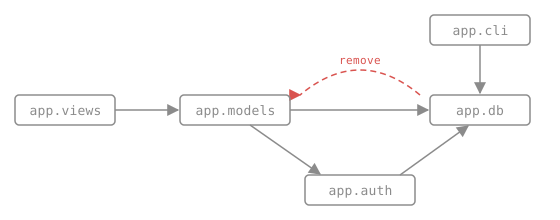
It gives you short and actionable feedback to structure your Python package better.
It works by computing the so-called Feedback Arc Set on the graph of Python modules (nodes) and import statements (edges).
Usage
uncycle [--exclude REGEX] [--inline] [--baseline OLD] [--dump-graph FILE] PACKAGE
Listing problematic import statements
Use uncycle path/to/pkg to list the minimal import statements to delete to break all circular imports:
$ uncycle werkzeug-3.1.8/src/werkzeug
werkzeug-3.1.8/src/werkzeug/http.py:1442: imports werkzeug.datastructures
werkzeug-3.1.8/src/werkzeug/http.py:1443: imports werkzeug.sansio.http
2 dependencies to remove
Finding regressions
Use --baseline to see whether a new commit or version regresses the number of dependencies to remove:
$ uncycle Werkzeug-2.2.0/src/werkzeug --baseline Werkzeug-2.1.2/src/werkzeug
Werkzeug-2.2.0/src/werkzeug/http.py:1304: imports werkzeug.datastructures
Werkzeug-2.2.0/src/werkzeug/http.py:1305: imports werkzeug.sansio.http
dependencies to remove increased from 1 to 2
The import statements that still have to go are listed either way; in red the ones this version added.
This check is useful in CI:
- uses: actions/checkout@v5
  with: { ref: "${{ github.event.pull_request.base.sha }}", path: old }
- uses: actions/checkout@v5
  with: { path: new }
- run: pip install uncycle
- run: uncycle new/src/mypkg --baseline old/src/mypkg
Install
pip install uncycle
Options
--exclude REGEX: exclude certain modules, for example:'^app\.(vendor|tests)\b'.--inline: also count imports inside functions and classes.--baseline OLD: an older version of the package. Lists the import statements that still have to go, highlights the ones this version added, and exits 1 if more dependencies have to go than before.--dump-graph FILE: write the import graph toFILE(-for stdout) instead of solving it.--format json|text: format of the dumped graph. Defaults totextwhenFILEends in.txt, otherwisejson.
Exit status
0: the dependencies were listed, or no more of them have to go than in the baseline.1: more dependencies have to go than in the baseline.2: a file could not be read or parsed, or the arguments were invalid.
Python API
import uncycle

graph = uncycle.build_graph("src/app", exclude=r"^app\.tests\b")
fas = uncycle.minimum_feedback_arc_set(graph)
print(graph.names(fas))  # [('app.db', 'app.models')]
The import graph
The import graph is constructed statically using AST parsing. Imports under if TYPE_CHECKING and if __name__ == "__main__" are dropped. Dynamic imports inside functions and classes only count with --inline.
Notes
Imports of submodules are never reported to make things actionable. Consider a module foo that imports a submodule foo.bar to re-export some of its API: it's practically impossible to eliminate this import. Technically this means that we're computing a constrained version of the feedback arc set.
Also notice there are typically many optimal solutions, but only one (arbitrary) solution is printed. For example a trivial cycle a -> b -> c -> a can be made acyclic by removing any edge.
See also
- pylint's
cyclic-import, pycycle and import-linter report every cycle they find, one chain of modules per cycle. In a package with many cycles that is a long list;uncyclereports the few imports that break all of them. - The minimum is exact, computed with clingo.
1 maintainer

Metadata
1 maintainer
Release files for uncycle 0.1.3
For a detailed explanation of source distributions (sdists) and built distributions (wheels), please see the package formats documentation.
Source distribution (sdist)
| File | Size | Uploaded | |
|---|---|---|---|
| uncycle-0.1.3.tar.gz | 18.5 kB | Details |
Built distribution (wheel)
| File | Interpreter | ABI | Platform | Reset |
|---|---|---|---|---|
| uncycle-0.1.3-py3-none-any.whl | Python 3 | none | any | Details |
Total release size: 31.9 kB
Release files / uncycle-0.1.3.tar.gz
| Download URL | uncycle-0.1.3.tar.gz |
|---|---|
| Size | 18.5 kB |
| Tags | Source |
|
SHA-256 checksum How to use checksums |
1e3abc38ec43905b5b1d35ca853a1331b3a4ef3db3d2b3623b0e4e0ae62b4151
|
|
BLAKE2b-256 checksum How to use checksums |
84c3df8ee0ad2841291925c77cf25239d883eba63e499c798179930d1c7be014
|
| Upload date | |
|
Uploaded using Trusted Publishing? What is trusted publishing? |
No |
| Uploaded via |
twine/7.0.0 CPython/3.14.5
|
Release files / uncycle-0.1.3-py3-none-any.whl
| Download URL | uncycle-0.1.3-py3-none-any.whl |
|---|---|
| Size | 13.4 kB |
| Tags | Python 3 |
|
SHA-256 checksum How to use checksums |
8dff9f1d1d552d3104eba6a37963f2dd0fa03ecc35ab4d98effd07250a593547
|
|
BLAKE2b-256 checksum How to use checksums |
692e90bc6fc7267a023696141a996f0142adf28c62fdba759d0da5797f972172
|
| Upload date | |
|
Uploaded using Trusted Publishing? What is trusted publishing? |
No |
| Uploaded via |
twine/7.0.0 CPython/3.14.5
|














