
Unimeth: A Unified Transformer Framework for DNA Methylation Detection from Nanopore Reads





🧬 Features
- Unified Detection: Supports DNA 5mC (CpG, CHG, CHH) and 6mA detection.
- Multi-Chemistry Support: Compatible with R9.4.1, R10.4.1 4kHz, and R10.4.1 5kHz chemistries.
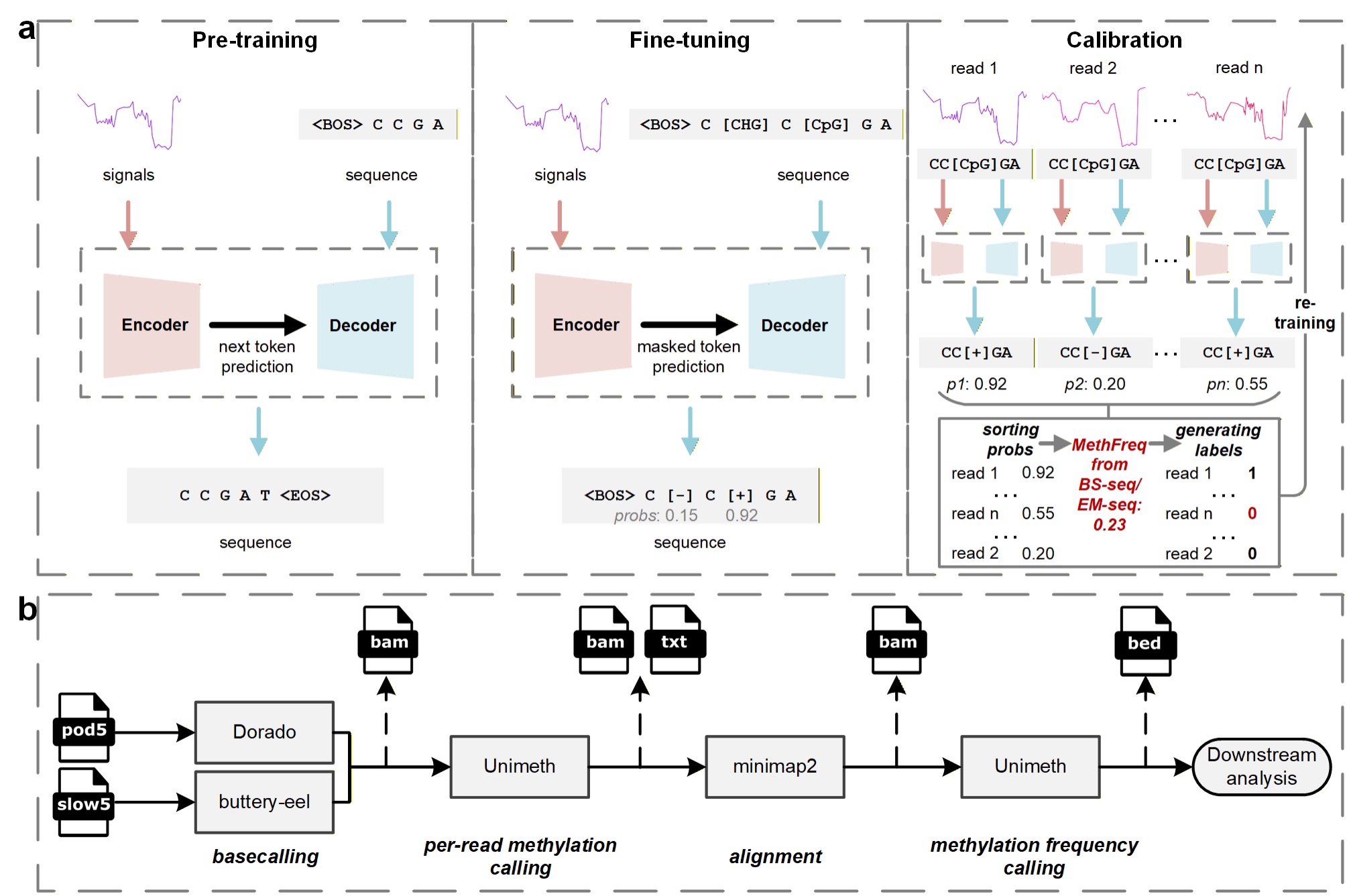
- Patch-Based Transformer: Captures contextual dependencies between neighboring methylation sites.
- Multi-Phase Training: Pre-training, read-level fine-tuning, and site-level calibration for robust performance.
- Low False Positive Rate: Especially effective in non-CpG contexts and low-methylation regions.
- Easy-to-Use: Standard input/output formats (POD5 and BAM, BED).
📦 Installation
Prerequisites
- Python 3.12+
- Dorado for basecalling
Option 1. Install from Source
git clone https://github.com/sekeyWang/Unimeth.git
cd Unimeth

conda create -n unimeth python=3.12
conda activate unimeth

pip install -e .
Option 2. Install via pip
conda create -n unimeth python=3.12
conda activate unimeth

pip install unimeth
Use unimeth -v to validate it successfully installed if it shows the version.
🚀 Quick Start
1. Download model checkpoints and sample data
- Model: Download
unimeth_r10.4.1_5kHz_5mC.ptfrom Google Drive to thecheckpointsfolder - Sample Data: Download the demo dataset using one of the following methods:
mkdir demo
pip install gdown
gdown --folder https://drive.google.com/drive/folders/1Gu7hgOQbHSUULG1MXjdE_qJ3na-6AdLi -O demo/
The demo dataset includes:
demo.bam- aligned readssubset_18.pod5- raw signal data
2. Basecalling and Alignment
Use dorado to basecall and align the nanopore reads (there is already a demo.bam file in the demo folder, this step is optional):
dorado basecaller --device cuda:all --recursive --emit-moves \
--reference /path/to/reference.fasta \
/path/to/dorado/models/dna_r10.4.1_e8.2_400bps_sup@v5.0.0 \
/path/to/subset_18.pod5 > demo.bam
3. Methylation Calling with Unimeth
Run Unimeth to detect methylation (use --accelerator to enable multi-GPUs if available):
# TSV output (default)
unimeth \
--pod5_dir demo/subset_18.pod5 \
--bam_dir demo/demo.bam \
--model_dir checkpoints/unimeth_r10.4.1_5kHz_5mC.pt \
--out_dir results/arab.tsv \
--output_format tsv \
--cpg 1 \
--chg 1 \
--chh 1 \
--batch_size 256 \
--pore_type R10.4.1 \
--frequency 5khz \
--dorado_version 0.71
# modBAM output
unimeth \
--pod5_dir demo/subset_18.pod5 \
--bam_dir demo/demo.bam \
--model_dir checkpoints/unimeth_r10.4.1_5kHz_5mC.pt \
--out_dir results/arab.bam \
--output_format bam \
--cpg 1 \
--batch_size 256 \
--pore_type R10.4.1 \
--frequency 5khz \
--dorado_version 0.71
Use --output_format both to generate TSV and modBAM simultaneously.
Output
Unimeth outputs read-level methylation calls in tsv or modBAM format. A sample TSV output is as follows:
| Chromosome | Ref pos | Strand | - | Read id | Read pos | Prob-positive | Prob-negative | Pred(0/1) | . |
|---|---|---|---|---|---|---|---|---|---|
| Chr2 | 15338477 | - | 9 | 28752a76-7007-40d7-8ede-f2939fe2ab26 | 0 | 0.985 | 0.014 | 0 | . |
| Chr2 | 15338471 | - | 5 | 28752a76-7007-40d7-8ede-f2939fe2ab26 | 6 | 0.990 | 0.009 | 0 | . |
| Chr2 | 15338465 | - | 6 | 28752a76-7007-40d7-8ede-f2939fe2ab26 | 12 | 0.998 | 0.001 | 0 | . |
| Chr2 | 15338462 | - | -1 | 28752a76-7007-40d7-8ede-f2939fe2ab26 | 15 | 0.998 | 0.001 | 0 | . |
| Chr2 | 15338457 | - | -1 | 28752a76-7007-40d7-8ede-f2939fe2ab26 | 20 | 0.999 | 0.000 | 0 | . |
The tsv file can be further processed to generate site-level methylation frequencies using the provided scripts/call_modification_frequency.py script, also can be converted to modBAM format using scripts/generate_5mC_modbam_file.py (only support 5mC now).
🧪 Models
We provide pre-trained models for:
- Plant 5mC (R10.4.1 5kHz, R9.4.1)
- Human CpG (R10.4.1 5kHz/4kHz, R9.4.1)
- 6mA Detection (R10.4.1)
Download models from the Google Drive page.
📊 Performance Highlights
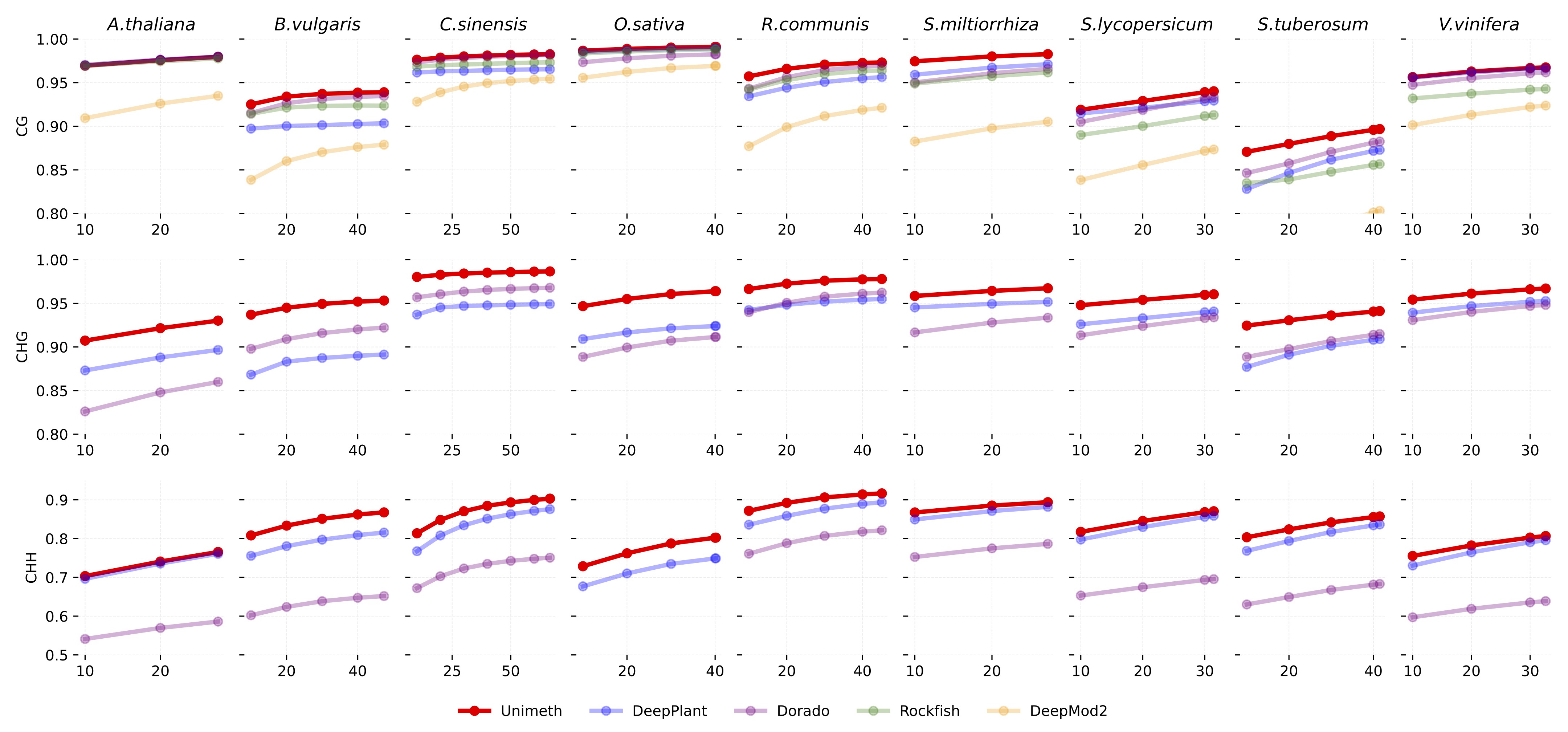
- Outperforms DeepPlant, Dorado, Rockfish, and DeepMod2 in cross-species benchmarks.
- Superior accuracy in repetitive regions (centromeres, transposons).
- Lower false positive rates in CHH and 6mA contexts.
- Robust to batch effects and unseen species.
For detailed benchmarks, see the manuscript.
📁 Input/Output Formats
| Input Format | Description |
|---|---|
| POD5 | Raw nanopore signals |
| BAM | Basecalled and aligned reads |
| Output Format | Description |
|---|---|
| tsv | Per-read methylation calls (--output_format tsv, default) |
| modBAM | BAM with MM/ML methylation tags (--output_format bam) |
| both | TSV and modBAM simultaneously (--output_format both) |
| bedmethyl | Site-level methylation frequencies (post-processing) |
📚 Citation
If you use Unimeth in your research, please cite:
Wang S, Xiao Y, Sheng T, et al. Unimeth: A unified transformer framework for accurate DNA methylation detection from nanopore reads[J]. bioRxiv, 2025: 2025.12.05.692231.
📄 License
This project is licensed under the BSD 3-Clause Clear License. See LICENSE for details.
📬 Contact
- GitHub Issues: https://github.com/sekeyWang/unimeth/issues
1 maintainer

Metadata
1 maintainer
Release files for unimeth 0.1.0
For a detailed explanation of source distributions (sdists) and built distributions (wheels), please see the package formats documentation.
Source distribution (sdist)
| File | Size | Uploaded | Provenance | Actions |
|---|---|---|---|---|
| unimeth-0.1.0.tar.gz | 54.2 kB | Without provenance | Details for unimeth-0.1.0.tar.gz |
Built distribution (wheel)
| File | Interpreter | ABI | Platform | Actions Reset |
|---|---|---|---|---|
| unimeth-0.1.0-py3-none-any.whl | Python 3 | none | any | Details for unimeth-0.1.0-py3-none-any.whl |
Total release size: 129.9 kB
Release files / unimeth-0.1.0.tar.gz
| Download URL | unimeth-0.1.0.tar.gz |
|---|---|
| Size | 54.2 kB |
| Tags | Source |
|
SHA-256 checksum How to use checksums |
259a5e8fab1505574d310908b5349f164ca7acd7b71e4a511f73816922f759ed
|
|
BLAKE2b-256 checksum How to use checksums |
e2c68de7f3b77ed054035c23855e05b6c03627746c2c26bebabacebef11a618c
|
| Upload date | |
|
Uploaded using Trusted Publishing? What is trusted publishing? |
No |
| Uploaded via |
twine/6.2.0 CPython/3.12.4
|
Release files / unimeth-0.1.0-py3-none-any.whl
| Download URL | unimeth-0.1.0-py3-none-any.whl |
|---|---|
| Size | 75.7 kB |
| Tags | Python 3 |
|
SHA-256 checksum How to use checksums |
d387e8f3bb2b60fbb222586c2061deb4d27dfbaae926f4f0589f6fbf16a866e9
|
|
BLAKE2b-256 checksum How to use checksums |
3f5565ac48dceec4c9f16b6b4211e49b67655844bb0332d373cadf9290574f85
|
| Upload date | |
|
Uploaded using Trusted Publishing? What is trusted publishing? |
No |
| Uploaded via |
twine/6.2.0 CPython/3.12.4
|
Security for unimeth 0.1.0
Provenance
Provenance describes where a file came from. On PyPI, provenance is shared via attestations, which provide a verifiable record of the build or publishing details. View details, limitations and caveats.
No provenance found
None of the files in this release were uploaded with provenance metadata.
A note on package security
PyPI is a repository for distributing packages, not a service for auditing them. While third-party security researchers and our staff do their best to detect and remove malicious packages, PyPI cannot guarantee the quality, security or suitability of any given package.
To learn more about protecting yourself from malicious actors, visit our package security documentation.














