






UniProtMapper 
Easily retrieve UniProt data and map protein identifiers using this Python package for UniProt's Retrieve & ID Mapping RESTful APIs. Read the full documentation.
📚 Table of Contents
⛏️ Features
UniProtMapper is a tool for bioinformatics and proteomics research that supports:
- Mapping any UniProt cross-referenced IDs to other identifiers & vice-versa;
- Programmatically retrieving any of the supported return and cross-reference fields from both UniProt-SwissProt and UniProt-TrEMBL (unreviewed) databases. For a full table containing all the supported resources, refer to the supported fields in the docs;
- Querying UniProtKB entries using complex field-based queries with boolean operators
~(NOT),|(OR),&(AND).
For the first two functionalities, check the examples Mapping IDs and Retrieving Information below. The third, see Field-based Querying.
The ID mapping API can also be accessed through the CLI. For more information, check CLI.
📦 Installation
From PyPI (recommended):
python -m pip install uniprot-id-mapper
Directly from GitHub:
python -m pip install git+https://github.com/David-Araripe/UniProtMapper.git
From source:
git clone https://github.com/David-Araripe/UniProtMapper
cd UniProtMapper
python -m pip install .
🛠️ Usage
Mapping IDs
Use UniProtMapper to easily map between different protein identifiers:
from UniProtMapper import ProtMapper

mapper = ProtMapper()

result, failed = mapper.get(
    ids=["P30542", "Q16678", "Q02880"], from_db="UniProtKB_AC-ID", to_db="Ensembl"
)
The result is a pandas DataFrame containing the mapped IDs (see below), while failed is a list of identifiers that couldn't be mapped.
| UniProtKB_AC-ID | Ensembl | |
|---|---|---|
| 0 | P30542 | ENSG00000163485.17 |
| 1 | Q16678 | ENSG00000138061.12 |
| 2 | Q02880 | ENSG00000077097.17 |
Retrieving Information
A DataFrame with the supported return fields is accessible through the attribute ProtMapper.fields_table:
from UniProtMapper import ProtMapper

mapper = ProtMapper()
df = mapper.fields_table
df.head()
| label | returned_field | field_type | has_full_version | type | |
|---|---|---|---|---|---|
| 0 | Entry | accession | Names & Taxonomy | - | uniprot_field |
| 1 | Entry Name | id | Names & Taxonomy | - | uniprot_field |
| 2 | Gene Names | gene_names | Names & Taxonomy | - | uniprot_field |
| 3 | Gene Names (primary) | gene_primary | Names & Taxonomy | - | uniprot_field |
| 4 | Gene Names (synonym) | gene_synonym | Names & Taxonomy | - | uniprot_field |
From the DataFrame, all return_field entries can be used to access UniProt data programmatically:
# To retrieve the default fields:
result, failed = mapper.get(["Q02880"])
>>> Fetched: 1 / 1

# Retrieve custom fields:
fields = ["accession", "organism_name", "structure_3d"]
result, failed = mapper.get(["Q02880"], fields=fields)
>>> Fetched: 1 / 1
Further, for the cross-referenced fields that have has_full_version set to yes, returning the same field with extra information is supported by passing <field_name>_full, such as xref_pdb_full.
All available return fields are also accessible through the attribute ProtMapper.supported_return_fields:
from UniProtMapper import ProtMapper
mapper = ProtMapper()
print(mapper.supported_return_fields)

>>> ['accession',
>>>  'id',
>>>  'gene_names',
>>>  ...
>>>  'xref_smart_full',
>>>  'xref_supfam_full']
Field-based Querying
UniProtMapper supports complex field-based protein queries using boolean operators (AND, OR, NOT) through the uniprotkb_fields module. This allows you to create sophisticated searches combining multiple criteria. For example:
from UniProtMapper import ProtKB
from UniProtMapper.uniprotkb_fields import (
    organism_name,
    length,
    reviewed,
    date_modified
)

# Find reviewed human proteins with length between 100-200 amino acids
# that were modified after January 1st, 2024
query = (
    organism_name("human") &
    reviewed(True) &
    length(100, 200) &
    date_modified("2024-01-01", "*")
)

protkb = ProtKB()
result = protkb.get(query)
For a list of all fields and their descriptions, check the API reference for the uniprotkb_fields module reference.
📖 Documentation
- Stable Branch Documentation (master branch)
- Development Documentation (dev branch)
💻 Command Line Interface (CLI)
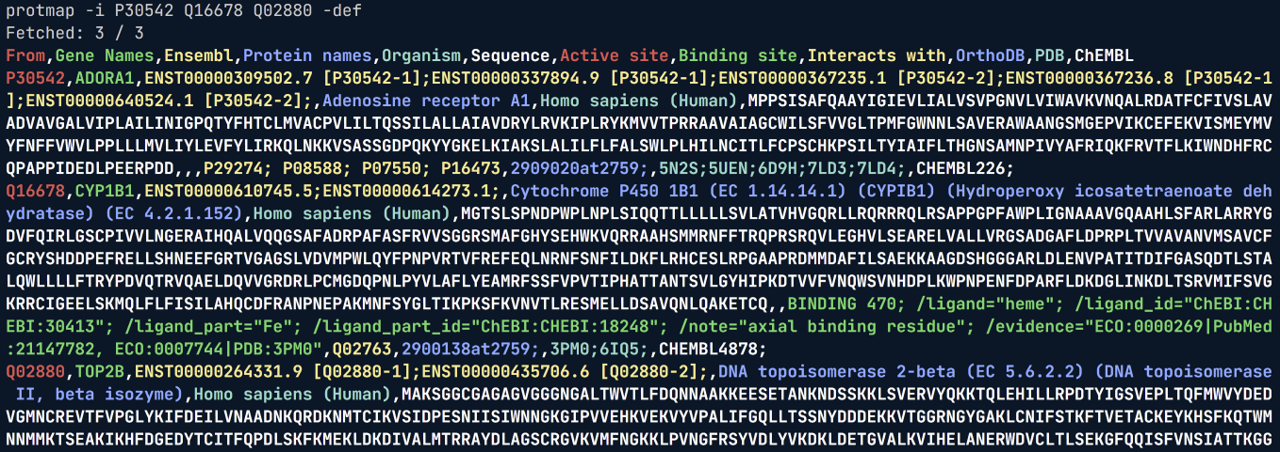
UniProtMapper provides a CLI for the ID Mapping class, ProtMapper, for easy access to lookups and data retrieval. Here is a list of the available arguments, shown by protmap -h:
usage: UniProtMapper [-h] -i [IDS ...] [-r [RETURN_FIELDS ...]] [--default-fields] [-o OUTPUT]
                     [-from FROM_DB] [-to TO_DB] [-over] [-pf]

Retrieve data from UniProt using UniProt's RESTful API. For a list of all available fields, see: https://www.uniprot.org/help/return_fields

Alternatively, use the --print-fields argument to print the available fields and exit the program.

optional arguments:
  -h, --help            show this help message and exit
  -i [IDS ...], --ids [IDS ...]
                        List of UniProt IDs to retrieve information from. Values must be
                        separated by spaces.
  -r [RETURN_FIELDS ...], --return-fields [RETURN_FIELDS ...]
                        If not defined, will pass `None`, returning all available fields.
                        Else, values should be fields to be returned separated by spaces. See
                        --print-fields for available options.
  --default-fields, -def
                        This option will override the --return-fields option. Returns only the
                        default fields stored in: <pkg_path>/resources/cli_return_fields.txt
  -o OUTPUT, --output OUTPUT
                        Path to the output file to write the returned fields. If not provided,
                        will write to stdout.
  -from FROM_DB, --from-db FROM_DB
                        The database from which the IDs are. For the available cross
                        references, see: <pkg_path>/resources/uniprot_mapping_dbs.json
  -to TO_DB, --to-db TO_DB
                        The database to which the IDs will be mapped. For the available cross
                        references, see: <pkg_path>/resources/uniprot_mapping_dbs.json
  -over, --overwrite    If desired to overwrite an existing file when using -o/--output
  -pf, --print-fields   Prints the available return fields and exits the program.
Usage example, retrieving default fields from <pkg_path>/resources/cli_return_fields.txt:
👏🏼 Credits
- UniProt for providing the API and the amazing database;
- Andrew White and the University of Rochester for the protein emoji;
For issues, feature requests, or questions, please open an issue on the GitHub repository.
1 maintainer

Metadata
1 maintainer
Release files for uniprot-id-mapper 1.1.5
For a detailed explanation of source distributions (sdists) and built distributions (wheels), please see the package formats documentation.
Built distribution (wheel)
| File | Interpreter | ABI | Platform | Reset |
|---|---|---|---|---|
| uniprot_id_mapper-1.1.5-py3-none-any.whl | Python 3 | none | any | Details |
Release files / uniprot_id_mapper-1.1.5-py3-none-any.whl
| Download URL | uniprot_id_mapper-1.1.5-py3-none-any.whl |
|---|---|
| Size | 46.0 kB |
| Tags | Python 3 |
|
SHA-256 checksum How to use checksums |
dc8627ea24ec1dfe1a07783dc05195db0751270ab9342ef1a1091dcfe4b04f7f
|
|
BLAKE2b-256 checksum How to use checksums |
11c265600302d40dadd0aca374823ede7bb073dbbd3cb78aa1c283eebe9cbe18
|
| Upload date | |
|
Uploaded using Trusted Publishing? What is trusted publishing? |
No |
| Uploaded via |
twine/6.2.0 CPython/3.10.18
|
Security for uniprot-id-mapper 1.1.5
Provenance
Provenance describes where a file came from. On PyPI, provenance is shared via attestations, which provide a verifiable record of the build or publishing details. View details, limitations and caveats.
No provenance found
None of the files in this release were uploaded with provenance metadata.
A note on package security
PyPI is a repository for distributing packages, not a service for auditing them. While third-party security researchers and our staff do their best to detect and remove malicious packages, PyPI cannot guarantee the quality, security or suitability of any given package.














