
Security protocols for estimating adversarial robustness of machine learning models for both tabular and image datasets. This package implements a set of evasion attacks based on heuristic optimization algorithms, and complex cost functions to give reliable results for tabular problems.

Project description
Universal Evasion Attacks
This repository contains the final code associated to my master's thesis "Heuristic-based Evasion Attacks on State-of-the-art Near-perfect Machine Learning Classifiers", supervised by Pr. Jean-Michel Dricot, president of jury for the cybersecurity master's degree at the Université Libre de Bruxelles.
Context
An evasion attack is a process that aims to find a perturbation of the input data that is small enough to be imperceptible to a human, but that is sufficient to change the prediction of a machine learning model. It has been proven in several articles that deep neural networks for image classification are particularly sensitive to such attacks, leading to very dangerous situations in the context of security (e.g., driverless cars) and privacy (e.g., face recognition).
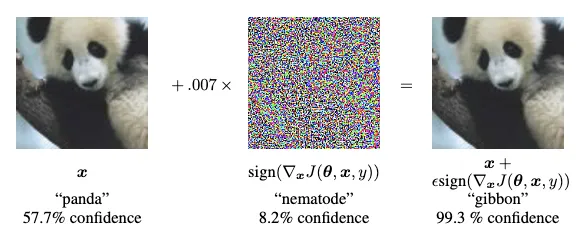
Image source: Explaining and Harnessing Adversarial Examples
Evasion attacks on image classifiers were widely used, but tabular data classifiers are also sensitive to such attacks, and the literature is considerably less developed in this area. The goal of this thesis was to develop a set of versatile evasion attacks that can be applied on both image and tabular data classifiers (hence the term "universal"), with a particular focus on the latter. A series of different constraints types can be considered by the algorithms (equalities, inequalities, ...), allowing the evasion attacks to be implemented in realistic black-box and white-box scenarios (in particular, decision-based and transfer-based attacks).
Content
This package contains security protocols for estimating adversarial robustness of machine learning models for both tabular and image datasets. It implements a set of evasion attacks based on heuristic optimization algorithms, and complex cost functions to give reliable results for tabular problems. Three protocols can be distinguished:
-
Image protocol: this protocol is designed to evaluate the robustness of image classifiers. It uses the L2 norm as a cost function.
-
Profit protocol: this protocol is designed to evaluate the robustness of tabular data classifiers, where the success of the attack can be estimated through a gain-cost approach. This implies that the features of the dataset are interpretable enough so that a custom cost function can be built in a reasonable time. This does not apply to "obscure" tabular datasets, where it is almost impossible to build such profit functions.
-
HAR protocol: for the latter case, the HAR protocol is used. "HAR" stands for Heuristic Adversarial Robustness. This metric goes from 0 to 1, with 1 being a "perfect" robustness, and 0.5 corresponding to a mediocre robustness. It uses several complex statistical metrics to evaluate the success of the attack (including feature importance towards the target class), even when the features are not interpretable. This protocol can only be used in targeted evasion attacks. It comes with a series of checks that ensure the reliability of the results before applying the algorithms. All details about cost functions and metrics can be found in the thesis at chapter 5.
The two first protocols are merged in a single function "master.protocols.custom_cost_protocol", in which the user can choose the protocol to use. The HAR protocol is implemented in the "master.protocols.HAR_protocol" function.
The following subfolders are present in the repository:
-
attacks: contains heuristic attacks algorithms, wrapped into classes. HillClimbing, SimulatedAnnealing and TabuSearch are fully implemented, the other attacks are still in development.
-
master: contains the "Master" class, which allows to automate several processes and change the global parameters of the attacks, neighborhoods and default machine learning classifiers. It also contains the "protocols.py" script, in which "HAR_protocol" and "custom_cost_protocol" are defined.
-
neighborhoods: contains neighborhood classes associated with heuristic attacks. The choice of the neighborhood is independent of the choice of the attack. Only the "Radar" neighborhood is fully implemented for the moment, but it is versatile enough to be used with any attack.
This library was successfully tested on several datasets with different attack and machine learning classifiers (including image classifiers and tabular data classifiers). Please note that attacks on deep neural networks were not tested, but it should work as well as any other classifier with the implemented code.
Dependencies
Please note that there are several dependencies to run the code. The following libraries are required (we do not force the version of the libraries, but the code was tested with the following versions):
-
Python version: 3.13.0 (tags/v3.13.0:60403a5, Oct 7 2024, 09:38:07) [MSC v.1941 64 bit (AMD64)]
-
pandas: 2.2.3
-
numpy: 2.1.3
-
seaborn: 0.13.2
-
tqdm: 4.67.0
-
xgboost: 2.1.2
-
lightgbm: 4.5.0
-
sklearn: 1.5.2
-
optuna: 4.0.0
-
joblib: 1.4.2
-
seaborn: 0.13.2
-
matplotlib: 3.9.2
Simple example
Here is a simple example of how to use the library. The complete juptyer notebook I used to generate results for chapter 6 of my master's thesis is available in the "examples" folder. Please not however that the data dependencies are not included in the repository.
# Dataset contained in a pandas format. All categorical features must be numerically encoded.

X, y = my_dataframe.drop(columns=["target"]), my_dataframe["target"]


# Define the constraints for your specific evasion problem

my_constraints = {

    "equality": ["x[4] = 0.0", "x[5] = 0.0", "x[6] = 1.0"], # cannot change the values of these features

    "inequality": ["x[2] >= x[1]"], # (inequality constaints were fully implemented but not tested yet)

    "clip_min": list(X.quantile(0.01)),

    "clip_max": list(X.quantile(0.99)),

    "categorical": [None]*(X.shape[1]) # this means you don't have any categorical features

}


# Apply the HAR protocol

results = HAR_protocol(X=X, y=y, # The only mandatory arguments

                target_class=0, # The class you want to "look like"

                constraints=my_constraints, # Optional. Default will only take 0.01 and 0.99 clipping constraints

                verbose=2, # Optional. 0: no print, 1: print main steps, 2: print everything

                ) # If no model is provided, a default model is used (LightGBM)


# Save the results in a pandas dataframe

results_df = pd.DataFrame([results], columns=["HAR", "confidence_score", "adversarial_accuracy", "avg_likelihood", "max_likelihood"])
The evasion attacks contain multiple parameters. The default parameter configurations can be found in "master.master_params.json". They can be changed by the Master class:
master = Master(params_file='../master/master_params.json', verbosity=1) # execute once


# Step 1: Inspection

for key, value in master.params["attack"]["HillClimbing"].items():

    print(key, ":", value)


# Step 1: Modification

master.update_params("attack", "HillClimbing", {"dynamic_perturbation_factor": 1.05})

print(f"\nNew dynamic perturbation factor: {master.params["attack"]["HillClimbing"]["dynamic_perturbation_factor"]}")


# Step 3: Rollback (at the end of the experiment)

master.rollback_json(category="attack", name="HillClimbing")
Compatibility with ART
This library is compatible with the Adversarial Robustness Toolbox (ART) library. To include specific ART attacks in the protocols, you simply need to wrap those attacks inside an Attack child class containing an appropriate "run" method (see the "attacks" folder). This might involve some work, but it is feasible in a reasonable time. After that, you can use the attack in the protocols as any other attack:
results = custom_cost_protocol(X=X, y=y,

                targeted=False,

                images=True,

                image_shape=my_image_shape,

                constraints=my_constraints, # Will not be considered by your ART attack unless you modify it

                attacks = [MyCustomARTAttack(), HillClimbing(), SimulatedAnnealing()],

                verbose=2

                )
Contributions
This library is still in development. If you want to contribute, please feel free to fork the repository and submit a pull request. I will be happy to review it. The main areas of improvement are the following:
-
Finish the implementation of the neighborhoods Flower and Lightning in the "neighborhoods" folder according the their respective descriptions in chapter 3 of my thesis.
-
Finish the implementation of the attacks in the "attacks" folder.
-
Test the inequality constraints (those are implemented in the neighborhoods mother class)
-
Improve ART compatibility
-
Test with deep neural networks
-
Compare evasion attacks performances with other tabular evasion attacks like LowProFool
-
Improve the HAR protocol if necessary
-
Implement other protocols for obscure tabular datasets if necessary
-
Optimizing the code for better performance if possible
License
This code is distributed under the MIT license. Feel free to use it for your own research, but please cite the thesis "Heuristic-based Evasion Attacks on State-of-the-art Near-perfect Machine Learning Classifiers" by Alexandre Le Mercier (will be published later in 2025) if you use it in a publication.
Happy coding!


Download files
Download the file for your platform. If you're not sure which to choose, learn more about installing packages.
Source Distribution
Built Distribution
Filter files by name, interpreter, ABI, and platform.
If you're not sure about the file name format, learn more about wheel file names.
Copy a direct link to the current filters
File details
Details for the file universal_evasion_attacks-0.1.3.tar.gz.
File metadata
- Download URL: universal_evasion_attacks-0.1.3.tar.gz
- Upload date:
- Size: 7.3 kB
- Tags: Source
- Uploaded using Trusted Publishing? No
- Uploaded via: twine/4.0.2 CPython/3.9.2
File hashes
| Algorithm | Hash digest | |
|---|---|---|
| SHA256 |
25d106b1a40a031d9e8a7d7b8388c4c7cd9a19a7448e96b21b48e7bc749ae818
|
|
| MD5 |
856b41156b8b27edebd1d07c138bc502
|
|
| BLAKE2b-256 |
8514ab59f8d75e9ba745ae74faf72e8303e5bd6933d91d6f28a46df6d11b4c43
|
File details
Details for the file universal_evasion_attacks-0.1.3-py3-none-any.whl.
File metadata
- Download URL: universal_evasion_attacks-0.1.3-py3-none-any.whl
- Upload date:
- Size: 6.5 kB
- Tags: Python 3
- Uploaded using Trusted Publishing? No
- Uploaded via: twine/4.0.2 CPython/3.9.2
File hashes
| Algorithm | Hash digest | |
|---|---|---|
| SHA256 |
eb658897f3e41b35bcc00959affe53b4276d797065a8448951a51001b13aa0cf
|
|
| MD5 |
e989510ed92965ebedefeefd9ba4658e
|
|
| BLAKE2b-256 |
eb947ce905d88e863bec43afd35b5f236e4b1aaf20e0a80516f7bccc92fd2428
|






