
Universal PII Firewall (UPF)




A privacy firewall that strips PII from text and documents before they reach any LLM or external API — running entirely on your machine, with no network calls, no API keys, and no cloud dependencies.
When you send a document to an LLM, you risk leaking names, ID numbers, financial data, and contact details. Traditional regex tools miss multilingual PII, OCR noise, and content embedded in images. UPF sits between your data and any downstream service, intercepts sensitive content locally, and hands back a clean payload.
The Problem It Solves
Developers integrating LLMs into document workflows face a hard compliance problem: the moment a user's data leaves the system boundary, GDPR, HIPAA, and similar obligations apply to the receiving service. Most LLM providers process inputs on remote infrastructure. UPF is the gate that ensures PII never reaches that boundary in the first place.
- Intercepts names, IDs, financial data, and contact info before any API call
- Works on raw text, OCR output, and scanned image files
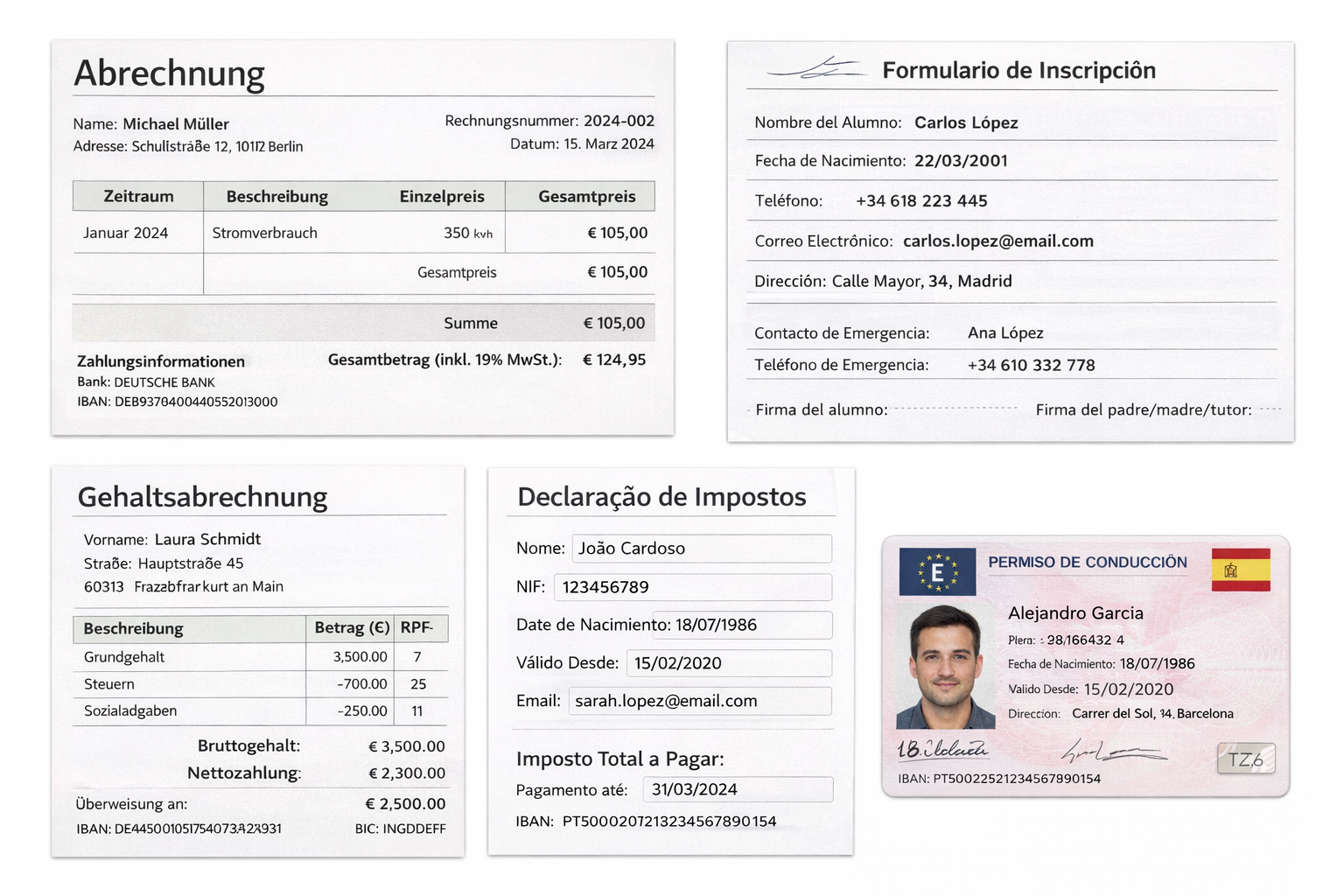
- Handles multilingual input (EN, ES, PL, PT, PT-BR, FR, DE, NL, IT) and OCR noise
- No LLM or cloud API required — all detection runs locally with deterministic rules and optional local ML
How It Works
[Your document / image]
        ↓
  OCR (optional, Tesseract — only if no text provided)
        ↓
  Multi-layer PII detection
  ├── Deterministic  — IBAN, credit card, national ID checksums
  ├── Regex + context — emails, phones, addresses, secrets, URLs
  ├── Multilingual keywords — name/address cues in 9 languages
  └── Optional ML NER — spaCy (local model, no API)
        ↓
  Redaction engine
  ├── Text  — label / mask / partial / pseudonym / skeleton
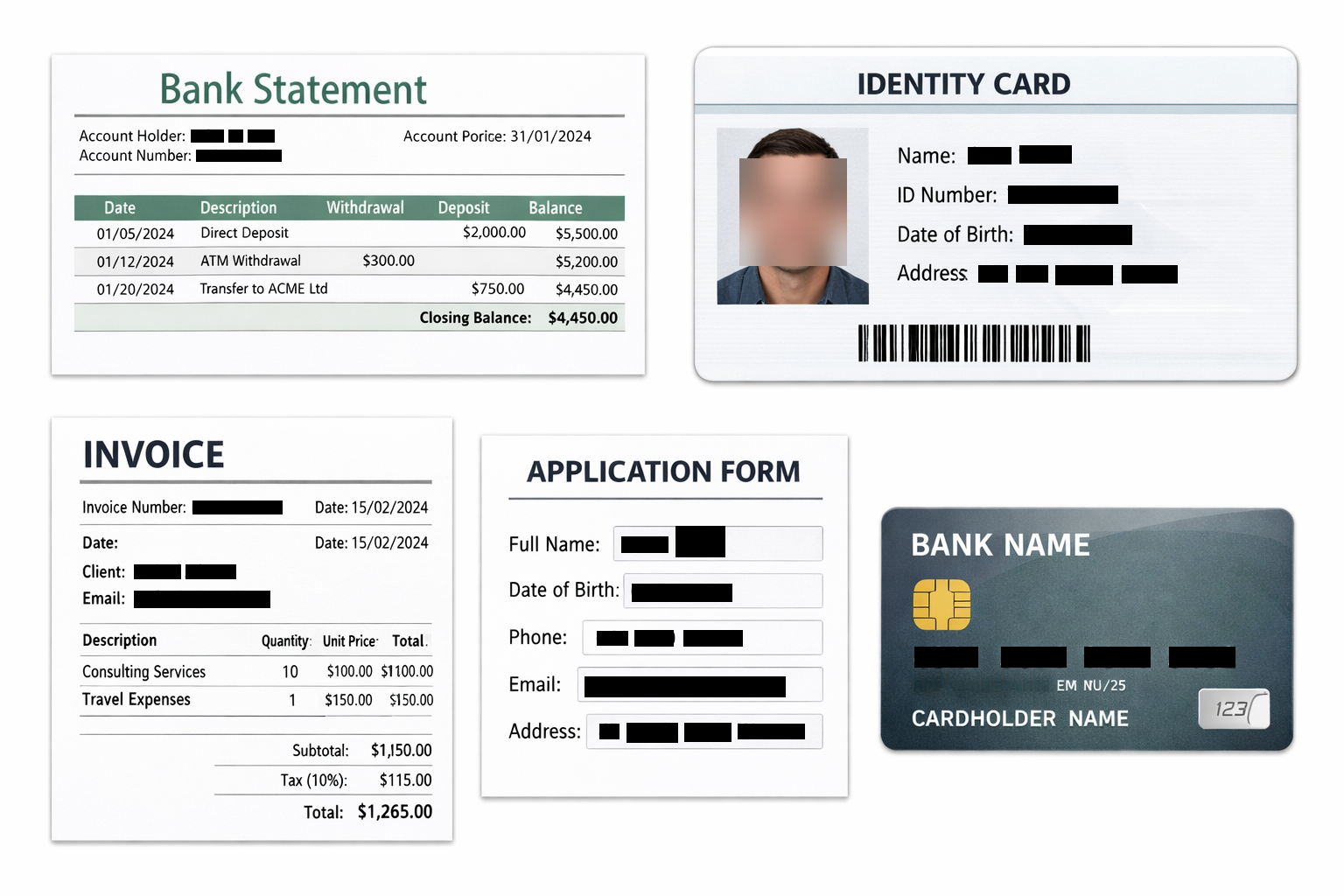
  └── Image — black-box overlay, face blur, signature blur
        ↓
  [Safe payload — ready for LLM, storage, or downstream service]
No data leaves your system at any stage. The core package has zero required dependencies.
Install
Core package:
pip install universal-pii-firewall
Optional extras:
# OCR/image text extraction + image redaction
pip install "universal-pii-firewall[image]"

# Optional face blur for image pipeline
pip install "universal-pii-firewall[face]"

# Optional ML NER layer
pip install "universal-pii-firewall[ml]"

# Dev and release tooling
pip install "universal-pii-firewall[dev]"
Quick Start
Text sanitization
from upf import sanitize_text

text = "Alice Smith paid with 4111-1111-1111-1111 and emailed alice@example.com"
print(sanitize_text(text))
# -> [REDACTED:NAME] paid with [REDACTED:CREDIT_CARD] and emailed [REDACTED:EMAIL]
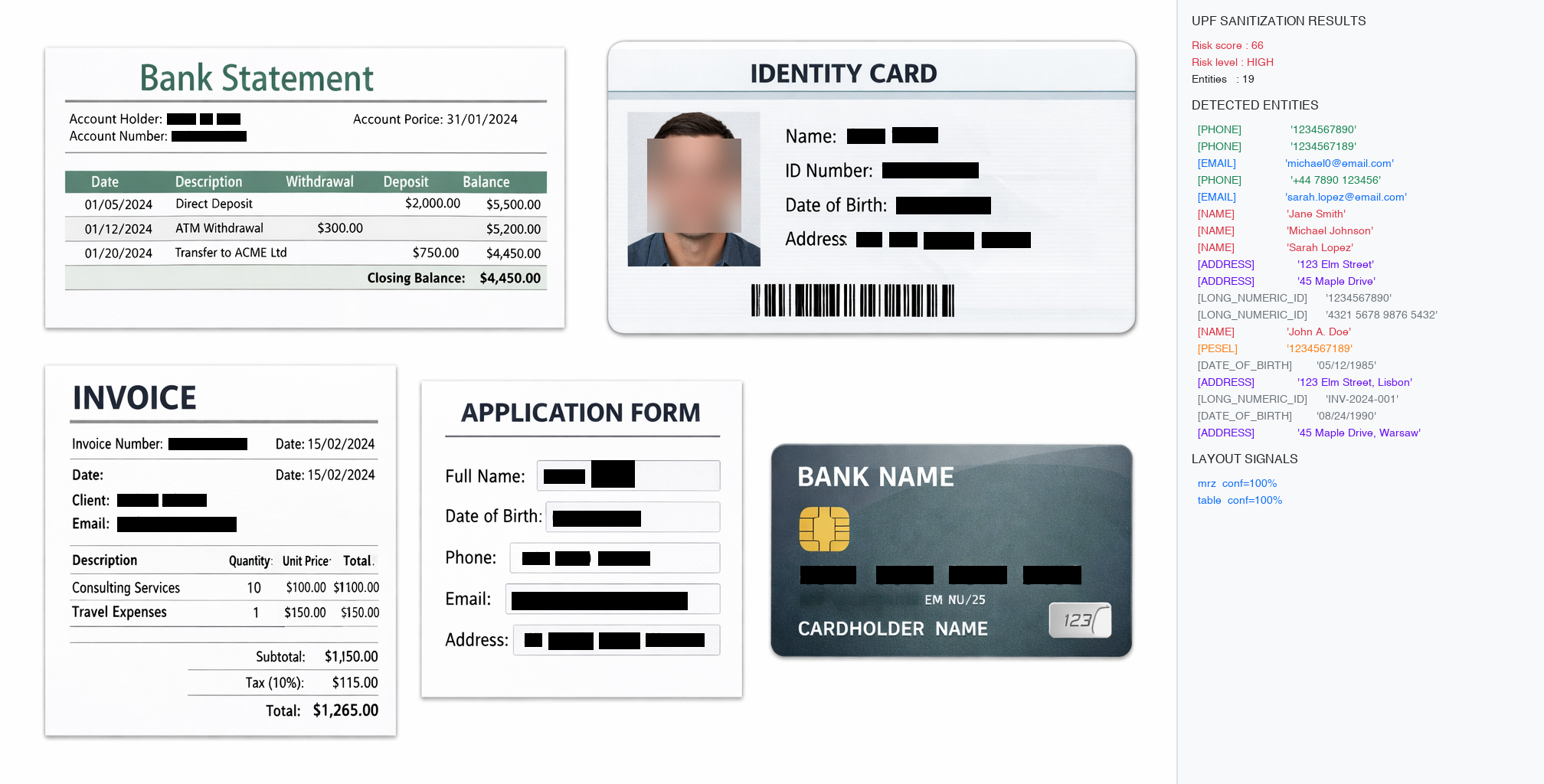
For a long-form, realistic before/after example (with risk score and detected entities),
run examples/text_example.py --mode detailed.
OCR text sanitization
from upf import sanitize_image

ocr_text = "John Doe IBAN DE89370400440532013000"
print(sanitize_image(ocr_text))
Image bytes sanitization
from upf import sanitize_image_bytes

with open("examples/inputs/1.png", "rb") as f:
    image_bytes = f.read()

result = sanitize_image_bytes(
    image_bytes,
    ocr_text="John Doe paid with 4111 1111 1111 1111 and email john@example.com",
)
print(result.sanitized_text)
print(result.risk_score, result.risk_level)
Optional face blur
from upf import UPFConfig, sanitize_image_bytes

cfg = UPFConfig(blur_faces=True, face_blur_strength=31)
with open("examples/inputs/2.png", "rb") as f:
    result = sanitize_image_bytes(
        f.read(),
        ocr_text="Alice Smith alice@example.com",
        config=cfg,
    )
Optional signature blur
Detects handwritten signature regions via contour heuristics and blurs them.
Requires the face extra (OpenCV).
from upf import UPFConfig, sanitize_image_bytes

cfg = UPFConfig(blur_signatures=True, signature_blur_strength=31)
with open("examples/inputs/1.png", "rb") as f:
    result = sanitize_image_bytes(
        f.read(),
        ocr_text="Signed by John Doe on 2026-03-06",
        config=cfg,
    )
Both face and signature blur can be combined:
cfg = UPFConfig(
    blur_faces=True,
    face_blur_strength=51,
    blur_signatures=True,
    signature_blur_strength=31,
)
Enable via environment variables in image_example.py --mode detailed:
UPF_BLUR_FACES=true UPF_BLUR_SIGNATURES=true uv run python examples/image_example.py --mode detailed
If you omit ocr_text, install the image extra and ensure Tesseract OCR is available on your system.
Configuration Knobs
All options with their defaults:
from upf import UPFConfig, RedactionMode

cfg = UPFConfig(
    # Detection toggles
    redact_names=True,
    redact_emails=True,
    redact_phones=True,
    redact_ibans=True,
    redact_credit_cards=True,
    redact_secrets=True,
    redact_addresses=True,
    redact_urls=True,
    redact_numeric_ids=True,
    redact_national_ids=True,   # NATIONAL_ID, PT_NISS, PT_NIF, BR_CPF
    redact_organizations=True,

    # Detector layers
    use_ml_ner=True,
    use_multilingual=True,
    use_relationship_detector=True,

    # Image behavior (requires [face] extra)
    blur_faces=False,
    face_blur_strength=51,
    blur_signatures=False,
    signature_blur_strength=23,

    # Redaction output format: label | mask | partial | pseudonym | skeleton
    redaction_mode=RedactionMode.LABEL,

    # Risk policy
    risk_mode="legacy",         # "legacy" | "threshold"
    low_threshold=0.40,
    high_threshold=0.75,
    block_high_risk=False,
)
Public API Reference
Stable exported interface from upf:
sanitize_textsanitize_text_with_detailssanitize_imagesanitize_image_bytessanitize_image_base64secure_llm_callSecureLLMResultUPFConfigRedactionModePseudonymSessionHighRiskBlockedErrorImageSanitizeResultTextSanitizeResult
Benchmark Methodology and Results
Text benchmark metrics below are from the included dataset and scripts:
- Command:
uv run python benchmarks/run_tests.py - Command:
uv run python benchmarks/run_tests_strict.py - Interpreter: Python 3.11.14
- Measurement date: March 6, 2026
- Dataset size: 74 labeled text cases (
text,multilingual,edge_cases)
Measured results:
| Metric | Value |
|---|---|
| Cases | 74 |
| Precision | 0.9733 |
| Recall | 1.0000 |
| Avg latency (ms) | 0.2495 |
| P95 latency (ms) | 0.3505 |
| Strict F1 | 0.9865 |
Language coverage in this dataset: EN, ES, PL, PT, PT-BR.
Image precision/recall benchmark is not published yet because labeled image sidecar cases are currently absent (benchmarks/run_image_tests.py reports 0 cases).
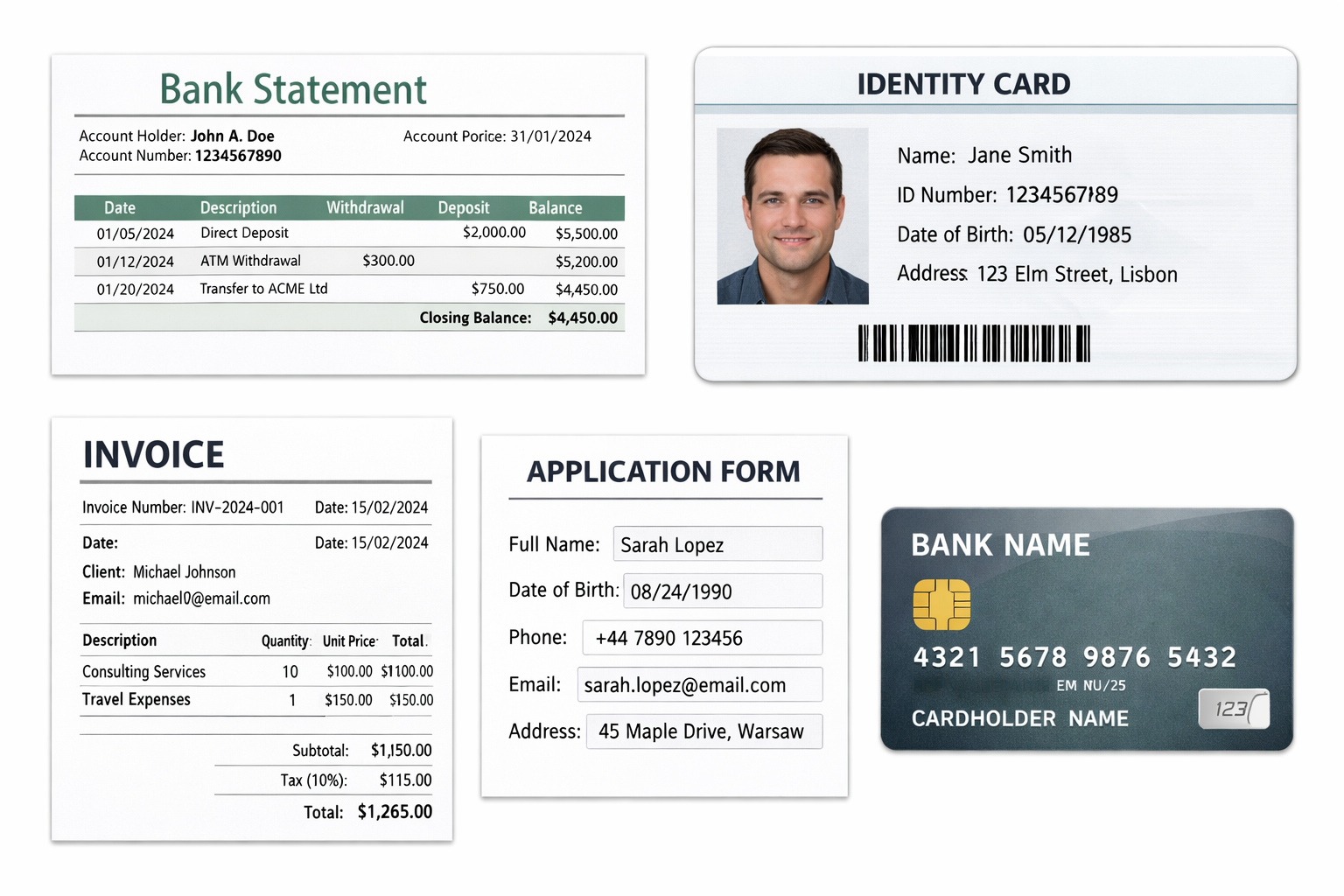
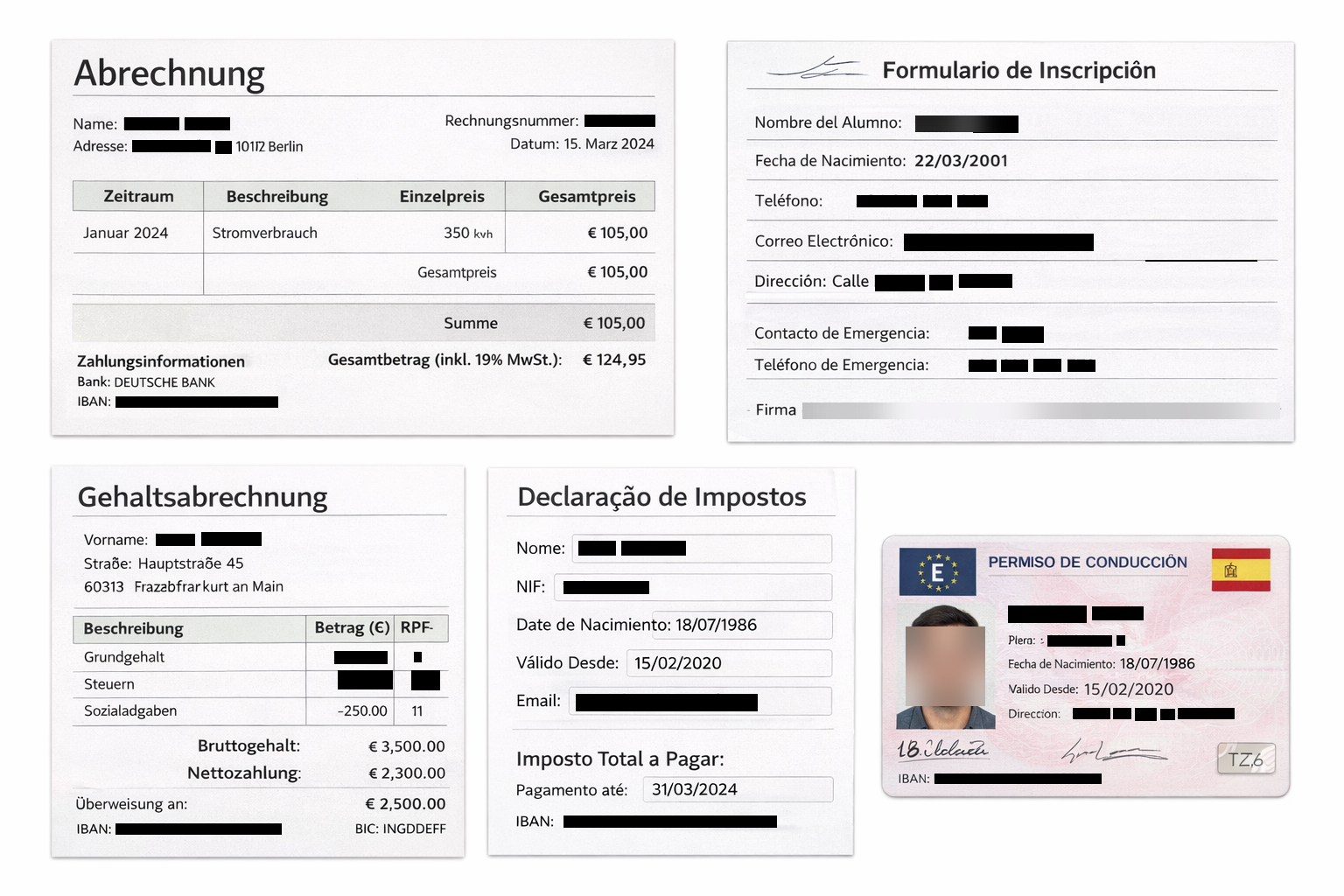
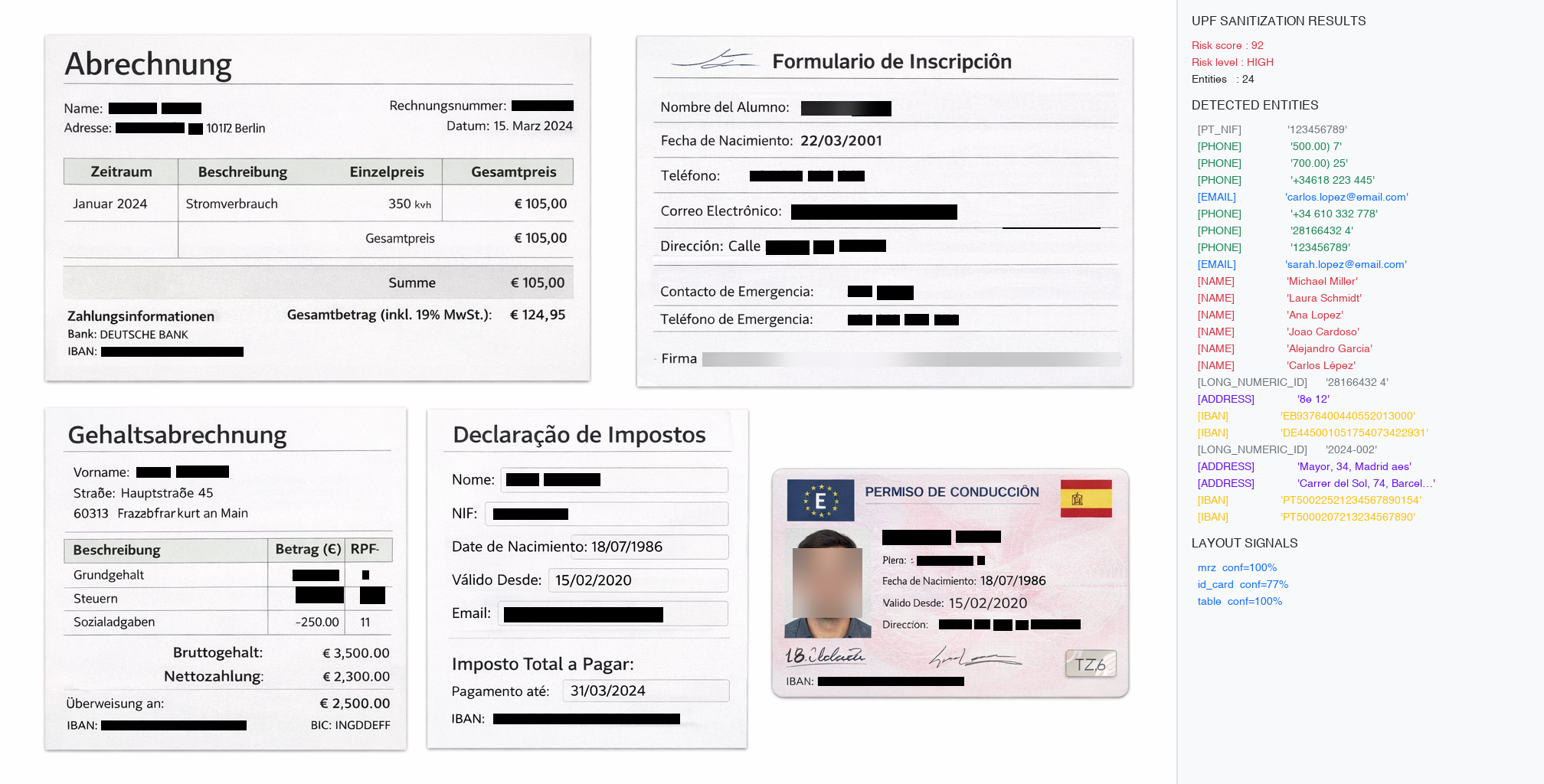
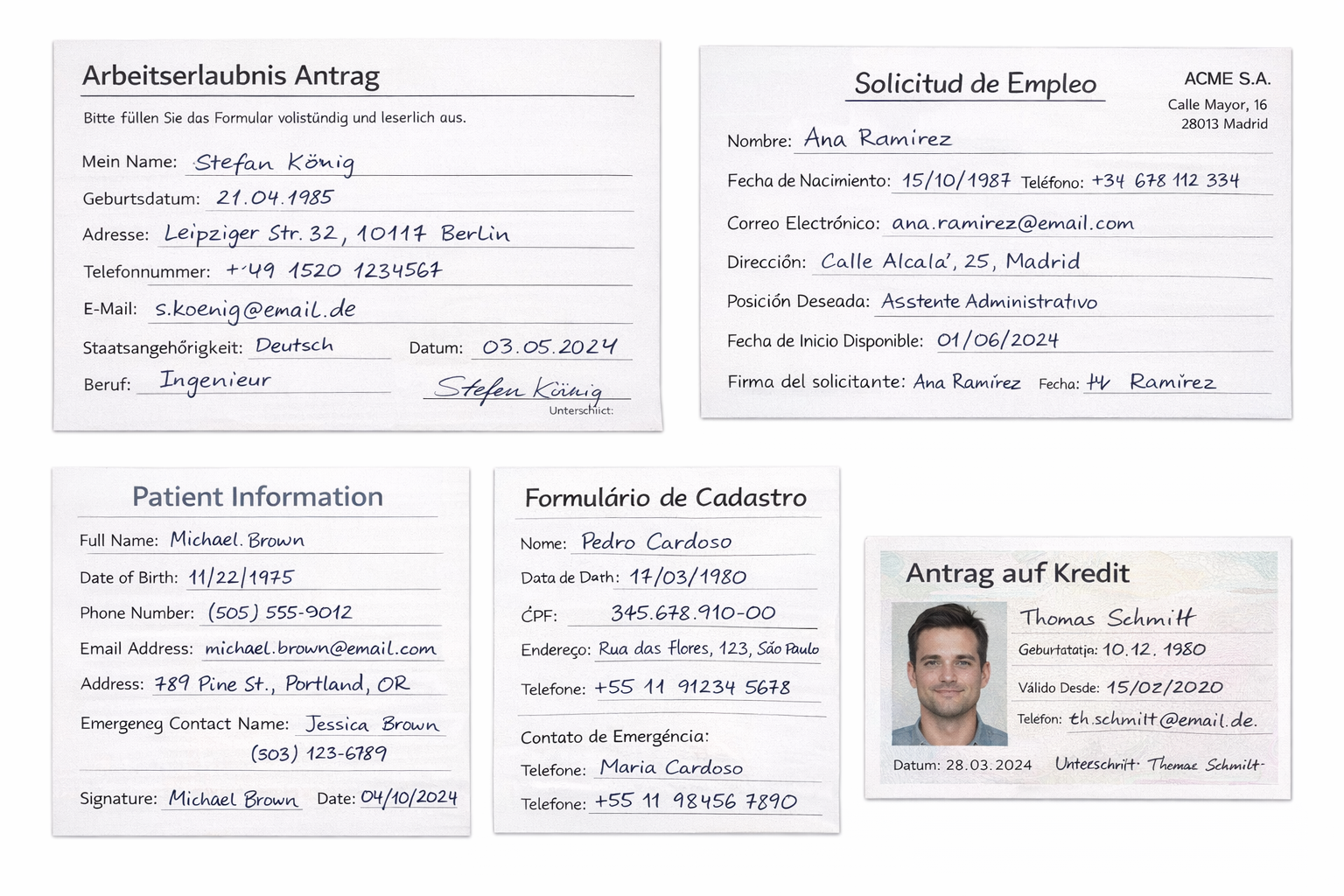
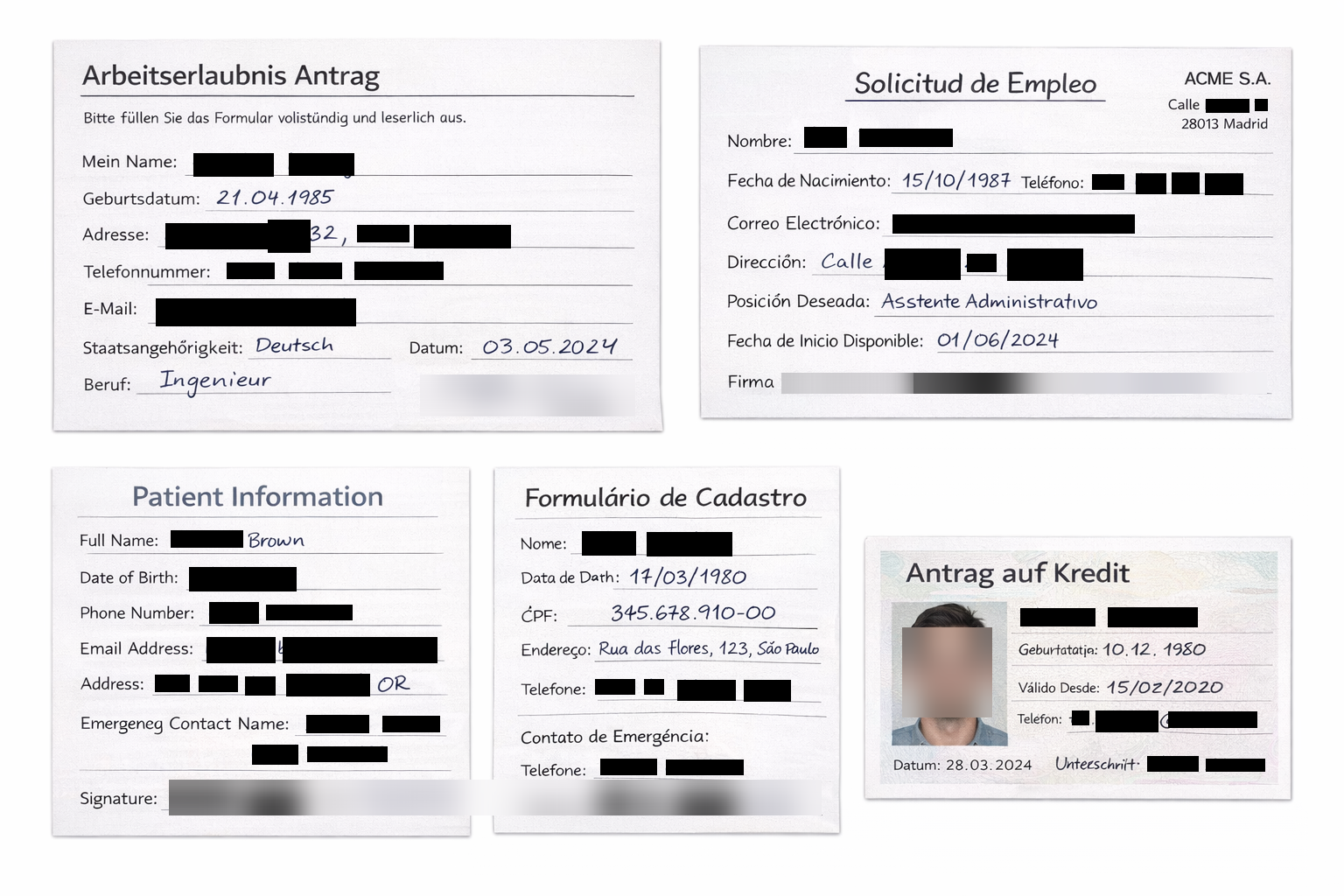
Showcase Gallery
Sample assets are included under examples/inputs/ and examples/outputs/.
Case 1
| Input | Redacted | Results Panel |
|---|---|---|
 |
 |
 |
Case 2
| Input | Redacted | Results Panel |
|---|---|---|
 |
 |
 |
Case 3
| Input | Redacted | Results Panel |
|---|---|---|
 |
 |
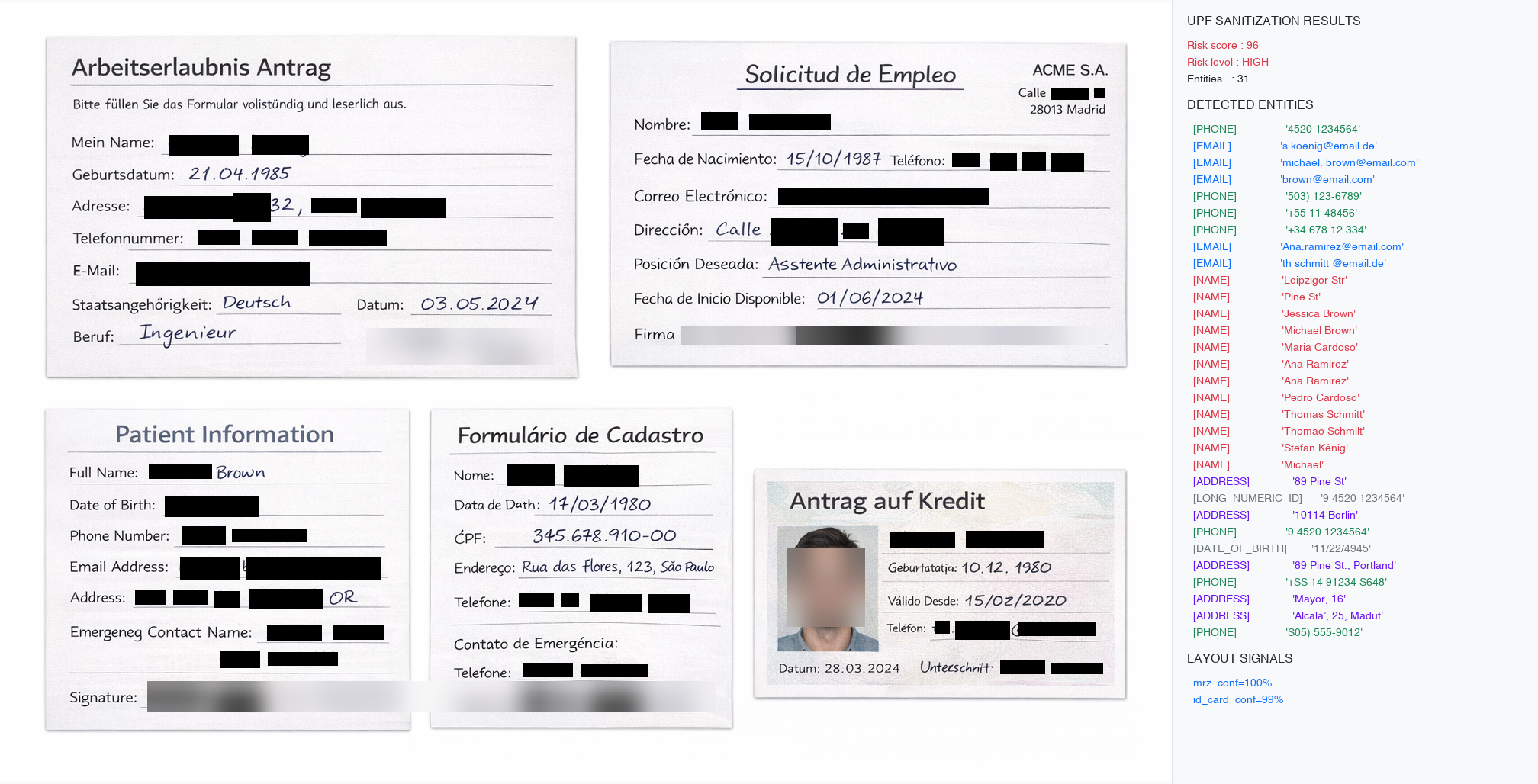 |
Running Local Examples
From repository root:
uv run python examples/text_example.py --mode quick
uv run python examples/text_example.py --mode detailed
uv run python examples/image_example.py --mode quick
uv run python examples/image_example.py --mode detailed
image_example.py --mode detailed requires the image extra and image inputs in examples/inputs/.
Limitations
- Image benchmark precision/recall is not yet formalized due to missing labeled sidecar cases.
- OCR quality directly affects image-text extraction quality.
- Optional ML detector (
[ml]) depends on external model/runtime availability.
License
Apache License 2.0.
1 maintainer

Metadata
1 maintainer
Release files for universal-pii-firewall 0.2.0
For a detailed explanation of source distributions (sdists) and built distributions (wheels), please see the package formats documentation.
Source distribution (sdist)
| File | Size | Uploaded | |
|---|---|---|---|
| universal_pii_firewall-0.2.0.tar.gz | 51.4 kB | Details |
Built distribution (wheel)
| File | Interpreter | ABI | Platform | Reset |
|---|---|---|---|---|
| universal_pii_firewall-0.2.0-py3-none-any.whl | Python 3 | none | any | Details |
Total release size: 114.6 kB
Release files / universal_pii_firewall-0.2.0.tar.gz
| Download URL | universal_pii_firewall-0.2.0.tar.gz |
|---|---|
| Size | 51.4 kB |
| Tags | Source |
|
SHA-256 checksum How to use checksums |
ebccd0792e393e9f508213a27f9c5fa53df7cf05bea482c70505b18178bf2a0b
|
|
BLAKE2b-256 checksum How to use checksums |
89d6bab522c09cd3a7c4cec34ad153e0ee66edfc578828f476ee548f98455f65
|
| Upload date | |
|
Uploaded using Trusted Publishing? What is trusted publishing? |
No |
| Uploaded via |
twine/6.2.0 CPython/3.11.14
|
Release files / universal_pii_firewall-0.2.0-py3-none-any.whl
| Download URL | universal_pii_firewall-0.2.0-py3-none-any.whl |
|---|---|
| Size | 63.2 kB |
| Tags | Python 3 |
|
SHA-256 checksum How to use checksums |
fce014dd594f846054fe05c37848062568970b6470188dbb5cf342f72367ba1b
|
|
BLAKE2b-256 checksum How to use checksums |
b506a9473bf7713a913c42e7318dd85863f197ba47de091921b644de3b5d414e
|
| Upload date | |
|
Uploaded using Trusted Publishing? What is trusted publishing? |
No |
| Uploaded via |
twine/6.2.0 CPython/3.11.14
|














