
UniVI








UniVI integrates single-cell modalities measured in the same cells (RNA, surface protein, chromatin accessibility, DNA methylation, and others) into one latent space. Each modality has its own encoder and decoder, so a trained model can align cells across assays, predict one modality from another, map new single-modality datasets onto a multimodal reference, and generate cells.
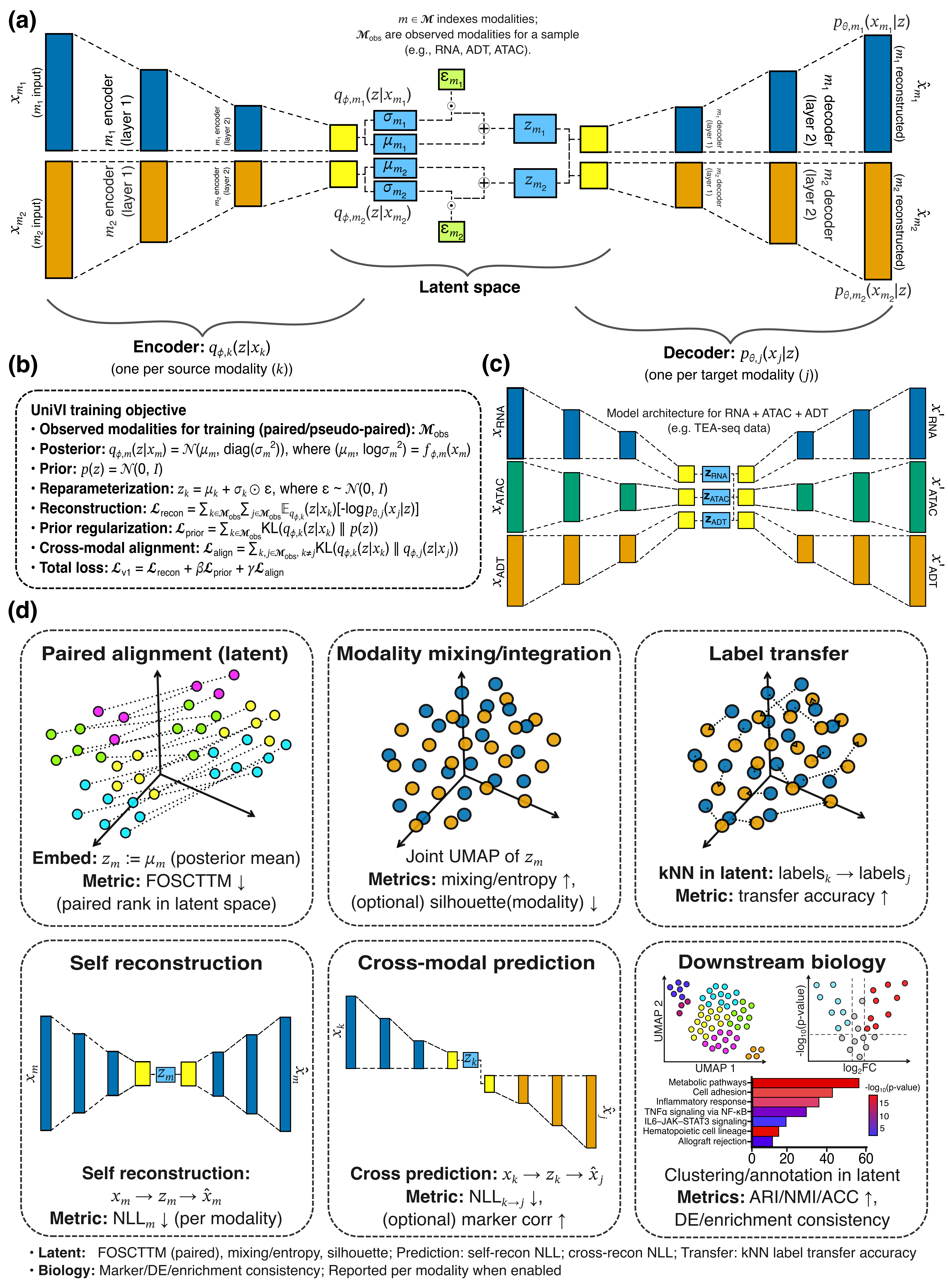
Documentation, tutorials, and API reference: univi.readthedocs.io
Installation
pip install univi                      # or: conda install -c conda-forge univi
pip install "univi[tutorials]"         # adds Jupyter and scikit-misc for the tutorials
UniVI requires PyTorch. If import torch fails, or you need a specific CUDA build, install PyTorch first from pytorch.org.
Quickstart
Train on paired RNA + ATAC from 10x Multiome PBMCs (downloaded and cached on first use), then embed held-out cells and predict their gene expression from chromatin accessibility:
import torch
import univi.datasets as uds
from univi import ModalityConfig, TrainingConfig, UniVIConfig, UniVIMultiModalVAE, UniVITrainer
from univi.evaluation import cross_modal_predict, encode_adata, evaluate_alignment
from univi.preprocessing import ATACPreprocessor, RNAPreprocessor, split_by_label
from univi.workflows import make_loader, save_reference

device = "cuda" if torch.cuda.is_available() else "cpu"

# 1. Paired data: one AnnData per modality, same cells in the same order
data = uds.pbmc_multiome_10k()
rna, atac = data["rna"], data["atac"]

# 2. Split, then fit preprocessing on training cells only
split = split_by_label(rna.obs["cell_type"], train_fraction=0.8, val_fraction=0.1, seed=0)
rna_prep = RNAPreprocessor(n_hvg=2000, scale=True).fit(rna[split["train"]])
atac_prep = ATACPreprocessor(n_components=101, drop_first=True).fit(atac[split["train"]])
parts = {k: {"rna": rna_prep.transform(rna[i]), "atac": atac_prep.transform(atac[i])}
         for k, i in split.items()}
train, val, test = parts["train"], parts["val"], parts["test"]

# 3. One encoder/decoder per modality, a shared 30-dimensional latent space
cfg = UniVIConfig(
    latent_dim=30, beta=1.25, gamma=4.35, encoder_dropout=0.1, decoder_dropout=0.05,
    kl_anneal_start=50, kl_anneal_end=85, align_anneal_start=75, align_anneal_end=110,
    modalities=[
        ModalityConfig("rna", train["rna"].n_vars, [512, 256, 128], [128, 256, 512], likelihood="gaussian"),
        ModalityConfig("atac", train["atac"].n_vars, [128, 64], [64, 128], likelihood="gaussian"),
    ],
)
model = UniVIMultiModalVAE(cfg)

# 4. Train with early stopping on the validation cells
UniVITrainer(
    model,
    train_loader=make_loader(train, batch_size=256, shuffle=True, drop_last=True),
    val_loader=make_loader(val, batch_size=1024),
    train_cfg=TrainingConfig(n_epochs=400, lr=1e-3, weight_decay=1e-4, device=device,
                             early_stopping=True, patience=50, best_epoch_warmup=110),
).fit()

# 5. Embed each modality, measure alignment, predict RNA from ATAC
z_rna = encode_adata(model, test["rna"], modality="rna", latent="modality_mean", device=device)
z_atac = encode_adata(model, test["atac"], modality="atac", latent="modality_mean", device=device)
labels = test["rna"].obs["cell_type"].astype(str).to_numpy()
metrics = evaluate_alignment(Z1=z_rna, Z2=z_atac, labels_source=labels, labels_target=labels)
print("FOSCTTM:", metrics["foscttm_mean"], "label transfer:", metrics["label_transfer_acc"])

rna_from_atac = cross_modal_predict(model, test["atac"], src_mod="atac", tgt_mod="rna", device=device)

# 6. Save weights + configuration + fitted preprocessing as a reusable reference
save_reference("multiome_reference", model, preprocessors={"rna": rna_prep, "atac": atac_prep})
The quickstart notebook runs the same steps with plots and explanations.
What you can do with UniVI
| Task | Tutorial |
|---|---|
| Integrate paired RNA + ATAC; check alignment; predict one modality from another | Quickstart |
| CITE-seq: fused embeddings, protein prediction, denoising, per-cell modality weights | CITE-seq |
| Map RNA-only or ATAC-only data onto a reference; transfer labels; flag unfamiliar cells | Query mapping |
| Add cell-type or genotype heads to a trained reference, with partial labels | Heads and refinement |
| Denoise, generate cells, run in-silico perturbations | Generation |
| Three or more modalities; count, methylation (beta-binomial) and other likelihoods | Custom modalities |
Every tutorial opens in Google Colab. The user guide covers data preparation, likelihood and hyperparameter choices, evaluation metrics, and saving models.
Reproducing the Genome Research analyses
The notebooks that produced every figure of the article are in notebooks/GR_manuscript_reproducibility/, with parameter files in parameter_files/ and a driver script in scripts/revision_reproduce_all.sh. The article was prepared against release v0.4.7 (pip install univi==0.4.7, or envs/univi_v0.4.7_env.yml). The reproduction guide maps each figure to its notebook and dataset.
Processed datasets download with univi.datasets (uds.list_datasets() shows what is available); the annotated Multiome PBMC data are on Zenodo.
Citation
Ashford AJ, Enright T, Somers J, Nikolova O, Demir E. Unifying multimodal single-cell data with a mixture-of-experts β-variational autoencoder framework. Genome Research (2026). doi:10.1101/gr.281431.125
@article{Ashford2026UniVI,
  title   = {Unifying multimodal single-cell data with a mixture-of-experts
             {$\beta$}-variational autoencoder framework},
  author  = {Ashford, Andrew J. and Enright, Trevor and Somers, Julia
             and Nikolova, Olga and Demir, Emek},
  journal = {Genome Research},
  year    = {2026},
  doi     = {10.1101/gr.281431.125},
  url     = {https://doi.org/10.1101/gr.281431.125}
}
Repository layout
univi/        the Python package
docs/         documentation source; tutorials are the notebooks in docs/tutorials/
notebooks/    archived analysis notebooks for the Genome Research article
parameter_files/, scripts/   JSON configurations and command-line entry points
envs/         conda environment files (including the v0.4.7 environment used for the article)
tests/        unit tests and tutorial execution tests
Contributing and support
Questions and bug reports are welcome as GitHub issues; please include the UniVI version (python -c "import univi; print(univi.__version__)") and a minimal example. See CONTRIBUTING.md for the development setup.
UniVI is released under the MIT License.
1 maintainer

Metadata
1 maintainer
Release files for univi 1.1.0
For a detailed explanation of source distributions (sdists) and built distributions (wheels), please see the package formats documentation.
Source distribution (sdist)
| File | Size | Uploaded | |
|---|---|---|---|
| univi-1.1.0.tar.gz | 141.9 kB | Details |
Built distribution (wheel)
| File | Interpreter | ABI | Platform | Reset |
|---|---|---|---|---|
| univi-1.1.0-py3-none-any.whl | Python 3 | none | any | Details |
Total release size: 285.2 kB
Release files / univi-1.1.0.tar.gz
| Download URL | univi-1.1.0.tar.gz |
|---|---|
| Size | 141.9 kB |
| Tags | Source |
|
SHA-256 checksum How to use checksums |
89081e785c5fdbf13f2efdcd69bf9505793c6158b6e029cfddf859256997ec3a
|
|
BLAKE2b-256 checksum How to use checksums |
326a5f8f9058d0b14f7f574c321ef0eed6df82d537a44a061e37f137ec61d0c9
|
| Upload date | |
|
Uploaded using Trusted Publishing? What is trusted publishing? |
No |
| Uploaded via |
twine/7.0.0 CPython/3.12.14
|
Release files / univi-1.1.0-py3-none-any.whl
| Download URL | univi-1.1.0-py3-none-any.whl |
|---|---|
| Size | 143.4 kB |
| Tags | Python 3 |
|
SHA-256 checksum How to use checksums |
9c3def6b713d6ab78abb43eeab5e3c10b6a248e806756da709c309d1093fe5d4
|
|
BLAKE2b-256 checksum How to use checksums |
88d59483f04314a240852c6ec946b3348d9463d30e177160df858663c7f3169e
|
| Upload date | |
|
Uploaded using Trusted Publishing? What is trusted publishing? |
No |
| Uploaded via |
twine/7.0.0 CPython/3.12.14
|














