
██╗   ██╗███╗   ██╗██╗██╗  ██╗    ██████╗  █████╗ ███████╗███████╗    ███╗   ███╗ ██████╗██████╗
██║   ██║████╗  ██║██║╚██╗██╔╝    ██╔══██╗██╔══██╗██╔════╝██╔════╝    ████╗ ████║██╔════╝██╔══██╗
██║   ██║██╔██╗ ██║██║ ╚███╔╝     ██████╔╝███████║███████╗███████╗    ██╔████╔██║██║     ██████╔╝
██║   ██║██║╚██╗██║██║ ██╔██╗     ██╔═══╝ ██╔══██║╚════██║╚════██║    ██║╚██╔╝██║██║     ██╔═══╝
╚██████╔╝██║ ╚████║██║██╔╝ ██╗    ██║     ██║  ██║███████║███████║    ██║ ╚═╝ ██║╚██████╗██║
 ╚═════╝ ╚═╝  ╚═══╝╚═╝╚═╝  ╚═╝    ╚═╝     ╚═╝  ╚═╝╚══════╝╚══════╝    ╚═╝     ╚═╝ ╚═════╝╚═╝
Connect your existing Unix pass/GPG store to AI tools.
Read-only by default. Writes, key administration, and network ops behind explicit env opt-ins. Single-chokepoint subprocess. Strict input validation. No shell, no clipboard, no secrets in logs.



Status — M5 complete. Read · safe-write · key administration · TOTP/OTP · git · hardening surfaces all shipped. 24 tools with unit, real-GPG integration, and stdio protocol regression suites. See installation examples, the demo, and release/publishing instructions.
Demo
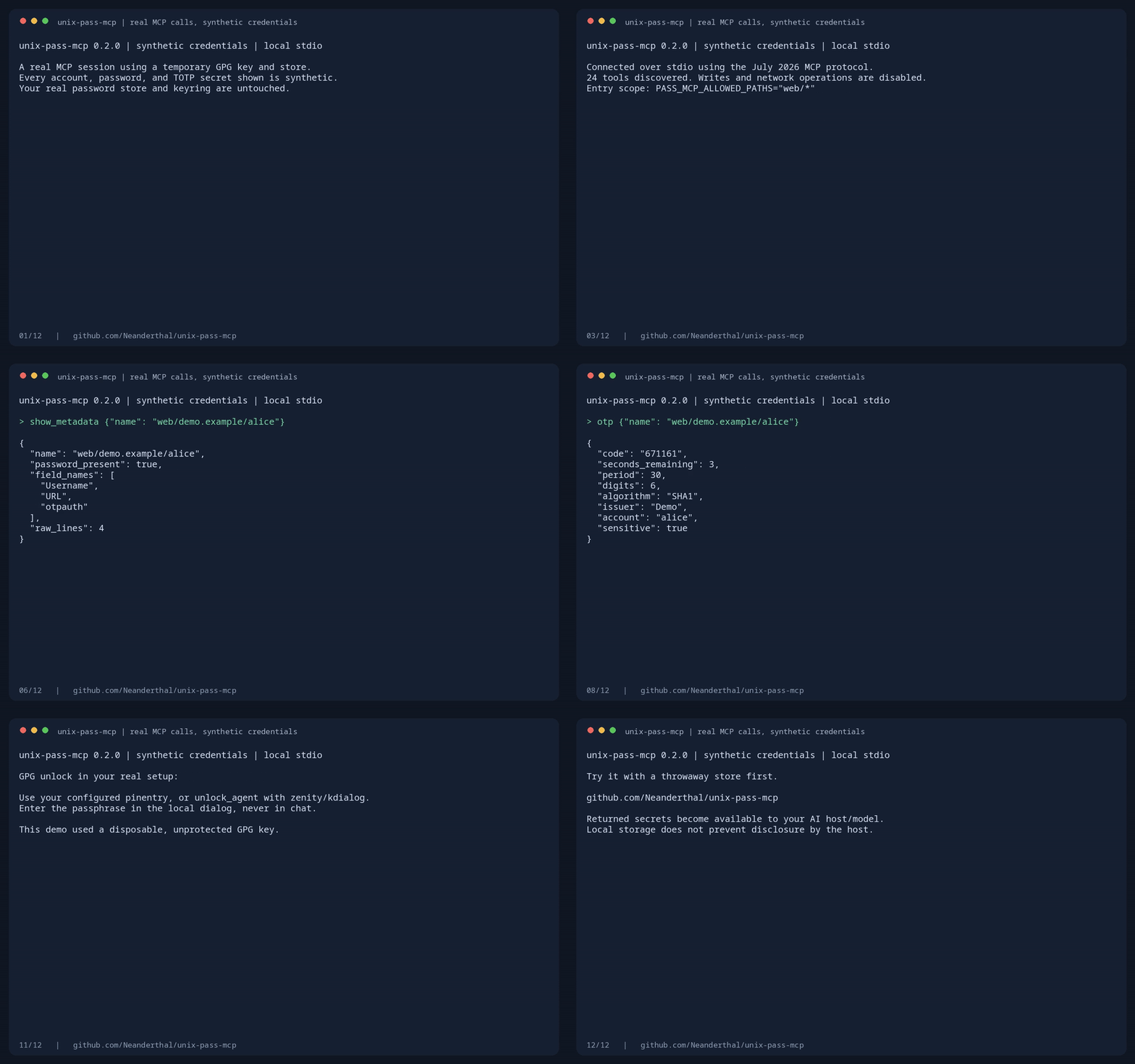
83-second MP4 · How it was recorded
Trying the beta? Report installation feedback. Launch status tracks package and directory publication separately.
Table of contents
- Why this exists
- Quickstart
- Requirements
- Install
- Wire into an MCP host
- Tools
- Configuration
- Security posture
- Development
- Disclaimer
- License
Why this exists
pass is a thin wrapper around gpg(1) and the filesystem. Anything that can shell out can use it — but exposing it raw to an LLM is a recipe for rm -rf regret. This server provides:
- A typed MCP surface over the safe subset of
pass. - Read-only by default; writes and destructive ops behind explicit env opt-ins.
- Strict input validation — no shell, no path escapes, no stdin smuggling of secrets.
- Sanitized error output, append-only audit log, and gpg-agent preflight.
See .claude/rules/architecture.md for the full design and security model.
Quickstart
Requires Python 3.11+, uv, pass, GnuPG, and an initialized store.
Install the published PyPI release:
claude mcp add unix-pass -e 'PASS_MCP_ALLOWED_PATHS=web/*' -- \
  uvx --from unix-pass-mcp==0.2.1 unix-pass-mcp
Copy-paste configurations: Codex, Claude Code, Claude Desktop. For source-checkout development and other client setup details, see installation.
That gets you the read-only surface. To enable mutations:
PASS_MCP_ALLOW_WRITES=1 \
PASS_MCP_ALLOWED_PATHS=web/* \
uv run unix-pass-mcp
Requirements
Required
| Component | Why | Notes |
|---|---|---|
| Python ≥ 3.11 | Runtime | 3.11 / 3.12 / 3.13 tested in CI |
pass on PATH |
The wrapped binary | pass --version must work |
gpg (GnuPG ≥ 2.2) on PATH |
Decryption | Used directly only by unlock_agent |
gpg-agent |
Passphrase caching | The server probes gpg-connect-agent /bye at startup and refuses to decrypt if no agent is reachable. Started automatically by GnuPG on first use. |
| A configured GPG key | Required for decryption / pass init |
Must have its trust level set to "ultimate" — see Arch wiki |
| An initialized password store | The thing being managed | pass init <gpg-id> if you don't have one |
Pinentry — pick one
The server can never serve an interactive passphrase prompt itself — pass/gpg will hang. You need one of:
- A GUI pinentry configured in
~/.gnupg/gpg-agent.conf—pinentry-gnome3,pinentry-qt,pinentry-qt5, orpinentry-gtk-2. The first decrypt of each cache window pops a desktop dialog. Recommended. zenityorkdialoginstalled — call theunlock_agentMCP tool once per cache window to warm gpg-agent. Use this if you can't changegpg-agent.conf.- A pre-warmed agent — run
pass show <name>in a real terminal before talking to the MCP. Cache expires perdefault-cache-ttl(default 600s).
OS install hints
# Arch / Manjaro
sudo pacman -S pass gnupg pinentry zenity         # zenity optional, for unlock_agent

# Debian / Ubuntu
sudo apt install pass gnupg pinentry-gnome3 zenity

# Fedora
sudo dnf install pass gnupg2 pinentry-gnome3 zenity

# macOS (Homebrew)
brew install pass gnupg pinentry-mac
Optional
| Component | Enables |
|---|---|
pass-otp |
Cross-tool compatibility for otp (the server has a native RFC 6238 implementation, no runtime dependency) |
git |
Auto-commit on writes if your store is a git repo, plus git_status / git_log / git_pull / git_push |
Development
| Component | Why |
|---|---|
uv |
Recommended installer / runner |
gpg with key-generation support |
Integration tests mint throwaway keys in an ephemeral GNUPGHOME |
Install
uv sync --locked --extra dev # for development
uv pip install .             # for use
Wire into an MCP host
Claude Desktop
Add to ~/.config/Claude/claude_desktop_config.json (or the platform equivalent):
{
  "mcpServers": {
    "pass": {
      "command": "uv",
      "args": ["run", "--directory", "/absolute/path/to/unix-pass-mcp", "unix-pass-mcp"],
      "env": {
        "PASSWORD_STORE_DIR": "/home/you/.password-store"
      }
    }
  }
}
Claude Code
# Read-only
claude mcp add pass -- uv run --directory /absolute/path/to/unix-pass-mcp unix-pass-mcp

# With writes enabled and path scope (recommended pairing)
claude mcp add pass -s user \
  -e PASS_MCP_ALLOW_WRITES=1 \
  -e PASS_MCP_ALLOWED_PATHS='web/*' \
  -- uv run --directory /absolute/path/to/unix-pass-mcp unix-pass-mcp
Each -e KEY=VALUE flag sets one env var on the spawned server. To change env on an existing server, claude mcp remove pass -s user then re-add — the CLI has no in-place edit. Verify with claude mcp get pass.
Driving an autonomous agent
For account creation / profile filling workflows that combine unix-pass-mcp with a browser-controlling MCP, load .claude/rules/agent-workflow.md into the agent's system prompt. It defines the canonical naming convention (web/<domain>/<handle>), body format, and signup/login/rotation loops.
Tools
24 tools, grouped by capability gate.
Read-only — always available
| Tool | Description |
|---|---|
store_info |
Inspect the store: path, recipients per subdir, git/agent/pinentry/signing status, warnings. No decryption. |
list |
List pass-names (optionally scoped to a subfolder). No decryption. |
find |
Substring search over leaf names. No decryption. |
show |
Decrypt and return one line of an entry (default = line 1 = password). Marked sensitive. |
show_field |
Decrypt and return one named metadata field (URL, Username, otpauth, …). Case-insensitive. |
show_metadata |
Decrypt and return only the entry shape (field names, password presence, and line count). Password value is never returned. |
unlock_agent |
Pop a desktop password dialog (zenity/kdialog) and warm gpg-agent's cache via loopback pinentry. Optional target for multi-recipient stores — pass an explicit pass-name if a no-arg call returns wrong_passphrase_or_decrypt_failed, which can happen on legacy stores where the smallest entry is encrypted to a rotated subkey. The LLM never sees the passphrase. |
grep |
Search inside the decrypted body of permitted entries. Slow + costly (decrypts permitted entries) — requires confirm_decrypt_all=true. Marked sensitive. Honours PASS_MCP_ALLOWED_PATHS. |
otp |
Compute the current TOTP code from an entry's otpauth:// line. Returns code + seconds_remaining. Marked sensitive. Native RFC 6238 — no pass-otp runtime dependency. |
otp_uri |
Return the raw otpauth:// URI (contains the secret). Use only when re-enrolling the same secret elsewhere. |
Writes — gated behind PASS_MCP_ALLOW_WRITES=1
| Tool | Description |
|---|---|
insert |
Create or overwrite a single-line entry. Password via stdin (never argv). Refuses overwrite without force=true. |
insert_multiline |
Create or overwrite a full-body entry (line 1 = password, rest = Key: value metadata). |
set_field |
Update one Key: value field; preserves password and other lines. simulate=true returns the would-be body without writing. |
unset_field |
Remove all lines matching a field key (case-insensitive). No-op if absent. simulate=true for dry-run. |
generate |
Generate a new password (length 1–1024, optional no_symbols). in_place=true keeps metadata; force=true overwrites everything. Returns the generated value (sensitive). |
mv |
Rename or move an entry/subfolder. Re-encrypts to the destination subfolder's recipients if they differ. |
cp |
Copy an entry/subfolder, with the same re-encryption semantics. |
otp_set |
Append or replace the otpauth:// URI on an existing entry. Validates the URI before writing. |
Git — git_status and git_log always; git_pull and git_push need PASS_MCP_ALLOW_NETWORK=1
| Tool | Description |
|---|---|
git_status |
Structured status: {clean, branch, upstream, ahead, behind, dirty_files}. Refuses if the store isn't a git repo. |
git_log |
Recent commits as [{hash, subject}, …]. limit defaults to 20 (max 200). |
git_pull |
git pull --ff-only — refuses divergence, no merge commits, no rebase. |
git_push |
git push — never --force. |
Destructive — gated behind PASS_MCP_ALLOW_DESTRUCTIVE=1
| Tool | Description |
|---|---|
init |
Initialize the store (or a subfolder) with new GPG recipients. Re-encrypts every entry in scope. Refuses if the user has no secret key for any of the new recipients, unless force=true. Empty gpg_ids list removes a subfolder's .gpg-id. |
reencrypt |
Re-run init with the current recipients. Useful after subkey rotation. No-op when recipients haven't changed. |
Full machine-readable surface — every arg, every error code — lives in
.claude/rules/api.md.
Configuration
Server-specific env vars:
| Var | Default | Effect |
|---|---|---|
PASS_MCP_ALLOW_WRITES |
unset | Required for any mutating tool |
PASS_MCP_ALLOW_DESTRUCTIVE |
unset | Required for init / reencrypt |
PASS_MCP_ALLOW_NETWORK |
unset | Required for git_pull / git_push |
PASS_MCP_ALLOW_UNSAFE |
unset | Bypass strict startup checks (world-readable store, weak umask). Don't. |
PASS_MCP_ALLOWED_PATHS |
unset (= all) | Comma-separated fnmatch globs scoping which entries the server may touch |
PASS_MCP_GREP_TIMEOUT_SECONDS |
120 |
Per-call timeout for grep (decrypts permitted entries) |
PASS_MCP_REQUIRE_AGENT |
1 |
Refuse to decrypt if gpg-agent is not reachable |
PASS_MCP_AUDIT_LOG |
~/.local/state/unix-pass-mcp/audit.log |
Append-only JSONL log of actions; set to empty string to disable |
PASS_MCP_TIMEOUT_SECONDS |
15 |
Per-call subprocess timeout |
Standard pass env vars are passed through (PASSWORD_STORE_DIR, PASSWORD_STORE_KEY, PASSWORD_STORE_UMASK, …). See .claude/rules/architecture.md §5 for the full list.
Not propagated:
PASSWORD_STORE_GPG_OPTS— lets a hostile env injectgpgflags like--recipient(silent re-encryption to attacker) or--output(decryption exfiltration).PASSWORD_STORE_X_SELECTION,PASSWORD_STORE_CLIP_TIME— clipboard tools dropped (meaningless over MCP).
Security posture
| No shell. | Every pass invocation goes through one chokepoint (pass_cli.run) using argument lists with shell execution disabled. Process launches are centralized in pass_cli.execute. |
| Strict input validation. | Pass-names match ^[A-Za-z0-9._@-][A-Za-z0-9._@/-]*$, ≤256 chars, no .., no leading -, no control chars. gpg-ids match a positive allowlist. |
| Path allowlist. | PASS_MCP_ALLOWED_PATHS lets you scope the server to e.g. "work/*,personal/notes/*" to restrict the entries exposed to the MCP host. Honoured by grep and unlock_agent too. |
| Sensitive output flagged. | show, show_field, generate, otp, otp_uri, grep, and simulated field ops carry meta.sensitive = true so MCP hosts can refuse to log/cache. |
| Stderr sanitization. | Anything between -----BEGIN/-----END markers is stripped before raising errors; output is truncated to 2 KB. |
| Audit log records names only. | Never values, never field contents, never grep patterns. |
| Stdin isolation. | Every subprocess runs with stdin=DEVNULL unless the caller is actively piping content. Protects MCP's stdio JSON-RPC framing from accidental child-process reads. |
| Strict startup. | Refuses to start if PASSWORD_STORE_UMASK is weaker than 077 or the store dir is world-readable. Bypass with PASS_MCP_ALLOW_UNSAFE=1 (don't). |
The server instructions tell the model to treat returned secrets as confidential and never repeat them in responses, summaries, logs, or unrelated tool calls. This is guidance for the model, not a technical logging boundary: an MCP client may still store raw tool results in its conversation transcript. Review and configure the host's transcript and logging policy accordingly.
Operational behavior
Scoped search
grep selects allowed entry names before decryption, decrypts each separately, and
searches its body with a basic regular expression. Header-like content never changes
the entry name. Patterns are operands, including those starting with -; invalid
patterns fail before decryption. PASS_MCP_GREP_TIMEOUT_SECONDS is a positive,
finite total budget for the entire search. redacted_entries remains zero because
excluded entries are never searched.
Filesystem containment
Entry access rejects symlinked files and directory components, including links within the store. Discovery and automatic unlock target selection skip links. Explicit unlock targets are validated before agent probes. Keep the local store under trusted ownership: these CLI checks do not sandbox concurrent filesystem changes by another process running as the same user.
Discovery and git scope
list and find omit excluded entries. Recipient discovery reports only ancestors
of visible entries when path scoping is active. Remote URLs omit userinfo, query
parameters, and fragments. Git tools operate on the whole repository and require
unrestricted access (no path allowlist, or an explicit * grant); partial path
grants cannot authorize git history or repository-wide network operations.
Structural metadata and sensitive results
show_metadata returns field_names, password_present, and raw_lines. It never
returns field values, passwords, free text, or OTP URIs. This replaces the former
fields mapping. Use show_field for an explicitly sensitive field read.
Both field-edit tools advertise sensitive output because simulations include the
complete decrypted before/after bodies. Custom sensitive metadata is a host hint,
not a protocol guarantee against logging or caching. Search queries are not audited.
PASS_MCP_TIMEOUT_SECONDS sets the default subprocess timeout. It must be a
positive finite number; invalid values fail before command execution. Explicit
operation budgets (search, key administration, and network operations) override it.
Runtime and cancellation
MCP handlers run in worker threads so slow GPG operations do not block protocol
processing. Mutating tool calls are serialized to prevent overlapping
read/modify/write operations. Cancellation signals the worker and terminates its
subprocess group; per-command timeouts still bound execution. Cancellation cannot
roll back changes already completed by pass; inspect the entry before retrying
a write. Production subprocess launches, including unlock dialogs, are centralized
in pass_cli.execute. Local tools advertise openWorldHint: false; network git
tools advertise openWorldHint: true.
MCP SDK compatibility
The server uses the official SDK v2 MCPServer API and requires mcp>=2.3,<3.
Its stdio transport supports both legacy initialization and July 2026 per-request
metadata/discovery. Tests launch real stdio clients in both modes. The lockfile
records the tested dependency set; use uv sync --locked --extra dev to reproduce it.
Development
uv run ruff check
uv run ruff format --check
uv run pytest -q tests/unit                                 # fast tests
PASS_MCP_INTEGRATION=1 uv run pytest -q tests/integration   # real-GPG tests
The integration suite mints a throwaway RSA key in an ephemeral GNUPGHOME (1-day expiry, no passphrase) and exercises real pass. CI runs both tiers across Python 3.11 / 3.12 / 3.13.
Disclaimer
unix-pass-mcp is a bridge between your password store and a non-deterministic large language model — and, in most realistic deployments, between your password store and every other MCP server that shares the same model session (browser automation, shell execution, web requests). Even with every gate disabled by default, the purpose of installing this server is to grant an LLM access to your secrets. The following are not bugs:
- An LLM can be prompted (by you, by a hostile webpage your browser MCP loads, by a poisoned tool result) to decrypt any entry within
PASS_MCP_ALLOWED_PATHSand forward it to another tool in the same session. - With
PASS_MCP_ALLOW_WRITES=1, an LLM can overwrite, rename, or generate-over entries in scope. - With
PASS_MCP_ALLOW_DESTRUCTIVE=1, an LLM can re-encrypt your store to a different recipient set, or remove a subfolder's.gpg-id. - With
PASS_MCP_ALLOW_NETWORK=1, an LLM can push commits — including credential changes — to your configured git remote.
The capability gates, path allowlist, audit log, sensitive-output flags, and validation hardening reduce the blast radius of mistakes and prompt injection. They do not make it safe to point an unsupervised agent at a production credential store. Treat the security posture documented above as best-effort engineering against a hostile and rapidly-evolving threat model, not a formal guarantee.
You are solely responsible for:
- Which capability gates you enable, and on which stores.
- The trust boundary of the MCP host you run this against — what it logs, caches, ships to telemetry, or lets other servers see.
- Backing up
~/.password-store(and~/.gnupg) before granting destructive or network access. - Reviewing
~/.local/state/unix-pass-mcp/audit.logperiodically. - Recovering from any mistake an agent makes — there is no undo.
THE SOFTWARE IS PROVIDED "AS IS", WITHOUT WARRANTY OF ANY KIND, EXPRESS OR IMPLIED, INCLUDING BUT NOT LIMITED TO THE WARRANTIES OF MERCHANTABILITY, FITNESS FOR A PARTICULAR PURPOSE AND NONINFRINGEMENT. THE AUTHORS AND CONTRIBUTORS SHALL NOT BE LIABLE FOR ANY CLAIM, DAMAGES OR OTHER LIABILITY — INCLUDING BUT NOT LIMITED TO DATA LOSS, CREDENTIAL COMPROMISE, STORE LOCK-OUT, UNINTENDED DISCLOSURE OF SECRETS, OR LOSS OF SERVICE — WHETHER ARISING FROM BUGS, PROMPT INJECTION, MISCONFIGURATION, OR ANY OTHER USE OR MISUSE OF THE SOFTWARE. See the LICENSE for the full MIT terms.
This project is not affiliated with, endorsed by, or sponsored by Anthropic, the maintainers of pass(1) (Jason A. Donenfeld and contributors), the GnuPG project, or any MCP host vendor. All trademarks are the property of their respective owners.
License
MIT — see LICENSE.
1 maintainer

Metadata
1 maintainer
Release files for unix-pass-mcp 0.2.1
For a detailed explanation of source distributions (sdists) and built distributions (wheels), please see the package formats documentation.
Source distribution (sdist)
| File | Size | Uploaded | Provenance | Actions |
|---|---|---|---|---|
| unix_pass_mcp-0.2.1.tar.gz | 742.1 kB | With provenance | Details for unix_pass_mcp-0.2.1.tar.gz |
Built distribution (wheel)
| File | Interpreter | ABI | Platform | Actions Reset |
|---|---|---|---|---|
| unix_pass_mcp-0.2.1-py3-none-any.whl | Python 3 | none | any | Details for unix_pass_mcp-0.2.1-py3-none-any.whl |
Total release size: 790.1 kB
Release files / unix_pass_mcp-0.2.1.tar.gz
| Download URL | unix_pass_mcp-0.2.1.tar.gz |
|---|---|
| Size | 742.1 kB |
| Tags | Source |
|
SHA-256 checksum How to use checksums |
ff1d62f4b3d6d8a291ed940648bd5d1b626c553fe58b687849a7db38786c98c8
|
|
BLAKE2b-256 checksum How to use checksums |
8740eec3a2f477e2e26cfa5df5aae618cd2a875801ecf0ea3122a16b98820292
|
| Upload date | |
|
Uploaded using Trusted Publishing? What is trusted publishing? |
Yes |
| Uploaded via |
twine/7.0.0 CPython/3.13.16
|
Provenance
Provenance describes where a file came from. On PyPI, provenance is shared via attestations, which provide a verifiable record of the build or publishing details. View details, limitations and caveats.


PyPI Publish Attestation
PyPI verified that this artifact, at this checksum, originated from the publisher listed below.
Signed by GitHub Actions, verified by PyPI on Nov 4, 2026.
Transparency logRelease files / unix_pass_mcp-0.2.1-py3-none-any.whl
| Download URL | unix_pass_mcp-0.2.1-py3-none-any.whl |
|---|---|
| Size | 48.0 kB |
| Tags | Python 3 |
|
SHA-256 checksum How to use checksums |
7b96c5157d258deedab7d56ed844cf890740c7d20160c1186fdb6cb14715f404
|
|
BLAKE2b-256 checksum How to use checksums |
89f51b7ca5ddc812d19723bbeca3a5cd2af318ef9767f56067c2aa9750da9777
|
| Upload date | |
|
Uploaded using Trusted Publishing? What is trusted publishing? |
Yes |
| Uploaded via |
twine/7.0.0 CPython/3.13.16
|
Provenance
Provenance describes where a file came from. On PyPI, provenance is shared via attestations, which provide a verifiable record of the build or publishing details. View details, limitations and caveats.
PyPI Publish Attestation
PyPI verified that this artifact, at this checksum, originated from the publisher listed below.
Signed by GitHub Actions, verified by PyPI on Nov 4, 2026.
Transparency logSecurity for unix-pass-mcp 0.2.1
Provenance
Provenance describes where a file came from. On PyPI, provenance is shared via attestations, which provide a verifiable record of the build or publishing details. View details, limitations and caveats.
Full provenance
All 2 files in this release have been uploaded with provenance metadata.
Attestation for unix_pass_mcp-0.2.1.tar.gz
PyPI Publish Attestation
PyPI verified that this artifact, at this checksum, originated from the publisher listed below.
Signed by GitHub Actions, verified by PyPI on Nov 4, 2026.
Transparency logA note on package security
PyPI is a repository for distributing packages, not a service for auditing them. While third-party security researchers and our staff do their best to detect and remove malicious packages, PyPI cannot guarantee the quality, security or suitability of any given package.
To learn more about protecting yourself from malicious actors, visit our package security documentation.














