





See which AI services your code depends on, what open source can replace them, and which models are about to stop working.
uvx unrent .
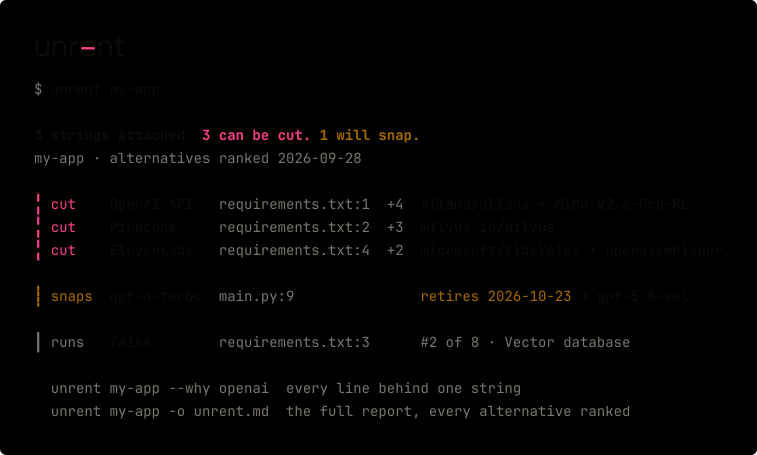
What each row means
╎ cut |
You use a closed AI service. The best open source replacement is on the row. |
│ held |
You use a closed AI service with no open source replacement yet. |
┆ snapped |
Your code asks for a model the vendor has shut down. Those calls fail today. |
┆ snaps |
Your code asks for a model the vendor shuts down on the date shown. |
│ runs |
Open source AI you already run, and how it ranks. |
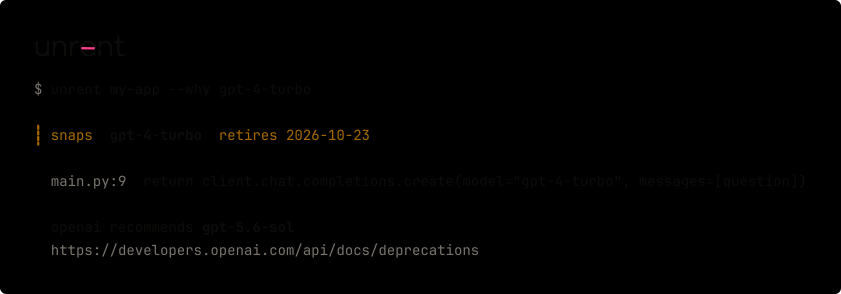
Every row points to a file and line. --why shows all of them, and what to use instead:
Install
uv tool install unrent # or: pipx install unrent
Python 3.11+.
Use
unrent .                         # scan the current directory
unrent . --why openai            # every line behind one row
unrent . -o report.md            # a Markdown report for an issue or PR
unrent . --format json           # for scripts
unrent . --skip-tests            # ignore test code
unrent . --exclude "examples/"   # .gitignore syntax, or a .unrentignore file
unrent scan --help lists the rest.
Use it from an AI agent
As an MCP server (Claude Code, Cursor, Copilot, …):
claude mcp add unrent -- uvx --from "unrent[mcp]" unrent mcp
Other clients: command uvx, args ["--from", "unrent[mcp]", "unrent", "mcp"].
As a skill, with a workflow for what unrent can't see on its own:
npx skills add stringcutter/unrent
How it works
What it finds
- 357 closed AI services in 21 categories: LLM APIs and gateways, embeddings, vector databases, RAG, document parsing, observability, speech, image generation, search, scraping, browser automation, sandboxes, agents and agent memory. 139 hosted model providers come from models.dev, regenerated weekly.
- 204 model retirements from OpenAI, Anthropic and Google, with dates and the vendor's replacement, checked weekly against their deprecation pages. A model counts when the code picks it (a default, a config value, a call), not when it is only listed in a menu or price table. Azure, Bedrock and Vertex have their own schedules and are not covered.
- 89 open source projects you may already run: vector databases, inference servers, gateways, RAG frameworks, document parsers, observability, evals, speech.
- Unknown candidates: API hosts and keys that look like a hosted AI service the catalog doesn't know yet. Listed for you to check, never counted.
It reads packages (Python, npm, Go, Cargo, Maven, Gradle, NuGet, RubyGems, Composer, pub, SwiftPM), imports, install commands, container images, and API hosts, model ids, env vars and SDK calls in code and config.
What it ignores
- Local servers behind a compatible SDK:
OpenAI(base_url="http://localhost:11434/v1")is Ollama, not OpenAI. - Comments, docs, lockfiles,
node_modulesand anything.gitignoreexcludes. - Generic names: your
perplexity.pyisn't Perplexity. - Open-weight models:
gpt-oss,deepseek-v3.2and Ollama tags aren't closed.
Secrets in the output are masked (OPENAI_API_KEY=****). Files too large to scan are
listed, never skipped silently.
How alternatives are ranked
- Projects by GitHub stars gained in the last 90 days, from unrent's own weekly snapshots (total stars until four weeks of history exist; the report says which).
- Models by Hugging Face trending: labs' own releases under an open licence.
- Open source only: an OSI licence for code; Apache, MIT, BSD or CC-BY for weights. Archived projects are dropped, and open core is marked.
The CLI uses the rankings shipped with its release. The MCP server fetches the latest
from this repo, cached for six hours (UNRENT_OFFLINE=1 turns that off). Only rankings
come in; your code never goes out.
How accurate it is
Every rule has a test that fails without it. A golden corpus of 54 real repos, labelled by hand, runs in CI: closed services precision 0.993, recall 0.957; models that stop working precision 0.939, recall 0.886.
With ripgrep installed, a 5,500-file repo scans in about 6 s.
1 maintainer

Metadata
1 maintainer
Release files for unrent 0.2.2
For a detailed explanation of source distributions (sdists) and built distributions (wheels), please see the package formats documentation.
Source distribution (sdist)
| File | Size | Uploaded | |
|---|---|---|---|
| unrent-0.2.2.tar.gz | 181.5 kB | Details |
Built distribution (wheel)
| File | Interpreter | ABI | Platform | Reset |
|---|---|---|---|---|
| unrent-0.2.2-py3-none-any.whl | Python 3 | none | any | Details |
Total release size: 306.8 kB
Release files / unrent-0.2.2.tar.gz
| Download URL | unrent-0.2.2.tar.gz |
|---|---|
| Size | 181.5 kB |
| Tags | Source |
|
SHA-256 checksum How to use checksums |
7c4816f60b76d94661187fb2d353c5857cad44b170a4550a344e943e5a018a91
|
|
BLAKE2b-256 checksum How to use checksums |
f01d6243de80575bfa089d4b04851fbf543967b0db6b045645e324ce30abdc3b
|
| Upload date | |
|
Uploaded using Trusted Publishing? What is trusted publishing? |
Yes |
| Uploaded via |
twine/7.0.0 CPython/3.13.14
|
Provenance
Provenance describes where a file came from. On PyPI, provenance is shared via attestations, which provide a verifiable record of the build or publishing details. View details, limitations and caveats.


PyPI Publish Attestation
PyPI verified that this artifact, at this checksum, originated from the publisher listed below.
Signed by GitHub Actions, verified by PyPI on Oct 4, 2026.
Transparency logRelease files / unrent-0.2.2-py3-none-any.whl
| Download URL | unrent-0.2.2-py3-none-any.whl |
|---|---|
| Size | 125.2 kB |
| Tags | Python 3 |
|
SHA-256 checksum How to use checksums |
aae2f3d157a090ad7a521a4b659836e6d6218aa43145ae628673d7edf72b7f93
|
|
BLAKE2b-256 checksum How to use checksums |
8ab018cb216a6ec74d7a268fe7166d7e4e7bb0ab2615c411197eaafb07878bc6
|
| Upload date | |
|
Uploaded using Trusted Publishing? What is trusted publishing? |
Yes |
| Uploaded via |
twine/7.0.0 CPython/3.13.14
|
Provenance
Provenance describes where a file came from. On PyPI, provenance is shared via attestations, which provide a verifiable record of the build or publishing details. View details, limitations and caveats.
PyPI Publish Attestation
PyPI verified that this artifact, at this checksum, originated from the publisher listed below.
Signed by GitHub Actions, verified by PyPI on Oct 4, 2026.
Transparency log













