

upd
Update dependencies across a polyglot repository—locally, safely, and in one command.
Python · Node.js · Rust · Go · Ruby · .NET · Docker · Terraform · GitHub Actions · pre-commit · Mise



upd gives you one reviewable update plan across mixed stacks. It preserves
hand-written constraints, comments, and formatting; previews every proposed
change before it writes; and runs without a hosted service or repository
onboarding.
Try it now
From any directory inside a Git repository:
uvx upd
That first run is a dry run: it reports what would change and leaves every file
untouched. No repository onboarding or hosted account is required. Review the
plan, then apply it with uvx upd --apply.
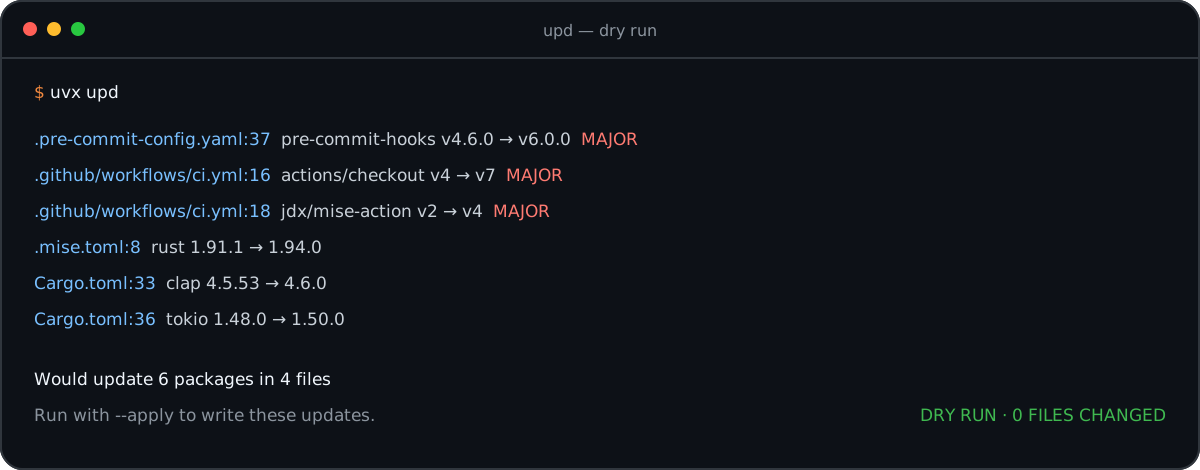
One preview across four file types. Nothing changes until you pass --apply.
Install another way · See every supported file · Compare dependency tools
Why upd
- One command for a mixed stack. Check application dependencies, tool versions, container images, GitHub Actions, pre-commit hooks, and Terraform modules in the same run instead of assembling a different updater for each file type.
- Safe on the first run. Dry-run is the default, constraints and formatting are preserved, and major updates are called out before you decide what to apply.
- Local first, automation ready. Start with an interactive terminal review, then use the same CLI, configuration, stable exit codes, JSON/SARIF output, and rolling PR or MR workflows in CI.
upd is a local checker and editor, not a package manager or a hosted update
bot. It can delegate lockfile refreshes to the package managers already in your
project and can run inside your own GitHub or GitLab automation. See the
decision guide and dated benchmarks
for an exact comparison with adjacent tools.
Where upd fits
Choose by the job rather than treating every dependency tool as interchangeable:
| If you need to… | Start with… |
|---|---|
| Preview and edit versions across a mixed-language repository from one local command | upd |
| Resolve, lock, install, and manage a Python environment | uv or PDM |
| Continuously create update branches and PRs across the broadest manager catalog | Renovate or Dependabot |
| Enforce immutable GitHub Actions references as a dedicated policy | pinact or ratchet |
Dated performance evidence
On the committed 18-reference fixture, the verified 2026-08-28 run recorded:
| Workload | upd mean | Same-workload cohort |
|---|---|---|
| Check 12 Python constraints | 134.7 ms | uppd: 269.7 ms |
| Update 12 Python constraints | 138.7 ms | uppd: 250.8 ms |
| Check 6 GitHub Actions | 758.7 ms | taze: 1,019.0 ms; ratchet: 1,029.1 ms |
| Update 6 GitHub Actions | 746.3 ms | taze: 566.3 ms; ratchet: 1,066.8 ms |
Lower is better. These are five-run live-network observations, not universal speed claims. Every timed update was first verified to change all intended references and leave a parseable result. See the full matrix, methodology, variance, commands, and raw JSON.
Features
- Multi-ecosystem: Python, Node.js, Rust, Go, Ruby, .NET, Docker, Terraform, GitHub Actions, pre-commit, Mise/asdf
- Dry-run by default: nothing is written without
--apply - Fast: parallel registry requests, with a 24-hour version cache
- Constraint-aware: respects
>=2.0,<3(Python),~> 7.1(Ruby), and^2.0.0/~2.0.0(npm, Cargo) - Format-preserving: keeps formatting, comments, and structure
- Update filters:
--only-bump,--max-bump,--package(exact names or quoted globs such as'shiny*'),--lang, or approve one by one with-i - Major warnings: breaking changes are flagged with
(MAJOR) - Pre-release aware: updates pre-releases to newer pre-releases
- Cooldown: hold back releases younger than N days, against supply-chain attacks
- Security auditing: OSV vulnerability scanning with auto-fix and SARIF output
- Check mode: exit 1 if updates are available (for CI and pre-commit)
- Gitignore-aware: honors
.gitignoreand prunes hidden directories, without missing the dotfiles it updates - Private registries: authentication for PyPI, npm, Cargo, Go, and GitHub
- Config file: include or exclude paths, ignore packages, and pin versions via
.updrc.toml
Installation
From crates.io
cargo install upd

# or with cargo-binstall (faster, pre-built binary)
cargo binstall upd
From PyPI
pip install upd
# or with uv
uv pip install upd
If you installed an earlier release under the old distribution name, migrate
once with pip uninstall upd-cli && pip install upd. The upd-cli command
remains available as a compatibility alias.
From source
git clone https://github.com/rvben/upd
cd upd
cargo install --path .
Usage
# Preview changes without modifying files (default when no --apply)
upd

# Apply updates to files
upd --apply

# Limit to specific files or directories
upd --apply requirements.txt pyproject.toml

# Approve updates one by one
upd -i

# Only the packages you name
upd -p requests,flask

# Select a package family (quote globs so your shell passes them to upd)
upd --package 'shiny*'

# Cap the bump level (allow patch + minor, skip major). Updates above the
# ceiling are reported as held back, never as up to date, and do not
# change the exit code.
upd --max-bump minor

# Restrict to exactly one level (repeatable, comma-separated)
upd --only-bump major

# One ecosystem at a time: python, node, rust, go, ruby, dot-net,
# docker, terraform, actions, pre-commit, mise, annotated
upd --lang python

# Exit 1 if anything is outdated (for CI and pre-commit)
upd --check

# Regenerate lockfiles after writing
upd --apply --lock

# Print the effective configuration and exit
upd --show-config
upd --help lists every flag; Stability
documents the ones that are contractual, and upd schema emits the whole
interface as JSON.
--package accepts exact names and case-sensitive globs using *, ?, and
character classes such as [ab]. Wildcards can cross namespace separators, so
patterns such as '@scope/*' and 'github.com/org/*' work as expected. Quote
globs on the command line to prevent shell expansion. A glob that matches no
package produces a warning without changing the exit code; use repeated or
comma-separated values instead of brace alternation.
Dry-run by default:
updwithout--applyonly previews changes. Pass--applyto write updates.--check,--dry-run, and--interactivedo not require--apply.VCS-root scoping: When no path argument is given,
updscans from the nearest.gitancestor directory rather than the current working directory. This prevents accidental rewrites when CWD is a subdirectory inside a repository.
Commands
upd --version      # Print version
upd self-update    # Check for upd updates
upd clean-cache    # Clear the version cache
upd align          # Align versions across files (--check exits 1 on misalignment)
upd audit          # Scan for known vulnerabilities (exit 6 if found)
upd schema         # Machine-readable interface description
For repositories replacing dependency bots, upd also provides separate
reusable GitHub workflows for policy-constrained freshness updates and
validated security-remediation pull requests. See
GitHub dependency pull requests.
Example Output
.pre-commit-config.yaml:37: Would update pre-commit/pre-commit-hooks v4.6.0 → v6.0.0 (MAJOR)
.github/workflows/ci.yml:16: Would update actions/checkout v4 → v6 (MAJOR)
.github/workflows/ci.yml:18: Would update jdx/mise-action v2 → v4 (MAJOR)
.mise.toml:8: Would update rust 1.91.1 → 1.94.0
Cargo.toml:33: Would update clap 4.5.53 → 4.6.0
Cargo.toml:36: Would update tokio 1.48.0 → 1.50.0

Would update 6 package(s) (2 major, 3 minor, 1 patch) in 4 file(s), 8 up to date
Output includes clickable file:line: locations (recognized by VS Code, iTerm2, and modern terminals).
Version Constraints
upd respects version constraints in your dependency files:
| Constraint | Behavior |
|---|---|
>=2.0,<3 |
Updates within 2.x range only |
^2.0.0 |
Updates within 2.x range (npm/Cargo); never crosses the major bound |
~2.0.0 |
Updates within 2.0.x range (npm); ~2.0.0 (Cargo) stays within 2.0.x |
~> 7.1 |
Updates within 7.x range (Ruby pessimistic) |
>=2.0 |
Updates to any version >= 2.0 |
==2.0.0 |
Updates the exact pin to the latest version (e.g. ==2.0.0 → ==3.1.5). To freeze a package, use [pin] or ignore in .updrc.toml. |
==2.0.* |
Never rewritten. A PEP 440 prefix match names a series, not a release. See Bounds that are not floors. |
An update moves the lower bound and leaves every other clause where the
author wrote it, so >=1.0, <2.0 becomes >=1.5.0, <2.0. A constraint is an
unordered set of clauses, so the lower bound is found wherever it sits
(<2.0, >=1.0 answers alike), and an upper bound is honored when picking the
new version: the release chosen is the newest one the constraint already admits.
npm ranges keep the shape they were written in. A comparator range
(">=1.0.0 <2.0.0") and a hyphen range ("4.17.0 - 4.18.0") each keep their
ceiling. A wildcard or partial range takes its ceiling from its own floor, like
a caret, so it follows the newest release and the whole shape moves with it:
"4.3.x" becomes "4.4.x" and "^1.2" becomes "^3.1", never a fully
written version. npm lets a comparator stand apart from the version it applies
to, and that spacing is part of the shape: ">= 1.2.7 < 1.3.0" is read as the
range it is and comes back spaced the same way. npm's tilde has two spellings
and "~>1.2.3" means what "~1.2.3" does, ceiling included; each comes back
spelled the way it was written.
An npm spec that names no published version is left alone and reported nowhere:
"*", a dist-tag ("latest", "next", "beta"), and the workspace:,
file:, link:, npm:, git+ssh: and github:owner/repo forms all resolve
somewhere other than a release on the registry, so there is no version to
compare and nothing an update could move.
Specifier shape changes are opt-in. A [normalize.pyproject] table in
.updrc.toml can independently make project dependencies, optional
dependencies, or standardized dependency groups use ==, >=, or <=; projects without
that table retain the shape-preserving behavior above. See
the configuration guide.
Bounds that are not floors
Only an inclusive lower bound names the version a project is on, so only
that bound is raised. >1.2.3 names the one version its author refuses, <3
and <=3 are ceilings, != 1.5 is an exclusion, and an OR range
("^1 || ^2") has no single branch to edit. None of them is a floor, so none
of them is moved. They are checked against the registry and reported anyway:
| Outcome | Reported as |
|---|---|
| The constraint admits the newest release | Up to date |
| The newest release has outgrown it | A warning naming the release and the constraint |
| The spec cannot be read at all | An error, exit 2 |
The last row is the point of the other two: a dependency nothing looked at must not be counted as up to date, and a constraint that has quietly frozen a dependency should say so rather than pass under a green tick.
A PEP 440 prefix match reads the same way for the same reason. ==6.* and
==6.0.* name a series rather than a release, so there is no version in them to
raise and nothing an update may write over them; they are checked and reported
by the table above. pyyaml==6.* with 6.0.3 published is up to date, and
rich==13.7.* with 15.0.0 published is a warning. [pin] and upd align
answer the same way: neither writes a release into a specifier that has nowhere
to hold one, and the pin reports an error rather than a rewrite.
Annotated Version Pins
Files without a dependency-manifest format can carry a trailing annotation:
shinyhub_version: "0.11.16" # upd: pypi shinyhub
Directory walks scan annotations in otherwise-unrecognized Makefile,
makefile, GNUmakefile, justfile, Justfile, *.mk, *.sh, *.bash,
*.yml, and *.yaml files. Any file passed explicitly is scanned as annotated.
To add other files to normal repository discovery, use repository-relative globs
in .updrc.toml:
include = ["deploy/*.env", "config/version.conf"]
exclude = ["**/archive/**"] # exclude wins over include
An include never changes a recognized manifest's parser: for example, a
matching main.tf remains Terraform. Use --verbose to diagnose an upd:
marker in an otherwise undiscovered UTF-8 text file up to 1 MiB.
A GitHub Actions workflow is the exception: it keeps its Actions updater and is
scanned for annotations as well, so a tool version passed to an action through a
with: input can be updated beside the uses: refs around it. See
GitHub Actions.
Version Precision
By default, upd preserves version precision from the original file:
# Original file has 2-component versions
flask>=2.0        →  flask>=3.1        (not 3.1.5)
django>=4         →  django>=6         (not 6.0.0)

# Original file has 3-component versions
requests>=2.0.0   →  requests>=2.32.5

# GitHub Actions major-only tags
actions/checkout@v3  →  actions/checkout@v4  (not @v4.2.0)
Use --full-precision to always output full semver versions:
upd --full-precision
flask>=2.0        →  flask>=3.1.5
django>=4         →  django>=6.0.0
requests>=2.0.0   →  requests>=2.32.5
Version Alignment
In monorepos or projects with multiple dependency files, the same package might have different versions:
# requirements.txt
requests==2.28.0

# requirements-dev.txt
requests==2.31.0

# services/api/requirements.txt
requests==2.25.0
upd align updates every occurrence to the highest version found:
upd align              # Align all packages to highest version
upd align --dry-run    # Preview changes
upd align --check      # Exit 1 if misalignments (for CI)
upd align --lang python # Align only Python packages
It only aligns within one ecosystem, skips packages with upper bound
constraints (e.g. >=2.0,<3.0) to avoid breaking them, and ignores
pre-release versions when finding the highest version.
Pre-commit Integration
Add upd to your .pre-commit-config.yaml:
repos:
  - repo: https://github.com/rvben/upd-pre-commit
    rev: v0.0.24
    hooks:
      - id: upd-check
        # Optional: only check specific ecosystems
        # args: ['--lang', 'python']
Available hooks:
| Hook ID | Description |
|---|---|
upd-check |
Fail if any dependencies are outdated |
upd-check-major |
Fail only on major (breaking) updates |
Both hooks run on pre-push by default. Uses language: python which installs upd from PyPI automatically, so no manual installation is needed.
Documentation
Everything you look up rather than read lives in docs/.
Releases
Vership workflow, publication guarantees, automated integration pins, and safe retry procedures. → docs/releases.md
Supported files
Every file upd discovers, per ecosystem, plus annotated version pins in files
it does not otherwise understand.
→ docs/ecosystems.md
Comparison and benchmarks
A dated feature matrix for related dependency tools, plus workload-based, reproducible benchmarks that avoid ranking unlike operations. → docs/comparison.md
Security auditing
OSV vulnerability scanning, --fix-audit, SARIF output, and CI integration.
→ docs/audit.md
Security policy
Private vulnerability reporting, supported versions, trust boundaries, and release integrity. → SECURITY.md
Configuration file
.updrc.toml discovery order and every key it accepts.
→ docs/configuration.md
Cooldown (minimum release age)
Hold back versions published less than N days ago, per ecosystem. → docs/configuration.md#cooldown-minimum-release-age
Caching
Where the 24-hour version cache lives and how to clear or bypass it. → docs/configuration.md#caching
Environment variables
Every variable upd reads, in one table.
→ docs/configuration.md#environment-variables
Private repositories
Credential detection for PyPI, npm, Cargo, Go, and GitHub, including private
indexes declared in pyproject.toml.
→ docs/private-registries.md
GitHub pull requests
Run any supported dependency updates as one rolling GitHub PR, with immutable Action SHA verification, validation, artifact reporting, and opt-in auto-merge. → docs/github-actions.md
GitLab merge requests
Run scheduled dependency updates as one rolling GitLab MR, with validation, lease-protected branch updates, and explicitly opt-in GitLab-native auto-merge. → docs/gitlab.md
Stability
The stable CLI surface, exit codes, --lock commands, and output guarantees.
→ docs/stability.md
Development
# Build
make build

# Run tests
make test

# Lint
make lint

# Format
make fmt

# All checks
make check
License
MIT
1 maintainer

Download files
Download the file for your platform. If you're not sure which to choose, learn more about installing packages.
Source Distribution
Built Distributions
Filter files by name, interpreter, ABI, and platform.
If you're not sure about the file name format, learn more about wheel file names.
Copy a direct link to the current filters
File details
Details for the file upd-0.10.4.tar.gz.
File metadata
- Download URL: upd-0.10.4.tar.gz
- Upload date:
- Size: 779.1 kB
- Tags: Source
- Uploaded using Trusted Publishing? No
- Uploaded via:
twine/7.0.0 CPython/3.12.3
File hashes
| Algorithm | Hash digest | |
|---|---|---|
| SHA256 |
7c86522d24d4de9a944b090851475a6ca60a5a91b7047f0643b80f64d49fa6e9
|
|
| MD5 |
6b740b76f2ef10d095464d650b45a177
|
|
| BLAKE2b-256 |
332efa7641dfd69afa7c9f08aced2d1cb013a85c5d8b4c5c1fa64f9851b41fce
|
File details
Details for the file upd-0.10.4-py3-none-win_amd64.whl.
File metadata
- Download URL: upd-0.10.4-py3-none-win_amd64.whl
- Upload date:
- Size: 3.9 MB
- Tags: Python 3, Windows x86-64
- Uploaded using Trusted Publishing? No
- Uploaded via:
twine/7.0.0 CPython/3.12.3
File hashes
| Algorithm | Hash digest | |
|---|---|---|
| SHA256 |
60c2ff4c15f833858accc5c22fc63e7421f3957efcf7cba4296704b6cdc59df5
|
|
| MD5 |
1f6384fb09ef8d3eaab68b7c9b2e212e
|
|
| BLAKE2b-256 |
3959b18f6e23288f1d87a1b4154e4c89ede156faec18c46d146718d2a0a71893
|
File details
Details for the file upd-0.10.4-py3-none-musllinux_1_2_x86_64.whl.
File metadata
- Download URL: upd-0.10.4-py3-none-musllinux_1_2_x86_64.whl
- Upload date:
- Size: 5.8 MB
- Tags: Python 3, musllinux: musl 1.2+ x86-64
- Uploaded using Trusted Publishing? No
- Uploaded via:
twine/7.0.0 CPython/3.12.3
File hashes
| Algorithm | Hash digest | |
|---|---|---|
| SHA256 |
4a9c13eacb926881dae96db6d70cf441ab4d1855b6c0470b6a57a8c71eabc7a3
|
|
| MD5 |
eda899b93e09a65bf7b0c9cd946f53df
|
|
| BLAKE2b-256 |
f91ed0fbfb26e1a429970133fb5d8ce7f26cf641792a2f5b46211617400737d0
|
File details
Details for the file upd-0.10.4-py3-none-manylinux_2_17_x86_64.manylinux2014_x86_64.whl.
File metadata
- Download URL: upd-0.10.4-py3-none-manylinux_2_17_x86_64.manylinux2014_x86_64.whl
- Upload date:
- Size: 5.8 MB
- Tags: Python 3, manylinux: glibc 2.17+ x86-64
- Uploaded using Trusted Publishing? No
- Uploaded via:
twine/7.0.0 CPython/3.12.3
File hashes
| Algorithm | Hash digest | |
|---|---|---|
| SHA256 |
76f55869fbdf7db1f7d17a3de3b212f61087d3a2d4ebc47b830385b56fe2a272
|
|
| MD5 |
21a931e9285e3075532c164b1eb7a923
|
|
| BLAKE2b-256 |
a9289ab4394a864950843dcd017b2b9cda4dc923154ea88f0a4f446a85554fed
|
File details
Details for the file upd-0.10.4-py3-none-manylinux_2_17_aarch64.manylinux2014_aarch64.whl.
File metadata
- Download URL: upd-0.10.4-py3-none-manylinux_2_17_aarch64.manylinux2014_aarch64.whl
- Upload date:
- Size: 5.9 MB
- Tags: Python 3, manylinux: glibc 2.17+ ARM64
- Uploaded using Trusted Publishing? No
- Uploaded via:
twine/7.0.0 CPython/3.12.3
File hashes
| Algorithm | Hash digest | |
|---|---|---|
| SHA256 |
48c5b65f60a48f177e2cc216f5638a749d823e5329021f4d1e14f7d29164d518
|
|
| MD5 |
a26acd2c6d242e050f01c2fb45423187
|
|
| BLAKE2b-256 |
58a29eaa70be312bcb66657f8e7af4523bd320bc9879add8336deec3e85bf405
|
File details
Details for the file upd-0.10.4-py3-none-macosx_11_0_arm64.whl.
File metadata
- Download URL: upd-0.10.4-py3-none-macosx_11_0_arm64.whl
- Upload date:
- Size: 3.4 MB
- Tags: Python 3, macOS 11.0+ ARM64
- Uploaded using Trusted Publishing? No
- Uploaded via:
twine/7.0.0 CPython/3.12.3
File hashes
| Algorithm | Hash digest | |
|---|---|---|
| SHA256 |
2477df6b2f36e36a0d6b6e9af3fcd5dfab43af37620eeb6f4537b01a7a3f1d29
|
|
| MD5 |
b0129f4ed9443c86209cec52925962fe
|
|
| BLAKE2b-256 |
6243b6027a0ee4d36d224c0b36b58c0d22db317c03faddb980ff8220a365d508
|
File details
Details for the file upd-0.10.4-py3-none-macosx_10_12_x86_64.whl.
File metadata
- Download URL: upd-0.10.4-py3-none-macosx_10_12_x86_64.whl
- Upload date:
- Size: 3.6 MB
- Tags: Python 3, macOS 10.12+ x86-64
- Uploaded using Trusted Publishing? No
- Uploaded via:
twine/7.0.0 CPython/3.12.3
File hashes
| Algorithm | Hash digest | |
|---|---|---|
| SHA256 |
b096a82d75aa944866aa730fe49faf44fe7bcfc3dd78e56b7c46130cf7174459
|
|
| MD5 |
3cb7f7bfec877d599e888c4a22165269
|
|
| BLAKE2b-256 |
aef4688965333daa91b1c41cc107f63ecc66da213ae09131ffe110c71db177a7
|














