

UQTOPUS
Uncertainty Quantification Toolbox for OpenFOAM and Python Unified Simulation

UQTOPUS is a Python framework for uncertainty quantification (UQ) studies with OpenFOAM CFD simulations. It automates sampling, case templating, execution, and results analysis to enable reproducible and scalable UQ experiments. The pipeline is designed to be extensible, including hooks for surrogate modeling and custom post-processing around OpenFOAM runs.
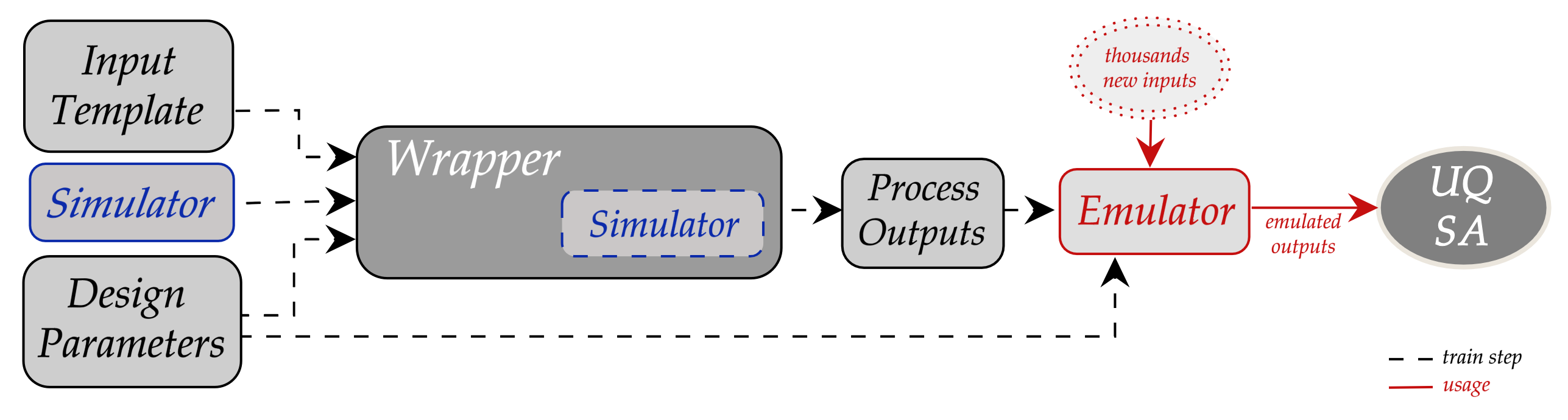
Ultimately, this project aims to enable the usage of OpenFOAM simulator to perform efficient and automated uncertainty quantification studies aided by surrogate modeling techniques wrapping the OpenFOAM simulation process.
Built on top of Jinja2, xarray and fluidfoam.
Features
- End-to-end UQ workflow: sample -> render cases -> run -> collect -> analyze
- OpenFOAM-native integration: Jinja2-templated dictionaries and Allrun orchestration
- Parallel execution built-in support for sampled scenarios
- Reproducible experiment management and basic statistics with CSV/NumPy-friendly outputs
- Extensible hooks for surrogate modeling with
uqpylab(https://uqpylab.uq-cloud.io/) and custom post-processing - Intrusive/Closed-loop reinforcement learning: the policy runs inside the OpenFOAM solver (
uqtopus.rl)
Installation
OpenFOAM
UQTOPUS targets OpenFOAM 9 from the OpenFOAM Foundation (openfoam.org).
sudo sh -c "wget -O - https://dl.openfoam.org/gpg.key | apt-key add -"
sudo add-apt-repository http://dl.openfoam.org/ubuntu
sudo apt-get update
sudo apt-get -y install openfoam9
source /opt/openfoam9/etc/bashrc
Python package
pip install uqtopus
Requires Python 3.10 or newer.
Basic Usage
- Set a config file:
# config.yaml
output_path: experiments/myUQStudy
input_path: templates/templateSimulation
solver: mySolverScript
parameter_ranges:
  [folder_path]__[file_name]__[param_name]: [0.01, 0.3]
nthreads: 2
- Templatize the simulation file with the desired variables in Jinja2 format (double curly braces):
...
FoamFile
{
    format      ascii;
    class       dictionary;
    location    "constant";
    object      transportProperties;
}
// * * * * * * * * * * * * * * * * * * * * * * * * * * * * * * * * * * * * * //

param1              {{param1}};
param2              {{param2}};
param3              {{param3}};
...
- Set the solver script:
#!/bin/bash
cd ${0%/*} || exit 1    # Run from this directory

# Source tutorial run functions
. $WM_PROJECT_DIR/bin/tools/RunFunctions

runApplication blockMesh
runApplication $(getApplication)
- Run a UQ study:
import uqtopus as uqt
config = 'config.yaml'
uqt.run_uq_study(config, n_samples=50)
For more information on configuring and running UQ studies, please refer to the example notebooks.
Directory Structure
UQTOPUS/
├── src/uqtopus/              # Python package
│   ├── rl/                   # closed-loop reinforcement learning
│   └── policy_src/           # OpenFOAM library: the actuators the policy drives
├── examples/                 # Example of usage with scripts and templates
│   ├── templates/            # OpenFOAM case templates
│   │   └── base_case/        # Base case with Jinja2 placeholders
│   │       ├── constant/
│   │       ├── system/
│   │       ├── 0/
│   │       └── [script_file]     # Run script (e.g., Allrun)
│   ├── experiments/          # UQ study results
│   │   └── [study_name]/     # Individual study results
│   │       ├── sample_0001/   # OpenFOAM case for sample 1
│   │       ├── sample_0002/   # OpenFOAM case for sample 2
│   │       └── ...
│   └── config_*.yml          # Configuration file for examples
└── README.md                 # This file
Configuring a template case
-
Add Jinja2 placeholders in OpenFOAM dictionaries where parameters vary.
- Example (constant/transportProperties):
transportModel {{ transportModel | default('Newtonian') }}; nu [0 2 -1 0 0 0 0] {{ nu | default(1e-5) }}; - Example with conditionals (constant/momentumTransport):
simulationType RAS; RAS { model {% if turbulence == "kEpsilon" %}kEpsilon{% else %}kOmegaSST{% endif %}; turbulence on; printCoeffs on; } - Jinja tips:
- Use default: {{ var|default(1.0) }}
- Use rounding: {{ diameter|round(5) }}
- Use conditionals/loops for switching models or patch sets.
- Example (constant/transportProperties):
-
Provide a run script in the template root (e.g., templates/base_case/Allrun). Keep it non-templated.
- Minimal example (mesh + solver):
cd ${0%/*} || exit 1    # Run from this directory

# Source tutorial run functions
. $WM_PROJECT_DIR/bin/tools/RunFunctions

runApplication blockMesh
runApplication $(getApplication)
- Minimal example (mesh + solver):
-
Place the template under
templatesdirectory to ensure organization with standard OpenFOAM layout (0/, constant/, system/). The UQ runner will render the Jinja placeholders per sample and invoke your run script.
Closed-loop RL module
Needed only for uqtopus.rl. The package ships an OpenFOAM library that adds three ways to apply the action: the uqtopusBoundaryCondition boundary condition, on a patch, the uqtopusSource source term, in a set of cells, and the uqtopusPolicy Function1, for a scalar input the solver reads. The solver loads it through the libs() line of controlDict.
1. Install it
pip install "uqtopus[rl]"
2. Build the OF library
Just run
uqtopus rl-build --install-onnxruntime
to find the OpenFOAM installation, download the ONNX Runtime C++ package if none is present, compile and write the library where the solver already looks for it.
Drop --install-onnxruntime if you already have the runtime; it is found through ONNXRUNTIME_ROOT or under ~/opt. Useful options:
| option | what it does |
|---|---|
--check |
run the checks and stop, building nothing |
--foam PATH |
use a specific etc/bashrc or installation root |
--onnxruntime PATH |
use a specific ONNX Runtime release |
3. Mark the case
Two lines in system/controlDict are added by the user to a working case: one to load the library, one to mark where the contract goes.
application     pimpleFoam;
libs            ("libuqtopusPolicy.so");

{{ controller }}
Then, just define each controlled patch names the boundary condition. It takes the action component of the target that carries its name and writes direction times that component. direction is required on a vector field:
patch
{
    type            uqtopusBoundaryCondition;
    direction       (1 0 0);
    value           uniform (0 0 0);
}
A scalar input of a model, read by the solver with Function1<scalar>::New from a file such as constant/<model>Properties, takes a uqtopusPolicy entry. action names the target and value holds until the first decision:
inputA { type uqtopusPolicy; action targetA; value 0; }
The class reading it takes the dictionary by reference from its file, as IOdictionary(...).subDict(...) gives it. The stock uniformFixedValue does the same on a scalar field.
4. Declare what the policy reads and drives
A PolicySpec is the contract both sides read. ActionSpec names the targets the action drives, one component each, in the order written. The observation is a list of sources, concatenated in declaration order, and there are two kinds.
ProbeSource reads a field at points. The solver samples the field held in memory during the step, so nothing is read back from a written file:
import numpy as np
import uqtopus.rl as rl

upstream = np.array([
    [-0.8,  0.3, 0.0],  # one row per probe
    [-0.8, -0.3, 0.0],  # in mesh coordinates: x, y, z
])

rl.ProbeSource(field_name="p", positions=upstream, name="upstream")
name labels the group in the trajectory columns, which come out as upstream.p.0 and upstream.p.1 for each probe.
RegistrySource brings in a custom quantity the case computed itself, by the name it stored it under:
rl.RegistrySource(name="myCustomSource")
One source per quantity, so two flow rates means two of these. Use it for what is not a point value of a field: a flux through a patch, a running total, average over a patch or mesh. The case should publish the quantity itself, as section 6 shows.
spec = rl.PolicySpec(
    observation=rl.ObservationSpec(
        sources=(
            rl.ProbeSource(field_name="p", positions=upstream, name="upstream"),
            rl.RegistrySource(name="myCustomSource"),
        )
    ),
    action=rl.ActionSpec(name="omega", targets=("patchA", "patchB"), low=-5.0, high=5.0),
    control_interval=0.5,
)
5. Let uqtopus render it!
uqtopus.rl fills the placeholder before every episode. The key names where it goes, as folder__file__variable:
runner = rl.ClosedLoopRunner(
    uqt.OpenFOAMSimulator(case, "Allrun", runs, ["U", "p"]),
    spec,
    reward_fn,
    controller_keys="system__controlDict__controller",
    function_objects=["forces"],
)
What lands in the case is the whole contract, so the solver and the network agree on where the observation is measured and what the bounds are:
uqtopusPolicy
{
    type            uqtopusPolicy;
    policy          "/abs/path/policy.onnx";
    specHash; controlInterval; startTime; seed; deterministic;
    observation
    {
        dim; sources;
    }
    action
    {
        name; nComponents; rampFraction; low; high; targets;
    }
}
No worries with the details here, it is all handled by the Python module itself.
Each episode writes postProcessing/uqtopusPolicy/<startTime>/trajectory.dat, one row per control step: the observation read at the start of the control interval, the action sampled for it, before the ramp and the clip to low and high, and as its time, the end of that interval. Each function object in function_objects is time-averaged over the same interval, every sample weighted by its time step, so reward_fn sees, for each action, what happened while it was applied. An entry name/file reads one file of a function object that writes several, such as probes/U. Each variable is named after the entry and the column: forces/Cd for the entry forces, and probes/p/0 and probes/T/0 for the same probe in two fields. A column holding a vector or tensor becomes one variable per component, such as probes/U/0.x, probes/U/0.y and probes/U/0.z.
To evaluate a trained policy, runner.collect(artifact, deterministic=True) applies the mean action instead of a draw.
6. Publish a quantity the mesh does not hold
RegistrySource reads a scalar by name, so the case stores it first. OpenFOAM compiles a block of controlDict for that, and the case author writes the quantity into it: codeRead creates the scalar once, codeExecute updates it every time step. This one averages a field over the whole mesh, which no single point carries:
myCustomSource
{
    // Specifies a dynamic, runtime-compiled OpenFOAM function object.
    type coded;
    libs ("libutilityFunctionObjects.so");

    // Includes required C++ headers for compilation.
    codeInclude
    #{
        #include "uniformDimensionedFields.H"
    #};

    // Executed at initialization to create and register the field in the object registry.
    codeRead
    #{
        if (!mesh().foundObject<uniformDimensionedScalarField>("myCustomSource"))
        {
            uniformDimensionedScalarField* source = new uniformDimensionedScalarField
            (
                IOobject("myCustomSource", mesh().time().constant(), mesh()),
                dimensionedScalar("myCustomSource", dimless, 0)
            );
            source->store();
        }
    #};

    // Executed at each time step to compute and update the field value.
    codeExecute
    #{
        const volScalarField& p = mesh().lookupObject<volScalarField>("p");

        mesh().lookupObjectRef<uniformDimensionedScalarField>("myCustomSource").value() =
            gSum(p.primitiveField()*mesh().V())/gSum(mesh().V());
    #};
}
See src/uqtopus/policy_src/README.md for the OpenFOAM controller library details.
Examples
See examples folder for notebooks with workflow demonstrations.
License
MIT License - see LICENSE file for details.
1 maintainer

Metadata
1 maintainer
Release files for uqtopus 0.3.0
For a detailed explanation of source distributions (sdists) and built distributions (wheels), please see the package formats documentation.
Source distribution (sdist)
| File | Size | Uploaded | |
|---|---|---|---|
| uqtopus-0.3.0.tar.gz | 7.4 MB | Details |
Built distribution (wheel)
| File | Interpreter | ABI | Platform | Reset |
|---|---|---|---|---|
| uqtopus-0.3.0-py3-none-any.whl | Python 3 | none | any | Details |
Total release size: 7.5 MB
Release files / uqtopus-0.3.0.tar.gz
| Download URL | uqtopus-0.3.0.tar.gz |
|---|---|
| Size | 7.4 MB |
| Tags | Source |
|
SHA-256 checksum How to use checksums |
dae061b6a11d60686e81c75d3a9a7ecaac2b87894a08166498f19663309a6057
|
|
BLAKE2b-256 checksum How to use checksums |
675dfc330c5ffadae34fe1baafeaadcd68bdaf40fb80a824b9758bbb469aeaec
|
| Upload date | |
|
Uploaded using Trusted Publishing? What is trusted publishing? |
Yes |
| Uploaded via |
twine/7.0.0 CPython/3.13.14
|
Provenance
Provenance describes where a file came from. On PyPI, provenance is shared via attestations, which provide a verifiable record of the build or publishing details. View details, limitations and caveats.


PyPI Publish Attestation
PyPI verified that this artifact, at this checksum, originated from the publisher listed below.
Signed by GitHub Actions, verified by PyPI on Oct 4, 2026.
Transparency logRelease files / uqtopus-0.3.0-py3-none-any.whl
| Download URL | uqtopus-0.3.0-py3-none-any.whl |
|---|---|
| Size | 73.5 kB |
| Tags | Python 3 |
|
SHA-256 checksum How to use checksums |
cfabede74d52bc499a86ea49a7b60ed932683ac1d17cd9c4695ed252cdd0d450
|
|
BLAKE2b-256 checksum How to use checksums |
3696ddf39f7642b68da4d08a7ce5e78331fdc4f8674aaaa3d117b185405536a6
|
| Upload date | |
|
Uploaded using Trusted Publishing? What is trusted publishing? |
Yes |
| Uploaded via |
twine/7.0.0 CPython/3.13.14
|
Provenance
Provenance describes where a file came from. On PyPI, provenance is shared via attestations, which provide a verifiable record of the build or publishing details. View details, limitations and caveats.
PyPI Publish Attestation
PyPI verified that this artifact, at this checksum, originated from the publisher listed below.
Signed by GitHub Actions, verified by PyPI on Oct 4, 2026.
Transparency log













