
scoreUS

DOI: https://doi.org/10.24433/CO.2791944.v1
Y. Takefuji, "The Best and Sustainable COVID-19 Policy in the World," in IEEE Transactions on Computational Social Systems, doi: 10.1109/TCSS.2022.3227926.
Takefuji, Y. Toyokura, J. Time-series COVID-19 policy outcome analysis of the 50 U.S. states. Clinical Immunology Communications. https://doi.org/10.1016/j.clicom.2023.08.002 (2023).
This is a practice or exercise for students.
-
Build a program for scoring U.S. states' policies toward the COVID-19 pandemic. Scoring is based on the number of deaths per population (millions).
-
Then, use machine learning for understanding the relationship between its scores and other indicators. Specify feature-importances in descending order.
Indicators such as the number of deaths, immunization rates, population, poverty rates, and others must be used in machine learning.
- Examine whether the result will play a key role for policymakers in their decision-making against the pandemic.
https://data.cdc.gov/api/views/9bhg-hcku/rows.csv
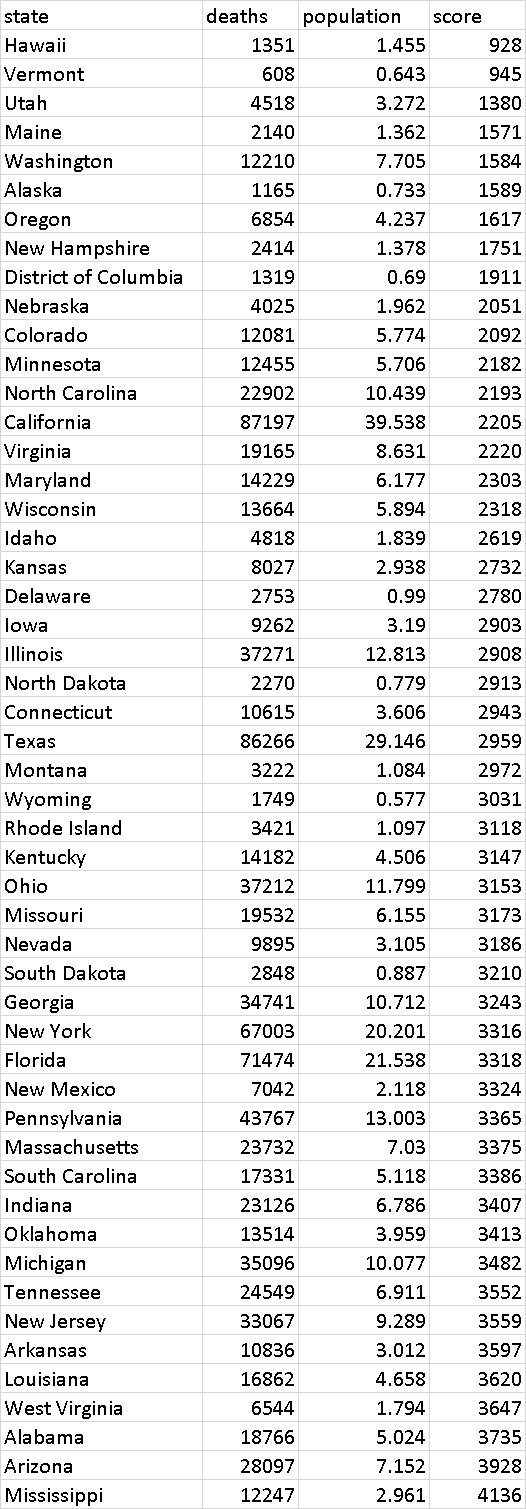
usscore is to score state COVID-19 policies in the US. Scoring is calculated by dividing the number of deaths due to COVID-19 by the population in millions. The goal of usscore is for states with poor scores to learn good strategies from states with excellent scores.
How to install usscore on Linux, MacOS, or WSL on Windows
$ pip install usscore
How to install usscore on Windows 11 or 10
$ pip install usscore --force-reinstall --no-cache-dir --no-binary :all:
how to run usscore
$ usscore
The result of sorted scores is shown as follows as of March 10 2022.
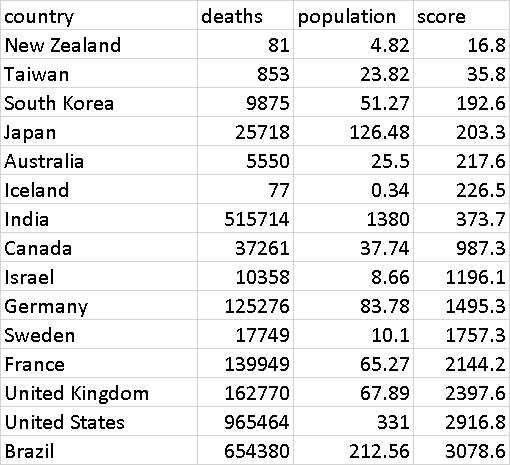
Comparison with other countries on scores generated by scorecovid: https://pypi.org/project/scorecovid
deaths of US states:
https://github.com/nytimes/covid-19-data/raw/master/live/us-states.csv
vaccination rate of US states:
https://covid.ourworldindata.org/data/vaccinations/us_state_vaccinations.csv
Use PopulationReport.csv on population by state in the US:
https://data.ers.usda.gov/reports.aspx?ID=17827
Use pov.csv file on poverty rate by state in the US:
https://data.ers.usda.gov/reports.aspx?ID=17826
Use health.csv:
education
1 maintainer

Metadata
1 maintainer
Release files for usscore 0.0.7
For a detailed explanation of source distributions (sdists) and built distributions (wheels), please see the package formats documentation.
Source distribution (sdist)
| File | Size | Uploaded | Provenance | |
|---|---|---|---|---|
| usscore-0.0.7.tar.gz | 3.5 kB | Without provenance | Details |
Built distribution (wheel)
| File | Interpreter | ABI | Platform | Reset |
|---|---|---|---|---|
| usscore-0.0.7-py3-none-any.whl | Python 3 | none | any | Details |
Total release size: 7.3 kB
Release files / usscore-0.0.7.tar.gz
| Download URL | usscore-0.0.7.tar.gz |
|---|---|
| Size | 3.5 kB |
| Tags | Source |
|
SHA-256 checksum How to use checksums |
6955355c8fe7c4a8d54ecbdc498af7ee46bbf87243bc048f291725111ce580c8
|
|
BLAKE2b-256 checksum How to use checksums |
7d4de8d72f4e34cc19cfb9d77cae14a791ae26f7066d4883003a847be0e650f1
|
| Upload date | |
|
Uploaded using Trusted Publishing? What is trusted publishing? |
No |
| Uploaded via |
twine/5.0.0 CPython/3.8.12
|
Release files / usscore-0.0.7-py3-none-any.whl
| Download URL | usscore-0.0.7-py3-none-any.whl |
|---|---|
| Size | 3.7 kB |
| Tags | Python 3 |
|
SHA-256 checksum How to use checksums |
f149b891f272cff12a74ec0a788240b4969567cbc8a006194d5055ef1a00672e
|
|
BLAKE2b-256 checksum How to use checksums |
792db97785a5d243c9b995a12198a0d0bbb6fba44572d97b71ff5c086aae61b5
|
| Upload date | |
|
Uploaded using Trusted Publishing? What is trusted publishing? |
No |
| Uploaded via |
twine/5.0.0 CPython/3.8.12
|
Security for usscore 0.0.7
Provenance
Provenance describes where a file came from. On PyPI, provenance is shared via attestations, which provide a verifiable record of the build or publishing details. View details, limitations and caveats.
No provenance found
None of the files in this release were uploaded with provenance metadata.
A note on package security
PyPI is a repository for distributing packages, not a service for auditing them. While third-party security researchers and our staff do their best to detect and remove malicious packages, PyPI cannot guarantee the quality, security or suitability of any given package.
To learn more about protecting yourself from malicious actors, visit our package security documentation.














