
Curio: A dataflow-based framework for urban visual analytics

Project description
Curio 





Curio is a framework for collaborative urban visual analytics that uses a dataflow model with multiple abstraction levels (code, grammar, GUI elements) to facilitate collaboration across the design and implementation of visual analytics components. The framework allows experts to intertwine preprocessing, managing, and visualization stages while tracking provenance of code and visualizations.
What's New
Curio v0.5.5 introduces a number of improvements and fixes thanks to the efforts of new contributors. Highlights include:
- 📦 Pip Installation Support: Curio can now be installed via
pip install utk-curio, making it easier to get started. Check the usage document for details. - 🚀 Performance Improvements: Enhanced computation execution speed in the backend.
- 🧪 Initial End-to-End Testing: Integrated test for backend/sandbox testing.
- 🧭 New Examples Added: Included new dataflows like "Complaints by Zip Code" and "Accessibility Analysis".
- 🐳 Docker Enhancements: Fixed Docker build issues by enforcing platform and fixing dependency installation errors.
- 🧹 General Bug Fixes: Resolved issues with icons, route definitions, upload status tracking, and environment variable references.
See the full Release notes for more. To get started with installation and setup, see the usage guide. For a quick hands-on walkthrough, try the quick start tutorial. If you'd like to contribute, read the contribution guide.
Roadmap
- 🔌 UTK-Serverless Integration: UTK and Curio's integration is being improved. A new UTK serverless version will be integrated soon.
- 🧪 Expanded Testing Suite: A more comprehensive testing framework is being extended to also cover frontend scenarios.
- 🧠 Enhanced Learning Resources: More example dataflows and revised documentation are being created.
- 🧩 Modular Node Architecture: A refactor is in progress to support a plug-in architecture, allowing programmers to define and register custom dataflow nodes more easily.
- 📓 Notebook Interoperability: We are building support for importing/exporting dataflows to and from Jupyter notebooks.
- 🧾 Advanced Provenance Tracking: We are improving how Curio tracks and visualizes the history of user actions.
- 📋 Improved Logging System: Curio's logging is being updated with clearer diagnostics, better error tracking, and improved debugging support.
Overview
Curio: A Dataflow-Based Framework for Collaborative Urban Visual Analytics
Gustavo Moreira, Maryam Hosseini, Carolina Veiga, Lucas Alexandre, Nico Colaninno, Daniel de Oliveira, Nivan Ferreira, Marcos Lage, Fabio Miranda
IEEE Transactions on Visualization and Computer Graphics ( Volume: 31, Issue: 1, January 2025)
Paper: [DOI], [Arxiv]
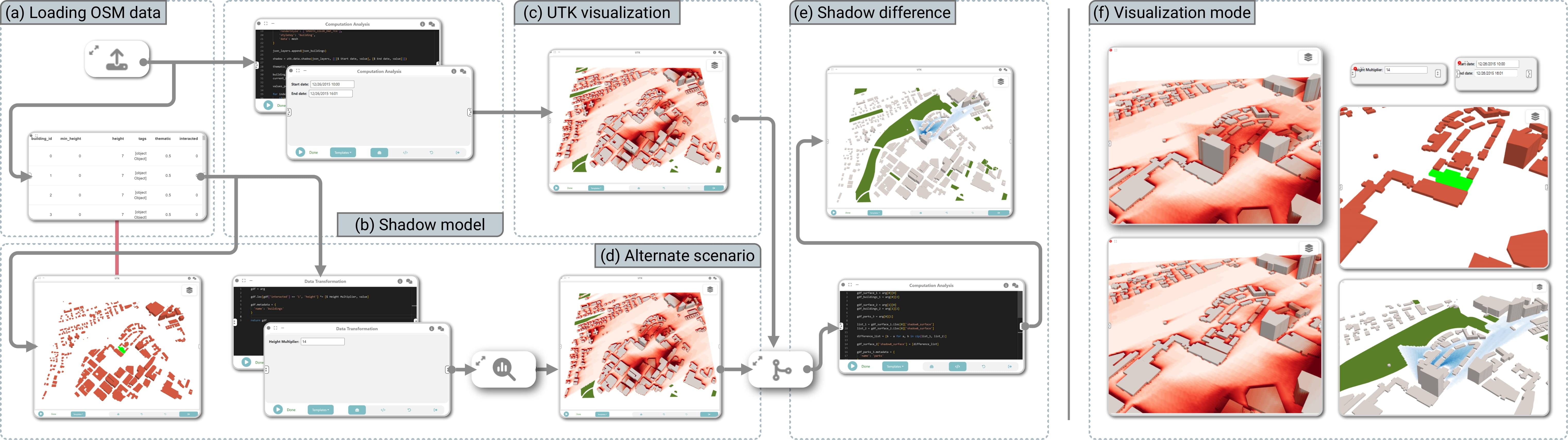
This project is part of the Urban Toolkit ecosystem, which includes Curio and UTK. Curio is a framework for collaborative urban visual analytics that uses a dataflow model with multiple abstraction levels to facilitate collaboration across the design and implementation of visual analytics components. UTK is a flexible and extensible visualization framework that enables the easy authoring of web-based visualizations through a new high-level grammar specifically built with common urban use cases in mind.
Key features
- Provenance-aware dataflow
- Modularized and collaborative visual analytics
- Support for 2D and 3D maps
- Linked data-driven interactions
- Integration with UTK and Vega-Lite
Usage and contributions
For detailed instructions on how to use the project, please see the usage document. A set of examples can be found here.
🚀 Curio now supports a Docker-based setup for easier installation and orchestration of all components. See the usage guide for instructions on running Curio with Docker.
If you'd like to contribute, see the contributions document for guidelines. For questions, join UTK's Discord server.
Citation
@ARTICLE{moreira2025curio,
  author={Moreira, Gustavo and Hosseini, Maryam and Veiga, Carolina and Alexandre, Lucas and Colaninno, Nicola and de Oliveira, Daniel and Ferreira, Nivan and Lage, Marcos and Miranda, Fabio},
  journal={IEEE Transactions on Visualization and Computer Graphics},
  title={Curio: A Dataflow-Based Framework for Collaborative Urban Visual Analytics},
  year={2025},
  volume={31},
  number={1},
  pages={1224-1234},
  doi={10.1109/TVCG.2024.3456353}
}
License
Curio is MIT Licensed. Free for both commercial and research use.
Acknowledgements
Curio and the Urban Toolkit have been supported by the National Science Foundation (NSF) (Awards #2320261, #2330565, and #2411223), Discovery Partners Institute (DPI), and IDOT.


Download files
Download the file for your platform. If you're not sure which to choose, learn more about installing packages.
Source Distribution
Built Distribution
Filter files by name, interpreter, ABI, and platform.
If you're not sure about the file name format, learn more about wheel file names.
Copy a direct link to the current filters
File details
Details for the file utk-curio-0.5.6.tar.gz.
File metadata
- Download URL: utk-curio-0.5.6.tar.gz
- Upload date:
- Size: 30.1 MB
- Tags: Source
- Uploaded using Trusted Publishing? No
- Uploaded via: twine/4.0.2 CPython/3.11.12
File hashes
| Algorithm | Hash digest | |
|---|---|---|
| SHA256 |
eb2ca6bd9ecd15c0f622f55db5879693fcb12f240e70a651b01393fa796a1114
|
|
| MD5 |
490d4228536222b49d3cee57df1151e3
|
|
| BLAKE2b-256 |
fbaf15169d75c2fbfcfa2877f9ee5c1e736155a03e5b92d0cd93e338bcf310ac
|
File details
Details for the file utk_curio-0.5.6-py3-none-any.whl.
File metadata
- Download URL: utk_curio-0.5.6-py3-none-any.whl
- Upload date:
- Size: 30.5 MB
- Tags: Python 3
- Uploaded using Trusted Publishing? No
- Uploaded via: twine/4.0.2 CPython/3.11.12
File hashes
| Algorithm | Hash digest | |
|---|---|---|
| SHA256 |
9103911344fc4c76c74465a2b2afa335fa433df3ea34699576b04b837511b54e
|
|
| MD5 |
f3d9bfa8a4b99cf071670a333b35c2d8
|
|
| BLAKE2b-256 |
297f06bc584e9f96ccb3c9197049de75b06126b617bd9cf8ffffb19b4e306269
|






