
An extremely fast Python package installer and resolver, written in Rust.


Project description
uv






An extremely fast Python package installer and resolver, written in Rust. Designed as a drop-in
replacement for common pip and pip-tools workflows.
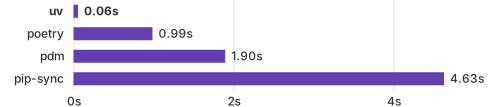
Installing the Trio dependencies with a warm cache.
Highlights
- ⚖️ Drop-in replacement for common
pip,pip-tools, andvirtualenvcommands. - ⚡️ 10-100x faster than
pipandpip-tools(pip-compileandpip-sync). - 💾 Disk-space efficient, with a global cache for dependency deduplication.
- 🐍 Installable via
curl,pip,pipx, etc. uv is a static binary that can be installed without Rust or Python. - 🧪 Tested at-scale against the top 10,000 PyPI packages.
- 🖥️ Support for macOS, Linux, and Windows.
- 🧰 Advanced features such as dependency version overrides and alternative resolution strategies.
- ⁉️ Best-in-class error messages with a conflict-tracking resolver.
- 🤝 Support for a wide range of advanced
pipfeatures, including editable installs, Git dependencies, direct URL dependencies, local dependencies, constraints, source distributions, HTML and JSON indexes, and more.
uv is backed by Astral, the creators of Ruff.
Getting Started
Install uv with our standalone installers, or from PyPI:
# On macOS and Linux.
curl -LsSf https://astral.sh/uv/install.sh | sh

# On Windows.
powershell -c "irm https://astral.sh/uv/install.ps1 | iex"

# With pip.
pip install uv

# With pipx.
pipx install uv

# With Homebrew.
brew install uv

# With Pacman.
pacman -S uv
To create a virtual environment:
uv venv # Create a virtual environment at .venv.
To activate the virtual environment:
# On macOS and Linux.
source .venv/bin/activate

# On Windows.
.venv\Scripts\activate
To install a package into the virtual environment:
uv pip install flask                # Install Flask.
uv pip install -r requirements.txt  # Install from a requirements.txt file.
uv pip install -e .                 # Install the current project in editable mode.
uv pip install "package @ ."        # Install the current project from disk.
uv pip install "flask[dotenv]"      # Install Flask with "dotenv" extra.
To generate a set of locked dependencies:
uv pip compile requirements.in -o requirements.txt    # Read a requirements.in file.
uv pip compile pyproject.toml -o requirements.txt     # Read a pyproject.toml file.
uv pip compile setup.py -o requirements.txt           # Read a setup.py file.
echo flask | uv pip compile - -o requirements.txt     # Read from stdin.
uv pip freeze | uv pip compile - -o requirements.txt  # Lock the current environment.
To sync a set of locked dependencies with the virtual environment:
uv pip sync requirements.txt # Install from a requirements.txt file.
uv's pip-install and pip-compile commands support many of the same command-line arguments
as existing tools, including -r requirements.txt, -c constraints.txt, -e . (for editable
installs), --index-url, and more.
Limitations
While uv supports a large subset of the pip interface, it does not support the entire feature set.
In some cases, those differences are intentional; in others, they're a result of uv's early stage of
development.
For details, see our pip compatibility guide.
Like pip-compile, uv generates a platform-specific requirements.txt file (unlike, e.g.,
poetry and pdm, which generate platform-agnostic poetry.lock and pdm.lock files). As such,
uv's requirements.txt files may not be portable across platforms and Python versions.
Roadmap
uv is an extremely fast Python package resolver and installer, designed as a drop-in
replacement for pip, pip-tools (pip-compile and pip-sync), and virtualenv.
uv represents an intermediary goal in our pursuit of a "Cargo for Python": a comprehensive project and package manager that is extremely fast, reliable, and easy to use.
Think: a single binary that bootstraps your Python installation and gives you everything you need to
be productive with Python, bundling not only pip, pip-tools, and virtualenv, but also pipx,
tox, poetry, pyenv, ruff, and more.
Our goal is to evolve uv into such a tool.
In the meantime, though, the narrower pip-tools scope allows us to solve the low-level problems
involved in building such a tool (like package installation) while shipping something immediately
useful with a minimal barrier to adoption.
Advanced Usage
Python discovery
uv itself does not depend on Python, but it does need to locate a Python environment to (1) install dependencies into the environment and (2) build source distributions.
When running pip sync or pip install, uv will search for a virtual environment in the
following order:
- An activated virtual environment based on the
VIRTUAL_ENVenvironment variable. - An activated Conda environment based on the
CONDA_PREFIXenvironment variable. - A virtual environment at
.venvin the current directory, or in the nearest parent directory.
If no virtual environment is found, uv will prompt the user to create one in the current
directory via uv venv.
When running pip compile, uv does not require a virtual environment and will search for a
Python interpreter in the following order:
- An activated virtual environment based on the
VIRTUAL_ENVenvironment variable. - An activated Conda environment based on the
CONDA_PREFIXenvironment variable. - A virtual environment at
.venvin the current directory, or in the nearest parent directory. - The Python interpreter available as
python3on macOS and Linux, orpython.exeon Windows.
If a --python-version is provided to pip compile (e.g., --python-version=3.7), uv will
search for a Python interpreter matching that version in the following order:
- An activated virtual environment based on the
VIRTUAL_ENVenvironment variable. - An activated Conda environment based on the
CONDA_PREFIXenvironment variable. - A virtual environment at
.venvin the current directory, or in the nearest parent directory. - The Python interpreter available as, e.g.,
python3.7on macOS and Linux. - The Python interpreter available as
python3on macOS and Linux, orpython.exeon Windows. - On Windows, the Python interpreter returned by
py --list-pathsthat matches the requested version.
Installing into arbitrary Python environments
Since uv has no dependency on Python, it can even install into virtual environments other than
its own. For example, setting VIRTUAL_ENV=/path/to/venv will cause uv to install into
/path/to/venv, no matter where uv is installed.
uv can also install into arbitrary, even non-virtual environments by providing a --python argument
to uv pip sync or uv pip install. For example, uv pip install --python=/path/to/python will
install into the environment linked to the /path/to/python interpreter.
For convenience, uv pip install --system will install into the system Python environment, as an
approximate shorthand for, e.g., uv pip install --python=$(which python3). Though we generally
recommend the use of virtual environments for dependency management, --system is intended to
enable the use of uv in continuous integration and containerized environments.
Installing into system Python across platforms and distributions is notoriously difficult. uv
supports the common cases, but will not work in all cases. For example, installing into system
Python on Debian prior to Python 3.10 is unsupported due to the distribution's patching
of distutils (but not sysconfig).
While we always recommend the use of virtual environments, uv considers them to be required in
these non-standard environments.
Git authentication
uv allows packages to be installed from Git and supports the following schemes for authenticating with private repositories.
Using SSH:
git+ssh://git@<hostname>/...(e.g.git+ssh://git@github.com/astral-sh/uv)git+ssh://git@<host>/...(e.g.git+ssh://git@github.com-key-2/astral-sh/uv)
See the GitHub SSH documentation for more details on how to configure SSH.
Using a password or token:
git+https://<user>:<token>@<hostname>/...(e.g.git+https://git:github_pat_asdf@github.com/astral-sh/uv)git+https://<token>@<hostname>/...(e.g.git+https://github_pat_asdf@github.com/astral-sh/uv)git+https://<user>@<hostname>/...(e.g.git+https://git@github.com/astral-sh/uv)
When using a GitHub personal access token, the username is arbitrary. GitHub does not support logging in with password directly, although other hosts may. If a username is provided without credentials, you will be prompted to enter them.
If there are no credentials present in the URL and authentication is needed, the Git credential helper will be queried.
HTTP authentication
uv supports credentials over HTTP when querying package registries.
Authentication can come from the following sources, in order of precedence:
- The URL, e.g.,
https://<user>:<password>@<hostname>/... - A
netrcconfiguration file - A keyring provider (requires opt-in)
If authentication is found for a single net location (scheme, host, and port), it will be cached for the duration of the command and used for other queries to that net location. Authentication is not cached across invocations of uv.
Note --keyring-provider subprocess or UV_KEYRING_PROVIDER=subprocess must be provided to enable keyring-based
authentication.
Authentication may be used for hosts specified in the following contexts:
index-urlextra-index-urlfind-linkspackage @ https://...
See the pip compatibility guide for details on differences from
pip.
Dependency caching
uv uses aggressive caching to avoid re-downloading (and re-building dependencies) that have already been accessed in prior runs.
The specifics of uv's caching semantics vary based on the nature of the dependency:
- For registry dependencies (like those downloaded from PyPI), uv respects HTTP caching headers.
- For direct URL dependencies, uv respects HTTP caching headers, and also caches based on the URL itself.
- For Git dependencies, uv caches based on the fully-resolved Git commit hash. As such,
uv pip compilewill pin Git dependencies to a specific commit hash when writing the resolved dependency set. - For local dependencies, uv caches based on the last-modified time of the source archive (i.e.,
the local
.whlor.tar.gzfile). For directories, uv caches based on the last-modified time of thepyproject.toml,setup.py, orsetup.cfgfile.
It's safe to run multiple uv commands concurrently, even against the same virtual environment.
uv's cache is designed to be thread-safe and append-only, and thus robust to multiple concurrent
readers and writers. uv applies a file-based lock to the target virtual environment when installing,
to avoid concurrent modifications across processes.
Note that it's not safe to modify the uv cache directly (e.g., uv cache clean) while other uv
commands are running, and never safe to modify the cache directly (e.g., by removing a file or
directory).
If you're running into caching issues, uv includes a few escape hatches:
- To force uv to revalidate cached data for all dependencies, run
uv pip install --refresh .... - To force uv to revalidate cached data for a specific dependency, run, e.g.,
uv pip install --refresh-package flask .... - To force uv to ignore existing installed versions, run
uv pip install --reinstall .... - To clear the global cache entirely, run
uv cache clean.
Resolution strategy
By default, uv follows the standard Python dependency resolution strategy of preferring the
latest compatible version of each package. For example, uv pip install flask>=2.0.0 will
install the latest version of Flask (at time of writing: 3.0.0).
However, uv's resolution strategy can be configured to support alternative workflows. With
--resolution=lowest, uv will install the lowest compatible versions for all dependencies,
both direct and transitive. Alternatively, --resolution=lowest-direct will opt for the
lowest compatible versions for all direct dependencies, while using the latest
compatible versions for all transitive dependencies. This distinction can be particularly useful
for library authors who wish to test against the lowest supported versions of direct dependencies
without restricting the versions of transitive dependencies.
For example, given the following requirements.in file:
flask>=2.0.0
Running uv pip compile requirements.in would produce the following requirements.txt file:
# This file was autogenerated by uv via the following command:
#    uv pip compile requirements.in
blinker==1.7.0
    # via flask
click==8.1.7
    # via flask
flask==3.0.0
itsdangerous==2.1.2
    # via flask
jinja2==3.1.2
    # via flask
markupsafe==2.1.3
    # via
    #   jinja2
    #   werkzeug
werkzeug==3.0.1
    # via flask
However, uv pip compile --resolution=lowest requirements.in would instead produce:
# This file was autogenerated by uv via the following command:
#    uv pip compile requirements.in --resolution=lowest
click==7.1.2
    # via flask
flask==2.0.0
itsdangerous==2.0.0
    # via flask
jinja2==3.0.0
    # via flask
markupsafe==2.0.0
    # via jinja2
werkzeug==2.0.0
    # via flask
Pre-release handling
By default, uv will accept pre-release versions during dependency resolution in two cases:
- If the package is a direct dependency, and its version markers include a pre-release specifier
(e.g.,
flask>=2.0.0rc1). - If all published versions of a package are pre-releases.
If dependency resolution fails due to a transitive pre-release, uv will prompt the user to
re-run with --prerelease=allow, to allow pre-releases for all dependencies.
Alternatively, you can add the transitive dependency to your requirements.in file with
pre-release specifier (e.g., flask>=2.0.0rc1) to opt in to pre-release support for that specific
dependency.
Pre-releases are notoriously difficult to model, and are a frequent source of bugs in other packaging tools. uv's pre-release handling is intentionally limited and intentionally requires user opt-in for pre-releases, to ensure correctness.
For more, see "Pre-release compatibility"
Dependency overrides
Historically, pip has supported "constraints" (-c constraints.txt), which allows users to
narrow the set of acceptable versions for a given package.
uv supports constraints, but also takes this concept further by allowing users to override the
acceptable versions of a package across the dependency tree via overrides (--override overrides.txt).
In short, overrides allow the user to lie to the resolver by overriding the declared dependencies of a package. Overrides are a useful last resort for cases in which the user knows that a dependency is compatible with a newer version of a package than the package declares, but the package has not yet been updated to declare that compatibility.
For example, if a transitive dependency declares pydantic>=1.0,<2.0, but the user knows that
the package is compatible with pydantic>=2.0, the user can override the declared dependency
with pydantic>=2.0,<3 to allow the resolver to continue.
While constraints are purely additive, and thus cannot expand the set of acceptable versions for a package, overrides can expand the set of acceptable versions for a package, providing an escape hatch for erroneous upper version bounds.
Multi-version resolution
uv's pip-compile command produces a resolution that's known to be compatible with the
current platform and Python version. Unlike Poetry, PDM, and other package managers, uv does
not yet produce a machine-agnostic lockfile.
However, uv does support resolving for alternate Python versions via the --python-version
command line argument. For example, if you're running uv on Python 3.9, but want to resolve for
Python 3.8, you can run uv pip compile --python-version=3.8 requirements.in to produce a
Python 3.8-compatible resolution.
Reproducible resolution
uv supports an --exclude-newer option to limit resolution to distributions published before a specific
date, allowing reproduction of installations regardless of new package releases. The date may be specified
as a RFC 3339 timestamp (e.g., 2006-12-02T02:07:43Z) or UTC date in the same format (e.g., 2006-12-02).
Note the package index must support the upload-time field as specified in PEP 700.
If the field is not present for a given distribution, the distribution will be treated as unavailable.
To ensure reproducibility, messages for unsatisfiable resolutions will not mention that distributions were excluded
due to the --exclude-newer flag — newer distributions will be treated as if they do not exist.
Platform support
uv has Tier 1 support for the following platforms:
- macOS (Apple Silicon)
- macOS (x86_64)
- Linux (x86_64)
- Windows (x86_64)
uv is continuously built, tested, and developed against its Tier 1 platforms. Inspired by the Rust project, Tier 1 can be thought of as "guaranteed to work".
uv has Tier 2 support ("guaranteed to build") for the following platforms:
- Linux (PPC64)
- Linux (PPC64LE)
- Linux (aarch64)
- Linux (armv7)
- Linux (i686)
- Linux (s390x)
uv ships pre-built wheels to PyPI for its Tier 1 and Tier 2 platforms. However, while Tier 2 platforms are continuously built, they are not continuously tested or developed against, and so stability may vary in practice.
Beyond the Tier 1 and Tier 2 platforms, uv is known to build on i686 Windows, and known not to build on aarch64 Windows, but does not consider either platform to be supported at this time.
uv supports and is tested against Python 3.8, 3.9, 3.10, 3.11, and 3.12.
Environment variables
uv accepts the following command-line arguments as environment variables:
UV_INDEX_URL: Equivalent to the--index-urlcommand-line argument. If set, uv will use this URL as the base index for searching for packages.UV_EXTRA_INDEX_URL: Equivalent to the--extra-index-urlcommand-line argument. If set, uv will use this space-separated list of URLs as additional indexes when searching for packages.UV_CACHE_DIR: Equivalent to the--cache-dircommand-line argument. If set, uv will use this directory for caching instead of the default cache directory.UV_NO_CACHE: Equivalent to the--no-cachecommand-line argument. If set, uv will not use the cache for any operations.UV_RESOLUTION: Equivalent to the--resolutioncommand-line argument. For example, if set tolowest-direct, uv will install the lowest compatible versions of all direct dependencies.UV_PRERELEASE: Equivalent to the--prereleasecommand-line argument. For example, if set toallow, uv will allow pre-release versions for all dependencies.UV_SYSTEM_PYTHON: Equivalent to the--systemcommand-line argument. If set totrue, uv will use the first Python interpreter found in the systemPATH. WARNING:UV_SYSTEM_PYTHON=trueis intended for use in continuous integration (CI) environments and should be used with caution, as it can modify the system Python installation.UV_NATIVE_TLS: Equivalent to the--native-tlscommand-line argument. If set totrue, uv will use the system's trust store instead of the bundledwebpki-rootscrate.UV_INDEX_STRATEGY: Equivalent to the--index-strategycommand-line argument. For example, if set tounsafe-any-match, uv will consider versions of a given package available across all index URLs, rather than limiting its search to the first index URL that contains the package.
In each case, the corresponding command-line argument takes precedence over an environment variable.
In addition, uv respects the following environment variables:
SSL_CERT_FILE: If set, uv will use this file as the certificate bundle instead of the system's trust store.RUST_LOG: If set, uv will use this value as the log level for its--verboseoutput. Accepts any filter compatible with thetracing_subscribercrate. For example,RUST_LOG=tracewill enable trace-level logging. See the tracing documentation for more.HTTP_TIMEOUT(orUV_HTTP_TIMEOUT): If set, uv will use this value (in seconds) as the timeout for HTTP requests.PYC_INVALIDATION_MODE: The validation modes to use when run with--compile. See:PycInvalidationMode.VIRTUAL_ENV: Used to detect an activated virtual environment.CONDA_PREFIX: Used to detect an activated Conda environment.PROMPT: Used to detect the appropriate activation script after generating a virtual environment.NU_VERSION: Used to detect the appropriate activation script after generating a virtual environment.
Custom CA Certificates
By default, uv loads certificates from the bundled webpki-roots crate. The webpki-roots are a
reliable set of trust roots from Mozilla, and including them in uv improves portability and
performance (especially on macOS, where reading the system trust store incurs a significant delay).
However, in some cases, you may want to use the platform's native certificate store, especially if
you're relying on a corporate trust root (e.g., for a mandatory proxy) that's included in your
system's certificate store. To instruct uv to use the system's trust store, run uv with the
--native-tls command-line flag, or set the UV_NATIVE_TLS environment variable to true.
If a direct path to the certificate is required (e.g., in CI), set the SSL_CERT_FILE environment
variable to the path of the certificate bundle, to instruct uv to use that file instead of the
system's trust store.
Acknowledgements
uv's dependency resolver uses PubGrub under the hood. We're grateful to the PubGrub maintainers, especially Jacob Finkelman, for their support.
uv's Git implementation is based on Cargo.
Some of uv's optimizations are inspired by the great work we've seen in pnpm, Orogene, and Bun. We've also learned a lot from Nathaniel J. Smith's Posy and adapted its trampoline for Windows support.
License
uv is licensed under either of
- Apache License, Version 2.0, (LICENSE-APACHE or https://www.apache.org/licenses/LICENSE-2.0)
- MIT license (LICENSE-MIT or https://opensource.org/licenses/MIT)
at your option.
Unless you explicitly state otherwise, any contribution intentionally submitted for inclusion in uv by you, as defined in the Apache-2.0 license, shall be dually licensed as above, without any additional terms or conditions.

Release history Release notifications | RSS feed


Download files
Download the file for your platform. If you're not sure which to choose, learn more about installing packages.
Source Distribution
Built Distributions
Filter files by name, interpreter, ABI, and platform.
If you're not sure about the file name format, learn more about wheel file names.
Copy a direct link to the current filters
File details
Details for the file uv-0.1.29.tar.gz.
File metadata
- Download URL: uv-0.1.29.tar.gz
- Upload date:
- Size: 626.0 kB
- Tags: Source
- Uploaded using Trusted Publishing? Yes
- Uploaded via: twine/5.0.0 CPython/3.12.2
File hashes
| Algorithm | Hash digest | |
|---|---|---|
| SHA256 |
ed5decffebca6041ce489cec0bfbc30141ff3c6e43e8685321f2553e716e5457
|
|
| MD5 |
98fd13cb2b64b8459a85a8036ebdf30d
|
|
| BLAKE2b-256 |
f30007947f7d9788b1f5629fcb12b7370f07d1c009ccf98b3a80106ca8c793b1
|
File details
Details for the file uv-0.1.29-py3-none-win_amd64.whl.
File metadata
- Download URL: uv-0.1.29-py3-none-win_amd64.whl
- Upload date:
- Size: 9.3 MB
- Tags: Python 3, Windows x86-64
- Uploaded using Trusted Publishing? Yes
- Uploaded via: twine/5.0.0 CPython/3.12.2
File hashes
| Algorithm | Hash digest | |
|---|---|---|
| SHA256 |
a8f58fcb2c8aeccd1295d271ba7388cfa5328be29f5ce91cfbb8161eff123b72
|
|
| MD5 |
a1e864809e8fa2197de631c5bf431bae
|
|
| BLAKE2b-256 |
30f38769d51a7d2d527f37e3710d49ff486e7d00874260bc8bf3093278fe0f81
|
File details
Details for the file uv-0.1.29-py3-none-win32.whl.
File metadata
- Download URL: uv-0.1.29-py3-none-win32.whl
- Upload date:
- Size: 8.2 MB
- Tags: Python 3, Windows x86
- Uploaded using Trusted Publishing? Yes
- Uploaded via: twine/5.0.0 CPython/3.12.2
File hashes
| Algorithm | Hash digest | |
|---|---|---|
| SHA256 |
79d25e384abab5207b1b3e29daee2a5c2e76c98519ffef6dc6686d63584ff687
|
|
| MD5 |
a649575a5153b99359b3e594cc050a03
|
|
| BLAKE2b-256 |
f2e184fb48df35f4424286990d3d7276ce99a3d619bdbb3dba546a58285d75b9
|
File details
Details for the file uv-0.1.29-py3-none-musllinux_1_2_x86_64.whl.
File metadata
- Download URL: uv-0.1.29-py3-none-musllinux_1_2_x86_64.whl
- Upload date:
- Size: 11.5 MB
- Tags: Python 3, musllinux: musl 1.2+ x86-64
- Uploaded using Trusted Publishing? Yes
- Uploaded via: twine/5.0.0 CPython/3.12.2
File hashes
| Algorithm | Hash digest | |
|---|---|---|
| SHA256 |
e154fdd4624b7ccbb94f3e0c350f29730f93562b1ab3e7a281b6ff5e652b0d3d
|
|
| MD5 |
daf80704405cdb0b3c577328d7963a14
|
|
| BLAKE2b-256 |
16e39409fe932d387a3876b55b646336322dc4a92b230d3227d5e81c6258d930
|
File details
Details for the file uv-0.1.29-py3-none-musllinux_1_2_i686.whl.
File metadata
- Download URL: uv-0.1.29-py3-none-musllinux_1_2_i686.whl
- Upload date:
- Size: 11.0 MB
- Tags: Python 3, musllinux: musl 1.2+ i686
- Uploaded using Trusted Publishing? Yes
- Uploaded via: twine/5.0.0 CPython/3.12.2
File hashes
| Algorithm | Hash digest | |
|---|---|---|
| SHA256 |
341783e6db18fdf1b3f179168c4c3ab6b87b36091603473a9a6ffc1dacee4e35
|
|
| MD5 |
7efc5f5328028c0e9167aa61cada57c1
|
|
| BLAKE2b-256 |
7441cf4681362ab0b6ac2b7d20808ad1cb343370e594e828f0d7fcd1d2ce62cf
|
File details
Details for the file uv-0.1.29-py3-none-musllinux_1_2_armv7l.whl.
File metadata
- Download URL: uv-0.1.29-py3-none-musllinux_1_2_armv7l.whl
- Upload date:
- Size: 9.6 MB
- Tags: Python 3, musllinux: musl 1.2+ ARMv7l
- Uploaded using Trusted Publishing? Yes
- Uploaded via: twine/5.0.0 CPython/3.12.2
File hashes
| Algorithm | Hash digest | |
|---|---|---|
| SHA256 |
f60da529d5cbc8fd4ab22e5fb7d899d800d7170a8ab42e193fc4403d583d9170
|
|
| MD5 |
6765e871fd0d04d07dd6ae45226f7354
|
|
| BLAKE2b-256 |
fc912d818a9cb3b33d85889cea763dec41ff62e4d93014b7b3a85a8d71cd0753
|
File details
Details for the file uv-0.1.29-py3-none-musllinux_1_2_aarch64.whl.
File metadata
- Download URL: uv-0.1.29-py3-none-musllinux_1_2_aarch64.whl
- Upload date:
- Size: 11.0 MB
- Tags: Python 3, musllinux: musl 1.2+ ARM64
- Uploaded using Trusted Publishing? Yes
- Uploaded via: twine/5.0.0 CPython/3.12.2
File hashes
| Algorithm | Hash digest | |
|---|---|---|
| SHA256 |
76fef8934e03f6b0b699265be8d3a2b26ecec76e5fcb277ebc5d5a2c4ff32a66
|
|
| MD5 |
d85446f128f5be568017d98be2130269
|
|
| BLAKE2b-256 |
eb7662aea9042978fa6133d8446c6761d89d6214d8b52a35c9da1844ba51d2df
|
File details
Details for the file uv-0.1.29-py3-none-manylinux_2_28_aarch64.whl.
File metadata
- Download URL: uv-0.1.29-py3-none-manylinux_2_28_aarch64.whl
- Upload date:
- Size: 11.1 MB
- Tags: Python 3, manylinux: glibc 2.28+ ARM64
- Uploaded using Trusted Publishing? Yes
- Uploaded via: twine/5.0.0 CPython/3.12.2
File hashes
| Algorithm | Hash digest | |
|---|---|---|
| SHA256 |
bb8f3f2d398dbeee3f9288e7ae590b79979247793d0dbb1dab806c55df3b0cca
|
|
| MD5 |
919ab6e1e3b17a40efee0109daf20207
|
|
| BLAKE2b-256 |
e2fd20e3d08e9460fb3248efb6685ef30f44abfd25258c66bce93b15d171563b
|
File details
Details for the file uv-0.1.29-py3-none-manylinux_2_17_x86_64.manylinux2014_x86_64.whl.
File metadata
- Download URL: uv-0.1.29-py3-none-manylinux_2_17_x86_64.manylinux2014_x86_64.whl
- Upload date:
- Size: 11.4 MB
- Tags: Python 3, manylinux: glibc 2.17+ x86-64
- Uploaded using Trusted Publishing? Yes
- Uploaded via: twine/5.0.0 CPython/3.12.2
File hashes
| Algorithm | Hash digest | |
|---|---|---|
| SHA256 |
aa8d00ee623a598c4486f40f005059d73b4d74ecd647a4303bb740ac7f269b1b
|
|
| MD5 |
c29948712972722d23947d8fc50c6579
|
|
| BLAKE2b-256 |
7449fc943055a18815ca0e35c7d453b45472f02eb52b98b8a957ef46f99de2e9
|
File details
Details for the file uv-0.1.29-py3-none-manylinux_2_17_s390x.manylinux2014_s390x.whl.
File metadata
- Download URL: uv-0.1.29-py3-none-manylinux_2_17_s390x.manylinux2014_s390x.whl
- Upload date:
- Size: 12.3 MB
- Tags: Python 3, manylinux: glibc 2.17+ s390x
- Uploaded using Trusted Publishing? Yes
- Uploaded via: twine/5.0.0 CPython/3.12.2
File hashes
| Algorithm | Hash digest | |
|---|---|---|
| SHA256 |
5e18e9db7dde120c736880a91a414d83e42057cbf0c5205003cfd1c4758d4e59
|
|
| MD5 |
db5efc1b7dc9b3129f0d73247a8f480c
|
|
| BLAKE2b-256 |
7e7192ffe655afe618bfe4acc2534b0bbd4c7e62a63c82055d9af09067c0bd52
|
File details
Details for the file uv-0.1.29-py3-none-manylinux_2_17_ppc64le.manylinux2014_ppc64le.whl.
File metadata
- Download URL: uv-0.1.29-py3-none-manylinux_2_17_ppc64le.manylinux2014_ppc64le.whl
- Upload date:
- Size: 11.9 MB
- Tags: Python 3, manylinux: glibc 2.17+ ppc64le
- Uploaded using Trusted Publishing? Yes
- Uploaded via: twine/5.0.0 CPython/3.12.2
File hashes
| Algorithm | Hash digest | |
|---|---|---|
| SHA256 |
4e677435abdc7a74c0a3eb8f5732a620815203886d8fda5f4e29724dd5e68e5a
|
|
| MD5 |
f2092a07fab1d8e105607193ebcfd48a
|
|
| BLAKE2b-256 |
b693bf0d0a5f1d4d3536d6b563ea912d4cdba085385d359b350337bf6de5c3ce
|
File details
Details for the file uv-0.1.29-py3-none-manylinux_2_17_ppc64.manylinux2014_ppc64.whl.
File metadata
- Download URL: uv-0.1.29-py3-none-manylinux_2_17_ppc64.manylinux2014_ppc64.whl
- Upload date:
- Size: 12.4 MB
- Tags: Python 3, manylinux: glibc 2.17+ ppc64
- Uploaded using Trusted Publishing? Yes
- Uploaded via: twine/5.0.0 CPython/3.12.2
File hashes
| Algorithm | Hash digest | |
|---|---|---|
| SHA256 |
ca8b16dc6ce8157409ea42ec7d7f68bd237fe7819c17690c4a7aee686569068f
|
|
| MD5 |
c1d4f665bab12b5c9352c6b702f1bd1a
|
|
| BLAKE2b-256 |
144c985b7a3c85a0e1245c9b6220f91597fe2716b055573a039a61a84821b4b6
|
File details
Details for the file uv-0.1.29-py3-none-manylinux_2_17_i686.manylinux2014_i686.whl.
File metadata
- Download URL: uv-0.1.29-py3-none-manylinux_2_17_i686.manylinux2014_i686.whl
- Upload date:
- Size: 11.5 MB
- Tags: Python 3, manylinux: glibc 2.17+ i686
- Uploaded using Trusted Publishing? Yes
- Uploaded via: twine/5.0.0 CPython/3.12.2
File hashes
| Algorithm | Hash digest | |
|---|---|---|
| SHA256 |
f9a6023fb1863830dd1fe9a5d656fa11f18cde156f671e736904be282b2427be
|
|
| MD5 |
a87c25bbd2694ba99bbe6887c427ced0
|
|
| BLAKE2b-256 |
8ec967fda6b0c70a8a8a817d7f98feeb29cfdb58bd72297a021c83aefca7f6d2
|
File details
Details for the file uv-0.1.29-py3-none-manylinux_2_17_armv7l.manylinux2014_armv7l.whl.
File metadata
- Download URL: uv-0.1.29-py3-none-manylinux_2_17_armv7l.manylinux2014_armv7l.whl
- Upload date:
- Size: 9.6 MB
- Tags: Python 3, manylinux: glibc 2.17+ ARMv7l
- Uploaded using Trusted Publishing? Yes
- Uploaded via: twine/5.0.0 CPython/3.12.2
File hashes
| Algorithm | Hash digest | |
|---|---|---|
| SHA256 |
686b813030096942921180029d5c4cf6223f01d72514a34cf1816d10e7845a59
|
|
| MD5 |
2a0838b8e8c16f946e031327f7e0ab32
|
|
| BLAKE2b-256 |
003e58d012cf5d39766af01198be3d3728ef17b34e8ea974f0f20827e7436eb0
|
File details
Details for the file uv-0.1.29-py3-none-macosx_10_12_x86_64.whl.
File metadata
- Download URL: uv-0.1.29-py3-none-macosx_10_12_x86_64.whl
- Upload date:
- Size: 10.5 MB
- Tags: Python 3, macOS 10.12+ x86-64
- Uploaded using Trusted Publishing? Yes
- Uploaded via: twine/5.0.0 CPython/3.12.2
File hashes
| Algorithm | Hash digest | |
|---|---|---|
| SHA256 |
718ea9b5815a0fe7e9c244298b1b1a844c8f8b2f12dec8b024aef8efb3cf543f
|
|
| MD5 |
a747a4adb406844ef1d7a65bfca5921f
|
|
| BLAKE2b-256 |
6a1c6b2f7500dffa2f7f2184903e230b9d83c915432690c9ecbadd4a54408084
|
File details
Details for the file uv-0.1.29-py3-none-macosx_10_12_x86_64.macosx_11_0_arm64.macosx_10_12_universal2.whl.
File metadata
- Download URL: uv-0.1.29-py3-none-macosx_10_12_x86_64.macosx_11_0_arm64.macosx_10_12_universal2.whl
- Upload date:
- Size: 20.9 MB
- Tags: Python 3, macOS 10.12+ universal2 (ARM64, x86-64), macOS 10.12+ x86-64, macOS 11.0+ ARM64
- Uploaded using Trusted Publishing? Yes
- Uploaded via: twine/5.0.0 CPython/3.12.2
File hashes
| Algorithm | Hash digest | |
|---|---|---|
| SHA256 |
ad1a4da6213fac5f76289ee91cb2f6900f0a924e411220641ec33c0a552df947
|
|
| MD5 |
92512b8abf189cce775ca200d4aeae3b
|
|
| BLAKE2b-256 |
b8824a23d3d25816516206deb31dcc07f79abb9cd970e29e7ca7f4d917872378
|
File details
Details for the file uv-0.1.29-py3-none-linux_armv6l.whl.
File metadata
- Download URL: uv-0.1.29-py3-none-linux_armv6l.whl
- Upload date:
- Size: 9.7 MB
- Tags: Python 3
- Uploaded using Trusted Publishing? Yes
- Uploaded via: twine/5.0.0 CPython/3.12.2
File hashes
| Algorithm | Hash digest | |
|---|---|---|
| SHA256 |
1c84b20e89dd807dc414c630ecf837c8d0764d7b1e23eddde01ea7781b44b0e8
|
|
| MD5 |
626e65a165fd7ed192b87214d1694de5
|
|
| BLAKE2b-256 |
b67a97c8c62812eee0422ff8190e55f86dab566044e2ef65655d888f2a5f70be
|






