
English · العربية · 简体中文 · 繁體中文 · 日本語 · 한국어 · हिन्दी · Bahasa Indonesia · Tiếng Việt · ไทย · Français · Deutsch · Español · Português · Italiano · Русский · Türkçe
ux-skill: the design intelligence engine for Claude Code, Cursor, and every other AI coding tool
A design-intelligence engine that makes AI-generated UI distinctive instead of generic. Drop it into any of 17 AI coding tools and your output stops reading as AI-built. Free, MIT, offline, no LLM.
pip install uxskill
Star ux-skill on GitHub if this is useful, it is the single cheapest way to help the project. New here? Start with the 60-second tour or see it live at uxskill.laithjunaidy.com.

Before: generic stock-photo SEO slop. After: real construction-photo hero under a dark scrim, editorial headline with an amber accent, quote form in the hero. Same AI coding tool, same prompt, different result when ux-skill supplies the constraints.
v4.0, FOUNDATIONS: one command builds a complete, WCAG-gated design system, with Arabic and right to left built in. The strongest UX plugin for AI coding. A Python reasoning core with a deterministic 7-axis synthesizer, 12 queryable JSON manifests (84 styles, 176 palettes, 70 type pairings, 148 components, 184 industries, 35 chart types, 57 motion presets, 112 UX laws, 171 anti-pattern rules, 25 tech stacks, 160 brand specs), 18 slash commands, 5 sub-agents, 25 MCP tools, and a deterministic anti-AI-slop linter. Cross-IDE: ships into Claude Code, Cursor, Windsurf, GitHub Copilot, Gemini CLI, Codex, Kiro, Cline, Continue, Aider, Zed, JetBrains AI, Pieces, Tabby, Tabnine, CodeWhisperer, and Roo Cline.
The brand name is
ux-skill. The PyPI / npm package name staysuxskill. The GitHub repo lives atLaith0003/ux-skill.
Author: Laith Aljunaidy, designer and CTO in Amman · Site: uxskill.laithjunaidy.com · Compare vs every Claude UX plugin: compare.html · GitHub: Laith0003/ux-skill · PyPI: uxskill · npm: uxskill











New in 4.0: foundations
One brand color in, a design system out, with its contrast checked before you get it.
pip install --upgrade uxskill
uxskill system build --brand '#3366FF' --brief .ux/last-discovery.json --out design-system
Python 3.10 or newer. For the MCP server, pip install --upgrade 'uxskill[mcp]'. With pipx, pipx install uxskill (over an installed 3.x, pipx upgrade uxskill). With npm, npx uxskill@latest. Coming from 3.x? The migration guide maps every 3.x token to its 4.0 role.
Building a product or a landing page? You get tokens.css to link from your page, fonts.css with metric-matched fallbacks for the chosen faces, fonts-self-host.css that loads the faces from your own files, tokens.json for tools, decorative brand art in art/, and system-report.md, which says in plain words what was built, why, and which page composition to start from. Style with the roles (var(--color-action-primary), var(--color-text-default), var(--color-surface-page)), and switch dark mode, high contrast, compact spacing, right to left or reduced motion with one attribute on <html>. Load the faces with the Google Fonts link the report gives, or with fonts-self-host.css and a fonts/ folder, and link fonts.css with either one, before tokens.css; edit neither file. With --brief, the look follows the industry and tone when the brief names them, and structured fields (age, languages, default scheme, reading context) set text size, targets, scripts and which scheme opens; discovery does not ask for an industry, so /ux-system create asks for one. In Claude Code, /ux-system create checks the installed version, runs the build and explains the report.
Designing a design system? Nine foundations (color, type, space, layout, radius, border, elevation, motion, imagery), each varying continuously with the seven axes, with primitives and semantic roles, in the W3C design tokens format (DTCG 2025.10) with every mode's values. Same inputs, same bytes. Over MCP, ux_system_build returns the report, the gate result and each file's size, and writes the same files as the command when given out.
- WCAG gate. Every text, control and focus color pairing is measured in light and dark, at standard and high contrast: WCAG 1.4.3 (text 4.5:1) and 1.4.11 (non-text 3:1) at standard contrast, WCAG 1.4.6 (text 7:1) at high contrast, plus a 4.5:1 high-contrast floor for most non-text parts that is our own, since WCAG sets no enhanced non-text level. A system that fails is not written; the message says what to change.
- Safe by default. It never overwrites a file that differs.
--forcereplaces files only when you ask. - Arabic. Under
dir="rtl"text switches to an Arabic face with its own sizes and line height; spacing uses logical properties and motion mirrors.--latin-onlyleaves it out.
A system you already have. /ux-system enhance --from reads it in its own names (DTCG tokens, CSS custom properties, a Tailwind theme, markdown rule files or a Figma variables export), checks it through the same gate and measures what your code actually does with it; nothing is rewritten. /ux-system extend --from adds foundations, roles or contracts without changing a token it has, in an extension file beside it, and uxskill system export writes it as tokens.css, a Tailwind 4 theme or Figma variables. 4.2 adds the trust layer (lint on every write, a finish reviewer) and the launch. See the changelog.
Components and sections. 23 component contracts say which tokens each part of a control binds in every state and how each state moves: a change of state transitions on motion.state, a press scales on motion.press.scale (and holds still under reduced motion), and tabs, menus and segmented controls slide one indicator. 14 section contracts (hero, pricing, FAQ, footer and the rest) name each section's job, the components its slots take, the proof it needs and how it stacks on a phone. Pages built from them use photographs; interface fragments are extra imagery, never a replacement.
A linter that reads the page. 171 rules, many with a check on the parsed CSS and markup, read the page's own system: motion is timed from its curve, display line height is held to the engine's floor, and a hidden control must leave the tab order. uxskill lint --render opens each page in headless Chromium at desktop and phone width and drives it: focus rings that do not show or are clipped, hover and press that answer late, focus lost after Escape, and a press that still moves under reduced motion.
Fewer commands. 25 slash commands become 18. /ux-discover takes --frame and --recommend, /ux-design takes --component, --dashboard and --from-image, /ux-polish loops lint, fix, re-lint until the score reaches 90 or three rounds pass, and /ux-init takes --stats. The seven old names still work as aliases and go away in 4.1; see the aliases.
Surface playbooks. Landing, dashboard and component rules live in references/surfaces/, one playbook each. /ux-design loads exactly one, picked by its mode, so a dashboard build never reads hero rules.
Tests 13101 passing. Offline. Deterministic. No LLM ever called.
New in v3.1: brand-true, responsive, alive
- Brand fidelity is enforced, not hoped. The primary color is read from the LOGO's pixels (not the most-painted CSS); default fonts are rejected for the logo's letterform style. The extracted brand travels
recommend->synthesize, and a hard floor inevaluateFAILS any output that drops the brand color/logo or ships no real imagery. Two-way interop with the openbrand.mdconvention (render + ingest). - Mobile-first, gated. New craft foundations (
responsive.md,component-behaviors.md) plus a wrap-aware gate that fails on horizontal scroll, a wrapping nav/wordmark/button label, or an over-tall sticky header. - The wow layer. The engine derives 2-3 coordinated signature moments per page, the "wow can only come from the user" doctrine is overturned.
- Sharper linter (152 rules): imagery-mandatory + icon-only detection, placeholder-token and
100vwrules; seeded picsum kept, random stripped.
Full notes in CHANGELOG.md.
What's new in v3
- Brand specs become training data, not templates. The 160 brand specs are no longer a catalogue the recommender picks from, they're vocabulary the synthesizer distills from. Output is novel every call.
- 7-axis synthesizer (warmth, contrast, density, geometry, formality, motion, type_personality). Briefs map deterministically to axis values; axis values compile to fresh palette + type + spacing + radius + motion tokens.
- Three auto-dispatched modes:
strict_brand(100% of one brand),brand_anchor(70% one brand + 30% axis-adapted siblings),pure_synthesis(no brand named, distill from 8 axis-matching exemplars). - Decisions ledger drives the recommender.
.ux/decisions.jsonlre-ranks candidates by past wins in the same(industry, ui_type)bucket. Cold-start safe. Counts onlylint_score >= 80+user_accepted = truedecisions. - Axis interaction matrix: explicit conflict resolution between competing axes (dense + corporate → 4px, airy + corporate → 12px, soft + playful → 18px radius). No more silent ad-hoc rules.
/ux-evolveauto-loop (in 4.0, the default loop of/ux-polish): lint → polish → re-lint until score ≥ 90 or plateau or 3 rounds in 4.0 (5 in v3). Quality gate at 65.- 3 new MCP tools (15 → 18):
ux_synthesize,ux_decisions_query,ux_decisions_stats. - Local stats dashboard:
uxskill stats --htmlwrites.ux/stats.htmlshowing what YOUR install has learned. No telemetry, no global aggregate. - 223 tests pass. Offline. Deterministic. No LLM ever called.
Full details in CHANGELOG.md.
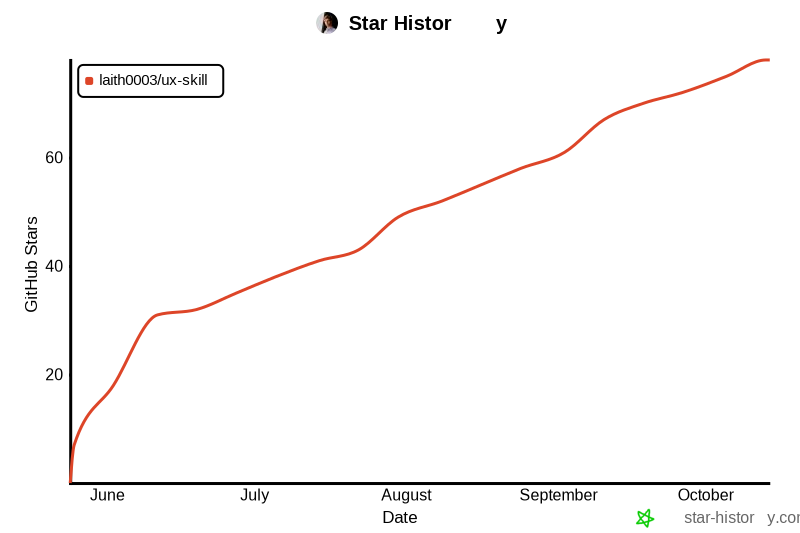
Star history
What is ux-skill
ux-skill is a design intelligence engine for AI coding tools. It runs as a Python package (pip install uxskill), as a Claude Code plugin, and as a 17-IDE multi-installer. The engine ingests a project brief (industry, audience, tone, must-haves, forbidden moves, stack, region) and returns a complete recommended design system: style, palette, type pair, motion presets, components, brand exemplars to study, and the anti-pattern guardrails that must hold. The recommendation is deterministic, same input always produces the same output.
The plugin sits between you and the AI coding tool. When you ask Claude Code, Cursor, or any other AI assistant to "build a fintech landing page," the assistant typically improvises, and the result reads as AI-generated within five seconds (purple-to-blue gradients, three equal cards, Inter at display size, "John Doe" in testimonials, 300ms default transitions, centered hero, bouncing arrow CTAs). ux-skill replaces improvisation with structured constraints: you run /ux-discover to capture the brief and pick the system, /ux-design to generate the code, and /ux-lint to verify it passes the 171 deterministic anti-AI-slop rules before commit.
This README is the canonical reference. Every command, every sub-agent, every data manifest, every install path, every brand spec, every anti-pattern category, it's all documented here. If you're shopping for a Claude Code design plugin or comparing AI design tools for Cursor, Windsurf, or Codex, read this top to bottom and the compare.html side by side.
Table of contents
- The Brain, what v3.0 is
- Quick install
- The numbers, live comparison vs the top 8 Claude UX skills
- Architecture, how the pieces fit
- The 18 slash commands, detailed reference
- The 5 sub-agents
- The 12 data manifests
- The 171 anti-AI-slop rules, the linter
- The 160 brand DESIGN.md specs, by category
- MCP server, the asymmetric move
- The 17-IDE installer
- Use cases, concrete scenarios
- Compared to alternatives
- Roadmap
- Contributing
- License, author, acknowledgments
The Brain: what v3.0 is
v3.0.0 is the biggest architectural shift in ux-skill's history. The recommender no longer picks templates from a catalogue, the engine synthesizes a fresh design language per brief. Same brief always yields the same output (fully deterministic), but every distinct brief gets its own novel system. Brand specs aren't templates anymore; they're training data the engine learns the vocabulary from. The system has eyes on its own history, closes the feedback loop locally, and never calls an LLM.
The compiler is a deterministic 7-axis synthesizer, warmth, contrast, density, geometry, formality, motion, type_personality. Every brief maps to axis values; axis values compile to fresh palette + type + spacing + radius + motion tokens. Modular type scales pick their ratio from contrast (1.200 quiet / 1.250 balanced / 1.333 loud). Layout primitives are responsive by construction (auto-fit minmax(min(N, 100%), 1fr) + container queries). Broken layouts can't be emitted because they aren't representable.
There are three auto-dispatched modes: strict_brand (reference_brands=[stripe] strict=True → 100% Stripe tokens, fastest path); brand_anchor (reference_brands=[stripe] → 70% Stripe + 30% axis-adapted from 4 sibling brands); and pure_synthesis (no brand named → infinity space, 8 axis-matching exemplars distilled into a novel design language). Conflicting axes are resolved by a documented axis interaction matrix, dense + corporate compiles to 4px (density wins, Bloomberg-school), airy + corporate to 12px (formality wins, luxury), soft + playful to 18px radius, sharp + corporate to 2px. No silent ad-hoc rules in the implementation.
The decisions ledger (.ux/decisions.jsonl, schema _v: 1 locked) closes the feedback loop. The recommender now re-ranks candidates by past wins in the same (industry, ui_type) bucket. Cold-start safe, it skips below 3 priors. It only counts decisions with lint_score >= 80 AND user_accepted = true. Plus /ux-polish runs lint → polish → re-lint until score ≥ 90 or plateau or 3 rounds, with a 65-score quality gate below which output is refused unless --force. The result: every install gets smarter on its own corpus, every run is reproducible across machines, and the engine stays fully offline.
Quick install
Three install paths. Pick the one that matches your environment.
Path 1: Claude Code marketplace (canonical)
If you live in Claude Code, install via the plugin marketplace:
/plugin marketplace add Laith0003/ux-skill
/plugin install ux@ux-skill
That wires all 18 slash commands (plus 7 old names kept as aliases until 4.1) and 5 sub-agents into your Claude Code session. After install, run /ux-init to set up the per-project .ux/ state directory and verify the Python engine is reachable.
Path 2: pip (universal)
If you live outside Claude Code (Cursor, Windsurf, CLI, CI), install the Python package:
pip install uxskill
uxskill init                       # auto-detects your IDE, installs the right artifact
uxskill stats                      # print manifest counts to verify install
uxskill lint .                     # run the linter against the current directory
The package exposes both ux and uxskill as CLI entry points, they're the same binary.
Path 3: npx (no Python required)
If you don't want to manage Python directly, the npx wrapper bootstraps everything via pipx:
npx uxskill init                  # downloads pipx + uxskill on first run
npx uxskill recommend --industry=fintech-neobank --tone=warm --stack=nextjs-15-app-router
Verify install
ux stats
# {
#   "version": "4.0.1",
#   "counts": {
#     "styles": 84,
#     "palettes": 176,
#     "type-pairs": 70,
#     "components": 148,
#     "industries": 184,
#     "chart-types": 35,
#     "tech-stacks": 25,
#     "ux-guidelines": 112,
#     "motion-presets": 57,
#     "anti-patterns": 171,
#     "landing-patterns": 40,
#     "brands": 160
#   }
# }
The twelve counts add up to 1,262 entries. If any count returns 0, the JSON file is missing, open an issue at github.com/Laith0003/ux-skill/issues.
The numbers: live comparison vs the top 8 Claude UX skills
Star counts last verified via gh api on 2026-05-28. ux-skill (Laith0003/ux-skill) is the newest entrant, we're tiny on awareness, deep on architecture. The comparison below is honest: where we lose, where we win.
| Plugin | Stars | Architecture | Slash commands | Linter (CI-safe) | Brand specs | Components | Motion presets | IDEs supported |
|---|---|---|---|---|---|---|---|---|
| nextlevelbuilder/ui-ux-pro-max-skill | 83,958 | Python BM25 + CSV, single skill | 1 | - | , | 0 | 0 | 18 |
| nexu-io/open-design | 54,406 | Node.js + 19 skills + preview | 19 | - | , | 0 | 0 | 1 |
| Leonxlnx/taste-skill | 25,202 | Bash + research-backed taste | 1 | - | , | 0 | 0 | 1 |
| alchaincyf/huashu-design | 15,455 | Single 62 KB SKILL.md + scripts | 1 | - | , | 0 | 0 | 1 |
| google-labs-code/stitch-skills | 5,762 | MCP-wired skill library | multi | - | , | 0 | 0 | 1 |
| dominikmartn/nothing-design-skill | 2,391 | Single-aesthetic skill | 1 | - | , | 0 | 0 | 1 |
| Nutlope/hallmark | 2,164 | Anti-slop design skill | 1 | - | , | 0 | 0 | 1 |
| hamen/material-3-skill | 955 | MD3 components + audit | 1 | - | (MD3 only) | 0 | 0 | 1 |
| Laith0003/ux-skill (ux-skill) | 14 | Python engine + 12 manifests + 18 commands + 5 sub-agents + CI linter | 18 | 171 deterministic rules | 160 | 148 | 57 | 17 |
Where we lose
- Awareness. They have hundreds of thousands of stars. We have 14. Star us, it's the cheapest way to help.
- Brand recognition. ui-ux-pro-max and open-design have a head start measured in months, not days.
- Marketing polish. They have screenshots, demo videos, and a discoverable landing page. We have a thorough README and a thin landing.
Where we win
- Component library: 148 documented components with anatomy, states, tokens used, and motion specs. None of the other 8 ship a component manifest.
- Motion presets: 57 stack-ready entries (Framer Motion, GSAP, CSS) with reduced-motion fallbacks. None of the others ship a motion manifest.
- Anti-pattern linter: 171 deterministic rules, runs in CI, exits non-zero on Critical/High. None of the others ship a deterministic linter.
- Brand specs: 160 real DESIGN.md specs (Apple, Stripe, Linear, Figma, Tesla, BMW, Notion, Spotify, Airbnb, Vercel, Supabase, Cursor, Raycast, Claude, and 146 more). None of the others ship a brand library.
- 17 IDEs supported: same engine, different glue per IDE.
- 18 slash commands: discovery, generation (pages, components, dashboards, from an image), audit, lint, polish loop, fix loop, case-study, workshop, copy, motion, a11y, conductor, fully integrated.
Full table-by-table side-by-side at uxskill.laithjunaidy.com/compare.html.
Architecture: how the pieces fit
ux-skill (package name: uxskill)
│
├── data/                              The brain, queryable JSON manifests
│   ├── styles.json                    84 design styles + when/skip + tokens
│   ├── palettes.json                  176 palettes (light/dark, contrast verified)
│   ├── type-pairs.json                70 display × body × mono triplets
│   ├── components.json                148 components (anatomy, states, motion)
│   ├── industries.json                184 industry rules + audience signals
│   ├── chart-types.json               35 chart types (when/skip, encoding)
│   ├── tech-stacks.json               25 stacks (Next, Astro, SvelteKit, Blade...)
│   ├── ux-guidelines.json             112 named UX laws (Hick, Fitts, Miller...)
│   ├── motion-presets.json            57 motion presets (entry, exit, hover...)
│   ├── anti-patterns.json             171 rules (CI-safe linter source)
│   └── brands/*.json                  160 brand DESIGN specs + _index.json
│
├── engine/                            Python, the reasoning
│   ├── synthesizer/                   v3-7-axis deterministic compiler
│   ├── decisions/                     v3, .ux/decisions.jsonl ledger + recommender re-rank
│   ├── recommender/                   5-parallel-search merge engine (re-ranked by decisions)
│   ├── linter/                        Deterministic anti-slop scanner
│   ├── discovery/                     10-field forcing protocol
│   ├── generator/                     Token + manifest emitter
│   ├── installer/                     17-IDE multi-installer
│   └── cli/                           `ux` / `uxskill` entry point
│
├── commands/                          18 Claude Code slash commands (.md) + 7 aliases
│   ├── ux-init.md                     bootstrap + inventory snapshot (--stats)
│   ├── ux-discover.md                 10-field intake (gate), --frame, --recommend
│   ├── ux-lint.md                     deterministic linter
│   ├── ux-design.md                   generate a page, --component, --dashboard, --from-image
│   ├── ux-system.md                   generate full design system
│   ├── ux-motion.md                   motion treatment + audit
│   ├── ux-audit.md                    6-lens design audit
│   ├── ux-a11y.md                     WCAG 2.1 AA audit
│   ├── ux-critique.md                 taste critique (3 wins, 3 misses, 1 move)
│   ├── ux-copy.md                     microcopy review + rewrite
│   ├── ux-fix.md                      apply findings as atomic commits
│   ├── ux-polish.md                   lint, fix, re-lint loop + taste pass
│   ├── ux-research.md                 research planning + synthesis
│   ├── ux-workshop.md                 5-phase design thinking workshop
│   ├── ux-case-study.md               publishable monochrome editorial case study
│   ├── ux-next.md                     workflow conductor (read-only)
│   ├── ux-expert.md                   consulting hook
│   ├── ux-mcp.md                      MCP server
│   └── ux-frame.md, ux-recommend.md, ux-stats.md, ux-evolve.md,
│       ux-component.md, ux-dashboard.md, ux-image-to-code.md
│                                      aliases, removed in 4.1
│
├── agents/                            5 sub-agents (.md)
│   ├── frontend-engineer.md           React/Next/Vue/Blade/Astro
│   ├── motion-engineer.md             Framer Motion / GSAP / CSS
│   ├── copy-writer.md                 microcopy in brand voice
│   ├── research-synthesizer.md        interviews + analytics + competitors
│   └── design-system-architect.md     tokens / components / foundations
│
├── references/                        Prose source for the data + demo pages
│   ├── foundations/                   anti-patterns.md, principles, taste
│   ├── laws/                          UX laws long-form
│   ├── process/                       discovery-protocol.md (load-bearing)
│   ├── styles/                        per-style prose (anti-slop.md, etc.)
│   ├── components/                    component long-form
│   ├── output/                        output rubrics
│   └── conditional/                   stack-specific guidance
│
├── bin/
│   ├── uxskill.mjs                    npx wrapper -> Python engine
│   ├── ux-lint.py                     v2 linter (preferred)
│   └── ux-lint.sh                     v1 fallback (bash + perl-PCRE)
│
└── .ux/                               (created per project)
    ├── last-discovery.json            brief snapshot
    ├── last-recommendation.json       picked system
    ├── last-frame.json                framing block
    ├── last-audit.json / last-a11y.json / last-copy.json / last-motion.json
    ├── last-design.json / last-component.json / last-dashboard.json
    └── last-critique.json / last-polish.json / last-research.json / last-workshop.json / last-case-study.json
How the engine actually works
- Input. You provide a brief, either interactively via
/ux-discover(10 fields) or non-interactively via flags toux recommend. - 5 parallel searches. The engine runs five lookups concurrently across the manifests:
- Industry → recommended_styles (industries.json)
- Style → palette + type + motion compatibility (styles.json)
- Tone × must-have → palette filter (palettes.json)
- Stack → component compatibility + motion presets (tech-stacks.json, motion-presets.json)
- Forbidden + region → guardrails + brand exemplar shortlist (anti-patterns.json, brands/)
- Merge. A deterministic merger ranks candidates, resolves conflicts (e.g., must-have dark-mode forces palette mode), and emits a single recommended system.
- Output. A JSON document with the picked style, palette, type pair, top 5 motion presets, top 12 components, top 5 brand exemplars, and all 171 anti-pattern guardrails active. Plus a rationale block explaining each pick.
- Generation. Downstream commands (
/ux-designin its page, component, dashboard and image modes, and/ux-system) consume the recommendation to generate actual code via the sub-agents. - Verification.
/ux-lintre-scans the generated code against the 171 rules. Exits non-zero on Critical/High in CI.
v3 additions. The recommender now re-ranks candidates from engine/decisions/ using .ux/decisions.jsonl (only counts decisions with lint_score >= 80 AND user_accepted = true; cold-start safe below 3 priors). The generator path can dispatch into engine/synthesizer/, a deterministic 7-axis compiler that produces fresh palette + type + spacing + radius + motion tokens per brief instead of picking templates from a catalogue. See The Brain, what v3.0 is for details.
Python thinks. HTML shows. Markdown chains.
The 18 slash commands: detailed reference
Every command is shipped as a .md file under commands/ with description, allowed-tools, triggers, when to use, when to skip, input, process, and output state file. The descriptions below are condensed; the full source is the canonical spec.
Commands are grouped into seven buckets: bootstrap & inventory, discovery & recommendation, generation, audit & verify, fix & polish, discovery & narrative, and conductor. Seven 3.x names still work as aliases until 4.1.
Bootstrap & inventory
/ux-init: bootstrap the project
- What: Detects which IDE you're using (
.claude/,.cursor/,.windsurf/, etc.), installs the right artifact, verifies the Python engine is reachable, prints a stats snapshot.--statsprints only the snapshot: version + entry counts for the data manifests. - When to use: First time installing in a new project. After cloning a project that uses ux-skill. After
pip install --upgrade uxskill.--statsafter install, after upgrade, or when a recommendation returns surprising picks and you suspect the manifests are incomplete. - When to skip: You already ran it in this project and nothing changed.
--statsnever needs skipping: it's a 50ms read. - Invocation:
/ux-init(no args),/ux-init --stats, oruxskill init/uxskill statsfrom the CLI.--decisionsadds the decisions ledger summary;--htmlwrites.ux/stats.html. - Output: Per-IDE artifact (see The 17-IDE installer) +
.ux/directory + stdout summary.--stats: JSON to stdout (see Verify install above). - Chains to:
/ux-discovernext.--statsis diagnostic only.
/ux-mcp: run the engine as an MCP server
- What: Starts the engine as a Model Context Protocol server over stdio. 25 tools (the recommender, linter, persistence, synthesizer, decisions ledger, image extraction, the data manifests, and building, importing, enhancing, extending, exporting and checking a design system) become callable from any MCP-capable host without the plugin.
- When to use: You work in another MCP-capable host and want the same engine. You run a multi-agent pipeline that needs one source of design constraints. You want the recommender or linter as a long-running process in CI.
- When to skip: You are inside Claude Code with the plugin installed; the slash commands already reach the engine. You need a one-shot answer;
uxskill recommendoruxskill lintis simpler. - Invocation:
/ux-mcp, orux-mcpfrom the shell afterpip install 'uxskill[mcp]'. - Output: A stdio JSON-RPC server. See MCP server and
commands/ux-mcp.mdfor per-client config. - Chains to: Nothing; it is a transport, not a step.
Discovery & recommendation
/ux-discover: the forcing function (10-field intake, framing, recommendation)
- What: The mandatory 10-field intake every project goes through before any generation command. Project type, audience, primary goal, tone, must-haves, forbidden, reference brands, stack, region, success metric. No improvisation. Banned phrases ("modern", "clean") force the user to be specific. Then runs the recommender: the Python engine's 5-parallel-search across 12 manifests returns one merged design system (Industry → Style → Palette → Type → Motion + Components + Brand Exemplars + Guardrails).
- Modes:
--framecaptures who-it's-for, outcome, hypothesis, and success signal in a four-field framing block, lighter than the full intake.--recommendruns only the recommender, from a saved brief or one-shot flags. - When to use: Before any
/ux-designor/ux-system. Whenever a previous brief has gone stale.--frameat the start of a project, sprint, or one-off engagement, or mid-stream when a conversation has drifted.--recommendwhen pivoting a tired-looking product. - When to skip: You're fixing a bug (
/ux-fix). You're only running a linter pass (/ux-lint). The brief is unchanged from the last session. - Invocation (Claude Code):
/ux-discover,/ux-discover --frame "loyalty wallet for a MENA retail pilot", or/ux-discover --recommend. Invocation (CLI):ux recommend \ --project-type=landing \ --industry=fintech-neobank \ --tone=warm --tone=editorial \ --must-have=dark-mode --must-have=a11y-AA \ --forbidden=brutalism --forbidden=purple-gradients \ --stack=nextjs-15-app-router \ --region=mena
- Output:
.ux/last-discovery.json(the 10-field brief),.ux/last-recommendation.json(picked style, palette, type pair, top 5 motion presets, top 12 components, top 5 brand exemplars, all 171 anti-pattern guardrails active, plus rationale), and with--frame,.ux/last-frame.json({audience, outcome, hypothesis, success_signal}). - Chains to:
/ux-design [extra brief]→ frontend code grounded in the recommendation./ux-design --component <name>→ one component aligned to the discovered constraints./ux-system→ full design system from the recommendation./ux-lint→ verify the generated code.
Generation
/ux-design: generate a beautiful, anti-slop surface from a brief
- What: Generates a complete, production-grade frontend artifact (landing, marketing site, app shell) from the discovery brief + recommendation. Dispatches
frontend-engineerwith creative direction from anti-slop and arsenal references. The brief, or a flag, picks one of four modes:- page (default): a full page or multi-section surface. Writes
.ux/last-design.json. --component [name]: a single, production-grade component (button, modal, navbar, sidebar, card, table, form, chart). All four interaction states, accessible, on-brand. Looks up the component in.ux/last-recommendation.jsonfirst, falls back to direct manifest query. Writes.ux/last-component.json.--dashboard: data density discipline, bento layout, tabular monospace numerals, sparkline patterns, anti-card-overuse, semantic state colors, sparing motion. Not a marketing site with charts pasted on. Writes.ux/last-dashboard.json.--from-image <path>: reads a design reference image (PNG/JPG/WebP) with pure Pillow CV (dominant palette, canvas polarity, type signal), matches it against the palettes and styles manifests, and builds from the resulting recommendation.--extract-onlystops after the extraction. Writes.ux/last-image-extract.json.
- page (default): a full page or multi-section surface. Writes
- When to use: "Design a", "build me a", "generate a landing page", "create a dashboard", "make a component", "build a button", "design the admin panel", "operator console", "KPI board", "build it like this screenshot", any free-form visual deliverable request.
- When to skip: You want a review, not a build (use
/ux-auditor/ux-critique). Backend or infrastructure work. - Invocation:
/ux-design generate a fintech landing for a MENA neobank, warm editorial tone, dark-mode AA, no purple gradients,/ux-design --component pricing-card-trio --brief="fintech, dark, monospace numbers",/ux-design --dashboard,/ux-design --from-image ref.png. - Output: Generated code (HTML / Blade / JSX / Vue / Astro), plus the mode's state file.
- Chains to:
/ux-lint→ verify against guardrails./ux-polish→ cosmetic pass./ux-a11y→ accessibility audit./ux-copy→ microcopy review./ux-fix→ apply findings as atomic commits.
/ux-system: generate a complete starter design system
- What: Proposes a complete starter design system for a project that doesn't have one, tokens (color, type, space, motion, radius, shadow), foundation docs, component contracts, dark-mode pairings, theme switcher. Dispatches
design-system-architect. - When to use: "We don't have a design system", "build us a system", "propose tokens", "what should our theme be", "set up our DS".
- When to skip: The project already has a design system, use
/ux-design --componentagainst the existing system instead. Backend or infrastructure. - Invocation:
/ux-system create(the foundations engine),/ux-system enhance --from <file>(measure a system you already have),/ux-system extend --from <file> --add <foundation>(add to it without changing it), or/ux-system(the 3.x flow; runs discovery first if not already on file). - Output:
tokens.json,foundations.md,components/*.mdcontracts, optional Tailwind / vanilla / SCSS emit. Writes.ux/last-system.jsonfor chain context. - Chains to:
/ux-design --component→ build against the new system./ux-design→ generate a surface using the new tokens.
/ux-motion: motion treatment
- What: Generates the motion layer of a surface, durations, easings, choreography, reduced-motion fallbacks, performance discipline. Also audits existing motion against the 5 dimensions (timing, easing, meaning, reduced-motion, performance).
- When to use: "Motion check", "are the animations good", "fix the motion", "review the animations", "motion audit", "performance pass on the motion".
- When to skip: Surface has no motion (use
/ux-auditor/ux-polish). Backend or infrastructure. - Invocation:
/ux-motion path/to/component.tsx(audit mode) or/ux-motion --generate hero-entry(generation). - Output: Updated code (in generation mode) or
.ux/last-motion.jsonreport (in audit mode). - Chains to:
/ux-fix→ apply motion findings./ux-polish→ tighten.
Audit & verify
/ux-lint: deterministic regex-based linter (no LLM, CI-safe)
- What: Runs 171 rules against your code. No LLM call. Exits non-zero on Critical / High in CI. Source:
data/anti-patterns.json. Rules cover A11y (45), Content (35), Layout (18), Typography (16), Motion (14), Visual (14), Quality (12), Color (10), Performance (5), Depth (2). - When to use: Pre-commit hook. CI gate. Fast first pass on a large codebase before paying the cost of
/ux-audit. After/ux-designin any mode to verify generation. - When to skip: You want a fix loop (the linter reports, it does not edit, chain into
/ux-polish --fixor/ux-fix). You want taste judgment (use/ux-critique). - Invocation (slash):
/ux-lint src/. - Invocation (CLI):
uxskill lint .orpython3 bin/ux-lint.py .orbash bin/ux-lint.sh --ci --fail-on high. - Invocation (CI):
- name: ux-lint
  run: bash bin/ux-lint.sh --ci --fail-on high
- Output: Findings to stdout (location, rule id, severity, evidence). Exit code 0 if clean, non-zero on Critical/High when
--fail-on highis set. - Chains to:
/ux-polish --fix→ LLM-driven counterpart on the same patterns./ux-fix→ apply findings as commits, severity-sorted./ux-audit→ full 6-lens reasoning pass./ux-next→ let the conductor decide.
/ux-audit: 6-lens design audit
- What: A structured, opinionated review against six lenses (clarity, hierarchy, accessibility, voice, motion, taste), producing severity-tagged findings. Polaris-style report. Reads
.ux/last-frame.jsonfirst, audience and outcome anchor every finding's severity. - When to use: Surface exists and you want a defensible critique. "Audit", "review the ux", "is this any good", "what's broken", "tear this apart".
- When to skip: Surface doesn't exist yet (use
/ux-design). User wants one lens (use the targeted command:/ux-a11y,/ux-copy,/ux-motion,/ux-polish). User wants taste opinion (use/ux-critique). Backend or infrastructure. - Invocation:
/ux-audit https://example.com/pricingor/ux-audit src/components/Pricing.tsx. - Output: Writes
.ux/last-audit.json,findingsarray of{lens, severity, title, principle, evidence, fix},severity_counts,dominant_lens,strategic_moves. - Chains to:
/ux-fix→ apply findings./ux-polish→ cosmetic pass./ux-design→ if structural redesign needed.
/ux-a11y: WCAG 2.1 AA audit + common-courtesy checks
- What: A structured WCAG 2.1 AA audit, plus the common-courtesy checks that pass automated tools but still hurt real users (focus visibility, error specificity, motion preferences, keyboard traps, color reliance).
- When to use: Pre-ship accessibility gate. After a redesign. "Accessibility check", "WCAG audit", "is this accessible", "a11y review", "screen reader test", "keyboard nav check".
- When to skip: Not user-facing. Backend or infrastructure. Work-in-progress sketches.
- Invocation:
/ux-a11y https://example.com(live URL preferred, automated tools and keyboard testing only work live). - Output: Writes
.ux/last-a11y.json,findingsarray of{wcag_sc, sc_name, severity, title, evidence, fix, category},beyond_wcagarray,severity_counts. - Chains to:
/ux-fix→ apply findings as commits./ux-copy→ fix alt text and form-error wiring as part of a copy pass.
/ux-critique: taste call (3 wins, 3 misses, 1 strategic move)
- What: A designer's opinion, not a structured audit, not a severity score, just a tight, opinionated take that names what's working, what's not, and the one strategic move that would change the most.
- When to use: "What do you think", "is this good", "critique this", "honest take", "is the vibe right", "does this feel like us", "should we ship this".
- When to skip: User explicitly wants a structured audit (use
/ux-audit). Backend or infrastructure. - Invocation:
/ux-critique https://example.com. - Output: Writes
.ux/last-critique.json, 3 wins, 3 misses, 1 strategic move, plus prose. - Chains to:
/ux-designif the take recommends redesign./ux-polishif the take recommends tightening.
/ux-copy: microcopy review + rewrite
- What: Evaluates every visible string against the voice rubric and produces a before/after rewrite. Catches: "form contains errors" (generic), "John Doe" (placeholder), AI-cheerful celebratory copy, generic CTAs, dead empty states, useless errors.
- When to use: Structure is right but words are weak. "Review the copy", "fix the microcopy", "the error messages are bad", "rewrite this", "tighten the strings", "the buttons sound generic", "this empty state is dead".
- When to skip: Layout problems (use
/ux-auditor/ux-polish). Accessibility-driven copy issues like alt text (use/ux-a11y). Backend or infrastructure. - Invocation:
/ux-copy src/views/checkout.blade.php. - Output: Writes
.ux/last-copy.json,stringsarray of{location, severity, before, after, notes}, plus rubric + locales needing translation. - Chains to:
/ux-fix→ apply rewrites./ux-a11y→ re-check after copy fixes.
Fix & polish
/ux-fix: apply findings as atomic commits
- What: Reads the latest report from
.ux/(audit, copy, a11y, motion, or polish), validates the working tree, and applies findings as atomic commits via the right sub-agents. Re-verifies by re-running the originating command. - When to use: After running an audit-class command and reviewing findings. "Fix the findings", "apply the fixes", "run the fix loop", "patch the surface", "make the changes", "go fix it".
- When to skip: No prior report in
.ux/. Working tree is dirty and the user hasn't agreed to stash/commit. Fixes need design judgment, not mechanical application (use/ux-designfor a redesign). - Invocation:
/ux-fix(auto-detects which report to fix) or/ux-fix --from=last-a11y.json. - Output: Atomic commits per finding. Re-runs the originating command and updates the
.ux/last-*.jsonfile. Prints a summary. - Chains to:
/ux-next→ conductor picks the next move.
/ux-polish: lint, fix, re-lint loop + AI-slop kill
- What: First a deterministic loop on a local HTML file: lint, apply six idempotent polish passes, re-lint, until the score reaches 90, the score plateaus, or three rounds pass (
--roundschanges the cap). By default the loop output stays at<file>.evolved.htmland the original is never touched. Only--loop-onlyor--fixreplace the original, after a clean-tree check, and a quality gate at 65 keeps a failing result from replacing it unless--force; with--brand-filethe brand-fidelity floor holds at every exit. Then the taste pass: spacing rhythm, hierarchy sharpening, AI-slop detection, token consistency. The LLM-driven counterpart to/ux-lint, uses your judgment on taste calls.--loop-onlyruns just the loop;--no-loopjust the taste pass;--fixapplies the taste findings. - When to use: Structure is right but execution is loose. "Polish", "tighten this up", "remove the AI-slop", "make it premium", "make this less AI-looking", "the spacing feels off", "this looks generic", "needs more taste", "improve until score 90+", "make it ship-ready".
- When to skip: Surface is missing core functionality (fix that first). Needs a redesign, not a polish (use
/ux-design). Copy issues (use/ux-copy). Motion issues (use/ux-motion). A11y issues (use/ux-a11y). - Invocation:
/ux-polish src/components/Hero.tsx,/ux-polish out/landing.html --css out/landing.css,/ux-polish out/landing.html --loop-only --rounds 5. - Output:
<file>.evolved.htmlfrom the loop (promoted over the original only under--loop-onlyor--fix), updated code under--fix,.ux/last-evolve.json, one line in.ux/decisions.jsonl, and.ux/last-polish.jsondescribing the taste findings. - Chains to:
/ux-lint→ verify the polish held./ux-a11y→ re-check accessibility.
Discovery & narrative
/ux-research: research planning + synthesis
- What: Planning mode: writes interview scripts, surveys, recruitment screeners. Synthesis mode (
--synthesize): digests interviews, analytics, competitor sites, A/B results, support tickets into recommendations. Dispatchesresearch-synthesizer. - When to use: "Plan a research study", "I need interview questions", "design a survey", "how do I recruit users", "user testing plan", "diary study", "preference test", "fake door", "smoke test", "synthesize my interview notes".
- When to skip: Answer is already known with high confidence. Low-risk reversible decisions. Backend or infrastructure.
- Invocation:
/ux-research --plan "loyalty wallet adoption in MENA"or/ux-research --synthesize interviews/*.md. - Output: Writes
.ux/last-research.json, research plan or synthesized themes + evidence + recommendations. - Chains to:
/ux-discover --frame→ integrate findings into a frame./ux-design→ generate from findings./ux-workshop→ run a workshop using the research as input.
/ux-workshop: 5-phase design thinking workshop
- What: Facilitates a discovery / design-thinking workshop end-to-end. Five sequential phases (exploration → heat map → stakeholder map → solution sketch → game plan). Time-boxed. Concrete artifacts per phase. Ends with a decision, not "interesting findings."
- When to use: Real question, real participants, real time budget. "Run a workshop", "facilitate a discovery", "let's do a design thinking session", "I have stakeholders for an hour, what do we do", "kick off the project".
- When to skip: Brief is already clear and scoped. Solo brainstorm (use
/ux-designor/ux-discover --frame). Team is mid-execution, not in discovery. - Invocation:
/ux-workshop "loyalty wallet pivot" --participants="2 PMs, 1 designer, 1 eng lead, 1 customer rep" --minutes=90. - Output: Writes
.ux/last-workshop.json, game plan + per-phase artifacts. - Chains to:
/ux-design→ execute the game plan./ux-research→ fill gaps the workshop surfaced./ux-case-study→ publish the journey.
/ux-case-study: publishable case study (monochrome editorial format)
- What: Generates a project case study in pure-monochrome editorial format, ultra-wide editorial typography, hairline separators, numbered (A) to (G) section codes, bilingual-safe layout. A document, not a marketing brochure. Reads from
.ux/last-frame.json,.ux/last-workshop.json,.ux/last-research.json,.ux/last-design.json,.ux/last-a11y.json,.ux/last-polish.json,.ux/last-recommendation.json,.ux/last-discovery.json. - When to use: Post-launch. After a discrete milestone. "Write a case study", "case study this project", "do the wrap-up doc", "publish this work", "portfolio piece".
- When to skip: Project lacks data to populate (A) to (G) sections. User wants a marketing landing, not a case study (use
/ux-design). - Invocation:
/ux-case-study --format=html --slug=northwind-loyalty. - Output:
case-studies/<slug>.<ext>+.ux/last-case-study.json. - Chains to: Terminal command, usually the end of a project.
Conductor
/ux-next: workflow conductor (read-only)
- What: Reads every
.ux/last-*.jsonand names the highest-leverage next command. A conductor, not a builder. Read-only. - When to use: Between commands. "What should I do next", "what's the next move", "decide for me", "where do we go from here".
- When to skip: No prior reports in
.ux/. You have a specific next command in mind. - Invocation:
/ux-next(no args) or/ux-next --focus=a11y. - Output: Stdout, recommended next command + rationale.
- Chains to: Whichever command it picks.
/ux-expert: consulting hook
- What: Surfaces the plugin creator's contact info when a user asks for a real-life UX expert. Brief, direct, no marketing.
- When to use: "Who built this", "I need a UX expert", "do you do consulting", "can I hire someone for this", "is there a human behind this plugin".
- When to skip: User is asking about plugin features, not about consulting.
- Invocation:
/ux-expert. - Output: Brief contact card with LinkedIn / email / repo.
Aliases, removed in 4.1
Seven 3.x commands merged into the 18 above. Their names still work for one release: each alias says where it moved, then runs the new command with the same arguments.
| Old command | Now | Notes |
|---|---|---|
/ux-frame |
/ux-discover --frame |
Same framing block, same .ux/last-frame.json |
/ux-recommend |
/ux-discover --recommend |
The ux_recommend MCP tool is unchanged |
/ux-stats |
/ux-init --stats |
Read-only snapshot |
/ux-evolve |
/ux-polish --loop-only --rounds 5 |
The alias keeps the old five-round cap; /ux-polish alone stops at three |
/ux-component |
/ux-design --component |
Same .ux/last-component.json |
/ux-dashboard |
/ux-design --dashboard |
Same .ux/last-dashboard.json |
/ux-image-to-code |
/ux-design --extract-only --from-image |
Drop --extract-only to build from the image |
Command chaining graph
                  ┌──────────────────────┐
                  │  /ux-init            │  --stats: inventory
                  └────────────┬─────────┘
                               │
                  ┌────────────▼─────────┐
                  │  /ux-discover        │  10-field intake (FORCING GATE)
                  │                      │  --frame: 4-field framing block
                  │                      │  then 5 parallel searches -> merged system
                  └────────────┬─────────┘
                               │ writes .ux/last-discovery.json
                               │ writes .ux/last-recommendation.json
            ┌──────────────────┼──────────────────┐
            │                  │                  │
   ┌────────▼───────┐ ┌────────▼────────┐ ┌──────▼──────┐
   │ /ux-design     │ │ /ux-motion      │ │ /ux-system  │
   │  --component   │ │                 │ │             │
   │  --dashboard   │ │                 │ │             │
   │  --from-image  │ │                 │ │             │
   └────────┬───────┘ └────────┬────────┘ └──────┬──────┘
            │                  │                  │
            └──────────────────┼──────────────────┘
                               │ writes .ux/last-<surface>.json
            ┌──────────────────┼──────────────────┐
            │                  │                  │
   ┌────────▼───────┐ ┌────────▼────────┐ ┌──────▼──────┐
   │ /ux-lint       │ │ /ux-audit       │ │ /ux-a11y    │
   │ /ux-critique   │ │ /ux-copy        │ │ /ux-motion  │
   └────────┬───────┘ └────────┬────────┘ └──────┬──────┘
            │                  │                  │
            └──────────────────┼──────────────────┘
                               │ writes .ux/last-<lens>.json
                  ┌────────────▼─────────┐
                  │  /ux-fix             │  apply findings as commits
                  │  /ux-polish          │
                  └────────────┬─────────┘
                               │
                  ┌────────────▼─────────┐
                  │  /ux-case-study      │  publishable artifact
                  └──────────────────────┘

                  ┌──────────────────────┐
                  │  /ux-next            │  conductor, read-only
                  │  /ux-expert          │  consulting hook
                  └──────────────────────┘
The 5 sub-agents
Sub-agents are role-specific generators dispatched by commands. They never run independently, they're called by /ux-design, /ux-system, /ux-fix, /ux-research, etc. Each agent has a defined ownership boundary: they do NOT decide the brief; they execute against it.
frontend-engineer
- Owns: Production-grade frontend code (React, Next.js, Vue, Blade+Alpine, vanilla HTML, Astro) with anti-AI-slop discipline.
- Dispatched by:
/ux-design(page, component, dashboard and image modes),/ux-fix. - Inputs: Brief + creative direction + tokens (from
.ux/last-recommendation.json). - Outputs: Working code that's distinguishable from generic AI output. No purple gradients, no centered hero, no three equal cards, no Inter at display size, no "John Doe", no emoji, no 300ms defaults.
- Tools:
Read, Write, Edit, Bash, Glob, Grep.
motion-engineer
- Owns: Motion in production frontend code, Framer Motion, GSAP, CSS animations. Durations, easings, choreography, reduced-motion fallbacks, performance discipline.
- Dispatched by:
/ux-design(every mode),/ux-motion --fix. - Inputs: Motion brief + tokens + the 57 motion presets from
data/motion-presets.json. - Outputs: Motion that earns its place. Always wrapped in
prefers-reduced-motionfallbacks. Always tested against Core Web Vitals. - Tools:
Read, Write, Edit, Bash, Glob, Grep.
copy-writer
- Owns: The strings that ship, error messages, empty states, CTAs, loading states, success messages, toasts, helper text, form labels, button text.
- Dispatched by:
/ux-copy --fix,/ux-design(every mode),/ux-discover --frame. - Inputs: Voice profile (named or pasted) + the surface's strings.
- Outputs: Production microcopy applied consistently across every state of a surface so the product sounds like one product, not ten. Bans: "form contains errors", "John Doe", AI-cheerful celebratory copy, generic CTAs, dead empty states.
- Tools:
Read, Write, Edit, Bash, Glob, Grep.
research-synthesizer
- Owns: Digesting research inputs (interviews, analytics, competitive sites, A/B results, support tickets) into actionable design recommendations.
- Dispatched by:
/ux-research,/ux-workshop,/ux-discover --frame. - Inputs: Raw research, transcripts, exports, competitor URLs, support clusters.
- Outputs: Themes, evidence, recommendations. Never designs the answer, gives the designer the substrate to design from.
- Tools:
Read, Write, WebFetch, Bash, Glob, Grep.
design-system-architect
- Owns: Complete design systems, tokens (color, type, space, motion, radius, shadow), foundation docs, component contracts, dark-mode pairings, theming layer.
- Dispatched by:
/ux-system,/ux-design --componentwhen no system exists. - Inputs: Brand brief +
.ux/last-recommendation.json(style + palette + type pair + motion presets). - Outputs: A coherent, opinionated, production-ready system that downstream agents can build against without re-deciding fundamentals. Tokens JSON, foundations MD, component contracts, dark-mode mapping.
- Tools:
Read, Write, Edit, Bash, Glob, Grep.
Sub-agent dispatch protocol
When a command dispatches a sub-agent, it passes:
- The brief / recommendation (loaded from
.ux/). - The relevant manifest slice (e.g.,
frontend-engineergets the picked style + palette + components;motion-engineergets the picked motion presets). - The 171 anti-pattern guardrails (always active).
- A success criterion (what the artifact must do).
Sub-agents return:
- The artifact (code, doc, system).
- A rationale block (why these picks).
- A self-check against the guardrails (which rules they verified).
The calling command then runs /ux-lint automatically before declaring done.
The 12 data manifests
The data layer is the brain. Every command reads from it; the engine merges across it; the linter scans against it. All files live under data/ and wrap their entries in {_meta, entries} for schema versioning.
styles.json: 84 design styles
| Field | Description |
|---|---|
entries |
84 |
keys per entry |
id, name, category, philosophy, when_to_use, when_to_skip, tokens, references, compatible_palettes, compatible_type_pairs, compatible_motion, compatible_industries, taste_score |
categories |
Minimalist / Swiss, Brutalist, Editorial, Glassmorphism, Neumorphism, Bento, Skeuomorphic, Industrial, Maximalist, AI-Futurist, MENA-modern, Vaporwave, etc. |
sample entry |
swiss-international, "Grid is law. Type does the heavy lifting. Decoration is failure." |
Used by: /ux-discover, /ux-system, /ux-design. Schema: data/SCHEMAS.md.
palettes.json: 176 color palettes
| Field | Description |
|---|---|
entries |
176 |
keys per entry |
id, name, mode (light/dark), tone, colors (canvas, surface, ink, body, muted, primary, primary_active, hairline, success, warning, danger, accent), wcag_contrast_audit, compatible_industries |
tones |
warm, editorial, magazine, clinical, playful, brutalist, monochrome, jewel-tone, MENA-warm, dev-tools-dark, etc. |
sample entry |
claude-warm-editorial, light, warm/editorial/magazine, canvas #faf9f5, primary #cc785c |
Used by: /ux-discover, /ux-system. Contrast verified at AA / AAA. Schema: data/SCHEMAS.md.
type-pairs.json: 70 type pairings
| Field | Description |
|---|---|
entries |
70 |
keys per entry |
id, name, display (family + weights + source + license + URL), body, mono, compatible_styles, taste_score |
sample entry |
cormorant-inter-jetbrains, Cormorant Garamond × Inter × JetBrains Mono |
All families have license + source URL. Used by /ux-discover, /ux-system.
components.json: 148 components
| Field | Description |
|---|---|
entries |
148 |
keys per entry |
id, name, category, purpose, anatomy, states, tokens_used, motion, accessibility, compatible_styles, compatible_industries, code_skeleton |
categories |
Navigation, Forms, Data Display, Feedback, Overlays, Layout, Content, Marketing, E-commerce, Auth, Dashboard, Charts, Empty States, Loading States, Error States |
sample entry |
mega-nav-product-grid, Mega Navigation, Product Grid, 6-part anatomy, 4 states |
This is our biggest moat. No other Claude UX plugin ships a structured component manifest.
industries.json: 184 industry rules
| Field | Description |
|---|---|
entries |
184 |
keys per entry |
id, name, category, characteristics, audience_signals, recommended_styles, recommended_palettes, recommended_type_pairs, recommended_motion, regulatory_notes, regional_notes |
categories |
Financial Services, Healthcare, Education, E-commerce, SaaS B2B, SaaS B2C, Developer Tools, Media, Gaming, Travel, Real Estate, MENA-specific, etc. |
sample entry |
fintech-neobank, high trust, regulatory disclosures, balance/transaction primary UI, mobile-first daily-use |
Used by the recommender (/ux-discover) as the first parallel search axis.
chart-types.json: 35 chart types
| Field | Description |
|---|---|
entries |
35 |
keys per entry |
id, name, category, when_to_use, when_to_skip, encoding, accessibility, data_shape, compatible_styles |
categories |
Comparison, Time Series, Distribution, Composition, Relationship, Flow, Geographic |
sample entry |
bar-vertical, Compare 4 to 15 discrete categories. Position along x-axis maps category; height maps value. |
Used by /ux-design --dashboard and /ux-design --component (chart instances).
tech-stacks.json: 25 stacks
| Field | Description |
|---|---|
entries |
25 |
keys per entry |
id, name, category, tier, languages, ssr, rsc, compatible_styling, scaffold_command, compatible_motion, gotchas |
tiers |
production, prerelease, experimental |
sample entry |
nextjs-15-app-router, Next.js 15 (App Router), TS/JS, SSR, RSC, compatible with Tailwind 4 / CSS Modules / vanilla-extract / styled-components / panda-css |
Other stacks include Astro, SvelteKit, Remix, Nuxt 3, Solid Start, Qwik, Blade+Alpine, Hotwire, Phoenix LiveView, Hydrogen 2025.
ux-guidelines.json: 112 named UX laws
| Field | Description |
|---|---|
entries |
112 |
keys per entry |
id, name, category, source, principle, application, examples, caveats, related_laws |
categories |
Decision Cost, Attention, Memory, Motor Control, Visual Perception, Social, Emotional, Form, Error Handling, Onboarding, Empty State, etc. |
sample entry |
hicks-law, Decision time grows logarithmically with the number of choices presented |
Used by /ux-audit (6-lens scoring) and /ux-critique (taste anchor).
motion-presets.json: 57 motion presets
| Field | Description |
|---|---|
entries |
57 |
keys per entry |
id, name, category, tokens (duration_ms, easing, transform_from/to, opacity_from/to), stacks (framer_motion, gsap, css), accessibility (reduced-motion fallback), when_to_use |
categories |
Entry, Exit, Hover, Focus, Tap, Loading, Empty, Success, Error, Scroll-linked |
sample entry |
fade-up-12px, 360ms, cubic-bezier(0.16, 1, 0.3, 1), translateY(12px) → 0, opacity 0 → 1 |
Every preset has a reduced-motion variant. Stack-ready code for Framer Motion, GSAP, and pure CSS.
anti-patterns.json: 171 rules
| Field | Description |
|---|---|
entries |
171 |
keys per entry |
id, name, severity (critical/high/medium/low), category, detection (type, pattern, flags, scope, and for many rules a post check on the parsed file), why, fix |
categories |
A11y (45), Content (35), Layout (18), Typography (16), Motion (14), Visual (14), Quality (12), Color (10), Performance (5), Depth (2) |
The full rule list is in The 171 anti-AI-slop rules.
landing-patterns.json: 40 landing patterns
| Field | Description |
|---|---|
entries |
40 |
keys per entry |
id, name, category, purpose, anatomy, states, tokens_used, motion, anti_slop_checks, compatible_styles, exemplars, ai_slop_risk, notes |
categories |
Hero (8), Features (6), Social Proof (5), CTA (5), Pricing (4), Footer (4), Navigation (4), Trust (2), Onboarding (2) |
sample entry |
hero-split-screen-typewriter |
brands/*.json: 160 brand specs
| Field | Description |
|---|---|
entries |
160 (plus _index.json listing all) |
keys per entry |
id, name, category, voice, tokens (color, type, motion), design_principles, signature_moves, anti-moves, references |
categories |
Developer Tools (36), Consumer / Lifestyle / Retail (19), Fintech / Crypto (14), Editorial / Media (13), AI / ML Platform (12), Productivity / Collaboration (8), Automotive (8) |
Full list in The 160 brand DESIGN.md specs.
The 171 anti-AI-slop rules: the linter
ux-skill ships a deterministic linter: each rule is a pattern, and many add a check on the parsed CSS and markup, so a match counts only in the context it names. No LLM. No API. No network. Runs in CI in ~200ms on a typical Next.js app. Exits non-zero on Critical / High findings when --fail-on high is set.
The rules are sourced from data/anti-patterns.json (v2 preferred) with a references/foundations/anti-patterns.md fallback (v1 bash). Two binaries ship: bin/ux-lint.py (Python, fast, extensible) and bin/ux-lint.sh (Bash + perl-PCRE, for environments without Python).
Rules by category
A11y (45 rules)
| Severity | Rule ID | Name |
|---|---|---|
| critical | aria-hidden-on-interactive |
aria-hidden on a focusable interactive element |
| critical | blink-tag |
element used |
| critical | div-onclick-no-role |
Click handler on without role or tabindex |
| critical | onclick-on-non-button |
onclick handler on non-interactive element |
| critical | outline-none-no-focus-visible |
outline removed without focus-visible replacement |
| critical | viewport-no-zoom |
Viewport blocks pinch-zoom |
| high | anchor-no-href-as-button |
Anchor styled as button without href |
| high | aria-live-polite-on-error |
aria-live='polite' on a critical error region |
| high | cursor-not-allowed-no-visual |
cursor: not-allowed with no visible disabled state |
| high | generic-alt-image-photo-icon |
Generic alt text: image / photo / picture / icon |
| high | generic-alt-untitled-screenshot-logo-banner |
Generic alt text: untitled / screenshot / logo / banner |
| high | hover-only-card-actions |
Card actions revealed only on hover |
| high | iframe-without-title |
<iframe> missing title attribute |
| high | img-no-alt |
Image missing alt attribute |
| high | inline-svg-no-aria |
SVG without aria-label or aria-hidden |
| high | lang-attribute-missing |
without lang attribute |
| high | link-onclick-no-href |
Anchor with onClick but no href |
| high | link-without-href |
element without an href attribute |
| high | meta-refresh-redirect |
redirect |
| high | overflow-hidden-on-html |
overflow: hidden applied to |
| high | placeholder-as-label |
Input placeholder used as the only label |
| high | pointer-events-none-on-link |
with pointer-events: none and no aria-disabled |
| high | role-button-on-anchor-without-href |
with no href |
| high | select-without-label |
with no associated or aria-label |
| high | tabindex-positive |
Positive tabindex value |
| high | target-blank-no-noopener |
target="_blank" without rel="noopener noreferrer" |
| high | text-ink-at-low-alpha |
Text in ink at low alpha |
| high | tooltip-on-required-info |
Load-bearing copy hidden in a title attribute |
| high | video-without-captions |
element without |
| medium | aria-busy-without-aria-live |
aria-busy='true' with no aria-live companion |
| medium | button-no-type |
Button missing type attribute |
| medium | cursor-pointer-non-interactive |
cursor:pointer on non-interactive element |
| medium | fieldset-without-legend |
missing a child |
| medium | focusable-at-opacity-zero |
Focusable control left at opacity 0 |
| medium | generic-alt-decorative-not-empty |
alt='decorative' instead of empty alt |
| medium | heading-skip-h1-h3 |
Skipped heading level |
| medium | href-empty-hash |
Dead link: href="#" placeholder |
| medium | href-javascript-void |
Dead link: javascript: URL as href |
| medium | infinite-scroll-no-pagination |
Infinite scroll without keyboard fallback |
| medium | inline-style-display-none-no-aria |
Interactive element hidden via inline display:none without aria-hidden |
| medium | menu-row-disabled-without-reason |
Disabled menu row with no reason |
| medium | repeated-action-same-name |
Actions in repeated items share one name |
| medium | safe-area-inset-only-bottom |
safe-area-inset-bottom without top/left/right siblings |
| medium | screen-reader-only-without-class |
Skip-to-content link with no sr-only / visually-hidden class |
| low | scroll-to-top-button-everywhere |
Fixed scroll-to-top button on short pages |
Content (35 rules)
| Severity | Rule ID | Name |
|---|---|---|
| high | cta-text-read-more |
Generic CTA text: Read more / View more / See more |
| high | emoji-in-ui |
Emoji used as UI element |
| high | filler-marketing-verbs |
Filler marketing verb in headline |
| high | generic-cta-text |
Generic CTA text (Click here, Learn more) |
| high | icon-emoji-stamp |
Emoji used as icon stamp |
| high | imagery-mandatory-missing |
Landing page with no photograph |
| high | lorem-ipsum-leak |
Lorem ipsum in shipping code |
| high | phone-field-requires-country-code |
Phone field that refuses a local number |
| high | picsum-photos-seed |
Random (unseeded) picsum.photos placeholder |
| high | placeholder-as-pricing |
Default AI pricing tier amounts |
| high | placeholder-com-direct |
placeholder.com direct placeholder |
| high | placeholder-token-shipped |
Literal placeholder token left in shipped markup |
| high | placeholder-via-com |
via.placeholder.com placeholder image |
| high | placekitten-com |
placekitten.com kitten placeholder |
| high | testimonial-fake-five-stars |
Hardcoded five-star testimonial |
| high | unsplash-photo-id-no-alt |
Unsplash photo URL with empty or missing alt |
| medium | before-after-100-percent |
Magnitude-default before-after claim |
| medium | cta-text-tap-continue-go |
Generic CTA text: Tap here / Continue / Go |
| medium | fake-line-of-code-count |
Unsourced large-number marketing claim |
| medium | fake-name-john-doe |
Generic placeholder names |
| medium | marketing-buzz-ai-powered-driven |
Buzzword: AI-powered / AI-driven |
| medium | marketing-buzz-best-in-class |
Buzzword: best-in-class |
| medium | marketing-buzz-cutting-edge |
Buzzword: cutting-edge |
| medium | marketing-buzz-game-changing |
Buzzword: game-changing / game-changer |
| medium | marketing-buzz-industry-leading |
Buzzword: industry-leading |
| medium | marketing-buzz-leverage-ai-harness |
Buzzword: leverage / harness the power of |
| medium | marketing-buzz-next-generation |
Buzzword: next-generation |
| medium | marketing-buzz-world-class |
Buzzword: world-class |
| medium | marketing-unlock-unleash-potential |
Buzzword: unlock / unleash the potential, reach new heights |
| medium | one-action-several-labels |
One action under several labels |
| medium | round-number-stats |
Round number marketing stat |
| medium | timestamp-just-now |
Fake just-now timestamp in static markup |
| medium | trust-badge-no-source |
Unsourced trust-by claim |
| low | footer-built-with-love-coffee |
Footer: Built with love / Made with coffee / Crafted with care |
| low | version-1-0-0-evergreen |
Hardcoded v1.0.0 in nav or footer |
Layout (18 rules)
| Severity | Rule ID | Name |
|---|---|---|
| high | h-screen-no-dvh-fallback |
100vh without 100dvh fallback for mobile |
| high | three-equal-card-grid |
Three equal cards in a row |
| medium | aspect-ratio-1-1-default |
Square aspect-ratio as default everywhere |
| medium | avatar-stack-overlapping |
Generic overlapping avatar stack |
| medium | centered-everything-hero |
Centered hero composition |
| medium | cta-buttons-clustered-in-hero |
Three-plus CTA buttons clustered in hero |
| medium | display-table-for-layout |
display: table used for layout outside data tables |
| medium | eyebrows-over-budget |
More eyebrows than the brand calls for |
| medium | fixed-height-text-block |
Pixel height on a text container |
| medium | full-viewport-width-overflow |
Full viewport width causes horizontal scroll |
| medium | layout-family-repeated |
One layout used for three sections |
| medium | logo-cloud-no-real-logos |
Logo cloud image with empty alt |
| medium | negative-margin-pull-left-right |
Large negative horizontal margin on body content |
| medium | split-sections-in-a-row |
More than two media-and-text splits in a row |
| low | flex-center-center-default |
flex + justify-center + align-center as the default block |
| low | grid-cols-3-1fr-default |
repeat(3, 1fr) as a default grid |
| low | nav-equal-hamburger-desktop |
Hamburger menu on desktop |
| low | pill-rounded-full-everywhere |
rounded-full applied to everything |
Typography (16 rules)
| Severity | Rule ID | Name |
|---|---|---|
| high | font-weight-numeric-100-or-900-on-body |
Body or paragraph font-weight set to 100 or 900 |
| high | inter-as-display |
Inter used as display font |
| medium | all-caps-large |
ALL CAPS at body-text size or larger |
| medium | body-font-weight-bold-or-700-keyword |
body / p / li set to font-weight: bold or 700 |
| medium | body-letter-spacing-too-wide |
Excessive letter-spacing on body / paragraph |
| medium | body-text-shadow-on-prose |
text-shadow applied to body or prose |
| medium | default-font-only |
Inter or Geist as the only font, no type decision |
| medium | display-bold-700 |
Display heading at 700+ font-weight |
| medium | hero-text-arbitrary-90px |
Arbitrary hero font size |
| medium | letterspacing-tracking-tight-display |
Tight letter-spacing on heavy display heading |
| medium | text-3xl-4xl-5xl-stack |
Tailwind text-3xl text-4xl text-5xl AI hero stack |
| medium | title-case-headlines |
Title Case On Display Headings |
| low | display-line-height-under-floor |
Display line height under the engine's floor |
| low | font-family-monospace-fallback-default |
font-family: monospace with no specific stack |
| low | font-system-only |
System font stack with no chosen typeface |
| low | text-align-justify-web |
Justified body text on the web |
Motion (14 rules)
| Severity | Rule ID | Name |
|---|---|---|
| high | animating-layout-properties |
Transition on a layout property |
| high | autoplay-without-muted |
without muted attribute |
| high | infinite-animation-without-reduced-motion |
Infinite animation that keeps running under reduced motion |
| high | marquee-tag |
element used |
| medium | animation-duration-too-long |
Long animation that starts slowly |
| medium | cta-arrow-rightward-bouncing |
Bouncing arrow on CTA |
| medium | marquee-more-than-one |
More than one marquee |
| medium | transition-duration-500ms-or-longer |
Interactive transition that answers late |
| medium | transition-property-all |
transition: all (lazy property list) |
| low | cubic-bezier-material-only |
Material default easing everywhere |
| low | exit-cut-by-display-none |
Exit animation cut by display: none |
| low | scale-1-1-on-card-hover |
Over-the-top hover scale |
| low | theme-switch-animates-everything |
Theme switch animates every color on the page |
| low | timing-300ms-default |
Default 300ms transition timing |
Visual (14 rules)
| Severity | Rule ID | Name |
|---|---|---|
| high | decorative-accent-ruler |
Decorative accent ruler (hairline ornament, fade, dot, or a line or dash beside an eyebrow) |
| high | emoji-bullet-marker |
Emoji at start of list item |
| high | lone-emoji-as-icon |
Lone emoji used as functional icon |
| medium | align-html-attribute |
Presentational align= HTML attribute |
| medium | bgcolor-html-attribute |
Presentational bgcolor= attribute |
| medium | box-shadow-multilayer-default |
Five-plus box-shadow layers stacked |
| medium | dynamic-island-glow-everywhere |
Dynamic Island inner glow on cards |
| medium | glass-morphism-default |
Backdrop-blur frosted-glass on four-plus surfaces |
| medium | noise-texture-overlay |
Repeating noise or grain texture overlay |
| low | blur-bg-only-decoration |
Backdrop blur with no glass surface |
| low | body-background-color-inherit |
body { background-color: inherit } |
| low | border-radius-2xl-default |
rounded-2xl or larger applied to everything |
| low | cursor-pointer-on-disabled |
cursor:pointer applied to :disabled state |
| low | loader-spinner-border-default |
Default CSS border-spin loader recipe |
Quality (12 rules)
| Severity | Rule ID | Name |
|---|---|---|
| high | console-log-leak |
console.log in component code |
| medium | any-type-leak |
TypeScript any type |
| medium | arbitrary-z-index-9999 |
Lazy z-index value |
| medium | body-cursor-pointer-default |
body or main given cursor: pointer |
| medium | inline-style-attribute |
Inline style attribute |
| low | class-multiple-utility-than-token |
Five-plus utility classes where a token would do |
| low | data-testid-in-production-markup |
data-testid left in production markup |
| low | generic-class-container-wrapper-only |
div with only 'wrapper' / 'box' / 'inner' as class |
| low | numbered-placeholder-classname |
Numbered placeholder class names (card-1, feature-2) |
| low | padding-shorthand-4-vals-zero-first |
Verbose 4-value padding/margin where 3 would do |
| low | shadcn-default-everywhere |
Default shadcn token block unmodified |
| low | todo-fixme-comment |
TODO or FIXME in shipping code |
Color (10 rules)
| Severity | Rule ID | Name |
|---|---|---|
| high | chrome-y-multi-stop-gradient |
Chrome-y multi-stop gradient |
| high | dark-text-on-dark-card |
Low-contrast text on card |
| high | gradient-on-text-rainbow |
Rainbow gradient on display text |
| high | purple-to-blue-gradient |
Default purple-to-blue AI gradient |
| medium | card-glow-purple-shadow |
Purple glow shadow on cards |
| medium | glass-without-fallback |
backdrop-filter blur without background fallback |
| medium | gradient-mesh-purple-pink |
Purple-pink mesh gradient hero |
| medium | gradient-text-rainbow |
Multi-stop gradient text |
| medium | navy-to-purple-gradient |
Navy to purple gradient |
| low | tailwind-color-named-vague |
Named Tailwind colors with no semantic token |
Performance (5 rules)
| Severity | Rule ID | Name |
|---|---|---|
| high | img-no-dimensions |
Image without width and height attributes |
| medium | css-import-render-blocking |
@import in CSS (render-blocking) |
| medium | event-listener-no-passive-on-scroll |
addEventListener('scroll' | 'touchmove' | 'wheel') without passive |
| medium | image-format-jpg-no-webp-avif |
 without |
| low | animated-grain-noise-no-perf-class |
Animated grain or noise without GPU hint |
Depth (2 rules)
| Severity | Rule ID | Name |
|---|---|---|
| medium | glow-shadow-zero-offset |
Glow shadow with zero offset and large blur |
| medium | hairline-border-heavy-shadow |
1px border combined with a heavy drop shadow |
Linter usage
One-off scan:
uxskill lint .
# or
python3 bin/ux-lint.py src/
# or
bash bin/ux-lint.sh src/
CI gate (GitHub Actions):
- name: ux-lint
  run: bash bin/ux-lint.sh --ci --fail-on high
Pre-commit hook:
# .git/hooks/pre-commit
#!/usr/bin/env bash
bash bin/ux-lint.sh --staged --fail-on high
Output (sample):
─── /ux-lint report ───
src/components/Hero.tsx:24  [high]   purple-to-blue-gradient
  evidence: bg-gradient-to-br from-purple-500 to-blue-500
  fix: replace with the recommended palette's primary gradient or remove gradient

src/components/Pricing.tsx:11  [high] three-equal-card-grid
  evidence: grid grid-cols-3 gap-6 (3 equal Card children)
  fix: feature one card; flank with two reduced-emphasis cards

3 files scanned · 2 high · 0 medium · 0 low · exit 1
Recommended next: /ux-polish --fix (LLM-driven, addresses both lintable and aesthetic findings)
The 160 brand DESIGN.md specs: by category
Real brands. Real design languages. Real DESIGN.md specs, not generic palettes. Tell the plugin "build a landing in Stripe's style" and it reads the actual brand vocabulary: voice rubric, color tokens, motion conventions, signature moves, anti-moves.
Each brand ships as a structured JSON (data/brands/<slug>.json) plus a prose reference (references/brands/<slug>.md).
Developer Tools (36)
ClickHouse, Composio, Cursor, Datadog, dbt Labs, Expo, Fivetran, Fly.io, Framer, HashiCorp, Honeycomb, IBM, Lovable, Mintlify, Modal, MongoDB, Neon, Ollama, OpenCode, PostHog, Railway, Raycast, Render, Replicate, Resend, Retool, Sanity, Sentry, Slack, Snowflake, Sourcegraph, Supabase, Superhuman, Vercel, Warp, Webflow
Consumer / Lifestyle / Retail (19)
Aesop, Airbnb, Allbirds, Apple, Apple Music, Glossier, HP, Hims & Hers, Instagram, Meta, Nike, Patagonia, Pinterest, PlayStation, Shopify, Spotify, Starbucks, TikTok, Uber
Fintech / Crypto (14)
Binance, Brex, Coinbase, Kraken, Mastercard, Mercury, Monzo, N26, Plaid, Ramp, Revolut, Robinhood, Stripe, Wise
Editorial / Media (13)
Bloomberg, Clay, Dezeen, NVIDIA, Pitchfork, Substack, The Atlantic, The Economist, The New York Times, The Verge, The Wall Street Journal, Vodafone, Wired
AI / ML Platform (12)
Anthropic, Claude, Cohere, ElevenLabs, MiniMax, Mistral AI, OpenAI, Perplexity, Runway, Together AI, VoltAgent, xAI
Productivity / Collaboration (8)
Airtable, Cal.com, Figma, Intercom, Linear, Miro, Notion, Zapier
Automotive (8)
BMW, BMW M, Bugatti, Ferrari, Lamborghini, Renault, SpaceX, Tesla
Why this matters
The other 8 popular Claude UX plugins generate "modern minimal" or "clean dashboard", variants of the same default aesthetic. ux-skill lets you ask for Linear's clarity, Stripe's seriousness, Apple's restraint, Tesla's monolith, Notion's friendliness, Cursor's gradient discipline, Raycast's hairline density, Claude's warm editorial, and the engine pulls the right tokens, voice, motion conventions, and signature moves from the brand spec.
MCP server: the asymmetric move
ux-skill ships a Model Context Protocol server. Run ux-mcp and the engine becomes a long-running stdio process that any MCP-capable host, Claude Desktop, Cursor, Windsurf, generic agents, can call into. 25 tools: ux_recommend, ux_system_detect, ux_lint, ux_styles, ux_palettes, ux_type_pairs, ux_components, ux_industries, ux_motion_presets, ux_anti_patterns, ux_brands, ux_landing_patterns, ux_persist_save, ux_persist_load, ux_stats, ux_image_extract, ux_synthesize, ux_decisions_query, ux_decisions_stats, ux_system_build, ux_system_import, ux_system_enhance, ux_system_extend, ux_system_export, ux_contracts_check. Same Python handlers the slash commands use; same data manifests; same deterministic recommender.
Why this is the asymmetric move: none of the top eight Claude UX skills (ui-ux-pro-max-skill, open-design, taste-skill, huashu-design, stitch, nothing-design, hallmark, material-3) ship an MCP server. They are locked inside Claude Code's plugin runtime. ux-skill is reachable from any host that speaks MCP, including agents that have never heard of a Claude Code plugin.
pip install 'uxskill[mcp]'             # mcp is an opt-in extra
ux-mcp                                  # stdio JSON-RPC server starts
Point your client at the ux-mcp binary. Full tool docs, JSON examples, and per-client config for Claude Desktop, Cursor, and Windsurf live at docs/mcp.html and in commands/ux-mcp.md.
The 17-IDE installer
uxskill init (or /ux-init inside Claude Code) auto-detects which IDE you're using and writes the right artifact. Same Python engine. Same recommendations. Different glue per IDE.
| IDE / Tool | Detection signal | Installed artifact |
|---|---|---|
| Claude Code | .claude/ or CLAUDE.md |
Plugin manifest at .claude-plugin/plugin.json + all 18 commands (and 7 aliases) + all 5 sub-agents |
| Cursor | .cursor/ or .cursorrules |
.cursorrules prompt header pointing at the engine |
| Windsurf | .windsurf/ or .windsurfrules |
.windsurfrules with the same prompt header |
| GitHub Copilot | .github/copilot-instructions.md or .vscode/ |
.github/copilot-instructions.md |
| Gemini CLI | GEMINI.md |
GEMINI.md |
| Codex | AGENTS.md |
AGENTS.md |
| Kiro | .kiro/ |
.kiro/instructions.md |
| Cline | .cline/ |
.cline/instructions.md |
| Continue | .continue/ |
.continue/config.json patch |
| Aider | .aider.conf.yml |
.aider.conf.yml + AIDER.md |
| Zed | .zed/ |
.zed/instructions.md |
| JetBrains AI | .jetbrains-ai/ or .idea/ |
.jetbrains-ai/instructions.md |
| Pieces | .pieces/ |
.pieces/instructions.md |
| Tabby | .tabby/ |
.tabby/instructions.md |
| Tabnine | .tabnine/ |
.tabnine/instructions.md |
| CodeWhisperer | .aws-codewhisperer/ |
.aws-codewhisperer/instructions.md |
| Roo Cline | .roo/ |
.roo/instructions.md |
In every IDE, the same uxskill recommend / uxskill lint / uxskill stats CLI commands work from the terminal. The Python engine is the source of truth; the IDE artifacts are thin prompt-headers that route into it.
Use cases: concrete scenarios
Eight real scenarios. Pick the one closest to your situation and adapt the invocation.
1. Building a fintech dashboard in Cursor
You're in Cursor working on a MENA neobank dashboard. You install the plugin and run discovery, recommendation, then dashboard generation.
pip install uxskill
uxskill init                                # detects Cursor, writes .cursorrules
uxskill discover                            # 10-field intake
uxskill recommend \
  --project-type=dashboard \
  --industry=fintech-neobank \
  --tone=clinical --tone=precise \
  --must-have=dark-mode --must-have=a11y-AA --must-have=RTL \
  --forbidden=brutalism --forbidden=purple-gradients \
  --stack=nextjs-15-app-router \
  --region=mena
Then in Cursor, ask: "Generate the dashboard surface using the recommendation in .ux/last-recommendation.json". Cursor reads the .cursorrules header, loads the recommendation, dispatches a dashboard generation with explicit constraints.
2. Generating a Stripe-style landing in Claude Code
/plugin marketplace add Laith0003/ux-skill
/plugin install ux@ux-skill
/ux-discover
> Project type? landing
> Industry? fintech-payments
> Tone? serious, technical, confident
> Must have? dark-mode, AA, mobile-first
> Forbidden? purple-gradients, three-equal-cards
> Reference brands? stripe
> Stack? nextjs-15-app-router
> Region? global
> Success metric? signup conversion

/ux-discover --recommend
> [returns picked style, palette, type pair, motion presets, components, brand exemplars]

/ux-design "generate the landing using the Stripe brand spec as exemplar"
> [frontend-engineer generates the page]

/ux-lint .
> [passes, Stripe brand spec was respected]
3. Auditing existing code for AI slop in CI
You shipped a Next.js app two weeks ago. You want a hard floor against AI fingerprints on every PR.
# .github/workflows/ux-lint.yml
name: ux-lint
on: [pull_request]
jobs:
  lint:
    runs-on: ubuntu-latest
    steps:
      - uses: actions/checkout@v4
      - uses: actions/setup-python@v5
        with: { python-version: '3.11' }
      - run: pip install uxskill
      - run: uxskill lint . --ci --fail-on high
PRs that introduce purple-to-blue gradients, Inter at 96px, "John Doe" testimonials, or emoji-as-icons fail CI. No LLM cost. ~200ms.
4. Polishing an existing surface that "feels AI-generated"
You inherited a React app that looks like every other AI-generated SaaS site. You want to make it not look like that.
/ux-critique src/components/Hero.tsx
> [3 wins, 3 misses, 1 strategic move, the take is honest]

/ux-lint src/
> [15 high-severity AI fingerprints flagged]

/ux-polish src/components/Hero.tsx
> [LLM-driven cosmetic pass + AI-slop kill]

/ux-fix
> [applies findings as atomic commits, re-runs the linter]
Three commands, one polished surface, atomic commits per fix.
5. Designing a Linear-style command palette
/ux-design --component command-palette --brief="Linear-style, dark, monospace shortcuts, recent items first"
> [reads data/brands/linear.app.json for tokens + signature moves]
> [reads data/components.json for the command-palette anatomy + states]
> [dispatches frontend-engineer with explicit Linear spec]
The generated component uses Linear's actual color tokens, type stack, motion conventions, hairline densities, not "generic dark UI."
6. Running a 90-minute design thinking workshop with stakeholders
You have a room of 5 people for 90 minutes. You want them to leave with a game plan, not a vibe.
/ux-workshop "loyalty wallet pivot" \
  --participants="2 PMs, 1 designer, 1 eng lead, 1 customer rep" \
  --minutes=90
The plugin facilitates the five phases (exploration → heat map → stakeholder map → solution sketch → game plan) end-to-end, time-boxed, with concrete per-phase artifacts. The output is .ux/last-workshop.json, the game plan, not just "interesting findings."
7. Writing a publishable case study after launch
You shipped the loyalty wallet. You want a portfolio piece.
/ux-case-study --format=html --slug=northwind-loyalty
> [reads .ux/last-frame.json, last-workshop.json, last-research.json, last-design.json, last-a11y.json, last-polish.json, last-recommendation.json, last-discovery.json]
> [generates monochrome editorial case study with numbered (A)-(G) sections, hairline separators, bilingual-safe layout]
> [writes case-studies/northwind-loyalty.html]
The case study is a finished, publishable artifact, not a draft. Pure monochrome, editorial typography, ready to ship to your portfolio.
8. Running discovery in a non-AI context (just structured intake)
You're scoping a project. You don't need a recommendation yet, you need a structured brief.
uxskill discover
# 10-field intake, saves to .ux/last-discovery.json

cat .ux/last-discovery.json
# {
#   "project_type": "...",
#   "audience": "...",
#   ...
# }
You can hand the JSON to your team, paste into a Notion doc, or feed it into a separate AI tool. ux-skill is also a structured intake tool in addition to being an engine.
9. MASTER.md persistence: your design decisions, in the repo
After /ux-discover (or /ux-discover --recommend), persist the picked style + palette + type + motion + components + brand exemplars + guardrails as a human-readable Markdown file your team can review, diff, and version-control.
python3 -m engine.cli.main persist save --project-root .
Writes .ux/design-system/MASTER.md (YAML frontmatter + body) and .ux/design-system/pages/<name>.md per generated surface via persist save-page. Idempotent, same input produces byte-identical output, so re-running on unchanged state is a no-op in git.
Compared to alternatives
Short summary table. Full table-by-table comparison is at uxskill.laithjunaidy.com/compare.html.
| Dimension | ux-skill | ui-ux-pro-max | open-design | taste-skill | huashu-design | stitch-skills | nothing-design | hallmark | material-3 |
|---|---|---|---|---|---|---|---|---|---|
| Slash commands | 18 | 1 | 19 | 1 | 1 | multi | 1 | 1 | 1 |
| Components | 148 | 0 | 0 | 0 | 0 | 0 | 0 | 0 | (MD3) |
| Motion presets | 57 | 0 | 0 | 0 | 0 | 0 | 0 | 0 | 0 |
| Brand specs | 160 | 0 | 0 | 0 | 0 | 0 | 0 | 0 | 0 |
| Anti-pattern rules | 171 | 0 | 0 | 0 | 0 | 0 | 0 | 0 | 0 |
| CI-safe deterministic linter | yes | no | no | no | no | no | no | no | no |
| IDEs supported | 17 | 18 | 1 | 1 | 1 | 1 | 1 | 1 | 1 |
| Discovery gate | 10 fields | implicit | implicit | implicit | implicit | implicit | implicit | implicit | implicit |
.ux/ state chain |
yes | no | no | no | no | no | no | no | no |
| Stars (2026-05-28) | 14 | 83,958 | 54,406 | 25,202 | 15,455 | 5,762 | 2,391 | 2,164 | 955 |
Honest assessment
- ui-ux-pro-max is bigger on awareness, ships 18 IDEs, has BM25-style search over its CSV. It doesn't ship a component manifest, motion manifest, brand library, or deterministic linter.
- open-design has 19 skills + preview but only Claude Code support and no anti-slop layer.
- hallmark is the closest in spirit (also anti-slop) but is a single skill, no engine, no manifests, no chained commands.
- material-3-skill is excellent if you specifically want Material Design 3. We don't compete on MD3.
For full detail per dimension, see compare.html.
Roadmap
Next, in no fixed release:
- Figma styles: effect styles for shadows, grid styles, and text styles bound to the field variables, written on a live file.
- Component mapping: a Figma component and its variants to a code component and its props, carried through the handoff.
- A live-site importer: read the system a published site actually renders, beside the file importers.
- Docs pages for a built system: the human view of its tokens, roles and contracts.
Also open:
uxskill lint --fixfor safe rewrites of mechanically fixable findings (button-no-type, img-no-alt empty string, console-log-leak removal).- VS Code extension that surfaces lint findings inline.
- Per-component code emit in six stacks (Next.js + React, Vue 3 + Nuxt, SvelteKit, Astro, Blade + Alpine, vanilla HTML/CSS).
- Brand spec marketplace: publish and discover community brand specs.
- Custom anti-pattern rules: discovery and sharing for the rules projects define in
data/anti-patterns.local.json. uxskill plan: multi-page site planning from a brief, not just one surface.
Contributing
Issues and PRs welcome. Three high-leverage areas:
Add an anti-pattern rule
- Edit
data/anti-patterns.json, add an entry withid,name,severity,category,detection.pattern,detection.flags,detection.scope,evidence_template,fix,references. - Add a test in
tests/linter/, one file that triggers the rule, one that doesn't. - Run
uxskill lint tests/linter/should-trigger/<rule>.tsx, confirm it fires. Run ontests/linter/should-not-trigger/<rule>.tsx, confirm it doesn't. - Open a PR.
Add a brand spec
- Create
data/brands/<slug>.jsonwithid,name,category,voice,tokens,design_principles,signature_moves,anti-moves,references. - Add the corresponding prose at
references/brands/<slug>.md. - Register in
data/brands/_index.json. - Open a PR. Spec must be backed by primary-source references (the brand's actual product, public design system, or DESIGN.md if they publish one).
Add a motion preset
- Edit
data/motion-presets.json, add an entry withid,name,category,tokens,stacks(framer_motion, gsap, css),accessibility.reduced_motion_fallback,when_to_use. - The preset must have a reduced-motion variant. No exceptions.
- Open a PR.
Process
- Read CONTRIBUTING.md for the full process.
- Read CODE_OF_CONDUCT.md.
- New rules and brand specs are reviewed for: primary-source grounding, no overfitting to a single project, no emoji in any of the data, RTL-safe behavior where applicable.
License, author, acknowledgments
License
MIT. Use it, fork it, build on it. If it saves you from shipping AI slop, star the repo, it's the cheapest way to support it.
Author
Laith Aljunaidy: solo founder of Dot, a MENA-first loyalty platform. Building ux-skill so the AI-generated frontend doesn't all look the same.
- LinkedIn: linkedin.com/in/laithaljunaidy
- Email: hello@laithjunaidy.com
- Repo: github.com/Laith0003/ux-skill
- Site: uxskill.laithjunaidy.com
- PyPI: pypi.org/project/uxskill
- npm: npmjs.com/package/uxskill
Acknowledgments
- The team at Anthropic for Claude Code and the skill / plugin architecture that made this distributable.
- Nielsen Norman Group, Laws of UX (lawsofux.com), and the UX research community whose work informs
data/ux-guidelines.json. - Every brand listed in
data/brands/, their public design systems are the source of truth for the brand specs. - The original v1 contributors: a single-shot Claude skill that became the seed for the v2 Python engine.
- The 8 popular Claude UX plugins we compared against, they raised the bar; this is our answer.
ux-skill · v4.0.1 · Built so Claude Code, Cursor, Windsurf, and every other AI coding tool output frontend that doesn't read as AI-generated.
Star the repo at github.com/Laith0003/ux-skill · Install via
pip install uxskillornpx uxskill init· Browse the comparison at uxskill.laithjunaidy.com/compare.html
1 maintainer

Metadata
1 maintainer
Release files for uxskill 4.0.1
For a detailed explanation of source distributions (sdists) and built distributions (wheels), please see the package formats documentation.
Source distribution (sdist)
| File | Size | Uploaded | Provenance | Actions |
|---|---|---|---|---|
| uxskill-4.0.1.tar.gz | 1.6 MB | Without provenance | Details for uxskill-4.0.1.tar.gz |
Built distribution (wheel)
| File | Interpreter | ABI | Platform | Actions Reset |
|---|---|---|---|---|
| uxskill-4.0.1-py3-none-any.whl | Python 3 | none | any | Details for uxskill-4.0.1-py3-none-any.whl |
Total release size: 3.4 MB
Release files / uxskill-4.0.1.tar.gz
| Download URL | uxskill-4.0.1.tar.gz |
|---|---|
| Size | 1.6 MB |
| Tags | Source |
|
SHA-256 checksum How to use checksums |
9bdd16e993147258608502f2a48cde700c736b06bdf430d815874c9685695a0d
|
|
BLAKE2b-256 checksum How to use checksums |
364b7cbbb86bcf7edb3afdf1bf5bb1f5f38fa4c27b3e52f845a68ef542294b97
|
| Upload date | |
|
Uploaded using Trusted Publishing? What is trusted publishing? |
No |
| Uploaded via |
twine/7.0.0 CPython/3.15.2
|
Release files / uxskill-4.0.1-py3-none-any.whl
| Download URL | uxskill-4.0.1-py3-none-any.whl |
|---|---|
| Size | 1.7 MB |
| Tags | Python 3 |
|
SHA-256 checksum How to use checksums |
f66c708642cb89fff78de151e41992814961024d558cff4cbda11c3dadac0587
|
|
BLAKE2b-256 checksum How to use checksums |
b818f097838c7f7c8c5ffefa7d52b1b608a3eedc7cd5dd4a6f298ef672329c7e
|
| Upload date | |
|
Uploaded using Trusted Publishing? What is trusted publishing? |
No |
| Uploaded via |
twine/7.0.0 CPython/3.15.2
|
Security for uxskill 4.0.1
Provenance
Provenance describes where a file came from. On PyPI, provenance is shared via attestations, which provide a verifiable record of the build or publishing details. View details, limitations and caveats.
No provenance found
None of the files in this release were uploaded with provenance metadata.
A note on package security
PyPI is a repository for distributing packages, not a service for auditing them. While third-party security researchers and our staff do their best to detect and remove malicious packages, PyPI cannot guarantee the quality, security or suitability of any given package.
To learn more about protecting yourself from malicious actors, visit our package security documentation.














